
c语言实现--顺序表操作
经过三天的时间终于把顺序表的操作实现搞定了。(主要是在测试部分停留了太长时间)
1;线性表顺序存储的概念:指的是在内存中用一段地址连续的存储单元依次存储线性表中的元素。
2;采用的实现方式:一段地址连续的存储单元可以用固定数组或者动态存储结构来实现,这里采用动态分配存储结构。
3;顺序表的定义及操作集合:头文件为defs.h
 1 #ifndef _DEFS_H

 2 #define _DEFS_H

 3

 4 #include<stdio.h>

 5 #include<stdlib.h>

 6 #include<malloc.h>

 7

 8 #define LIST_INIT_MAX 10      //长表为10

 9 #define LIST_INCREMENT 2     //短表为2

10 typedef struct

11 {

12     int * elem;               //采用动态存储分配结构

13     int length;

14     int listsize;

15 }sqlist;

16                     //线性表操作集合

17 void InitList(sqlist *L);              //初始化,动态分配一块存储空间

18 void DestroyList(sqlist *L);        //释放这一段存储空间(撤销对应于动态)

19 void ClearList(sqlist *L);

20 void ListEmpty(sqlist L);

21 int ListLength(sqlist L);

22 int GetElem(sqlist L, int i, int *e);

23 void LocateList(sqlist L, int e);     //在表中查找值为e的元素

24 int PriorElem(sqlist L, int cur_e, int *pri_e);  //求当前元素的前驱

25 int NextElem(sqlist L, int cur_e, int *Nex_e); //求当前元素的后继

26 int ListInsert(sqlist &L, int i, int e);    //插入操作

27 int ListDelete(sqlist &L, int i, int *e); //删除操作

28 void TravelList(sqlist L);                //便历操作

29 #endif
4;顺序表结构体示意图
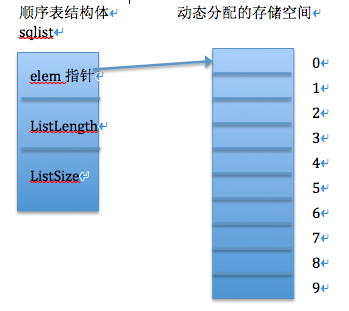
5;InitList函数实现
 1 #include"defs.h"

 2

 3 void InitList(sqlist *L)

 4 {

 5     L->elem = (int *)malloc(LIST_INIT_MAX*sizeof(int)); //初始化指针

 6     if (!L->elem)

 7         exit(-1);

 8     L->length = 0;           //初始化当前元素个数

 9     L->listsize = LIST_INIT_MAX;  //初始化表长

10 }
InitList
6;DestroyList函数实现
1 #include"defs.h"

2

3 void DestroyList(sqlist *L)

4 {

5     free(L->elem);         //释放空间

6     L->elem = NULL;      //将指针置空

7     L->length = 0;         //当前元素个数为0

8     L->listsize = 0;        //表长为0

9 }
DestroyList
7;ClearList函数实现
1 #include"defs.h"

2

3 void ClearList(sqlist *L)

4 {

5     L->length = 0;  //令当前元素个数为0

6 }
ClearList
8;ListEmpty函数实现
1 #include"defs.h"

2

3 void ListEmpty(sqlist L)

4 {

5     if (L.length == 0)

6         printf("表为空.\n");

7     else

8         printf("表不为空.\n");

9 }
ListEmpty
9;ListLength函数实现
1 #include"defs.h"

2

3 int ListLength(sqlist L)

4 {

5     return L.length;  //返回表的当前元素个数

6 }
ListLength
10;GetElem函数实现
 1 #include"defs.h"

 2

 3 int GetElem(sqlist L, int i, int *e) //1<= i <=L.length

 4 {

 5     if (i<1 || i>L.length)

 6     {

 7         printf("取值位置不正确。\n");

 8         return 0;

 9     }

10     *e = *(L.elem + i - 1);

11     return 0;

12 }
GetElem
11;LocateElem函数实现
 1 #include"defs.h"

 2

 3 void LocateElem(sqlist L, int e)

 4 {

 5     int i;

 6     int * p = L.elem;

 7

 8     for (i=0; i<L.length; i++, p++)

 9         if (*p == e)

10               printf("找到值为%d的元素,其位置为%d\n", e, i+1);

11

12      printf("在顺序表中没有找到值为%d的元素.\n", e);

13 }
LocateElem
12;PriorElem函数实现
 1 PriorElem.c

 2 #include"defs.h"

 3

 4 int PriorElem(sqlist L, int cur_e, int *pri_e) //第一个元素无前驱

 5 {

 6     int i;

 7     int *p = L.elem;

 8

 9     for (i=0; i<L.length; i++,p++) //顺序表长度已知,故用for循环

10     {

11         if (i==0 && *p==cur_e)

12         {

13             printf("当前元素为第一个元素,无前驱.\n");

14             return 0;

15         }

16         if (*p == cur_e)       //找到了当前元素且不是第一个元素,

17       {

18            *pri_e = *--p;      //将其前驱赋给引用参数

19          return 0;

20       }

21     }

22     printf("顺序表中无当前值%d。\n", cur_e);

23     return 0;

24 }
PriorElem
13;NextElem函数实现
 1 NextElem.c

 2 #include"defs.h"

 3

 4 int NextElem(sqlist L, int cur_e, int *nex_e) //最后一个元素无后继

 5 {

 6     int i;

 7     int *p = L.elem;

 8

 9     for (i=0; i<L.length; i++)  //顺序表长度已知,故用for

10     {

11         if (i==L.length-1 || *p==cur_e)

12         {

13              printf("当前元素为最后一个元素,无后继.\n");

14              return 0;

15         }

16         if (*p == cur_e)

17         {

18              *nex_e = *++p;   //将后继赋给引用参数带回

19              return 0;

20         }

21     }

22     printf("顺序表中无当前值%d。\n", cur_e);

23     return 0;

24 }
NextElem
14;ListInsert函数实现
 1 ListInsert.c

 2 #include"defs.h"

 3

 4 int ListInsert(sqlist *L, int i, int e) //1<= i <=L->length+1

 5 {

 6     int *newbase, *p, *q;

 7

 8     if (i<1 || i>L->length+1)   //插入位置不合理

 9     {

10         printf("插入位置不合理.\n");

11         return 0;

12     }

13     if (L->length == L->listsize)   //表已满

14     {

15         newbase = (int *)realloc(L->elem, (L->listsize + LIST_INCREMENT) * sizeof (int));  //用newbase指针是为了保护L->elem

16         if (!newbase)

17         {

18             printf("继续分配内存空间失败.\n");

19             exit(-1);

20         }

21         L->listsize += LIST_INCREMENT;

22     }

23     p = L->elem + i - 1;                 //p指向插入的位置

24    q = L->elem + L->length - 1;    //q指向表中元素最后一个位置

25

26    for (; q>=p; q--)    //从最后一个元素开始依次向后移动表中元素

27         *(q+1) = *q;

28     *q = e;              //插入元素

29     L->length++;     // 表长增一

30    return 0;

31 }
ListInsert
15;ListDelete函数实现
 1 ListDelete.c

 2

 3 #include"defs.h"

 4

 5 int ListDelete(sqlist *L, int i, int *e) //1<= i <=L->length

 6 {

 7     int *p, *q;

 8

 9     if (i<1 || i>L->length)

10     {

11         printf("删除位置不合理.\n");

12         return 0;

13     }

14

15     p = L->elem + i - 1;         //p指向要删除的元素的位置

16    q = L->elem + L->length - 1;  //q指向表中最后一个元素位置

17

18    *e = *p;                //将要删除的元素保存起来

19    for (; p<=q; p++)   //从要删除元素的后面一个元素开始移动元素

20         *p = *(p+1);

21     L->length--;          //表长减一

22    return 0;

23 }
ListDelete
16;TravelList函数实现
 1 TravelList.c

 2

 3 #include "defs.h"

 4

 5 void TravelList(sqlist L)

 6 {

 7     int i

 8     int *p = L.elem;

 9

10     for (i=0; i<L.length; i++,p++)

11     {

12         printf("第%d个元素为:%d\n", i+1, *p);

13     }

14

15 }
TravelList
17;makefile的实现
 1 object = main.o InitList.o DestroyList.o ClearList.o ListEmpty.o \

 2 ListLength.o GetElem.o LocateElem.o PriorElem.o NextElem.o \

 3 ListInsert.o ListDelete.o TravelList.o

 4

 5 test : $(object)

 6         gcc -g -Wall -o test $(object)

 7 main.o : defs.h

 8 InitList.o : defs.h

 9 DestroyList.o : defs.h

10 ClearList.o : defs.h

11 ListEmpty.o : defs.h

12 ListLength.o : defs.h

13 GetElem.o : defs.h

14 LocateElem.o : defs.h

15 PriorElem.o : defs.h

16 NextElem.o : defs.h

17 ListInsert.o : defs.h

18 ListDelete.o : defs.h

19 TravelList.o : defs.h

20

21 .PHONY : clean

22 clean :

23         rm *.o -f
18;顺序表的优缺点:顺序表由于其存储结构的特点,特别适合查找(其时间复杂度为O(1)),不适合频繁插入和删除(每一次插入和删除的时间复杂度都是O(n))
c语言实现--顺序表操作的更多相关文章
- C++语言实现顺序表
C++语言实现顺序表 顺序表的定义及其特点 顺序表的定义是:把线性表中的所有表项按照其逻辑顺序依次存储到从计算机存储中指定存储位置开始的一块连续的存储空间中. 这样,线性表中第一个表项的存储位置就是被 ...
- C语言实现顺序表(顺序存储结构)
顺序表(顺序存储结构)及初始化过程详解 顺序表,全名顺序存储结构,是线性表的一种.通过<线性表>一节的学习我们知道,线性表用于存储逻辑关系为"一对一"的数据,顺序表自然 ...
- C语言实现顺序表
C语言实现顺序表代码 文件SeqList.cpp #pragma warning(disable: 4715) #include"SeqList.h" void ShowSeqLi ...
- C语言实现顺序表的基本操作(从键盘输入 生成线性表,读txt文件生成线性表和数组生成线性表----三种写法)
经过三天的时间终于把顺序表的操作实现搞定了.(主要是在测试部分停留了太长时间) 1. 线性表顺序存储的概念:指的是在内存中用一段地址连续的存储单元依次存储线性表中的元素. 2. 采用的实现方式:一段地 ...
- java语言建立顺序表
package datastructure; //线性表 public interface IList { public void clear(); public boolean isEmpty(); ...
- [PTA] 数据结构与算法题目集 6-2 顺序表操作集
//创建并返回一个空的线性表: List MakeEmpty() { List L; L = (List)malloc(sizeof(struct LNode)); L->Last = -1; ...
- C# 顺序表操作
虽然.NET已经是现实了Reverse(),但是学习算法有必要知道其是怎么实现的: private static void ReverseArray(int[] array) { int temp; ...
- 顺序表的C语言实现
在现实应用中,有两种实现线性表数据元素存储功能的方法,分别是顺序存储结构和链式存储结构.顺序表操作是最简单的操作线性表的方法.下面的代码实现了顺序表的几种简单的操作.代码如下 //start from ...
- 顺序表及其多种实现方式 --- C/C++
所谓顺序表,即线性表的顺序存储结构.下面给出的是数据结构---线性表的定义. ADT List{ 数据对象: 线性表的数据对象的集合为{a1,a2,a3,...,an},每个元素的类型为ElemTyp ...
随机推荐
- 浅谈JVM垃圾回收
JVM内存区域 要想搞懂啊垃圾回收机制,首先就要知道垃圾回收主要回收的是哪些数据,这些数据主要在哪一块区域. Java8和Java8之前的相同点有很多. 都有虚拟机栈,本地方法栈,程序计数器,这三个是 ...
- linux源码安装软件的一般方法
rhel系统貌似安装不了xmgrace,配置的时候居然说要那个M*tif库.百度了一下,需要openmotif库,然后用root账户想要用yum安装一下这个库,搞了好久没搞懂.后面搞明白了,原因竟是因 ...
- 深入剖析setState同步异步机制
关于 setState setState 的更新是同步还是异步,一直是人们津津乐道的话题.不过,实际上如果我们需要用到更新后的状态值,并不需要强依赖其同步/异步更新机制.在类组件中,我们可以通过thi ...
- python3 最基本且简单的实现组合设计模式
组合模式是把一个类别归为一个整体,并且组织多个整体之间的关系,使用通过树形结构来描述所有整体. 一般的编写方式为一个类别对象下添加多个该对象的元素,该对象又为其它对象下的元素.简单来说就是一个学校有一 ...
- 【Linux】CentOS7中yumbackend.py进程的结束方法
环境: CentOS Linux release 7.3.1611 (Core) 今天启动这个不怎么用的机器,才启动,就发现后台的yum无法进行安装,持续报这个错误 Loaded plugins: f ...
- kubernets之节点和网络的安全保障策略
一 在pod中使用宿主节点的命名空间 1.1 在pod中使用宿主的网络命名空间 [root@node01 Chapter13]# cat pod-with-host-network.yml api ...
- Pandas 常见操作详解
Pandas 常见操作详解 很多人有误解,总以为Pandas跟熊猫有点关系,跟gui叔创建Python一样觉得Pandas是某某奇葩程序员喜欢熊猫就以此命名,简单介绍一下,Pandas的命名来自于面板 ...
- C# 请求被中止: 未能创建 SSL/TLS 安全通道。 设置SecurityProtocol无效
今天为了获取一张图片,用了一段代码: ServicePointManager.ServerCertificateValidationCallback += new RemoteCertificateV ...
- mybatis中传集合时 报异常 invalid comparison: java.util.Arrays$ArrayList and java.lang.String
犯了一个低级的错误,在传集合类型的参数时,把他当成字符串处理了,导致报类型转换的错误 把 and nsrsbh!=' ' 删掉就行了
- 入门OJ:扫雪
扫雪1 题目描述 大雪履盖了整个城市,市政府要求冬季服务部门尽快将一些街道(列在一份清单中)的积雪清除掉以恢复交通,整个城市由许多交叉路口和街道构成,当然任意两个交叉路口都是直接或间接连通的,清单给出 ...