
Collection集合。
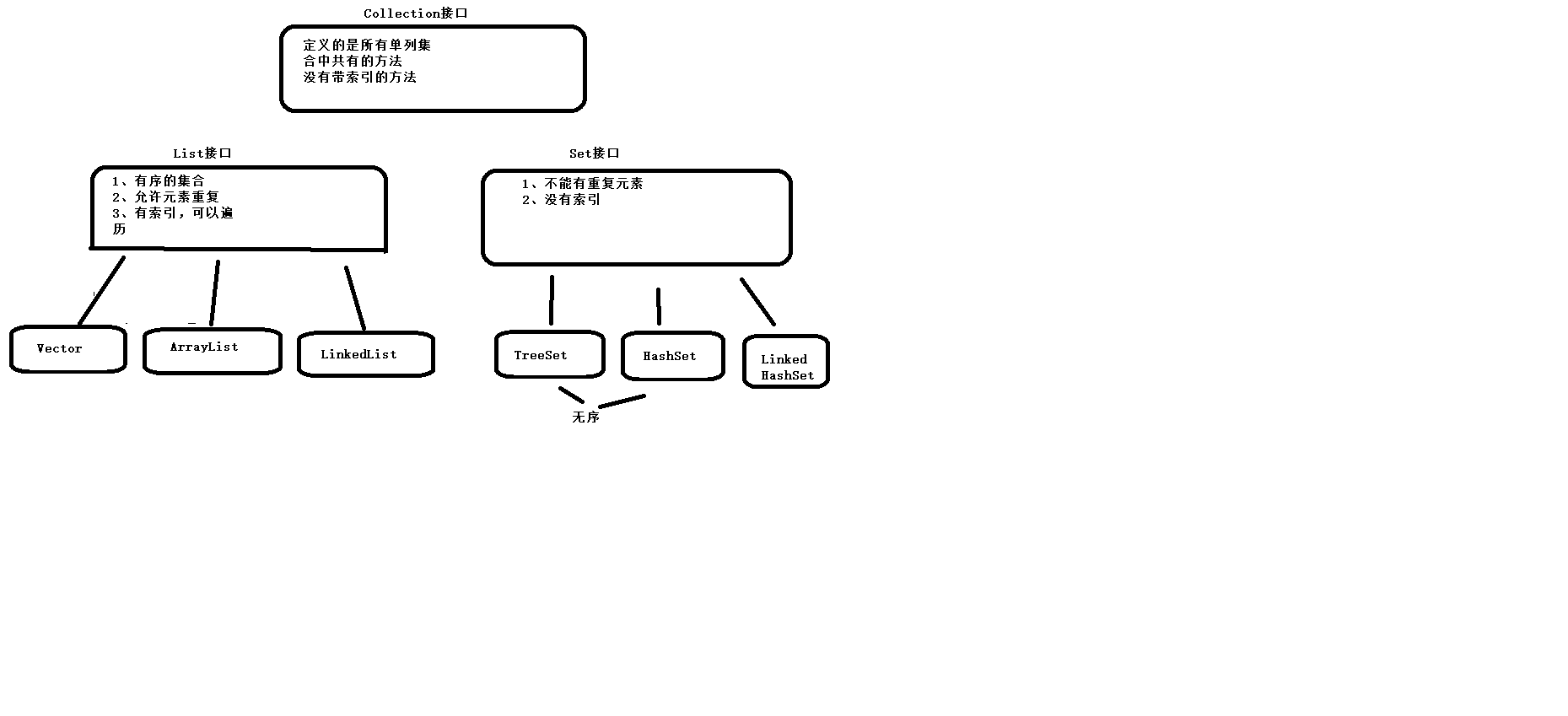
Collection集合。
java.util.Collection 接口。 没有索引
是所有单列集合的最顶层的接口,里面定义了所有单列集合共性的方法。
任意的单列集合都可以使用Collecion接口中的方法。
共性的方法:
............................
Iterator接口
java.util.Iterator
迭代器,Collection集合元素的通用取出方式。对集合遍历。 也是有泛型的,跟着集合走
常用方法: boolean hasNext() 还有没有元素可以迭代。
next()取出集合的下一个元素。
获取实现类的方式比较特殊:
在Collection接口中有一个方法叫 Iterator,这个方法的返回就是迭代器的实现类对象。
使用步骤:重点
1、使用集合中的方法,Iterator()获取迭代器的实现类对象,使用Iterator接口接收(多态)
2、使用hasnext方法,判断是否还有下一个
3、使用next,取出下一个元素
代码实现:
 public static void main(String[] args) {

        Collection<String> collection=new ArrayList<>();

        collection.add("科比");

        collection.add("姚明");

        collection.add("乔丹");

       Iterator<String> iterator =collection.iterator();

        while (iterator.hasNext()){

            System.out.println(iterator.next());

        }

    }
Java的foreach:
内部也是迭代器,简化迭代器的使用:
public static void main(String[] args) {

        int[] arr={1,2,3,4};

        for(int i : arr){

            System.out.println(i);

        }

    }
List接口。
List 接口 extends Collection类。
List接口的特点:
1、有序的集合,存储元素和取出元素的顺序是一致的。
2、有索引,包含了一些索引的方法。
3、允许重复元素。
List接口特有的方法:
注意:操作索引要注意越界问题。
   public static void main(String[] args) {

        /* 创建一个List集合对象,多态。 */

        List<String> list=new ArrayList<>();

        //add 添加元素。

        list.add("a");

        list.add("b");

        list.add("a"); //可重复

        System.out.println(list); //重写了tostring方法。

        // public void add(int index, E elemet);

        list.add(2,"c");

        System.out.println(list);

        //public E remove (int index) 移除指定位置元素,

        //并返回该元素。

        String remove=list.remove(3);

        System.out.println(list);

        System.out.println(remove);

        //public E set(int index, E element)

        //替换指定位置的元素,并返回被替换的值。

        String update=list.set(2,"update");

        System.out.println(list);

        System.out.println(update);

        //List集合遍历有三种方式。

        //1、for

        //2、迭代器。

        //3、foreach

    }
LinkedList 集合:
java.util.LinkedList 集合 implements List 接口。
特有特点:
链表结构,查询慢,但增删快。
有大量操作首位元素的方法。
public static void main(String[] args) {

      //Public void addFirst(E e) =public void push(E e)

        LinkedList<String> linkedList=new LinkedList<>();

        linkedList.add("b");

        linkedList.add("c");

        linkedList.addFirst("a");

        System.out.println(linkedList);

        linkedList.push("push an element");

        System.out.println(linkedList);

        //public void addLast(E e) = add()

        linkedList.addLast("d");

        System.out.println(linkedList);

        //获取元素。

        //getFirst   getLast

        //移除

        // removeFirst  = pop    removeLast

    }
Set接口:
特点:
java.util.Set extends Collection
不允许重复
没有索引,不能用普通的for遍历
java.util.HashSet 集合 implement Set 接口
HashSet特点:
1、无序集合,存元素和取元素的顺序有可能不一致。
2、底层是哈希表结构 查询速度快。
哈希表:
哈希值:是一个十进制的整数,由系统随机给出(就是对象的地址值,是一个逻辑
地址,是模拟出来的地址看,不是数据实际存储的物理地址)
Object类有一个方法能获取对象的哈希值。
int hashCode() 返回该对象的哈希值。
源码: public native int hashCode()
native 代表该方法调用的是本地操作系统的方法。
String类的哈希值:
重写了Object类的hashCode方法。
哈希表:
jdk1.8之前,哈希表=数组+链表 jdk1.8之后, 哈希表还=数组+红黑树(查询快)
Set不允许重复元素的原理:
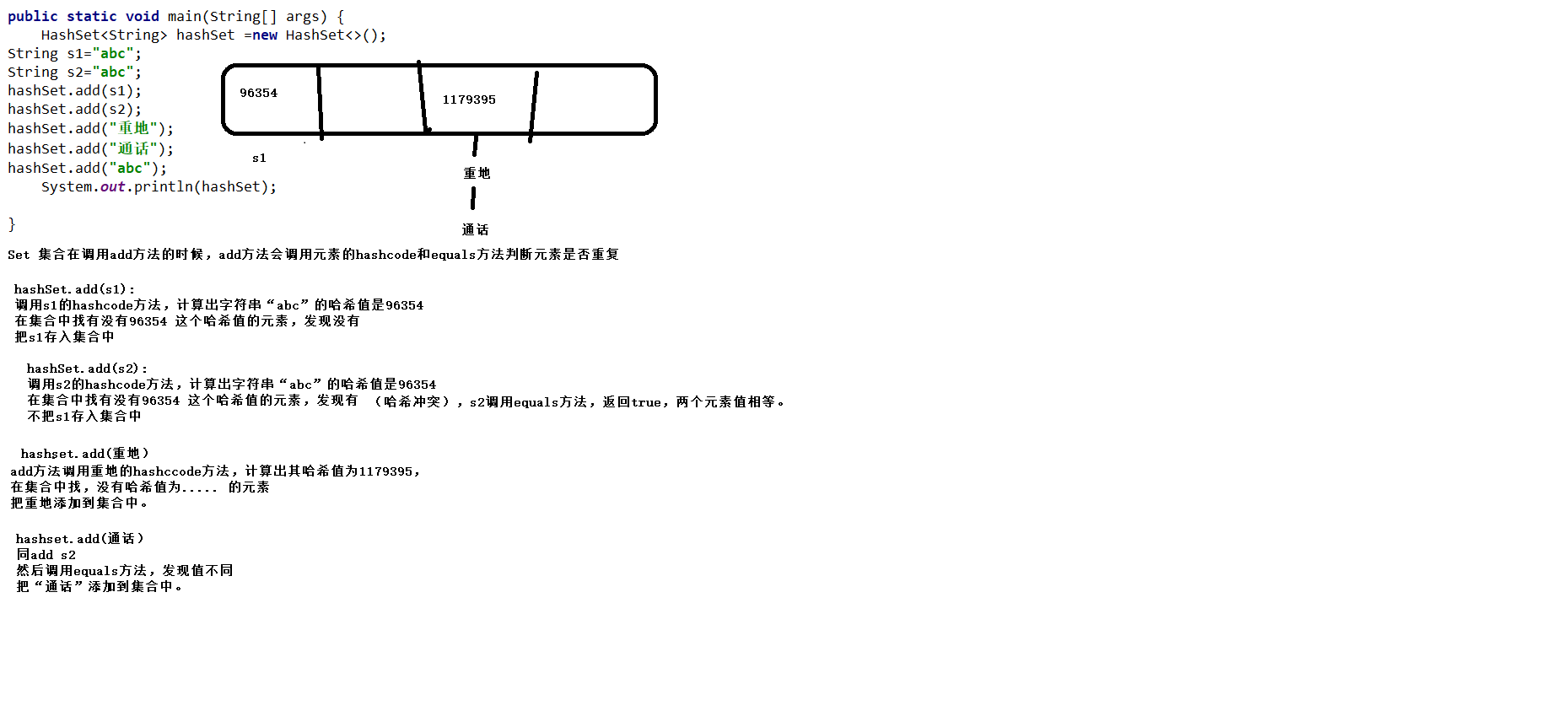
Hash Set存储自定义类型元素:
需要重写对象中的hashcode 和 equals方法,建立自己的比较方式,
才能保证 HashSet中的对象唯一。
//需求:

    //同名同龄的人,视为同一个人,只能存储一次。

public class main {

    public static void main(String[] args) {

        HashSet<Person> set=new HashSet<>();

        Person p1=new Person("Sam",18);

        Person p2=new Person("Sam",18);

        Person p3=new Person("Penny",19);

        set.add(p1);

        set.add(p2);

        set.add(p3);

        System.out.println(set);

        //[Person{name='Sam', age=18}, Person{name='Penny', age=19}, Person{name='Sam', age=18}]

        System.out.println(p1.hashCode());

        System.out.println(p2.hashCode());

        //1355531311

        //

    }

}
重写方法后:
  public static void main(String[] args) {

        HashSet<Person> set=new HashSet<>();

        Person p1=new Person("Sam",18);

        Person p2=new Person("Sam",18);

        Person p3=new Person("Penny",19);

        set.add(p1);

        set.add(p2);

        set.add(p3);

        System.out.println(set);

        System.out.println(p1.hashCode());

        System.out.println(p2.hashCode());

        //[Person{name='Sam', age=18}, Person{name='Penny', age=19}]

        //2570228

       //

    }
LinkedHashSet:
extends HashSet
特点:
底层是哈希表(数组+链表/红黑色) + 链表(用来记录元素的存储顺序)。
   public static void main(String[] args) {

    HashSet<String> set=new HashSet<>();

        set.add("c");

        set.add("a");

        set.add("b");

        System.out.println(set);// 无序,不允许重复。

        LinkedHashSet<String> linked=new LinkedHashSet<>();

        linked.add("a");

        linked.add("b");

        linked.add("c");

        System.out.println(linked);//有序,不允许重复

        //[a, b, c]

        //[a, b, c]

    }
可变参数:
jdk 1.5 之后出现。
前提: 参数列表的数据类型已确定,但参数个数不确定时。
格式:
修饰符 返回值类型 方法名 (数据类型...变量名){}
可变参数原理:
底层:数组,根据参数个数不同,来创建不同长度的数组,来存储参数。
参数个数: 0个-多个。
注意事项:
1、一个方法的参数列表,只能有一个可变参数。
2、如果参数有多个,可变参数放最后。
可变参数的终极写法 : method(Object...obj)
 public static void main(String[] args) {

    int sum=add(10,20,30);//创建一个长度为三的数组

        System.out.println(sum);

    }

    //计算多个整数的和。

    public  static int add(int...arr){

        int sum=0;

       for(int i:arr)

           sum+=i;

        return sum;

    }
Collections 工具类:
java.utils.Collections 是集合工具类,用来对集合进行操作。
public static void main(String[] args) {

        //public static <T> boolean addAll(Collection<T> c,T...elements)

        //往集合添加多个元素。

        //public static void shuffle(List<T> list)

        //打乱集合顺序。

        ArrayList<String> list=new ArrayList<>();

        Collections.addAll(list,"a","b","c","d");

        System.out.println(list);//[a, b, c, d]

        Collections.shuffle(list);

        System.out.println(list);//[c, d, b, a]

    }
public static void main(String[] args) {

        //public static <T> void sort(List<T> list)

        //对集合排序,默认升序。

        ArrayList<Integer> list=new ArrayList<Integer>();

        Collections.addAll(list, 1,3,2);

        Collections.sort(list);

        System.out.println(list);

    }
sort方法的使用前提:
被排序的集合里边存储的元素,必须实现Comparable,重写接口中的compareTo
定义排序的规则。
Compareble 的排序规则:this - 参数 升序 反之。
public static void main(String[] args) {

       //对Person类型的集合排序。

        ArrayList<Person> personList=new ArrayList<>();

        personList.add(new Person("张三",17));

        personList.add(new Person("李四",19));

        personList.add(new Person("王麻子",15));

        Collections.sort(personList);

        System.out.println(personList);

        //[Person{name='王麻子', age=15}, Person{name='张三', age=17}, Person{name='李四', age=19}]

    }
Person类:
 @Override

    public int compareTo(Person o) {

        //return 0; 认为元素都是相同的。

        //自定义比较规则,比较两个人的年龄(this,参数Person)

        return this.getAge()-o.getAge(); //年龄升序排序

    }
Comparator 接口:
 public static void main(String[] args) {

    //public static <T> void sort(List<T> list,Comparator<? super T>)

        //将集合中的元素按指定规则排序。

        //Comparator和 Comparable的区别:

        //Comparable : 自己 this  和别人(参数)比较,

          //自己需要实现Comparable接口,重写compareto 方法

        //Comparator:相当于找一个第三方裁判,来比较两个。

        ArrayList<Integer> list=new ArrayList<>();

        Collections.addAll(list,1,3,2);

        System.out.println(list);

        Collections.sort(list, new Comparator<Integer>() {

            @Override

            public int compare(Integer o1, Integer o2) {

                return  o1-o2;//升序。

            }

        });

        System.out.println(list);

        // Person 类型的集合排序。

        ArrayList<Person> personList=new ArrayList<>();

        personList.add(new Person("张三",17));

        personList.add(new Person("b李四",19));

        personList.add(new Person("a王麻子",19));

        //一个规则

//        Collections.sort(personList, new Comparator<Person>() {

//            @Override

//            public int compare(Person o1, Person o2) {

//                //年龄升序

//                return o1.getAge()-o2.getAge();

//            }

//        });

        //多个规则:

        Collections.sort(personList, new Comparator<Person>() {

            @Override

            public int compare(Person o1, Person o2) {

                int result=o1.getAge()-o2.getAge();

                if (result==0){

                    result=o1.getName().charAt(0)-o2.getName().charAt(0);

                }

                return  result;

            }

        });

        System.out.println(personList);

    }
Collection集合。的更多相关文章
- 浅谈Collection集合
俗话说:一个东西,一件事都离不开三句话:"是什么,为什么,怎么办" 集合是什么: 集合简单的说一个数组集合的高级体现,用来存储数据或对象的容器: 集合为什么存在: 集合只是体现了对 ...
- Collection集合的功能及总结
Collection集合是集合顶层接口,不能实例化 功能 1.添加功能 boolean add(Object obj):添加一个元素 boolean addAll(Collection c):添加一个 ...
- JAVA collection集合之 扑克牌游戏
主要内容:这里使用collection集合,模拟香港电影中大佬们玩的扑克牌游戏. 1.游戏规则:两个玩家每人手中发两张牌,进行比较.比较每个玩家手中牌最大的点数,大小由A-2,点数大者获胜.如果点数相 ...
- Collection集合List、Set
Collection集合,用来保存一组数据的数据结构. Collection是一个接口,定义了所有集合都应该包含的特征和行为 Collection派生出了两类集合 List和Set List接口:Li ...
- Collection集合之六大接口(Collection、Set、List、Map、Iterator和Comparable)
首先,我们先看一下Collection集合的基本结构: 1.Collection接口 Collection是最基本集合接口,它定义了一组允许重复的对象.Collection接口派生了两个子接口Set和 ...
- java.util.Map按照key值合并的value的Collection 集合中。
用java实现把多个map的内容合并的一个resultMap中 代码大致如下 /** * @author Shalf */ public class MapUtil { /** * 把partMa ...
- javad的Collection集合
集合框架:★★★★★,用于存储数据的容器. 特点: 1:对象封装数据,对象多了也需要存储.集合用于存储对象. 2:对象的个数确定可以使用数组,但是不确定怎么办?可以用集合.因为集合是可变长度的. 集合 ...
- Java基础知识强化之集合框架笔记13:Collection集合存储学生对象并遍历
1. Collection集合存储学生对象并遍历: 需求:存储自定义对象并遍历Student(name,age) 分析: (1)创建学生类 (2)创建集合对象 (3)创建学生对象 (4)把学生对象添加 ...
- Java基础知识强化之集合框架笔记12:Collection集合存储字符串并遍历
1. Collection集合存储字符串并遍历 分析: (1)创建集合对象 (2)创建字符串对象 (3)把字符串对象添加到集合中 (4)遍历集合 2. 代码示例: package cn.itcast ...
- Java基础知识强化之集合框架笔记09:Collection集合迭代器使用的问题探讨
1.Collection集合迭代器使用的问题探讨: (1)问题1:能用while循环写这个程序,我能不能用for循环呢? 可以使用for循环替代. (2)问题2:不要 ...
随机推荐
- angular.lowercase()
<!DOCTYPE html> <html> <head> <meta charset="UTF-8"> <title> ...
- 关于部署php遇到的坑
业务突然要启动一个久不使用的PHP项目, 发现部署到centos7上后 各种报错 就是不行. 我怀疑是apache或者php问题 就重新安装 编译安装也试过就是不行. 只能按笨办法 在测试环境安装了a ...
- Nginx的虚拟主机配置
虚拟主机技术能够让同一台服务器.同一组Nginx进程上运行多个网站,降低了资金和服务器资源的损耗.Nginx可以配置三种类型的虚拟主机,本文就是主要介绍这三种虚拟主机配置方式. 配置基于IP的虚拟主机 ...
- ip锁死怎么设置ip地址
单击电脑网络连接图标,打开网络和共享中心 点击本地连接 点击详细信息,即可看到IP地址.子网掩码.默认网关.DNS服务器信息 再点击本地连接状态下的属性 找到Internet 协议版本 ...
- excel写入操作
字典列表类型数据写入excel. #导入xlwt库 import xlwt import os # 步骤1:获取excel文件的绝对路径 dirPath = os.path.join(os.getcw ...
- Vue 学习笔记 — css属性计算的问题
简书 今天在使用Vue时遇到一个问题:在切换css内联属性时某些特殊属性的计算会有问题,无法得到预期的结果. 例子: https://jsfiddle.net/blqw/cLwau40z/ 上面的页面 ...
- 时时监听input内容的改变
心得:我们都知道input有一个change事件,但是是在input元素失去焦点的时候发生,不能时时的监听input内容的改变. 刚开始的时候我是想用setInterval设置计时器的原理定时监听in ...
- [Swift]LeetCode112. 路径总和 | Path Sum
Given a binary tree and a sum, determine if the tree has a root-to-leaf path such that adding up all ...
- [Swift]LeetCode200.岛屿的个数 | Number of Islands
Given a 2d grid map of '1's (land) and '0's (water), count the number of islands. An island is surro ...
- [Swift]LeetCode497. 非重叠矩形中的随机点 | Random Point in Non-overlapping Rectangles
Given a list of non-overlapping axis-aligned rectangles rects, write a function pick which randomly ...