
Lambda02 函数式接口
1 java8默认提供的函数式接口
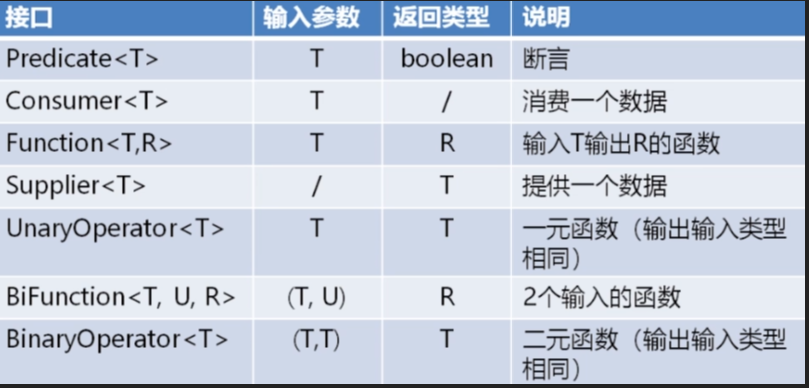
1.1 Predicate
/*

 * Copyright (c) 2010, 2013, Oracle and/or its affiliates. All rights reserved.

 * ORACLE PROPRIETARY/CONFIDENTIAL. Use is subject to license terms.

 *

 *

 *

 *

 *

 *

 *

 *

 *

 *

 *

 *

 *

 *

 *

 *

 *

 *

 *

 *

 */

package java.util.function;

import java.util.Objects;

/**

 * Represents a predicate (boolean-valued function) of one argument.

 *

 * <p>This is a <a href="package-summary.html">functional interface</a>

 * whose functional method is {@link #test(Object)}.

 *

 * @param <T> the type of the input to the predicate

 *

 * @since 1.8

 */

@FunctionalInterface

public interface Predicate<T> {

    /**

     * Evaluates this predicate on the given argument.

     *

     * @param t the input argument

     * @return {@code true} if the input argument matches the predicate,

     * otherwise {@code false}

     */

    boolean test(T t);

    /**

     * Returns a composed predicate that represents a short-circuiting logical

     * AND of this predicate and another.  When evaluating the composed

     * predicate, if this predicate is {@code false}, then the {@code other}

     * predicate is not evaluated.

     *

     * <p>Any exceptions thrown during evaluation of either predicate are relayed

     * to the caller; if evaluation of this predicate throws an exception, the

     * {@code other} predicate will not be evaluated.

     *

     * @param other a predicate that will be logically-ANDed with this

     *              predicate

     * @return a composed predicate that represents the short-circuiting logical

     * AND of this predicate and the {@code other} predicate

     * @throws NullPointerException if other is null

     */

    default Predicate<T> and(Predicate<? super T> other) {

        Objects.requireNonNull(other);

        return (t) -> test(t) && other.test(t);

    }

    /**

     * Returns a predicate that represents the logical negation of this

     * predicate.

     *

     * @return a predicate that represents the logical negation of this

     * predicate

     */

    default Predicate<T> negate() {

        return (t) -> !test(t);

    }

    /**

     * Returns a composed predicate that represents a short-circuiting logical

     * OR of this predicate and another.  When evaluating the composed

     * predicate, if this predicate is {@code true}, then the {@code other}

     * predicate is not evaluated.

     *

     * <p>Any exceptions thrown during evaluation of either predicate are relayed

     * to the caller; if evaluation of this predicate throws an exception, the

     * {@code other} predicate will not be evaluated.

     *

     * @param other a predicate that will be logically-ORed with this

     *              predicate

     * @return a composed predicate that represents the short-circuiting logical

     * OR of this predicate and the {@code other} predicate

     * @throws NullPointerException if other is null

     */

    default Predicate<T> or(Predicate<? super T> other) {

        Objects.requireNonNull(other);

        return (t) -> test(t) || other.test(t);

    }

    /**

     * Returns a predicate that tests if two arguments are equal according

     * to {@link Objects#equals(Object, Object)}.

     *

     * @param <T> the type of arguments to the predicate

     * @param targetRef the object reference with which to compare for equality,

     *               which may be {@code null}

     * @return a predicate that tests if two arguments are equal according

     * to {@link Objects#equals(Object, Object)}

     */

    static <T> Predicate<T> isEqual(Object targetRef) {

        return (null == targetRef)

                ? Objects::isNull

                : object -> targetRef.equals(object);

    }

}
Predicate.java
1.2 Consumer
/*

 * Copyright (c) 2010, 2013, Oracle and/or its affiliates. All rights reserved.

 * ORACLE PROPRIETARY/CONFIDENTIAL. Use is subject to license terms.

 *

 *

 *

 *

 *

 *

 *

 *

 *

 *

 *

 *

 *

 *

 *

 *

 *

 *

 *

 *

 */

package java.util.function;

import java.util.Objects;

/**

 * Represents an operation that accepts a single input argument and returns no

 * result. Unlike most other functional interfaces, {@code Consumer} is expected

 * to operate via side-effects.

 *

 * <p>This is a <a href="package-summary.html">functional interface</a>

 * whose functional method is {@link #accept(Object)}.

 *

 * @param <T> the type of the input to the operation

 *

 * @since 1.8

 */

@FunctionalInterface

public interface Consumer<T> {

    /**

     * Performs this operation on the given argument.

     *

     * @param t the input argument

     */

    void accept(T t);

    /**

     * Returns a composed {@code Consumer} that performs, in sequence, this

     * operation followed by the {@code after} operation. If performing either

     * operation throws an exception, it is relayed to the caller of the

     * composed operation.  If performing this operation throws an exception,

     * the {@code after} operation will not be performed.

     *

     * @param after the operation to perform after this operation

     * @return a composed {@code Consumer} that performs in sequence this

     * operation followed by the {@code after} operation

     * @throws NullPointerException if {@code after} is null

     */

    default Consumer<T> andThen(Consumer<? super T> after) {

        Objects.requireNonNull(after);

        return (T t) -> { accept(t); after.accept(t); };

    }

}
Consumer.java
1 Predicate
该接口称为断言接口,有输入也有输出;输入类型是泛型,输出类型是Boolean类型。
1.1 源代码
/*

 * Copyright (c) 2010, 2013, Oracle and/or its affiliates. All rights reserved.

 * ORACLE PROPRIETARY/CONFIDENTIAL. Use is subject to license terms.

 *

 *

 *

 *

 *

 *

 *

 *

 *

 *

 *

 *

 *

 *

 *

 *

 *

 *

 *

 *

 */

package java.util.function;

import java.util.Objects;

/**

 * Represents a predicate (boolean-valued function) of one argument.

 *

 * <p>This is a <a href="package-summary.html">functional interface</a>

 * whose functional method is {@link #test(Object)}.

 *

 * @param <T> the type of the input to the predicate

 *

 * @since 1.8

 */

@FunctionalInterface

public interface Predicate<T> {

    /**

     * Evaluates this predicate on the given argument.

     *

     * @param t the input argument

     * @return {@code true} if the input argument matches the predicate,

     * otherwise {@code false}

     */

    boolean test(T t);

    /**

     * Returns a composed predicate that represents a short-circuiting logical

     * AND of this predicate and another.  When evaluating the composed

     * predicate, if this predicate is {@code false}, then the {@code other}

     * predicate is not evaluated.

     *

     * <p>Any exceptions thrown during evaluation of either predicate are relayed

     * to the caller; if evaluation of this predicate throws an exception, the

     * {@code other} predicate will not be evaluated.

     *

     * @param other a predicate that will be logically-ANDed with this

     *              predicate

     * @return a composed predicate that represents the short-circuiting logical

     * AND of this predicate and the {@code other} predicate

     * @throws NullPointerException if other is null

     */

    default Predicate<T> and(Predicate<? super T> other) {

        Objects.requireNonNull(other);

        return (t) -> test(t) && other.test(t);

    }

    /**

     * Returns a predicate that represents the logical negation of this

     * predicate.

     *

     * @return a predicate that represents the logical negation of this

     * predicate

     */

    default Predicate<T> negate() {

        return (t) -> !test(t);

    }

    /**

     * Returns a composed predicate that represents a short-circuiting logical

     * OR of this predicate and another.  When evaluating the composed

     * predicate, if this predicate is {@code true}, then the {@code other}

     * predicate is not evaluated.

     *

     * <p>Any exceptions thrown during evaluation of either predicate are relayed

     * to the caller; if evaluation of this predicate throws an exception, the

     * {@code other} predicate will not be evaluated.

     *

     * @param other a predicate that will be logically-ORed with this

     *              predicate

     * @return a composed predicate that represents the short-circuiting logical

     * OR of this predicate and the {@code other} predicate

     * @throws NullPointerException if other is null

     */

    default Predicate<T> or(Predicate<? super T> other) {

        Objects.requireNonNull(other);

        return (t) -> test(t) || other.test(t);

    }

    /**

     * Returns a predicate that tests if two arguments are equal according

     * to {@link Objects#equals(Object, Object)}.

     *

     * @param <T> the type of arguments to the predicate

     * @param targetRef the object reference with which to compare for equality,

     *               which may be {@code null}

     * @return a predicate that tests if two arguments are equal according

     * to {@link Objects#equals(Object, Object)}

     */

    static <T> Predicate<T> isEqual(Object targetRef) {

        return (null == targetRef)

                ? Objects::isNull

                : object -> targetRef.equals(object);

    }

}
predicate.java
1.2 test()
test方法时Predicate接口中唯一一个未实现的接口,test的存在说明Predicate是一个函数式接口;该方法接收任意类型的数据,返回值是一个布尔类型,如果输入参数满足test方法体中的逻辑就返回true,否则返回false
    /**

     * Evaluates this predicate on the given argument.

     *

     * @param t the input argument

     * @return {@code true} if the input argument matches the predicate,

     * otherwise {@code false}

     */

    boolean test(T t);
技巧01:利用lambda表达式来实现Predicate接口中的test方法【PS: 也可以利用匿名内部类或者实现类来实现】
1.2.1 需求
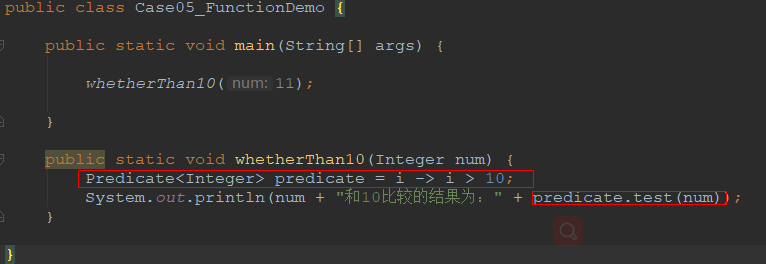
判断一个Integer类型的数据是否大于10
1.2.2 思路
》创建一个类型为Predicate的实例【利用lambda表达式实现】
》调用Predicate实例的test方法进行判断,test方法的参数就是待判断的数据
1.2.3 代码实现
package demo05_webflux.chapter02;

import java.util.function.Predicate;

/**

 * @author 王杨帅

 * @create 2018-07-29 14:29

 * @desc 函数式接口

 **/

public class Case05_FunctionDemo {

    public static void main(String[] args) {

        whetherThan10(11);

    }

    public static void whetherThan10(Integer num) {

        Predicate<Integer> predicate = i -> i > 10;

        System.out.println(num + "和10比较的结果为:" + predicate.test(num));

    }

}
1.3 and()
and方法是Predicate中的一个默认方法,该方法接收一个Predicate类型的实例返回一个Predicate类型的实例;
相当于将两个Predicate类型的实例结合起来,只有待判断的数据满足这两个Predicate类型实例的test方法时才返回true,否则返回false
    /**

     * Returns a composed predicate that represents a short-circuiting logical

     * AND of this predicate and another.  When evaluating the composed

     * predicate, if this predicate is {@code false}, then the {@code other}

     * predicate is not evaluated.

     *

     * <p>Any exceptions thrown during evaluation of either predicate are relayed

     * to the caller; if evaluation of this predicate throws an exception, the

     * {@code other} predicate will not be evaluated.

     *

     * @param other a predicate that will be logically-ANDed with this

     *              predicate

     * @return a composed predicate that represents the short-circuiting logical

     * AND of this predicate and the {@code other} predicate

     * @throws NullPointerException if other is null

     */

    default Predicate<T> and(Predicate<? super T> other) {

        Objects.requireNonNull(other);

        return (t) -> test(t) && other.test(t);

    }
1.3.1 需求
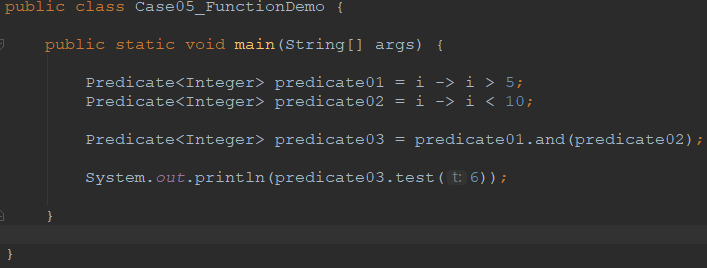
判断一个Integer类型的数据介于5到10之间
1.3.2 思路
》实例化两个Prdicate类型的实例【利用lambda表达式实现】
》》predicate01这个实例负责判断数据大于5
Predicate<Integer> predicate01 = i -> i > 5;
》》predicate02这个数据负责判断数据小于10
Predicate<Integer> predicate02 = i -> i < 10;
》利用Predicatae类型的and方法将两个Predicate类型的实例进行整合
Predicate<Integer> predicate03 = predicate01.and(predicate02);
》利用组合后的Prdicate类型的实例调用test方法去判断数据是否满足条件
System.out.println(predicate03.test(6));
1.3.3 代码实现
package demo05_webflux.chapter02;

import java.util.function.Predicate;

/**

 * @author 王杨帅

 * @create 2018-07-29 14:29

 * @desc 函数式接口

 **/

public class Case05_FunctionDemo {

    public static void main(String[] args) {

        Predicate<Integer> predicate01 = i -> i > 5;

        Predicate<Integer> predicate02 = i -> i < 10;

        Predicate<Integer> predicate03 = predicate01.and(predicate02);

        System.out.println(predicate03.test(6));

    }

}
1.4 or()
or方法是Predicate中的一个默认方法,该方法接收一个Predicate类型的实例返回一个Predicate类型的实例;
相当于将两个Predicate类型的实例结合起来,只有待判断的数据满足这两个Predicate类型实例的test方法中的任何一个时都可以返回true,都不满足时才返回false
1.4.1 需求
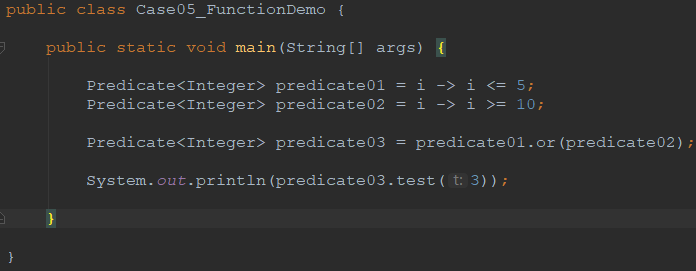
判断一个Integer类型的数据是否小于等于5,或者大于等于10
1.4.2 思路
》实例化两个Prdicate类型的实例【利用lambda表达式实现】
》》predicate01这个实例负责判断数据小于等于5
Predicate<Integer> predicate01 = i -> i <= 5;
》》predicate02这个数据负责判断数据大于等于10
Predicate<Integer> predicate02 = i -> i >= 10;
》利用Predicatae类型的and方法将两个Predicate类型的实例进行整合
Predicate<Integer> predicate03 = predicate01.or(predicate02);
》利用组合后的Prdicate类型的实例调用test方法去判断数据是否满足条件
System.out.println(predicate03.test(3));
1.4.3 代码实现
package demo05_webflux.chapter02;

import java.util.function.Predicate;

/**

 * @author 王杨帅

 * @create 2018-07-29 14:29

 * @desc 函数式接口

 **/

public class Case05_FunctionDemo {

    public static void main(String[] args) {

        Predicate<Integer> predicate01 = i -> i <= 5;

        Predicate<Integer> predicate02 = i -> i >= 10;

        Predicate<Integer> predicate03 = predicate01.or(predicate02);

        System.out.println(predicate03.test(3));

    }

}
1.5 negate()
negate方法也是Predicate方法中的一个默认方法,该方法不接受参数,返回一个Predicate类型的实例;
negate方法的主要作用是对原Predicate方法的test逻辑进行取反操作
    /**

     * Returns a predicate that represents the logical negation of this

     * predicate.

     *

     * @return a predicate that represents the logical negation of this

     * predicate

     */

    default Predicate<T> negate() {

        return (t) -> !test(t);

    }
1.5.1 需求
判断一个Integer类型的数据是否小于等于5,不能用 < 和 = 这两个操作符
1.5.2 实录
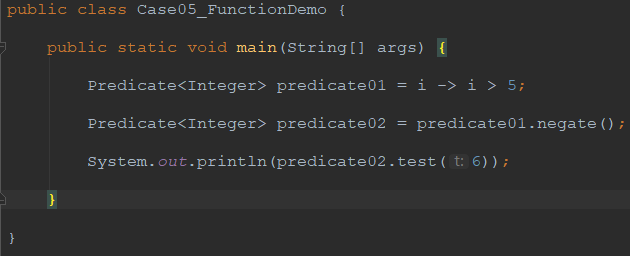
》创建一个predicate类型的实例predicate01用来判断Integer类型的数据大于5
Predicate<Integer> predicate01 = i -> i > 5;
》利用predicate01实例创建一个Predicate类型的实例predicate02用来判断Integer类型的数据小于等于5
Predicate<Integer> predicate02 = predicate01.negate();
》调用predicate02的test方法来判断一个Intehger类型的实例是否小于等于5,如果满足条件就返回true,否则返回false
System.out.println(predicate02.test(6));
1.5.3 代码实现
package demo05_webflux.chapter02;

import java.util.function.Predicate;

/**

 * @author 王杨帅

 * @create 2018-07-29 14:29

 * @desc 函数式接口

 **/

public class Case05_FunctionDemo {

    public static void main(String[] args) {

        Predicate<Integer> predicate01 = i -> i > 5;

        Predicate<Integer> predicate02 = predicate01.negate();

        System.out.println(predicate02.test(6));

    }

}
1.6 isEqual
isEqual方法是Predicate接口的一个静态方法,该方法接收一个引用类型的变量,返回一个Predicate类型的实例;
调用isEaual方法返回的Predicate类型实例的test方法时,会将test方法的参数和isEqual方法参数进行equals比较
    /**

     * Returns a predicate that tests if two arguments are equal according

     * to {@link Objects#equals(Object, Object)}.

     *

     * @param <T> the type of arguments to the predicate

     * @param targetRef the object reference with which to compare for equality,

     *               which may be {@code null}

     * @return a predicate that tests if two arguments are equal according

     * to {@link Objects#equals(Object, Object)}

     */

    static <T> Predicate<T> isEqual(Object targetRef) {

        return (null == targetRef)

                ? Objects::isNull

                : object -> targetRef.equals(object);

    }
1.6.1 需求
判断一个String类型的数据是否等于“xyj_fury”
1.6.2 思路
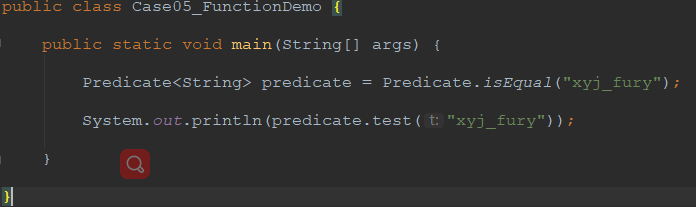
》利用Predicate接口的默认方法isEqual来创建一个Predicate类型的实例predicate
Predicate<String> predicate = Predicate.isEqual("xyj_fury");
》调用predicate实例的test方法来判断一个String类型的数据是否和 “xyj_fury”相等
System.out.println(predicate.test("xyj_fury"));
1.6.3 代码实现
package demo05_webflux.chapter02;

import java.util.function.Predicate;

/**

 * @author 王杨帅

 * @create 2018-07-29 14:29

 * @desc 函数式接口

 **/

public class Case05_FunctionDemo {

    public static void main(String[] args) {

        Predicate<String> predicate = Predicate.isEqual("xyj_fury");

        System.out.println(predicate.test("xyj_fury"));

    }

}
2 Consumer
该接口是一个消费者接口,只有输入没有输出;输入是一个泛型类型。
/*

 * Copyright (c) 2010, 2013, Oracle and/or its affiliates. All rights reserved.

 * ORACLE PROPRIETARY/CONFIDENTIAL. Use is subject to license terms.

 *

 *

 *

 *

 *

 *

 *

 *

 *

 *

 *

 *

 *

 *

 *

 *

 *

 *

 *

 *

 */

package java.util.function;

import java.util.Objects;

/**

 * Represents an operation that accepts a single input argument and returns no

 * result. Unlike most other functional interfaces, {@code Consumer} is expected

 * to operate via side-effects.

 *

 * <p>This is a <a href="package-summary.html">functional interface</a>

 * whose functional method is {@link #accept(Object)}.

 *

 * @param <T> the type of the input to the operation

 *

 * @since 1.8

 */

@FunctionalInterface

public interface Consumer<T> {

    /**

     * Performs this operation on the given argument.

     *

     * @param t the input argument

     */

    void accept(T t);

    /**

     * Returns a composed {@code Consumer} that performs, in sequence, this

     * operation followed by the {@code after} operation. If performing either

     * operation throws an exception, it is relayed to the caller of the

     * composed operation.  If performing this operation throws an exception,

     * the {@code after} operation will not be performed.

     *

     * @param after the operation to perform after this operation

     * @return a composed {@code Consumer} that performs in sequence this

     * operation followed by the {@code after} operation

     * @throws NullPointerException if {@code after} is null

     */

    default Consumer<T> andThen(Consumer<? super T> after) {

        Objects.requireNonNull(after);

        return (T t) -> { accept(t); after.accept(t); };

    }

}
Consumer.java
2.1 accept
accept是Consumer中那个为实现的方法,Consumer类型的实例只要调用accept方法就相当于消费了数据;该方法接受一个泛型类型,没有返回值。
    /**

     * Performs this operation on the given argument.

     *

     * @param t the input argument

     */

    void accept(T t);
2.1.1 需求
打印获取到的String类型数据到控制台,用标准输出函数打印和日志打印两种方式实现
2.1.2 思路
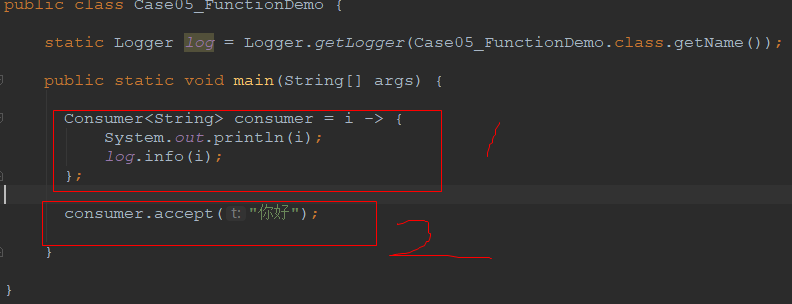
》创建一个Consummer类型的实例 consumer
      Consumer<String> consumer = i -> {

          System.out.println(i);

          log.info(i);

      };
》调用consumer实例的accept方法
consumer.accept("你好");
2.1.3 代码实现
package demo05_webflux.chapter02;

import java.util.function.Consumer;

import java.util.logging.Logger;

/**

 * @author 王杨帅

 * @create 2018-07-29 14:29

 * @desc 函数式接口

 **/

public class Case05_FunctionDemo {

    static Logger log = Logger.getLogger(Case05_FunctionDemo.class.getName());

    public static void main(String[] args) {

      Consumer<String> consumer = i -> {

          System.out.println(i);

          log.info(i);

      };

      consumer.accept("你好");

    }

}
2.2 andThen
该方法时Consumer接口中的一个默认方法;该方法接收一个Consummer类型的实例,也返回一个Consummer的实例;该方法的作用是对同一个数据再次进行消费。
    /**

     * Returns a composed {@code Consumer} that performs, in sequence, this

     * operation followed by the {@code after} operation. If performing either

     * operation throws an exception, it is relayed to the caller of the

     * composed operation.  If performing this operation throws an exception,

     * the {@code after} operation will not be performed.

     *

     * @param after the operation to perform after this operation

     * @return a composed {@code Consumer} that performs in sequence this

     * operation followed by the {@code after} operation

     * @throws NullPointerException if {@code after} is null

     */

    default Consumer<T> andThen(Consumer<? super T> after) {

        Objects.requireNonNull(after);

        return (T t) -> { accept(t); after.accept(t); };

    }
2.2.1 需求
将接收到的String类型的数据拼接“fury”后以标准输出的方式打印到控制台,并且将接收到的数据拼接“warrior”后用日志的形式打印到控制台。
2.2.2 思路
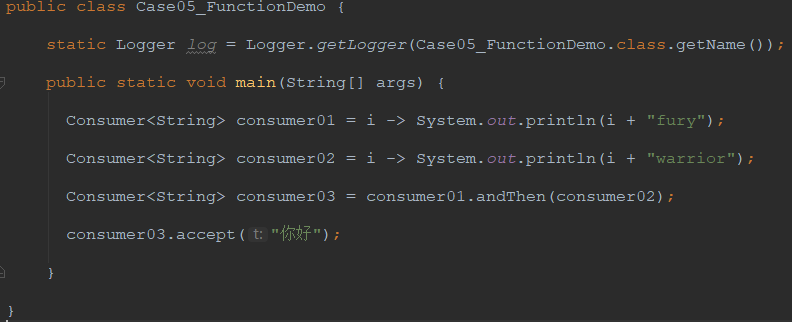
》创建一个类型为Consumer的实例consumer01用来接收数据,并将接收到的数据拼接上“fury”后再打印
Consumer<String> consumer01 = i -> System.out.println(i + "fury");
》创建一个类型为Consumer的实例consumer02用来接收数据,并将接收到的数据拼接上“warrior”后再打印
Consumer<String> consumer02 = i -> System.out.println(i + "warrior");
》调用consumer01的andThen方法来接收consumer02并返回第三个Consumer类型的数据consumer03
Consumer<String> consumer03 = consumer01.andThen(consumer02);
》调用consumer03实例的accept方法来消费数据
consumer03.accept("你好");
2.2.3 代码实现
package demo05_webflux.chapter02;

import java.util.function.Consumer;

import java.util.logging.Logger;

/**

 * @author 王杨帅

 * @create 2018-07-29 14:29

 * @desc 函数式接口

 **/

public class Case05_FunctionDemo {

    static Logger log = Logger.getLogger(Case05_FunctionDemo.class.getName());

    public static void main(String[] args) {

      Consumer<String> consumer01 = i -> System.out.println(i + "fury");

      Consumer<String> consumer02 = i -> System.out.println(i + "warrior");

      Consumer<String> consumer03 = consumer01.andThen(consumer02);

      consumer03.accept("你好");

    }

}
Lambda02 函数式接口的更多相关文章
- Java 8中一些常用的全新的函数式接口
这一篇属于菜鸟级博客,只是介绍了一些在Java 8中新出现的一些很有用的接口,通过一些简单的例子加以说明,没有深入地阐述. 函数式接口 什么是函数式接口? 函数式接口,@FunctionalInter ...
- Java 8新特性-1 函数式接口
Java 8 引入的一个核心概念是函数式接口(Functional Interfaces). 通过在接口里面添加一个抽象方法,这些方法可以直接从接口中运行. 如果一个接口定义个唯一一个抽象方法,那么这 ...
- java1.8常用的函数式接口
//常用函数式接口 final ; //num++; //第一个为传入参数的类型:第二个为返回数据的类型 Function<int[],String> function = (from) ...
- java1.8函数式接口
package com.wzy.t1; @FunctionalInterface//此注解用来声明此接口为函数式接口 public interface People { /** * 1.函数式接口只能 ...
- JAVA 8 函数式接口 - Functional Interface
什么是函数式接口(Functional Interface) 其实之前在讲Lambda表达式的时候提到过,所谓的函数式接口,当然首先是一个接口,然后就是在这个接口里面只能有一个抽象方法. 这种类型的接 ...
- Function接口 – Java8中java.util.function包下的函数式接口
Introduction to Functional Interfaces – A concept recreated in Java 8 Any java developer around the ...
- java8的函数式接口
函数式接口 就是在java8里允许你为一个接口(只有一个实现的,声明为FunctionalInterface注解的)实现一个匿名的对象,大叔感觉它与.net平台的委托很类似,一个方法里允许你接收一个方 ...
- (四)jdk8学习心得之函数式接口
四.函数式接口 1. 格式 注:抽象方法就是通过lambda表达式或者方法引用实现. 2. Jdk提供的函数式接口(这里提供五个最为常用的) 3. 技巧 通过函数式接口,就可以把一个函数作为一个参数进 ...
- Java 8 特性 —— 函数式接口
函数式接口 概述:接口中只有一个抽象方法. 函数式接口,即适用于函数式编程场景的接口.而 Java 中的函数式编程体现就是 Lambda,所以函数式接口就是可以适用于 Lambda 使用的接口.只有确 ...
随机推荐
- [转]MFC 调用 printf 输出
摘自:http://blog.csdn.net/miyunhong/article/details/6704121 #include <io.h> #include <fcntl.h ...
- 深入理解java虚拟机-第三章
1.概述 2.对象已死吗? 引用计数器 给对象添加一个引用计数器,每当有引用时,计数器加1,引用失效时,计数器减1:任何时刻计数器为0的对象就是不可能再被使用的. 若对象是循环引用,则无法处理.JVM ...
- Fedora14使用yum安装mysql
linux下使用yum安装mysql 1.安装 查看有没有安装过: yum list installed mysql* rpm -qa | grep mys ...
- linux学习 XShell上传、下载本地文件到linux服务器
(一)通过命令行的方式 1.linux服务器端设置 在linux主机上,安装上传下载工具包rz及sz; 如果不知道你要安装包的具体名称,可以使用yum provides */name 进行查找系统自带 ...
- win10如何在局域网中设置一台电脑的固定ip地址
在工作和生活中,经常要遇到远程访问一台电脑的情况,但是在局域网中如果不进行设置,通常一台电脑的ip是自动生成的,,没有固定,这就导致下次访问这个地址时,不能正常访问,下面就交大家如何在win10系统中 ...
- Kafka源码深度解析-序列7 -Consumer -coordinator协议与heartbeat实现原理
转自:http://blog.csdn.net/chunlongyu/article/details/52791874 单线程的consumer 在前面我们讲过,KafkaProducer是线程安全的 ...
- 剑指offer—第二章算法之快速排序
算法:排序和查找(二分查找,归并排序,快速排序),位运算等. 查找:顺序查找,哈希查找,二叉排序树查找,哈希表. 二分查找可以解决:"旋转数组中的最小数字","数字在排序 ...
- UVA11168 Airport
题意 PDF 分析 首先发现距离最短的直线肯定在凸包上面. 然后考虑直线一般方程\(Ax+By+C=0\),点\((x_0,y_0)\)到该直线的距离为 \[ \frac{|Ax_0+By_0+C|} ...
- json数据格式字符串在java中的转移
说明:项目中遇到请求的json数据字符串,打印出来没有问题,但是想加入到代码中,就需要进行转移 原数据为(用src代替)(没有写完): {"adjust_fee":"0. ...
- AppScan 8.0.3安全漏洞扫描总结
本文记录了通过AppScan 8.0.3工具进行扫描的安全漏洞问题以及解决方案, 1.使用SQL注入的认证旁路 问题描述: 解决方案: 一般通过XSSFIlter过滤器进行过滤处理即可,通过XSSFI ...