
为什么要在游戏开发中使用ECS模式
http://www.richardlord.net/blog/why-use-an-entity-framework
Why use an entity system framework for game development?
Following my previous post on entity systems for game development I received a number of good questions from developers. I answered many of them in the comments on that post, but one question stands out. It’s all very well explaining what an entity system framework is, and even building one, but why would you want to use one? In particular, why use the later component/system architecture I described and that I implement in Ashrather than the earlier object-oriented entity architecture as used, for example, inPushButton Engine.
So, in this post I will look more at what the final architecture is, what it gives us that other architectures don’t, and why I personally prefer this architecture.
The core of the architecture
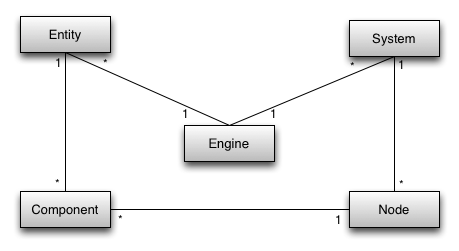
First, it’s worth noting that the core of this architecture is the components and the systems. Components are value-objects that contain the state of the game, and systems are the logic that operates on that state, changing it as the game progresses. The other elements of the architecture are purely incidental, designed to make life easier.
The entity object is present to collect related components together. The relation between components is encapsulated by the concept of an entity and that is vital to the architecture, but it isn’t necessary to use an explicit Entity object for this. There are some frameworks that simply use an id to represent the entity, adding the entity id to every component to indicate which entity it belongs to. In this scenario there is no requirement for an entity object at all and entity based operations are performed through an entity manager, using the id to indicate which entity they are operating on.
As a concept, the entity is vital to the architecture. But as a code construct it is entirely optional. I include it because, when using an object-oriented language, the entity object makes life easier. In particular, it enables us to create the methods that operate on the entity as methods of an entity object and to track and manage the entity through this object, removing the need to track ids throughout the code.
While the concept of an entity is vital to the architecture, the concept of node objects is entirely incidental. The nodes are used as the objects in the collections of components supplied to the systems. We could instead provide each system with a collection of the relevant entities and let the systems pull the components they want to operate on out of the entities, using the get() method of the entity.
In Ash, the nodes serve two purposes. First they enable us to use a more efficient data structure in which the node objects that the systems receive are nodes in a linked list. This improves the execution speed of the framework.
Second, using the node objects enables us to apply strong, static typing throughout our code. The method to fetch a component from an entity necessarily returns an untyped object, which must then be cast to the correct component type for use in the game code. The properties on the node are already statically typed to the components’ data types, so no casting is necessary.
So, fundamentally, the entity architecture is about components and systems.
This is not object-oriented programming
We can build our entity architecture using an object-oriented language but, on a fundamental level, this is not object-oriented programming. The architecture is not about objects, it’s about data (components) and sub-routines that operate on that data (systems).
For many object-oriented programmers this is the hardest part of working with an entity system framework. Our tendency is to fall back to what we know and as an object-oriented programmer using an object-oriented language that means encapsulating data and operations together into objects. If you do this with a framework like Ash you will fail.
Data-Oriented Programming
Games tend to be about lots of fast changing state, with players, non-player characters, game objects like bullets and lasers, bats and balls, tables and chairs, and levels, scores, lives and more all having state that might include position, rotation, speed, acceleration, weight, colour, intention, goals, desires, friendships, enemies and more.
The state of the game can be encapsulated in this large mass of constantly changing data, and on a technical level the game is entirely about what this data is and how this data changes.
In a game a single little piece of this data may have many operations acting on it. Take, for example, a player character that has a position property that represents the character’s position in the game world. This single piece of data may be used by
- The render system, to draw the player in the world.
- The camera system, to position the camera relative to the player.
- The AI systems of all non-player characters, to decide how they should react to the player.
- The input system, which alters the player’s position based on user input.
- The physics system, which alters the player’s position based on the physics of the game world.
- The collision system, which tests whether the player is colliding with other objects and resolves those collisions.
and probably many more systems besides. If we try to build our game using objects that encapsulate data with the operations that act on that data, then we will build dependencies between all these different systems as they all want to be encapsulated with the player’s position data. This can’t be done unless we code the game as one single, massive class, so inevitably we break some parts of the game into separate systems and provide data to those systems – the physics system, the graphics system – while including other elements of the game logic within the entity objects themselves.
An entity architecture based on components and systems takes the idea of discrete systems to its logical conclusion. All operations are programmed as independent systems, and all game state is stored separately in a set of data components, which are provided to the systems according to their need.
The systems are decoupled form each other. Each system knows only about itself and the data it operates on. It knows and cares nothing at all about the other systems and how they may have affected by or used the data before or after this system gets to work with it.
Also, by embracing the system as the core logic of the architecture, we are encouraged to make many smaller and simpler systems rather than a few large complex ones, which again leads to simpler code and looser coupling.
This decoupling makes building your game much easier. It is why I enjoy working with this form of entity system so much, and why I built Ash.
Storing the game state
Another benefit of the component/system architecture is apparent when you want to save and restore the game state. Because the game state is contained entirely in the components, and because these are simple value objects, saving the game state is a relatively simple matter of serialising out the components, and restoring the game state involves just deserialising the data back in again.
In most cases, serialising a value-object is straightforward, and one could simply json-encode each component, with additional data to indicate its entity owner (an id) and its component type (a string), to save the game state.
Adam Martin wrote about comparing components in an entity system framework to data in a relational database (there’s lots of interesting entity related stuff on Adam’s blog), and emphasising that conversion between a relational database for long-term storage and components for game play doesn’t require any object/relational mapping, because components are simple copies of the relational database’s data structure rather than complex objects.
This leads further to the conclusion that a component/system architecture is ideal for an MMO game, since state will be stored in a relational database on the game servers, and much of the processing of that state will occur on the servers, where using a set of discrete, independent systems to process the data as the game unfolds is an excellent fit to both the data storage requirements of the state and the parallelism available on the servers.
Concurrency
Indeed, a component/system architecture is well suited to applying concurrency to a game. In most games, some of the systems are entirely independent of each other, including being independent of the order in which they are applied. This makes it easy to run these systems in parallel.
Further, most systems consist of a loop in which all nodes are processed sequentially. In many cases, the loop can be parallelised since the nodes can be updated independently of each other.
This gives us two places in the code where concurrency can be applied without altering the core logic of the game, which is inside the loop in the systems, or the core state of the game, which is in the components.
This makes adding concurrency to the game relatively simple.
We don’t need object-orientation
Finally, because the component/system architecture is not object-oriented, it lends itself to other programming languages that implement different programming paradigms like functional programming and procedural programming. While I created Ash as an Actionscript framework, this architecture would be well suited to Javascript for client side development or any of the many functional languages used for highly concurrent server side development.
Update: In-game editors
Tom Davies has pointed out that a very valuable benefit to him is how easy it is to create an in-game level editor when developing with an entity system framework like Ember orAsh. You can see his example here.
I agree with Tom, this is a very useful benefit of these frameworks. The complete separation of the game state and the game logic in an entity system framework makes it easy to create an editor that lets you alter the state (configuration, level design, AI, etc.) while playing the game. Add to this the easier saving and loading of state and you have a framework that is very well suited to in-game editing.
为什么要在游戏开发中使用ECS模式的更多相关文章
- [Unity游戏开发]向量在游戏开发中的应用(三)
本文已同步发表在CSDN:http://blog.csdn.net/wenxin2011/article/details/51088236 在上一篇博客中讲了利用向量点乘在游戏开发中应用的几种情景.本 ...
- [Unity游戏开发]向量在游戏开发中的应用(二)
本文已同步发表在CSDN:http://blog.csdn.net/wenxin2011/article/details/50972976 在上一篇博客中讲了利用向量方向的性质来解决问题.这篇博客将继 ...
- [Unity游戏开发]向量在游戏开发中的应用(一)
本文已同步发表在CSDN:http://blog.csdn.net/wenxin2011/article/details/50810102 向量在游戏开发中是非常实用的,我们在学校学完向量的知识后,只 ...
- Cocos2d-x游戏开发中的消息机制:CCNotificationCenter的使用
在HTML5游戏开发中,js可以使用Event对象的addEventListener(添加事件监听).dispatchEvent(触发事件)实现监听机制,如果在coocos2d-x中,去实现这种机制该 ...
- 二、Cocos2dx概念介绍(游戏开发中不同的坐标系,cocos2dx锚点)
注:ccp是cocos2dx中的一个宏定义,#define ccp(__X__,__Y__)CCPointMake((float)__X__, (float)__Y__),在此文章中表示坐标信息 1. ...
- [C++基金会]位计算 游戏开发中的应用
定义的位操作:通俗点说,,位计算是计算机操作二进制整数. 无论整数可以用二的方式来表示进度,不同类型的其长度的整数位的是不一样的.INT8要么char靠8个月2 位表示,INT16或者short是由1 ...
- 在基于TypeScript的LayaAir HTML5游戏开发中使用AMD
在基于TypeScript的LayaAir HTML5游戏开发中使用AMD AMD AMD是"Asynchronous Module Definition"的缩写,意思就是&quo ...
- 借助AMD来解决HTML5游戏开发中的痛点
借助AMD来解决HTML5游戏开发中的痛点 游戏开发的痛点 现在,基于国内流行引擎(LayaAir和Egret)和TypeScript的HTML5游戏开发有诸多痛点: 未采用TypeScript编译器 ...
- 游戏开发中IIS常见支持MIME类型文件解析
游戏开发中IIS常见支持MIME类型文件解析 .apkapplication/vnd.android .ipaapplication/vnd.iphone .csbapplication/octet- ...
随机推荐
- EF Code First学习系列
EF Model First在实际工作中基本用不到,前段时间学了一下,大概的了解一下.现在开始学习Code First这种方式.这也是在实际工作中用到最多的方式. 下面先给出一些目录: 1.什么是Co ...
- 如何在虚拟机里安装Linux
本篇仅为作业... 实验课程:Linux 实验机器:联想y410p 指导老师:刘臣奇 实验时间:2016年9月25日 学生学号:140815 姓名:杨文乾 一.先安装虚拟机,之后创建一个新的虚拟机 之 ...
- 继续上篇抢QQ口令红包,抢那招抢不了的红包技巧
- - - - - - - - - - -- - - --长按红包,出现回复,点击回复,那回复里有个表情,直接输入那个表情回复就可以抢了 - - - - - - - - --------------- ...
- 使用java泛型设计通用方法
泛型是Java SE 1.5的新特性, 泛型的本质是参数化类型, 也就是说所操作的数据类型被指定为一个参数. 因此我们可以利用泛型和反射来设计一些通用方法. 现在有2张表, 一张user表和一张stu ...
- python 学习笔记 -logging模块(日志)
模块级函数 logging.getLogger([name]):返回一个logger对象,如果没有指定名字将返回root loggerlogging.debug().logging.info().lo ...
- PHP跨域form提交
因为安全性因素,直接跨域访问是不被允许的. 1.PHP CURL方式 function curlPost($url,$params) { $postData = ''; foreach($params ...
- 学习笔记 MYSQL报错注入(count()、rand()、group by)
首先看下常见的攻击载荷,如下: select count(*),(floor(rand(0)*2))x from table group by x; 然后对于攻击载荷进行解释, floor(rand( ...
- 百度地图隐藏BMKAnnotationView
BMKAnnotationview.hidden 失效,只能移除Annotation BMKPinAnnotationView设置setHidden为yes时不能隐藏
- Mac下查看端口占用
netstat命令 netstat -an | grep 端口号 lsof命令 lsof -i:端口号
- Python 环境搭建,开发工具,基本语法
python环境 https://www.python.org/downloads/ 现在pthon有两个版本 一个是3.5系列的 , 一个是2.7系列的.建议用3.5版本的 开发工具 PyCharm ...