
C++数据结构学习之顺序表
顺序表是数据结构中最基本也是应用相当广泛的一种数据结构类型。它通常包含三个私有成分,即指向数据数组的头指针、当前表长以及表的实际容量。表的头指针通常指向数据数组的基地址,通过数组的形式进行访问数据数组中的每个元素。其基本结构类型如下图所示:
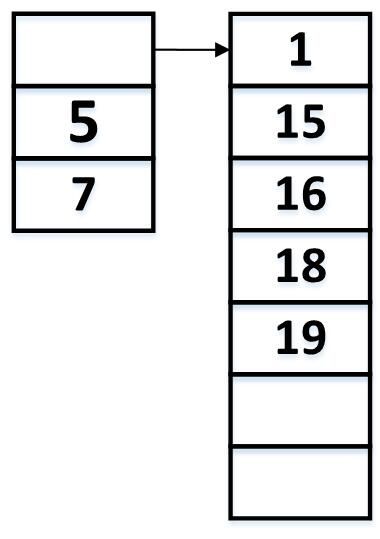
从上图可以看到,其基本结构包含一个指向数据数组的头指针,当前表长为5,但是该顺序表实际表的容量有7。
下面附上实现该数据结构的各项操作代码
在C.h文件中存放可能要用到的C++库:
 #ifndef _C_H_

 #define _C_H_

 #include<iostream>

 #include<fstream>

 #include<iomanip>

 #include<cmath>

 #include<vector>

 #include<list>

 #include<stack>

 #include<queue>

 #include<deque>

 #include<string>

 #include<bitset>

 #include<algorithm>

 #include<ctime>

 #include<cstdarg>

 #include<assert.h>

 using namespace std;

 #endif // _C_H_
在SequenceTable.h存放对应的数据结构类型:
 #ifndef _SEQUENCETABLE_H_

 #define _SEQUENCETABLE_H_

 template<typename T>class STL{

 private:

     T *elem;   //save the base address of STL

     int length;     //save the current length of STL;

     int listsize;   //save the opacity of STL

 public:

     //a function to create k length STL, if k doesn't exist, it can use default function to create 1 length STL

     STL(int k=){

         elem = new T[k];

         length = ;

         listsize = k;

     }

     //destruct STL

     ~STL(){

         delete[]elem;

     }

     int getLength();

     int getListsize();

     void Insert(int k, int data);   //a function to insert elem in the specific location

     void Delete(int k, int data);   //a function to delete elem in the specific location

     int getElem(int k);     //get elem in the specific location

     int getLocation(int data);

     void ListEmpty();

     void showSTL();

 };

 template<typename T>

 int STL<T>::getListsize(){

     return listsize;

 }

 template<typename T>

 int STL<T>::getLength(){

     return length;

 }

 template<typename T>

 void STL<T>::Insert(int k, int data){

     //confirm whether the k is reasonable

     if(k <=  || k > (length+)){

         cout<<"k is unreasonable!"<<endl;

     }

     int t;     //an empty bottle

     //insert data while satisfy this situation

     while(length<listsize && k<=length){

         if(k<length){

             t = elem[k];

             elem[k] = data;

             data = elem[k+];

             k++;

         }

         else{

             length++;

             t = elem[k];

             elem[k] = data;

             data = elem[k+];

             k++;

         }

     }

     if(k==(length+)){

         if(length<listsize){

             length++;

             elem[k] = data;

         }

         else{

             listsize++;

             length++;

             elem[k] = data;

         }

     }

 }

 template<typename T>

 void STL<T>::Delete(int k, int data){

     //confirm whether the k is reasonable

     if(k <=  || k > (length+)){

         cout<<"k is unreasonable!"<<endl;

     }

     //insert data while satisfy this situation

     if(elem[k]==data){

         while(k<=length){

             if(k<length){

                 elem[k] = elem[k+];

                 k++;

             }

             else{

                 k++;

             }

         }

         length--;

     }

     else{

         cout<<"delete error!"<<endl;

     }

 }

 template<typename T>

 int STL<T>::getLocation(int data){

     int i = ; //consider when the length is 0 but the listsize is 1

     while(i<=length){

         if(elem[i] == data){

             return i;

         }

         i++;

     }

 }

 template<typename T>

 int STL<T>::getElem(int k){

     if(k<= || k>=(length+)){

         cout<<"k is unreasonable!"<<endl;

     }

     else{

         return elem[k];

     }

 }

 template<typename T>

 void STL<T>::ListEmpty(){

     length = ;

 }

 template<typename T>

 void STL<T>::showSTL(){

     for(int i=;i<=length; i++){

         cout<<elem[i]<<endl;

     }

 }

 #endif
然后再main.cpp文件中实现对该数据结构的调用:
 #include "C.h"

 #include "SequenceTable.h"

 typedef int T;

 int main(){

     STL<T> L;

     for(int i=; i<;i++){

         L.Insert(i+, i+);

     }

     cout<<L.getLocation()<<endl;

     cout<<L.getLength()<<endl;

     cout<<L.getListsize()<<endl;

     L.showSTL();

     int a = L.getElem();

     L.Delete(,);

     L.showSTL();

     cout<<L.getLength()<<endl;

     cout<<L.getListsize()<<endl;

     L.Delete(,);

     L.showSTL();

     cout<<L.getLength()<<endl;

     cout<<L.getListsize()<<endl;

 }
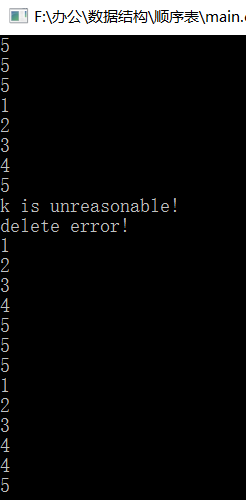
运行实现:
C++数据结构学习之顺序表的更多相关文章
- C++ 数据结构学习一(顺序表)
//SequentialList.h 顺序表模板类 #ifndef SEQUENTIAL_LIST_HXX#define SEQUENTIAL_LIST_HXX using std::cout; us ...
- 【数据结构】之顺序表(Java语言描述)
之前总结过使用C语言描述的顺序表数据结构.在C语言类库中没有为我们提供顺序表的数据结构,因此我们需要自己手写,详细的有关顺序表的数据结构描述和C语言代码请见[我的这篇文章]. 在Java语言的JDK中 ...
- 【数据结构】之顺序表(C语言描述)
顺序表是线性表的一种,它将元素存储在一段连续的内存空间中,表中的任意元素都可以通过下标快速的获取到,因此,顺序表适合查询操作频繁的场景,而不适合增删操作频繁的场景. 下面是使用 C语言 编写的顺序表的 ...
- C语言学习笔记-顺序表
#include "stdafx.h" #include <stdio.h> #include <stdlib.h> #include "coni ...
- 数据结构 单链表&顺序表
顺序表: 一般使用数组(C语言中的数组采用顺序存储方式.即连续地址存储)来描述. 优点:在于随机访问元素, 缺点:插入和和删除的时候,需要移动大量的元素. 链表: 优点:插入或删除元素时很方便,使用灵 ...
- 数据结构——Java实现顺序表
一.分析 什么是顺序表?顺序表是指用一组地址连续的存储单元依次存储各个元素,使得在逻辑结构上相邻的数据元素存储在相邻的物理存储单元中的线性表.一个标准的顺序表需要实现以下基本操作: 1.初始化顺序表 ...
- 数据结构之线性顺序表ArrayList(Java实现)
一.ListMe接口: import java.util.ArrayList; //实现线性表(顺序表和链表)的接口://提供add get isEmpty size 功能public interfa ...
- 数据结构之动态顺序表(C实现)
线性表有2种,分为顺序表和链表. 顺序表: 采用顺序存储方式,在一组地址连续的存储空间上存储数据元素的线性表(长度固定) 链表: 有3种,单链表.双向链表.循环链表(长度不固定) seqList.h ...
- 【c++版数据结构】之顺序表的实现
SeqList.h #ifndef SEQLIST_H #define SEQLIST_H #include<iostream> using namespace std; typedef ...
随机推荐
- Django App(四) Submit a form
经过前面的努力,到这里我们已经基本完成了,从服务器到浏览器的数据下发,还没有解决从浏览器到服务器的数据上传,这一节将创建一个Form获取从浏览器提交的数据 1.新建Form 接着前面建的项目,网上调查 ...
- [学习OpenCV攻略][017][ARM9下移植OpenCV]
安装环境 宿主机: Red Hat Enterprise Linux Server 6.3 开发板: mini2440 相关软件: cmake-3.5.1.tar.gz.OpenCV-2.3.1a.t ...
- .24-浅析webpack源码之事件流compilation(2)
下一个compilation来源于以下代码: compiler.apply(new EntryOptionPlugin()); compiler.applyPluginsBailResult(&quo ...
- 虚拟主机、VPS以及云主机的区别和对比
对于很多需要建网站的朋友来说,虚拟主机是必须要了解的基础知识.虚拟主机相对于VPS与云主机来说出现的较早,也是被大多数站长所了解的主机.很多人容易将这三者混淆,弄不清楚三者的联系与区别.那么虚拟主机. ...
- PHP move_uploaded_file() 函数
PHP Filesystem 函数 定义和用法 move_uploaded_file() 函数将上传的文件移动到新位置. 若成功,则返回 true,否则返回 false. 语法 move_upload ...
- 深入理解:Linear Regression及其正则方法
这是最近看到的一个平时一直忽略但深入研究后发现这里面的门道还是很多,Linear Regression及其正则方法(主要是Lasso,Ridge, Elastic Net)这一套理论的建立花了很长一段 ...
- Django_中国化
需求: 要求Django显示中文,并使用北京时间 问题原因: Django具有相当的国际化,已经内置了多种语言,汉语当然也不落下,Django默认的时间是utc时间,也就是说相隔八个时区的中国,显示北 ...
- js随机生成验证码及其颜色
今天迎来了2018年第一场雪,这个美好的日子,总的写点什么纪念一下,在这里写了一个在js中使用Math.random()函数,随机生成四位数的验证码及其验证码换颜色. js代码如下: var arra ...
- java 基本数据类型与变量类型
Java语言提供了八种基本类型.六种数字类型(四个整数型,两个浮点型),一种字符类型,还有一种布尔型. byte,short,char,int,long,float,double Java语言支持的变 ...
- SQL 2005/2008 连接SQL 2000报18456错误
在看文章前,你先看看下面这两个问题,考考你对MSSMS工具的掌握情况: 1: SQL 2005/2008 能连接 SQL 2000数据库服务器吗? 2: SQL 2000 能连接SQL 2005/20 ...