
Space Golf~物理题目
Description
You surely have never heard of this new planet surface exploration scheme, as it is being carried out in a project with utmost secrecy. The scheme is expected to cut costs of conventional rover-type mobile explorers considerably, using projected-type equipment nicknamed "observation bullets".
Bullets do not have any active mobile abilities of their own, which is the main reason of their cost-efficiency. Each of the bullets, after being shot out on a launcher given its initial velocity, makes a parabolic trajectory until it touches down. It bounces on the surface and makes another parabolic trajectory. This will be repeated virtually infinitely.
We want each of the bullets to bounce precisely at the respective spot of interest on the planet surface, adjusting its initial velocity. A variety of sensors in the bullet can gather valuable data at this instant of bounce, and send them to the observation base. Although this may sound like a conventional target shooting practice, there are several issues that make the problem more difficult.
- There may be some obstacles between the launcher and the target spot. The obstacles stand upright and are very thin that we can ignore their widths. Once the bullet touches any of the obstacles, we cannot be sure of its trajectory thereafter. So we have to plan launches to avoid these obstacles.
- Launching the bullet almost vertically in a speed high enough, we can easily make it hit the target without touching any of the obstacles, but giving a high initial speed is energy-consuming. Energy is extremely precious in space exploration, and the initial speed of the bullet should be minimized. Making the bullet bounce a number of times may make the bullet reach the target with lower initial speed.
- The bullet should bounce, however, no more than a given number of times. Although the body of the bullet is made strong enough, some of the sensors inside may not stand repetitive shocks. The allowed numbers of bounces vary on the type of the observation bullets.
You are summoned engineering assistance to this project to author a smart program that tells the minimum required initial speed of the bullet to accomplish the mission.
Figure D.1 gives a sketch of a situation, roughly corresponding to the situation of the Sample Input 4 given below.

Figure D.1. A sample situation
You can assume the following.
- The atmosphere of the planet is so thin that atmospheric resistance can be ignored.
- The planet is large enough so that its surface can be approximated to be a completely flat plane.
- The gravity acceleration can be approximated to be constant up to the highest points a bullet can reach.
These mean that the bullets fly along a perfect parabolic trajectory.
You can also assume the following.
- The surface of the planet and the bullets are made so hard that bounces can be approximated as elastic collisions. In other words, loss of kinetic energy on bounces can be ignored. As we can also ignore the atmospheric resistance, the velocity of a bullet immediately after a bounce is equal to the velocity immediately after its launch.
- The bullets are made compact enough to ignore their sizes.
- The launcher is also built compact enough to ignore its height.
You, a programming genius, may not be an expert in physics. Let us review basics of rigid-body dynamics.
We will describe here the velocity of the bullet v with its horizontal and vertical components vx and vy (positive meaning upward). The initial velocity has the components vix and viy, that is, immediately after the launch of the bullet, vx = vix and vy = viy hold. We denote the horizontal distance of the bullet from the launcher as x and its altitude as y at time t.
The horizontal velocity component of the bullet is kept constant during its flight when atmospheric resistance is ignored. Thus the horizontal distance from the launcher is proportional to the time elapsed.
x=vixt(1)(1)x=vixtThe vertical velocity component vy is gradually decelerated by the gravity. With the gravity acceleration of g, the following differential equation holds during the flight.
dvydt=−g(2)(2)dvydt=−gSolving this with the initial conditions of vy = viy and y = 0 when t = 0, we obtain the following.
y==−12gt2+viyt−(12gt−viy)t(3)(4)(3)y=−12gt2+viyt(4)=−(12gt−viy)tThe equation (4) tells that the bullet reaches the ground again when t = 2viy/g. Thus, the distance of the point of the bounce from the launcher is 2vixviy/g. In other words, to make the bullet fly the distance of l, the two components of the initial velocity should satisfy 2vixviy = lg.
Eliminating the parameter t from the simultaneous equations above, we obtain the following equation that escribes the parabolic trajectory of the bullet.
y=−(g2v2ix)x2+(viyvix)x(5)(5)y=−(g2vix2)x2+(viyvix)x
For ease of computation, a special unit system is used in this project, according to which the gravity acceleration g of the planet is exactly 1.0.
Input
The input consists of several tests case with the following format.
For each test, the first line contains three integers, d, n, and b. Here, d is the distance from the launcher to the target spot (1 ≤ d ≤ 10000), n is the number of obstacles (1 ≤ n ≤ 10), and b is the maximum number of bounces allowed, not including the bounce at the target spot (0 ≤ b ≤ 15).
Each of the following n lines has two integers. In the k-th line, pk is the position of the k-th obstacle, its distance from the launcher, and hk is its height from the ground level. You can assume that 0 < p1, pk < pk + 1 for k = 1, …, n − 1, and pn < d. You can also assume that 1 ≤ hk ≤ 10000 for k = 1, …, n.
Output
Output the smallest possible initial speed vi that makes the bullet reach the target. The initial speed vi of the bullet is defined as follows.
The output should not contain an error greater than 0.0001.
Sample Input
100 1 0

50 100

10 1 0

4 2

100 4 3

20 10

30 10

40 10

50 10

343 3 2

56 42

190 27

286 34
Sample Output
14.57738

3.16228

7.78175

11.08710

这题一开始二分写的,但是第二组样例一直过不去,后面深入思考,
速度其实是有一个表达式的,hmax有一个最小值,二分没有想到这点,
需要特判一下
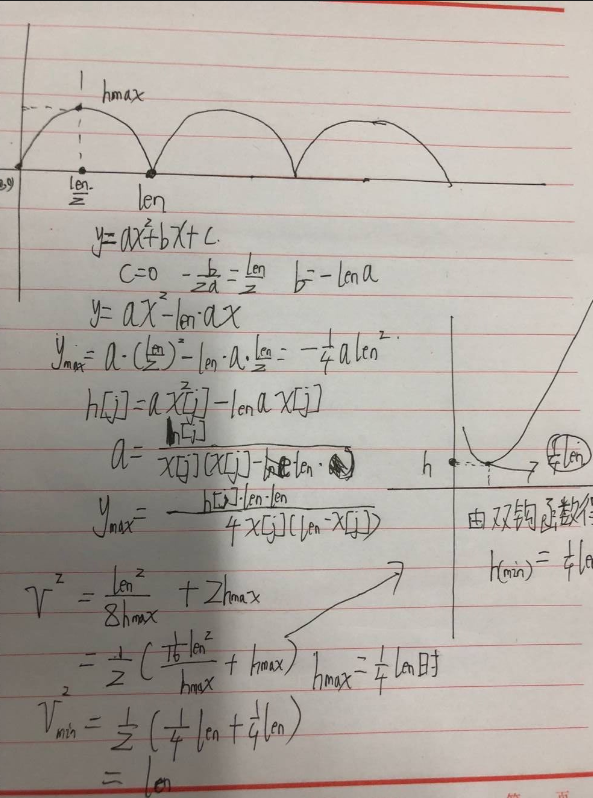
不会电脑画图,就这样吧,一些重要的公式推导写出来了。
 #include <cstdio>

 #include <algorithm>

 #include <vector>

 #include <queue>

 #include <cstring>

 #include <string>

 #include <cmath>

 #include <map>

 using namespace std;

 const int maxn = 2e5 + ;

 const int INF = 0x7fffffff;

 double x[], h[], x1[], h1[];

 double d, len, ans, hmax;

 int n, b;

 int main() {

     while(scanf("%lf%d%d", &d, &n, &b) != EOF) {

         ans = 1.0 * INF;

         for (int i =  ; i < n ; i++) {

             scanf("%lf%lf", &x[i], &h[i]);

         }

         int flag = ;

         for (int i =  ; i <= b +  ; i++) {

             len = 1.0 * d / (1.0 * i);

             flag = ;

             hmax = -;

             for (int j =  ; j < n ; j++) {

                 x1[j] = x[j];

                 while(x1[j] - len >= ) {

                     x1[j] -= len;

                 }

                 h1[j] = h[j];

                 if (fabs(x[j]) <= 1e-) {

                     flag = ;

                     break;

                 }

                 double temph = len * len * h1[j] / (len - x1[j]) / x1[j] / 4.0;

                 hmax = max(hmax, temph);

             }

             if (flag == )   continue;

             if (hmax < len /  ) ans = min(ans, len);

             else ans = min(len * len /  / hmax +  * hmax, ans);

         }

         printf("%.5f\n", sqrt(ans));

     }

     return ;

 }
Space Golf~物理题目的更多相关文章
- Codeforces Gym 100803D Space Golf 物理题
Space Golf 题目连接: http://codeforces.com/gym/100803/attachments Description You surely have never hear ...
- UVALive 6886 Golf Bot FFT
Golf Bot 题目连接: http://acm.hust.edu.cn/vjudge/problem/visitOriginUrl.action?id=129724 Description Do ...
- HDU 6373.Pinball -简单的计算几何+物理受力分析 (2018 Multi-University Training Contest 6 1012)
6373.Pinball 物理受力分析题目. 画的有点丑,通过受力分析,先求出θ角,为arctan(b/a),就是atan(b/a),然后将重力加速度分解为垂直斜面的和平行斜面的,垂直斜面的记为a1, ...
- 2014-2015 ACM-ICPC, Asia Tokyo Regional Contest
2014-2015 ACM-ICPC, Asia Tokyo Regional Contest A B C D E F G H I J K O O O O O O A - Bit ...
- C语言100道经典算法
经典的100个c算法 C语言的学习要从基础,100个经典的算法真不知道关于语言的应该发在那里,所以就在这里发了,发贴的原因有2个,第一个,这东西非常值得学习,第二个,想..........嘿嘿,大家应 ...
- MMO之禅(三)职业能力
MMO之禅(三)职业能力 --技术九层阶梯 Zephyr 201304 有了精神,我们还需要实际的行动. 到底需要什么能力?自我分析,窃以为为有九层,无所谓高低,因为每一层都需要不断地砥砺,编程,本身 ...
- C语言100个经典算法
POJ上做做ACM的题 语言的学习基础,100个经典的算法C语言的学习要从基础开始,这里是100个经典的算法-1C语言的学习要从基础开始,这里是100个经典的算法 题目:古典问题:有一对兔子,从出生后 ...
- c-大量经典的c算法---ShinePans
经典的100个c算法 算法 题目:古典问题:有一对兔子.从出生后第3个月起每一个月都生一对兔子.小兔 子长到第三个月后每一个月又生一对兔子,假如兔子都不死,问每一个月的兔子总数 为多少? _____ ...
- LeetCode OJ 73. Set Matrix Zeroes
Given a m x n matrix, if an element is 0, set its entire row and column to 0. Do it in place. click ...
随机推荐
- 发布一个参考ssdb,用go实现的类似redis的高性能nosql:ledisdb
起因 ledisdb是一个参考ssdb,采用go实现,底层基于leveldb,类似redis的高性能nosql数据库,提供了kv,list,hash以及zset数据结构的支持. 我们现在的应用极大的依 ...
- 【unix网络编程第三版】阅读笔记(二):套接字编程简介
unp第二章主要将了TCP和UDP的简介,这些在<TCP/IP详解>和<计算机网络>等书中有很多细致的讲解,可以参考本人的这篇博客[计算机网络 第五版]阅读笔记之五:运输层,这 ...
- EBS Form个性化的工作原理
Form的个性化是EBS的比较好用的一个东西.好像很少人研究它的工作原理,都是直接用.最近有个同事问我问题,说他在个性化编写的代码无效果.解决之后,才发现,原来传说中的EBS的Form的个性化是这样子 ...
- Android进阶(八)Can't create handler inside thread that has not called Looper.prepare()
Error:Can't create handler inside thread that has not called Looper.prepare() 原代码: //利用Handler消息传递机制 ...
- Java 8新特性探究(二)类型注解和重复注解
本文将介绍java 8的第二个特性:类型注解. 注解大家都知道,从java5开始加入这一特性,发展到现在已然是遍地开花,在很多框架中得到了广泛的使用,用来简化程序中的配置.那充满争议的类型注解究竟是什 ...
- ant的设置properties
特点 大小写敏感: 不可改变,先到先得,谁先设定,之后的都不能改变. 怎样设置 1 .设置 name 和 value 属性值,比如: <property name="srcdir&qu ...
- 网站开发进阶(二十五)js如何将html表格导出为excel文件
js如何将html表格导出为excel文件 赠人玫瑰,手留余香.若您感觉此篇博文对您有用,请花费2秒时间点个赞,您的鼓励是我不断前进的动力,共勉! jsp页面数据导出成excel的方法很 ...
- AngularJS进阶(十二)AngularJS常用知识汇总(不断更新中....)
AngularJS常用知识汇总(不断更新中....) 注:请点击此处进行充电! app.controller('editCtrl',['$http','$location','$rootScope', ...
- Memcached学习笔记 — 第四部分:Memcached Java 客户端-gwhalin(1)-介绍及使用
介绍 Memcached java client是官方推荐的最早的memcached java客户端.最新版本:java_memcached-release_2.6.1. 官方下载地址:http ...
- JUnit4快速入门
JUnit最佳实践 1 2 3 4 5 6 7 8 9 10 11 12 13 14 15 16 17 public class CardServiceTest { /** * 最佳 ...