
union, enum, and struct, 以及结构填充和位字段实现。
Table 4-9 Compiler storage of data objects by byte alignment
| Type | Bytes | Alignment |
|---|---|---|
char, bool, _Bool |
1 | Located at any byte address. |
short, wchar_t |
2 | Located at any address that is evenly divisible by 2. |
float, int, long, pointer |
4 | Located at an address that is evenly divisible by 4. |
long long, double, long double |
8 | Located at an address that is evenly divisible by 8. |
Unions
当使用不同类型的成员访问联合成员时,可以从原始类型的表示中预测结果值。没有错误。
Enumerations
枚举类型的一个对象是最小的整数类型包含枚举的范围内实现。
在C和C++中的模式,模式没有-- enum_is_int,如果枚举包含积极的枚举值,该枚举的存储类型是从下面的列表中的第一个符号类型,根据该枚举器枚举的范围。在其他模式,在这种情况下,一个枚举包含任何负面的枚举值,该枚举的存储类型是下列第一,根据该枚举数的范围在枚举:
unsigned charif not using--enum_is_intsigned charif not using--enum_is_intunsigned shortif not using--enum_is_intsigned shortif not using--enum_is_intsigned intunsigned intexcept C with--strictsigned long longexcept C with--strictunsigned long longexcept C with--strict.
在混合使用和不使用-enum_is_int选项编译的转换单元以及共享接口或数据结构时,必须注意。在严格C中,枚举数值必须表示为INT。也就是说,他们必须在范围内-2147483648到2147483647,包括在内。对超出范围的枚举数值发出警告:
#66: enumeration value is out of "int" range
Structures
结构可以包含填充,以确保字段正确对齐,并确保结构本身正确地对齐。下图显示了一个常规的、不打包的结构的示例。填充字节1、2和3以确保正确的字段对齐。填充字节11和12以确保正确的结构对齐。函数返回结构的大小,包括填充。
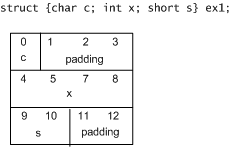
编译器根据结构的定义方式以下列方式之一对结构进行解析:
- 定义为静态或外部结构的结构用零填充。
- 堆栈或堆上的结构,如使用malloc()或AUTO定义的结构,将填充以前存储在这些内存位置中的内容。您不能使用memcmp()来比较以这种方式定义的填充结构。
Bitfields
在非打包结构中,ARM编译器在容器中分配位字段。容器是声明类型的对齐对象。分配Bitfield使指定的第一个字段占用单词中寻址最低的位,具体取决于配置:
小端(Little-endian):最低地址意味着最不重要。大端(Big-endian):最低地址意味着最重要。
在严格的1990 ISO标准C中,唯一允许使用位字段的类型是int、符号int和无符号int。对于非int位字段,编译器将显示一个错误。无符号或无符号限定符声明的普通位字段被视为无符号。例如,intx:10分配一个10位的无符号整数。位字段被分配给具有足够数量未分配位的正确类型的第一个容器,例如:
struct X

{

    int x:;

    int y:;

};
第一个声明创建一个整数容器,并将10位分配给x。在第二个声明中,编译器找到具有足够数量未分配位的现有整数容器,并在与x相同的容器中分配y。
位字段完全包含在其容器中。不适合于容器的位字段放置在相同类型的下一个容器中。例如,如果为结构声明了额外的位字段,则z的声明会溢出容器:
struct X

{

    int x:;

    int y:;

    int z:;

};
编译器为第一个容器分配剩余的两位,并为z分配一个新的整数容器。Bitfield容器可以相互重叠,例如:
struct X

{

    int x:;

    char y:;

};
第一个声明创建一个整数容器,并将10位分配给x。这10位占用整数容器的第一个字节和第二个字节的两个位。在第二个声明中,编译器检查char类型的容器。没有合适的容器,因此编译器分配一个新的正确对齐的char容器。
由于CHAR的自然对齐是1,编译器会搜索包含足够数量未分配位的第一个字节,以完全包含位字段。在示例结构中,int容器的第二字节具有分配给x的两个比特,以及未分配的六个比特。编译器在前一个int容器的第二个字节开始分配一个字符容器,跳过分配给x的前两个位,并将两个位分配给y。
如果y被声明为char y:8,编译器会将第二个字节存储起来,并将一个新的char容器分配给第三个字节,因为位字段不能溢出它的容器。下图显示了以下示例结构的位字段分配:
struct X

{

    int x:;

    char y:;

};

相同的基本规则适用于具有不同容器类型的位字段声明。例如,向示例结构中添加int位字段会提供:
struct X

{

    int x:10;

    char y:8;

    int z:5;

}
int container starting at the same location as the int x:10 container and allocates a byte-aligned char and 5-bit bitfield, as follows:bitfield of size zero. A bitfield of zero size fills the container up to the end
if the container is not empty. A subsequent bitfield declaration starts a new
empty container.
Note
container with unspecified values when a bitfield is written. This does not
affect normal usage of bitfields.
Bitfields in packed structures
packed structures, have an alignment of 1. Therefore the maximum bit padding
inserted to align a packed bitfield container is 7 bits.
8*sizeof(container-type)-1 bits.ensure arrays of the structure will have their elements correctly aligned.
the bitfield that declared it. Non-packed bitfield containers are the size of
their type.
struct A {          int z:17; }; // sizeof(A) = 4, alignment = 4

struct A { __packed int z:17; }; // sizeof(A) = 3, alignment = 1

__packed struct A { int z:17; }; // sizeof(A) = 3, alignment = 1
struct A { char y:1;          int z:31; }; // sizeof(A) = 4, alignment = 4

struct A { char y:1; __packed int z:31; }; // sizeof(A) = 4, alignment = 1

__packed struct A { char y:1; int z:31; }; // sizeof(A) = 4, alignment = 1
struct A { char y:1;          int z:32; }; // sizeof(A) = 8, alignment = 4

struct A { char y:1; __packed int z:32; }; // sizeof(A) = 5, alignment = 1

__packed struct A { char y:1; int z:32; }; // sizeof(A) = 5, alignment = 1
struct A { int x; char y:1;          int z:31; };  // sizeof(A) = 8, alignment = 4

struct A { int x; char y:1; __packed int z:31; };  // sizeof(A) = 8, alignment = 4

__packed struct A { int x; char y:1; int z:31; };  // sizeof(A) = 8, alignment = 1
struct A { int x; char y:1;          int z:32; };  // sizeof(A) = 12, alignment = 4 [1]

struct A { int x; char y:1; __packed int z:32; };  // sizeof(A) = 12, alignment = 4 [2]

__packed struct A { int x; char y:1; int z:32; };  // sizeof(A) = 9, alignment = 1
struct example1

{

int a : 8;  /* 4-byte container at offset 0 */

__packed int b : 8;  /* 1-byte container at offset 1 */

__packed int c : 24; /* 3-byte container at offset 2 */

}; /* Total size 8 (3 bytes tail padding) */;
struct example2

{

__packed int a : 8; /* 1-byte container at offset 0 */

__packed int b : 8; /* 1-byte container at offset 1 */

int c : 8; /* 4-byte container at offset 0 */

}; /* Total size 4 (No tail padding) */
struct example3

{

int a : 8;  /* 4-byte container at offset 0 */

__packed int b : 32; /* 4-byte container at offset 1 */

__packed int c : 32; /* 4-byte container at offset 5 */

int d : 16; /* 4-byte container at offset 8 */

int e : 16; /* 4-byte container at offset 12 */

int f : 16; /* In previous container */

}; /* Total size 16 (No tail padding) */
union, enum, and struct, 以及结构填充和位字段实现。的更多相关文章
- 关于C与C++的struct,union,enum用法差异
对着代码说话: #include <stdio.h> #include <stdlib.h> struct test { int abc; }; enum _enum {A,B ...
- struct ifreq结构体与ip,子网掩码,网关等信息
总结一下,今天学习的关于通过socket,ioctl来获得ip,netmask等信息,其中很多内容参照了很多网上的信息,我会一一列出的 我用的这个函数,就是下面这个函数,其中的有一些全局变量,很好懂, ...
- union内嵌struct用法
// union内嵌struct用法 // 众所周知,union为联合体,struct为结构体.下面根据实例谈谈用法 #include <stdio.h> #include & ...
- struct termios结构体【转】
本文转载自:http://blog.csdn.net/vevenlcf/article/details/51096122 一.数据成员 termios 函数族提供了一个常规的终端接口,用于控制非同步通 ...
- Linux串口—struct termios结构体【转】
转自:https://blog.csdn.net/yemingzhu163/article/details/5897156 一.数据成员 termios 函数族提供了一个常规的终端接口,用于控制非同步 ...
- struct termios结构体详解
一.数据成员 termios 函数族提供了一个常规的终端接口,用于控制非同步通信端口. 这个结构包含了至少下列成员:tcflag_t c_iflag; /* 输入模式 */tcflag_t ...
- struct socket结构体详解
原创作品,允许转载,转载时请务必以超链接形式标明文章 原始出处 .作者信息和本声明.否则将追究法律责任.http://weiguozhihui.blog.51cto.com/3060615/15852 ...
- linux网络接口,struct ifreq struct ifconf结构
网络相关的ioctl请求的request参数及arg地址必须指向的数据类型如下表所示: 接口 SIOCGIFCONF SIOCSIFADDR SIOCGIFADDR SIOCSIFBRDADDR SI ...
- Golang面向对象编程-struct(结构体)
Golang面向对象编程-struct(结构体) 作者:尹正杰 版权声明:原创作品,谢绝转载!否则将追究法律责任. 一.什么是面向对象编程 面向对象编程(Object Oriented Program ...
随机推荐
- 【LeetCode 26】删除排序数组中的重复项
题目链接 [题解] 沙比提 [代码] class Solution { public: int removeDuplicates(vector<int>& nums) { if ( ...
- 基于aop的日志记录方式实现
说明 最近有个项目需要增加日志记录功能,因为这个项目原来是基于spring开发的,在查阅了相关资料以后,我采用了spring aop的方式实现该需求,然后就有了本篇文章. 思路 我这边需求是这样的:要 ...
- 【Shiro】一、Apache Shiro简介
一.Apache Shiro简介 1.简介 一个安全性框架 特点:功能丰富.使用简单.运行独立 核心功能: Authentication(认证):你是谁? Authorization(授权):谁能干什 ...
- css 导航样式
html 结构 <div class="nav-menu float-r"> <ul class="menu-item"> <l ...
- fiddler抓包工具详解
转自:http://www.cnblogs.com/yyhh/p/5140852.html Fiddler 抓包工具总结 阅读目录 1. Fiddler 抓包简介 1). 字段说明 2). Sta ...
- 20、Linux命令对服务器磁盘进行监控
服务器磁盘性能测试也是一个比较有意思的过程.首先我们要弄清楚磁盘储存哪些内容,这里推荐鸟哥的私房菜 我们不仅要推算出磁盘什么时候被占满,也要监控磁盘的读写速度.也就是我们常说的 I/O df -h ...
- C# 十六进制转换ASCII
string s = "这里放十六进制字符串"; byte[]buff=new byte[s.Length/2]; int ind ...
- WebServer Project-01-反射
简介 上网浏览网页,离不开服务器,客户请求页面,服务器响应页面,响应的内容是根据每个web请求来产生动态内容的,其内部即启动多个线程来产生不同内容.这种请求响应的交互,都是基于HTTP协议的. 当然现 ...
- Vue双向数据绑定原理深度解析
首先,什么是双向数据绑定?Vue是三大MVVM框架之一,数据绑定简单来说,就是当数据发生变化时,相应的视图会进行更新,当视图更新时,数据也会跟着变化. 在分析其原理和代码的时候,大家首先了解如下几个j ...
- .Net平台调用の初识
前言 工作过程中难免遇到混合编程,现在我们要谈的是C#和c++语言的编程.C#要调用C++的库目前可选主要有两种方式:Com技术和平台调用(P/Invoke).现在我们要谈的是P/Invoke技术. ...