
MPI - 缓冲区和非阻塞通信
转载自: Introduction to MPI - Part II (Youtube)
Buffering
Suppose we have
if(rank==)

    MPI_Send(sendbuf,...,,...)

if(rank==)

    MPI_Recv(recvbuf,...,,...)
These are blocking communications, which means they will not return until the arguments to the functions can be safely modified by subsequent statements in the program.
Assume that process 1 is not ready to receive. Then there are 3 possibilities for process 0:
(1) stops and waits until process 1 is ready to receive
(2) copies the message at sendbuf into a system buffer (can be on process 0, process 1 or somewhere else) and returns from MPI_Send
(3) fails
As long as buffer space is available, (2) is a reasonable alternative.
An MPI implementation is permitted to copy the message to be sent into internal storage, but it is not required to do so.
What if not enough space is available?
>> In applications communicating large amounts of data, there may not be enough momory (left) in buffers.
>> Until receive starts, no place to store the send message.
>> Practically, (1) results in a serial execution.
A programmer should not assume that the system provides adequate buffering.
Now consider a program executing:
| Process 0 | Process 1 |
| MPI_Send to process 1 | MPI_Send to process 0 |
| MPI_Recv from process 1 | MPI_Recv from process 0 |
Such a program may work in many cases, but it is certain to fail for message of some size that is large enough.
There are some possible solutions:
>> Ordered send and receive - make sure each receive is matched with send in execution order across processes.
>> The aboved matched pairing can be difficult in complex applications. An alternative is to use MPI_Sendrecv. It performs both send and receive such that if no buffering is available, no deadlock will occur.
>> Buffered sends. MPI allows the programmer to provide a buffer into which data can be placed until it is delivered (or at lease left in buffer) via MPI_Bsend.
>> Nonblocking communication. Initiated, then program proceeds while the communication is ongoing, until a check that communication is completed later in the program. IMPORTANT: must make certain data not modified until communication has completed.
Safe programs
>> A program is safe if it will produce correct results even if the system provides no buffering.
>> Need safe programs for portability.
>> Most programmers expect the system to provide some buffering, hence many unsafe MPI programs are around.
>> Write safe programs using matching send with receive, MPI_Sendrecv, allocating own buffers, nonblocking operations.
Nonblocking communications
>> nonblocking communications are useful for overlapping communication with computation, and ensuring safe programs.
>> a nonblocking operation request the MPI library to perform an operation (when it can).
>> nonblocking operations do not wait for any communication events to complete.
>> nonblocking send and receive: return almost immediately
>> can safely modify a send (receive) buffer only after send (receive) is completed.
>> "wait" routines will let program know when a nonblocking operation is done.
Example - Communication between processes in ring topology
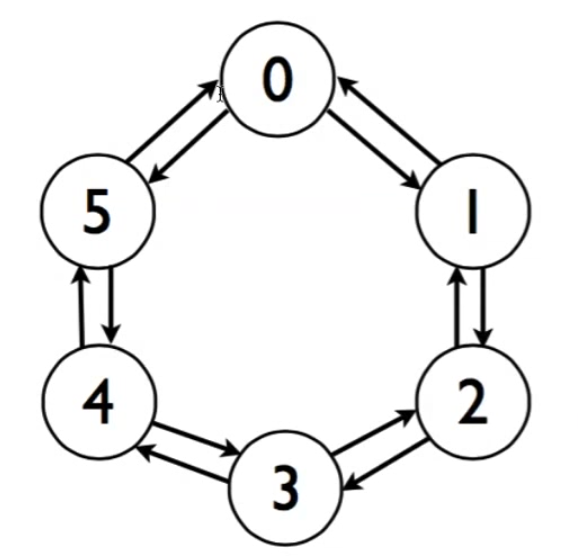
>> With blocking communications it is not possible to write a simple code to accomplish this data exchange.
>> For example, if we have MPI_Send first in all processes, program will get stuck as there will be no matching MPI_Recv to send data.
>> Nonblocking communication avoids this problem.
 #include <stdio.h>

 #include <stdlib.h>

 #include "mpi.h"

 int main(int argc, char *argv[]) {

     int numtasks, rank, next, prev, buf[], tag1=, tag2=;

     tag1=tag2=;

     MPI_Request reqs[];

     MPI_Status stats[];

     MPI_Init(&argc, &argv);

     MPI_Comm_size(MPI_COMM_WORLD, &numtasks);

     MPI_Comm_rank(MPI_COMM_WORLD, &rank);

     prev= rank-;

     next= rank+;

     if(rank == )    prev= numtasks - ;

     if(rank == numtasks-) next= ;

     MPI_Irecv(&buf[], , MPI_INT, prev, tag1, MPI_COMM_WORLD, &reqs[]);

     MPI_Irecv(&buf[], , MPI_INT, next, tag2, MPI_COMM_WORLD, &reqs[]);

     MPI_Isend(&rank, , MPI_INT, prev, tag2, MPI_COMM_WORLD, &reqs[]);

     MPI_Isend(&rank, , MPI_INT, next, tag1, MPI_COMM_WORLD, &reqs[]);

     MPI_Waitall(, reqs, stats);

     printf("Task %d communicated with tasks %d & %d\n",rank,prev,next);

     MPI_Finalize();

     return ;

 }
Summary for Nonblocking Communications
>> nonblocking send can be posted whether a matching receive has been posted or not.
>> send is completed when data has been copied out of send buffer.
>> nonblocking send can be matched with blocking receive and vice versa.
>> communications are initiated by sender
>> a communication will generally have lower overhead if a receive buffer is already posted when a sender initiates a communication.
MPI - 缓冲区和非阻塞通信的更多相关文章
- 【MPI学习4】MPI并行程序设计模式:非阻塞通信MPI程序设计
这一章讲了MPI非阻塞通信的原理和一些函数接口,最后再用非阻塞通信方式实现Jacobi迭代,记录学习中的一些知识. (1)阻塞通信与非阻塞通信 阻塞通信调用时,整个程序只能执行通信相关的内容,而无法执 ...
- 用Java实现非阻塞通信
用ServerSocket和Socket来编写服务器程序和客户程序,是Java网络编程的最基本的方式.这些服务器程序或客户程序在运行过程中常常会阻塞.例如当一个线程执行ServerSocket的acc ...
- UE4 Socket多线程非阻塞通信
转自:https://blog.csdn.net/lunweiwangxi3/article/details/50468593 ue4自带的Fsocket用起来依旧不是那么的顺手,感觉超出了我的理解范 ...
- Java NIO Socket 非阻塞通信
相对于非阻塞通信的复杂性,通常客户端并不需要使用非阻塞通信以提高性能,故这里只有服务端使用非阻塞通信方式实现 客户端: package com.test.client; import java.io. ...
- 利用Python中SocketServer 实现客户端与服务器间非阻塞通信
利用SocketServer模块来实现网络客户端与服务器并发连接非阻塞通信 版权声明 本文转自:http://blog.csdn.net/cnmilan/article/details/9664823 ...
- 【python】网络编程-SocketServer 实现客户端与服务器间非阻塞通信
利用SocketServer模块来实现网络客户端与服务器并发连接非阻塞通信.首先,先了解下SocketServer模块中可供使用的类:BaseServer:包含服务器的核心功能与混合(mix-in)类 ...
- 基于MFC的socket编程(异步非阻塞通信)
对于许多初学者来说,网络通信程序的开发,普遍的一个现象就是觉得难以入手.许多概念,诸如:同步(Sync)/异步(Async),阻塞(Block)/非阻塞(Unblock)等,初学者往往迷惑不清, ...
- TCP非阻塞通信
一.SelectableChannel SelectableChannel支持阻塞和非阻塞模式的channel 非阻塞模式下的SelectableChannel,读写不会阻塞 SelectableCh ...
- java网络通信之非阻塞通信
java中提供的非阻塞类主要包含在java.nio,包括: 1.ServerSocketChannel:ServerSocket替代类,支持阻塞与非阻塞: 2.SocketChannel:Socket ...
随机推荐
- 2.aop中几个注解的含义
参考地址:http://elim.iteye.com/blog/2395255
- POJ 1556 The Doors 线段交 dijkstra
LINK 题意:在$10*10$的几何平面内,给出n条垂直x轴的线,且在线上开了两个口,起点为$(0, 5)$,终点为$(10, 5)$,问起点到终点不与其他线段相交的情况下的最小距离. 思路:将每个 ...
- Linux高级编程--01.vi命令
VI是Linux/Unix下标配的一个纯字符界面的文本编辑器.由于不支持鼠标功能,也没有图形界面,相关的操作都要通过键盘指令来完成,需要记忆大量命令.因此很多人不大喜欢它,但同时由于键盘的方式往往比鼠 ...
- [linux]linux下安装mysql
1.安装g++$sudo apt-get install build-essential注:此命令会同时安装gcc和make2.安装cmake$sudo apt-get install cmake3. ...
- Stat3—因子分析(Factor Analysis)
题注:主成分分析分析与因子分析也有不同,主成分分析仅仅是变量变换,而因子分析需要构造因子模型.主成分分析:原始变量的线性组合表示新的综合变量,即主成分:因子分析:潜在的假想变量和随机影响变量的线性组合 ...
- HTML5实现仪表盘、温度计等插件实用源码
- .net APIHelper client获取数据
using Newtonsoft.Json; using System.Net.Http.Headers; public static class APIHepler { public static ...
- Linux必备工具Tmux
之前介绍了Linux的Screen命令,今天介绍一个更为强大的终端工具Tmux. Tmux 是一个用于在一个终端窗口中运行多个终端会话的工具.它基本能替代nohup以及screen,甚至比它们更为强大 ...
- 南邮PHP反序列化
题目如下: <?php class just4fun { var $enter; var $secret; } if (isset($_GET['pass'])) { $pass = $_GET ...
- 巅峰极客CTF writeup[上]
经验教训 1.CTF不比实战,最好不要死磕.死磕就输了.我就是死磕在缓存文件死的.真的惭愧: 2.对于flag的位置不要太局限于web目录下,如果是命令执行直接上find / -name flag*: ...