
Dubbo RPC源码解读
https://yq.aliyun.com/articles/272405#27
本文代码摘录的时候,将一些与本流程无关的内容去掉了,如有需要请看源码。
一、闲言碎语
使用rpc框架已经多年了,虽然之前有研究过rpc的过程,但是却不曾详细阅读过dubbo的源码,探究过其中的设计思路与亮点。所以抽时间阅读了一下dubbo的源码,分享出来和大家一起学习。
二、目标与示例
1. 目标
l  探究dubbo rpc实现原理。
l  探究rpc从发出请求到收到返回结果这整个过程的详细过程。
l  学习rpc的负载均衡原理。
l  学习服务暴露、服务发现的原理以及实现细节。
l  多线程中dubbo是如何做到将返回结果和每个线程一一对应的。
本文重点为源码分析和模型实现分析,如果对dubbo的概念和使用不熟悉,情移步官网。
本文的所有分析均基于dubbo 2.5.3版本。
本文假定使用zookeeper管理服务。
2. 示例代码
以下的分析基于以下配置方式。不同的配置方式并不会影响本文所需要解决的几个问题,只是一下方式配置会比较便于理解,所以这里依次做为示例。
1) consumer
<bean id="rpcServiceRef" class="com.alibaba.dubbo.config.spring.ReferenceBean">

        <property name="interface" value="com.wzf.service.RpcService"/>

        <property name="application" ref="dubboApplicationConfig"/>

        <property name="registry" ref="dubboRegistryConfig"/>

        <property name="version" value="dev"/>

        <property name="timeout" value="3000"/>

        <property name="retries" value="0"/>

        <property name="check" value="false"/>

    </bean>
2) provider
<bean id="rpcServiceExport" class="com.alibaba.dubbo.config.spring.ServiceBean">

        <property name="interface" value="com.wzf.funny.service.RpcService"/>

        <property name="ref" ref="rpcServiceImpl"/>

        <property name="application" ref="dubboApplicationConfig"/>

        <property name="registry" ref="dubboRegistryConfig"/>

        <property name="protocol" ref="dubboProtocolConfig"/>

        <property name="version" value="dev"/>

        <property name="timeout" value="0"/>

        <property name="retries" value="0"/>

    </bean>
三、 模型
1. dubbo的模块模型
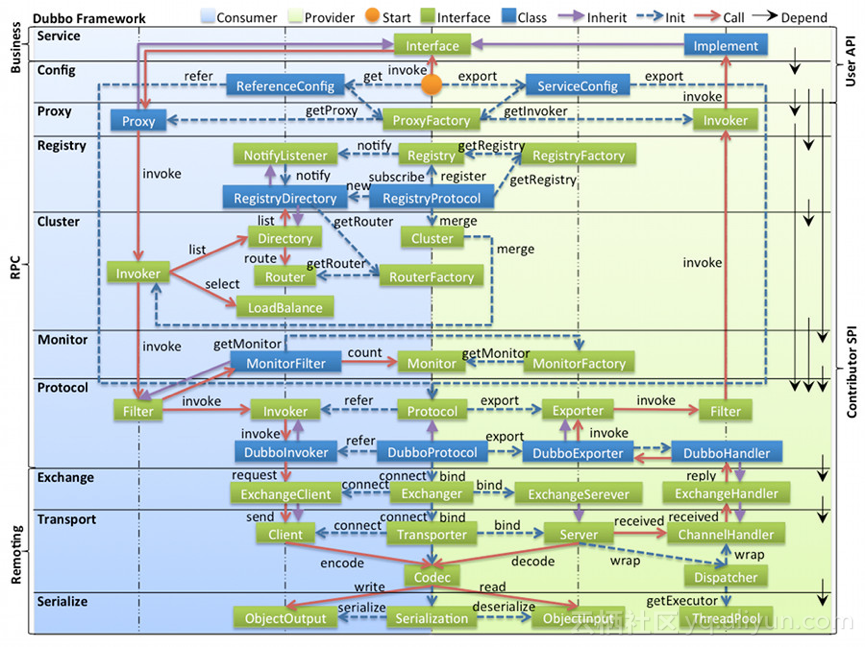
dubbo的模块模型有些复杂,不太容易看懂,如果你也有同感的话,可以看一下本文后面的几部分,他们详细讲述了dubbo中rpc的调用链,其中包括了核心的几个类,比较便于理解。
2. 服务调用关系模型
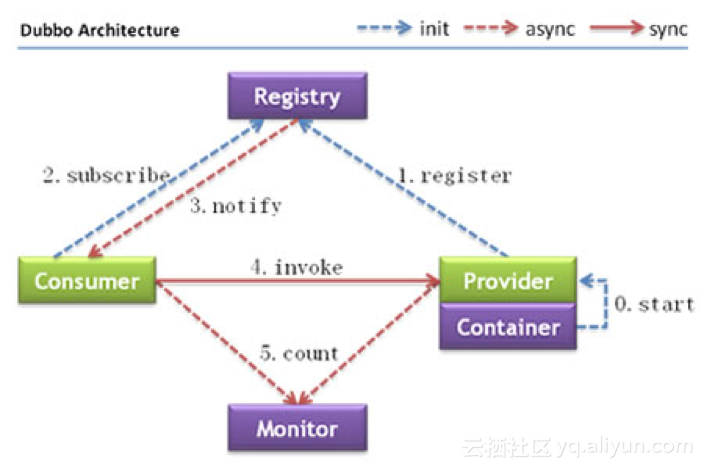
如图所示,dubbo的RPC调用模型分为registry、provider、consumer、monitor这几个部分。此图展示了从服务注册、发现、调用的全过程,但dubbo是如何做到的呢?其实这个问题包括了以下几个问题:provider如何注册服务到zookeeper;consumer如何从zookeeper拉取provider信息;provider变化以后,zookeeper如何告知consumer;consumer如何调用provider。另外,监控逻辑很简单本文暂时不做分析。
3. Provider
从源码上看ServiceBean主要完成以下几件工作:服务暴露,取消暴露服务。
1) 暴露服务
服务暴露开始于ServiceBean的afterPropertiesSet方法,此方法在ServiceBean的所有属性都被赋值以后被BeanFactory调用。服务暴露的调用链是: ServiceConfig#export -> ServiceConfig#doExport -> ServiceConfig#doExportUrls -> ServiceConfig#doExportUrlsFor1Protocol -> ServiceConfig#exportLocal(URL url)。 暴露服务其实包括两个类容:
l  将Invoker存入AbstractProtocol#exporterMap,调用服务时从次map中取出Invoker直接使用。
protected final Set<Invoker<?>> invokers = new ConcurrentHashSet<Invoker<?>>();其中key为:com.wzf.funny.service.ArticleService:dev, value为invoker对象
l  将url注册到zookeeper。
此过程的入口在RegistryProtocol#export方法中,调用链为:
RegistryProtocol#export -> FailbackRegistry#register -> AbstractRegistry#register -> ZookeeperRegistry#doRegister -> ZookeeperClient#create -> AbstractZookeeperClient#create
2) 服务发现
ZookeeperRegistry是服务发现的核心类之一,实现了《服务调用关系模型》中的register、subscribe、notify。以下分析一下几个主要的方法。
l 构造函数
从以下代码中可以看到,zkClient创建成功以后,会监听RECONNECTED事件,recover方法主要做一件事:将需要暴露的url放在failedRegistered(Set<URL>)中,将需要订阅的服务放在failedSubscribed(Set<URL>)中。说明RECONNECTED时,因为所有需要暴露的服务都需要重新注册,所以其实是将需要暴露、订阅的url都放到failedRegistered、failedSubscribed中。
public ZookeeperRegistry(URL url, ZookeeperTransporter zookeeperTransporter) {

        super(url);

        //其他代码省略

        this.root = group;

        zkClient = zookeeperTransporter.connect(url);

        zkClient.addStateListener(new StateListener() {

            public void stateChanged(int state) {

                 if (state == RECONNECTED) {

                      try {

                                recover();

                          } catch (Exception e) {

                                logger.error(e.getMessage(), e);

                          }

                 }

            }

        });

}
创建zkclient的url示例如下:
zookeeper://localhost:2181/com.alibaba.dubbo.registry.RegistryService?application=funny&dubbo=2.5.3&interface=com.alibaba.dubbo.registry.RegistryService&pid=38796×tamp=1502594657663
l register(URL url)
注册url代表的服务到zookeeper
l unregister(URL url)
从zookeeper中删除之前注册的服务
l subscribe(URL url, NotifyListener listener)
订阅url的服务
l unsubscribe(URL url, NotifyListener listener)
取消订阅url对应的服务
l notify(URL url, NotifyListener listener, List<URL> urls)
通知
l retry()
上面提到过,在recover()中将需要暴露的服务放到failedRegistered(Set<URL>)中,将需要订阅的服务放在failedSubscribed(Set<URL>)中,并没有真正的重新暴露服务或者订阅服务,这个工作是放在retry()中的,另外notify、doUnsubscribe,failedUnregistered也都放在此方法中处理。retry()方法的主要逻辑如下(为了方便阅读,我删掉了部分代码),retry被一个定时线程调用:
    protected void retry() {

        if (! failedRegistered.isEmpty()) {

            for (URL url : failed) {

               doRegister(url);

               failedRegistered.remove(url);

            }

        }

        if(! failedUnregistered.isEmpty()) {

            for (URL url : failed) {

               doUnregister(url);

               failedUnregistered.remove(url);

            }

        }

        if (! failedSubscribed.isEmpty()) {

           for (Map.Entry<URL, Set<NotifyListener>> entry : failed.entrySet()) {

               URL url = entry.getKey();

               Set<NotifyListener> listeners = entry.getValue();

               for (NotifyListener listener : listeners) {

                   doSubscribe(url, listener);

                   listeners.remove(listener);

               }

            }

        }

        if (! failedUnsubscribed.isEmpty()) {

           for (Map.Entry<URL, Set<NotifyListener>> entry : failed.entrySet()) {

               URL url = entry.getKey();

               Set<NotifyListener> listeners = entry.getValue();

               for (NotifyListener listener : listeners) {

                   doUnsubscribe(url, listener);

                   listeners.remove(listener);

               }

            }

        }

        if (! failedNotified.isEmpty()) {

           for (Map<NotifyListener, List<URL>> values : failed.values()) {

              for (Map.Entry<NotifyListener, List<URL>> entry:values.entrySet()) {

                 NotifyListener listener = entry.getKey();

                 List<URL> urls = entry.getValue();

                 listener.notify(urls);

                 values.remove(listener);

              }

            }

        }

    }

      this.retryFuture = retryExecutor.scheduleWithFixedDelay(new Runnable() {

            public void run() {

                // 检测并连接注册中心

                try {

                    retry();

                } catch (Throwable t) { // 防御性容错

                    logger.error("Unexpected error occur at failed retry, cause: " + t.getMessage(), t);

                }

            }

        }, retryPeriod, retryPeriod, TimeUnit.MILLISECONDS);
3) 取消暴露服务
取消服务暴露是将服务从zk中移除的过程,保证此后consumer无法再使用此服务。ZkclientZookeeperClient中订阅了所有状态改变的事件,状态的改变最终会触发调用recover方法,从而导致调用unRegister方法,将zk节点删除。
另外,因为在zk那边建立的是临时的节点,所以服务器和zk断开联系后,node将自动删除。Consumer将收到notify消息。
public ZkclientZookeeperClient(URL url) {

           super(url);

           client = new ZkClient(url.getBackupAddress());

           client.subscribeStateChanges(new IZkStateListener() {

                public void handleStateChanged(KeeperState state) throws Exception {

                     ZkclientZookeeperClient.this.state = state;

                     if (state == KeeperState.Disconnected) {

                          stateChanged(StateListener.DISCONNECTED);

                     } else if (state == KeeperState.SyncConnected) {

                          stateChanged(StateListener.CONNECTED);

                     }

                }

                public void handleNewSession() throws Exception {

                     stateChanged(StateListener.RECONNECTED);

                }

           });

     }
4) RPC调用
l  Wrapper类
调用Wrapper#getWrapper方法时,会尝试从WRAPPER_MAP中获取,如果获取到直接返回,如果获取不到,则进入makeWrapper方法创建一个,创建好了以后放入WRAPPER_MAP中。makeWrapper是一个核心的方法,这个方法中做对原有RpcService的封装,具体逻辑如下。
首先创建三个方法:setPropertyValue、getPropertyValue、invokeMethod,代码如下
StringBuilder c1 = new StringBuilder("public void setPropertyValue(Object o, String n, Object v){ ");

     StringBuilder c2 = new StringBuilder("public Object getPropertyValue(Object o, String n){ ");

     StringBuilder c3 = new StringBuilder("public Object invokeMethod(Object o, String n, Class[] p, Object[] v) throws " + InvocationTargetException.class.getName() + "{ "};
然后遍历RpcService的所有属性、方法,在原有属性的get、set、invoke的时候添加一些逻辑,因为invokeMethod方法与rpc关系最为密切的方法,所以重点讨论此方法。生成invokemethod的逻辑就是一个字符串拼接的过程,就不讨论了,这里将结果贴出来讨论一下,如下。其中:$1表示proxy;$2表示methodName;$3表示parameterTypes;$4表示arguments;$w表示returnType
public Object invokeMethod(Object o, String n, Class[] p, Object[] v)

                throws java.lang.reflect.InvocationTargetException {

           com.wzf.funny.service.ArticleService w;

           try {

                w = ((com.wzf.funny.service.ArticleService) $1);

           } catch (Throwable e) {

                throw new IllegalArgumentException(e);

           }

           try {

                if ("pageQuery".equals($2) && $3.length == 2) {

                     return ($w) w.pageQuery((com.wzf.funny.query.ArticleQuery) $4[0], ((Boolean) $4[1]).booleanValue());

                }

           } catch (Throwable e) {

                throw new java.lang.reflect.InvocationTargetException(e);

           }

           throw new com.alibaba.dubbo.common.bytecode.NoSuchMethodException(

                     "Not found method \"" + $2 + "\" in class com.wzf.funny.service.ArticleService.");

     }
最后构建Wrapper对象,构建的时候加上一些属性、方法,其中c1表示setPropertyValue,c2表示getPropertyValue ,c3表示invokeMethod。代码如下:
     ClassGenerator cc = ClassGenerator.newInstance(cl);

     cc.setClassName( ( Modifier.isPublic(c.getModifiers()) ? Wrapper.class.getName() : c.getName() + "$sw" ) + id );

     cc.setSuperClass(Wrapper.class);

     cc.addDefaultConstructor();

     cc.addField("public static String[] pns;"); // property name array.

     cc.addField("public static " + Map.class.getName() + " pts;"); // property type map.

     cc.addField("public static String[] mns;"); // all method name array.

     cc.addField("public static String[] dmns;"); // declared method name array.

     for(int i=0,len=ms.size();i<len;i++)

          cc.addField("public static Class[] mts" + i + ";");

     cc.addMethod("public String[] getPropertyNames(){ return pns; }");

     cc.addMethod("public boolean hasProperty(String n){ return pts.containsKey($1); }");

     cc.addMethod("public Class getPropertyType(String n){ return (Class)pts.get($1); }");

     cc.addMethod("public String[] getMethodNames(){ return mns; }");

     cc.addMethod("public String[] getDeclaredMethodNames(){ return dmns; }");

     cc.addMethod(c1.toString());

     cc.addMethod(c2.toString());

     cc.addMethod(c3.toString());

     Class<?> wc = cc.toClass();

     // setup static field.

     wc.getField("pts").set(null, pts);

     wc.getField("pns").set(null, pts.keySet().toArray(new String[0]));

     wc.getField("mns").set(null, mns.toArray(new String[0]));

     wc.getField("dmns").set(null, dmns.toArray(new String[0]));

     int ix = 0;

     for( Method m : ms.values() )

          wc.getField("mts" + ix++).set(null, m.getParameterTypes());

     return (Wrapper)wc.newInstance();
l  JavassistProxyFactory#getInvoker
如下代码所示,在JavassistProxyFactory中创建Invoker时,其实创建的是AbstractProxyInvoker的子类,其中proxy为xml中配置的rpcServiceImpl对象,即我们的目标对象。当consumer发起Rpc请求时,会将classname、methodname、 parameterTypes、arguments这些数据传输过来,在wrapper.invokeMethod中通过动态代理技术,直接调用rpcServiceImpl中的 methodname方法。
   public <T> Invoker<T> getInvoker(T proxy, Class<T> type, URL url) {

        // TODO Wrapper类不能正确处理带$的类名

        final Wrapper wrapper = Wrapper.getWrapper(proxy.getClass().getName().indexOf('$') < 0 ? proxy.getClass() : type);

        return new AbstractProxyInvoker<T>(proxy, type, url) {

            @Override

            protected Object doInvoke(T proxy, String methodName,   Class<?>[] parameterTypes,  Object[] arguments) throws Throwable {

                return wrapper.invokeMethod(proxy, methodName, parameterTypes, arguments);

            }

        };

    }
4. Consumer
1)Â Â 负载均衡算法
l  RandomLoadBalance
先计算是否所有invoker的权重是否相同,相同则直接random一下,否则根据权重加权。主要代码如下:
if (totalWeight > 0 && ! sameWeight) {

            // 如果权重不相同且权重大于0则按总权重数随机

            int offset = random.nextInt(totalWeight);

            // 并确定随机值落在哪个片断上

            for (int i = 0; i < length; i++) {

                offset -= getWeight(invokers.get(i), invocation);

                if (offset < 0) {

                    return invokers.get(i);

                }

            }

        }

        // 如果权重相同或权重为0则均等随机

        return invokers.get(random.nextInt(length));
l  LeastActiveLoadBalance
先计算出一个最少活跃数的invoker集合,然后从这个集合中随机选取一个,然后计算是否所有invoker的权重是否相同,相同则直接random一下,否则根据权重加权取invoker。代码如下:
       int length = invokers.size(); // 总个数

        int leastActive = -1; // 最小的活跃数

        int leastCount = 0; // 相同最小活跃数的个数

        int[] leastIndexs = new int[length]; // 相同最小活跃数的下标

        int totalWeight = 0; // 总权重

        int firstWeight = 0; // 第一个权重,用于于计算是否相同

        boolean sameWeight = true; // 是否所有权重相同

        for (int i = 0; i < length; i++) {

            Invoker<T> invoker = invokers.get(i);

            int active = RpcStatus.getStatus(invoker.getUrl(), invocation.getMethodName()).getActive(); // 活跃数

            int weight = invoker.getUrl().getMethodParameter(invocation.getMethodName(), Constants.WEIGHT_KEY, Constants.DEFAULT_WEIGHT); // 权重

            if (leastActive == -1 || active < leastActive) { // 发现更小的活跃数,重新开始

                leastActive = active; // 记录最小活跃数

                leastCount = 1; // 重新统计相同最小活跃数的个数

                leastIndexs[0] = i; // 重新记录最小活跃数下标

                totalWeight = weight; // 重新累计总权重

                firstWeight = weight; // 记录第一个权重

                sameWeight = true; // 还原权重相同标识

            } else if (active == leastActive) { // 累计相同最小的活跃数

                leastIndexs[leastCount ++] = i; // 累计相同最小活跃数下标

                totalWeight += weight; // 累计总权重

                // 判断所有权重是否一样

                if (sameWeight && i > 0

                        && weight != firstWeight) {

                    sameWeight = false;

                }

            }

        }

        // assert(leastCount > 0)

        if (leastCount == 1) {

            // 如果只有一个最小则直接返回

            return invokers.get(leastIndexs[0]);

        }

        if (! sameWeight && totalWeight > 0) {

            // 如果权重不相同且权重大于0则按总权重数随机

            int offsetWeight = random.nextInt(totalWeight);

            // 并确定随机值落在哪个片断上

            for (int i = 0; i < leastCount; i++) {

                int leastIndex = leastIndexs[i];

                offsetWeight -= getWeight(invokers.get(leastIndex), invocation);

                if (offsetWeight <= 0)

                    return invokers.get(leastIndex);

            }

        }

        // 如果权重相同或权重为0则均等随机

        return invokers.get(leastIndexs[random.nextInt(leastCount)]);
l  RoundRobinLoadBalance
记录一个调用次数的数字,然后每次调用时对总invoker取模,并在调用次数基础上自增;权重不同的时候,逻辑稍有不同,具体可以参考远嘛。主要代码如下:
        AtomicPositiveInteger sequence = sequences.get(key);

        if (sequence == null) {

            sequences.putIfAbsent(key, new AtomicPositiveInteger());

            sequence = sequences.get(key);

        }

        // 取模轮循

        return invokers.get(sequence.getAndIncrement() % length);
l  ConsistentHashLoadBalance
计算一致性hash的值,然后选取invoker。代码如下:
        String key = invokers.get(0).getUrl().getServiceKey() + "." + invocation.getMethodName();

        int identityHashCode = System.identityHashCode(invokers);

        ConsistentHashSelector<T> selector = (ConsistentHashSelector<T>) selectors.get(key);

        if (selector == null || selector.getIdentityHashCode() != identityHashCode) {

            selectors.put(key, new ConsistentHashSelector<T>(invokers, invocation.getMethodName(), identityHashCode));

            selector = (ConsistentHashSelector<T>) selectors.get(key);

        }

        return selector.select(invocation);
2) Invoker
l FactoryBean创建proxy的调用链:
ReferenceBean#getObject–>ReferenceBean#get–> ReferenceConfig#init–>ReferenceBean#createProxy。
在ReferenceBean#createProxy()方法中创建Invoker;通过Invoker创建proxy。
l 创建Invoker,并向zk注册监听的consumer。
RegistryProtocol#doRefer–>RegistryProtocol#doRefer–>FailbackRegistry#register–>FailbackRegistry#doRegister–>ZookeeperRegistry#doRegister–>zkClient#create
在RegistryProtocol#doRefer方法中,除了调用FailbackRegistry#register注册服务以外,还会调用RegistryDirectory#subscribe来订阅此服务,次操作会注册Listener。
Consumer url示例:
consumer://192.168.222.34/com.wzf.funny.service.RpcService?application=weixin&category=consumers&check=false&dubbo=2.5.3&interface=com.wzf.funny.service.RpcService&methods=sayHello&pid=44244&retries=0&revision=0.1.0-SNAPSHOT&side=consumer&timeout=5000×tamp=1502795345908&version=dev
3) InvokerInvocationHandler
示例代码中com.alibaba.dubbo.config.spring.ReferenceBean是一个FactoryBean,通过context.getBean方法获取的是ReferenceBean#getObject方法的返回结果,ReferenceBean#getObject()方法返回的是一个proxy对象,此proxy持有一个InvokerInvocationHandler属性,如下图所示

rpc调用示例代码如下:
rpcService.sayHello()
rpcService是一个proxy对象(ReferenceBean#getObject()返回的对象),当调用sayHello()方法时,最终由InvokerInvocationHandler#invoker处理。
5. 多线程下的通信
DubboInvoker#doInvoke方法中,在ExchangeClient#request(inv, timeout)调用时,返回一个DefaultFuture对象,接着会调用DefaultFuture.get()方法(等待返回结果)。
对于consumer端而言,服务器会为每一个请求创建一个线程,因为rpc操作是一个慢动作,为了节省资源,当线程发送rpc请求后,需要让当前线程释放资源、进入等待队列,当获取到返回结果以后,再唤醒这个线程。
RPC请求的过程为:每一个RPC请求都有一个唯一的id,RPC请求的时候,会将此id也发送给provider;provider处理完请求后会将此id和返回结果一同返回给consumer;consumer收到返回信息以后解析出id,然后从FUTURES中找到相对应的DefaultFuture,并通过DefaultFuture.done#signal()唤醒之前等待线程。
下面根据源码详细讨论一下多线程情况下rpc请求的细节,即dubbo多线程模型的实现。
1) DefaultFuture#field
这里列出了与多线程相关的几个重要的属性
 private final Lock                            lock = new ReentrantLock();

    private final Condition                       done = lock.newCondition();

    private static final Map<Long, DefaultFuture> FUTURES   = new ConcurrentHashMap<Long, DefaultFuture>();
2) DefaultFuture#构造函数
创建好DefaultFuture对象以后,将DefaultFuture存入了FUTURES中。其实每一次请求,多会生成一个唯一的id,即对于每个服务器而言,id唯一。
 public DefaultFuture(Channel channel, Request request, int timeout){

        this.channel = channel;

        this.request = request;

        this.id = request.getId();

        this.timeout = timeout > 0 ? timeout : channel.getUrl().getPositiveParameter(Constants.TIMEOUT_KEY, Constants.DEFAULT_TIMEOUT);

        // put into waiting map.

        FUTURES.put(id, this);

        CHANNELS.put(id, channel);

    }
3) DefaultFuture#get
主要逻辑是:获取锁,调用await方法,此时当前线程进入等待队列,此线程会有两种结果过:要么超时,要么被唤醒;如果被唤醒,则返回rpc的结果。
   public Object get(int timeout) throws RemotingException {

        if (timeout <= 0) {

            timeout = Constants.DEFAULT_TIMEOUT;

        }

        if (! isDone()) {

            long start = System.currentTimeMillis();

            lock.lock();

            try {

                while (! isDone()) {

                    done.await(timeout, TimeUnit.MILLISECONDS);

                    if (isDone() || System.currentTimeMillis() - start > timeout) {

                        break;

                    }

                }

            } catch (InterruptedException e) {

                throw new RuntimeException(e);

            } finally {

                lock.unlock();

            }

            if (! isDone()) {

                throw new TimeoutException(sent > 0, channel, getTimeoutMessage(false));

            }

        }

        return returnFromResponse();

    }
4) DefaultFuture#received
收到返回结果时,调用此方法。首先从FUTURES中根据id获取DefaultFuture,如果不存在,打印一条日志;如果存在则通过signal释放一个唤醒信号,将线程从等待队列中唤醒。
public static void received(Channel channel, Response response) {

        try {

            DefaultFuture future = FUTURES.remove(response.getId());

            if (future != null) {

                future.doReceived(response);

            } else {

                logger.warn("The timeout response finally returned at ")。

            }

        } finally {

            CHANNELS.remove(response.getId());

        }

    }

    private void doReceived(Response res) {

        lock.lock();

        try {

            response = res;

            if (done != null) {

                done.signal();

            }

        } finally {

            lock.unlock();

        }

        if (callback != null) {

            invokeCallback(callback);

        }

    }
5) DefaultFuture#RemotingInvocationTimeoutScan
以下代码是用来从FUTURES清理rpc请求超时的DefaultFuture
private static class RemotingInvocationTimeoutScan implements Runnable {

        public void run() {

            while (true) {

                try {

                    for (DefaultFuture future : FUTURES.values()) {

                        if (future == null || future.isDone()) {

                            continue;

                        }

                        if (System.currentTimeMillis() - future.getStartTimestamp() > future.getTimeout()) {

                            // create exception response.

                            Response timeoutResponse = new Response(future.getId());

                            // set timeout status.

                            timeoutResponse.setStatus(future.isSent() ? Response.SERVER_TIMEOUT : Response.CLIENT_TIMEOUT);

                            timeoutResponse.setErrorMessage(future.getTimeoutMessage(true));

                            // handle response.

                            DefaultFuture.received(future.getChannel(), timeoutResponse);

                        }

                    }

                    Thread.sleep(30);

                } catch (Throwable e) {

                    logger.error("Exception when scan the timeout invocation of remoting.", e);

                }

            }

        }

    }

    static {

        Thread th = new Thread(new RemotingInvocationTimeoutScan(), "DubboResponseTimeoutScanTimer");

        th.setDaemon(true);

        th.start();

    }
四、 RPC调用流程
1. 简化流程图
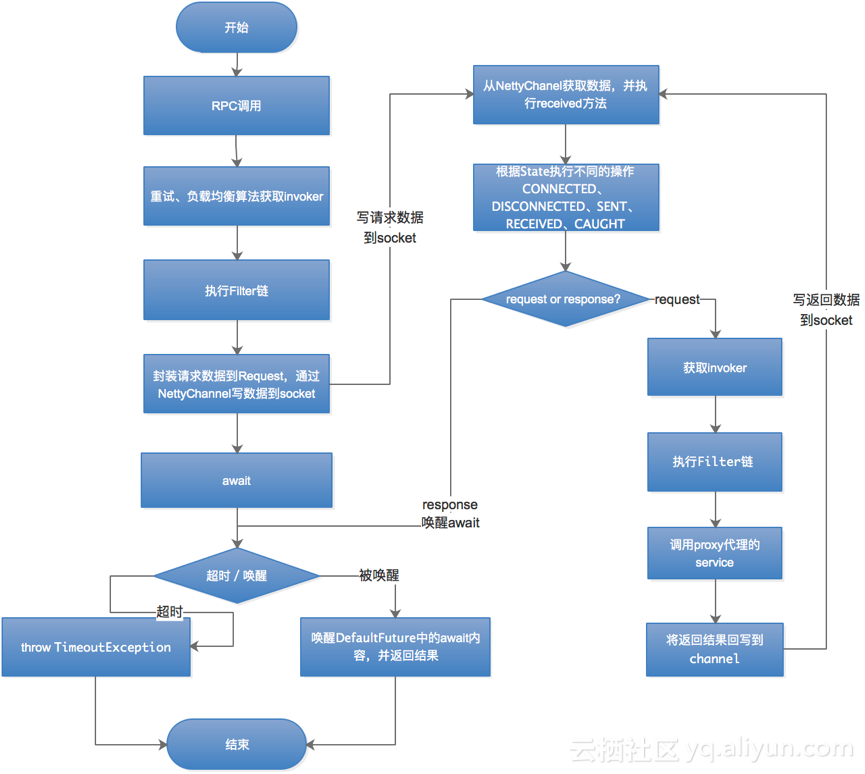
此流程图是一个简化的流程图,主要描述dubbo调用的全过程。
RPC调用时,Consumer根据负载均衡算法获取invoker,在执行完filter链以后,就开始平装数据,发送数据到socket中,consumer这一端通过ReentrantLock进入await状态。
Provider从socket获取数据后,执行receive方法, 接着执行Filter链,接着找到invoker通过代理对象执行Service,最后将返回结果写入socket。
Consumer收到返回结果以后,唤醒之前await的内容,然后将返回结果返回给调用方。
2. 完整流程图
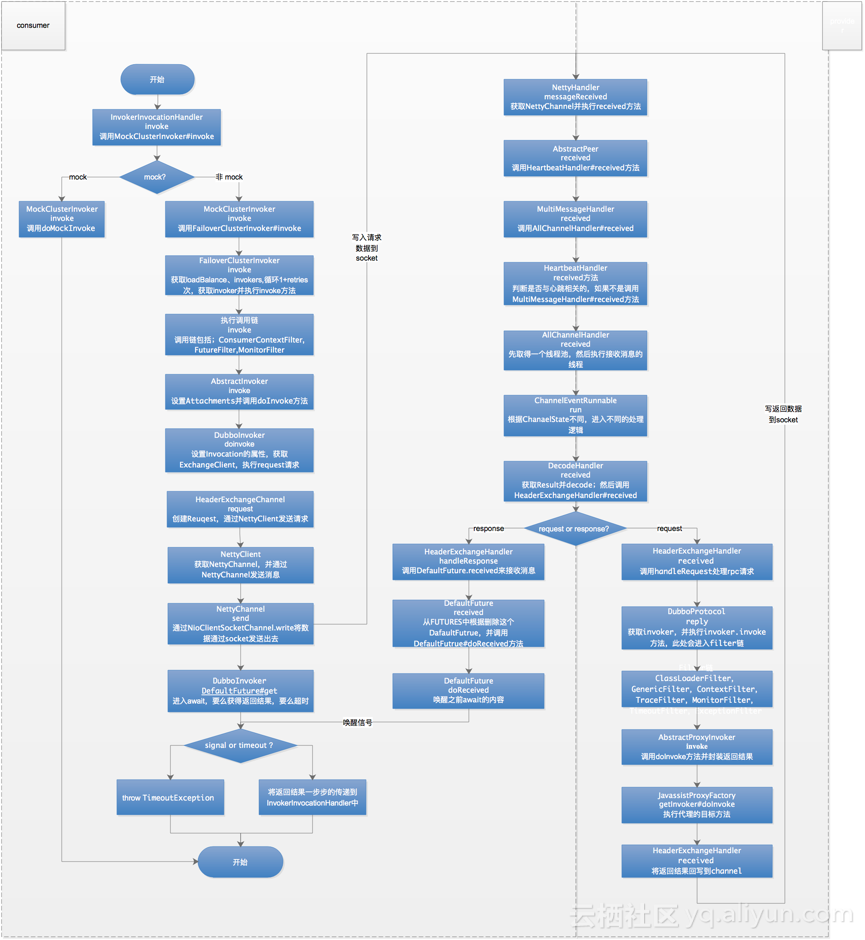
如上图所示,这是一个完整的调用流程图,包括了执行过程中主要的类和方法。
后续内容主要是对次流程图的详细描述,如果次流程图已经完全清晰,可以忽略后面的内容。
五、 consumer端远程调用请求链
对远程方法的调用,其实是对InvokerInvocationHandler#invoke的调用。
1. InvokerHandler
1) InvokerInvocationHandler#invoke
对执行方法做简单处理(toString、hashCode、equals这些方法不调用远程接口)后,执行MockClusterInvoker#invoke方法。
        if (method.getDeclaringClass() == Object.class) {

            return method.invoke(invoker, args);

        }

        if ("toString".equals(methodName) && parameterTypes.length == 0) {

            return invoker.toString();

        }

        if ("hashCode".equals(methodName) && parameterTypes.length == 0) {

            return invoker.hashCode();

        }

        if ("equals".equals(methodName) && parameterTypes.length == 1) {

            return invoker.equals(args[0]);

        }

        return invoker.invoke(new RpcInvocation(method, args)).recreate();
2) MockClusterInvoker#invoke
检查是否是mock,如果是,mock返回结果;如果不是的话进入FailoverClusterInvoker#invoke方法。
        String value = directory.getUrl().getMethodParameter(invocation.getMethodName(), Constants.MOCK_KEY, Boolean.FALSE.toString()).trim();

        if (value.length() == 0 || value.equalsIgnoreCase("false")){

        //no mock

        result = this.invoker.invoke(invocation);

        } else if (value.startsWith("force")) {

        //force:direct mock

        result = doMockInvoke(invocation, null);

        } else {

        //fail-mock

              result = this.invoker.invoke(invocation);

        }
2. 解析出loadBalance,通过loadBalance算法获取Invoker对象。
1) FailoverClusterInvoker#invoke方法
先执行父类AbstractClusterInvoker#invoke方法,获取List<Invoker<T>> invokers,loadBanlace;然后调用FailoverClusterInvoker#doInvoke方法。
        LoadBalance loadbalance;

        List<Invoker<T>> invokers = list(invocation);

        if (invokers != null && invokers.size() > 0) {

            loadbalance = ExtensionLoader.getExtensionLoader(LoadBalance.class).getExtension(invokers.get(0).getUrl().getMethodParameter(invocation.getMethodName(),Constants.LOADBALANCE_KEY, Constants.DEFAULT_LOADBALANCE));

        } else {

            loadbalance = ExtensionLoader.getExtensionLoader(LoadBalance.class).getExtension(Constants.DEFAULT_LOADBALANCE);

        }

        RpcUtils.attachInvocationIdIfAsync(getUrl(), invocation);

        return doInvoke(invocation, invokers, loadbalance);
2) FailoverClusterInvoker#doInvoke
循环1+retries次,知道成功或者重试次数耗尽,每次都先通过父类AbstractClusterInvoker#doselect方法获取invoker;然后执行invoker.invoke(),这个方法会进入一个调用链。
其中需要注意的是,重试获取invoker的时候,需要间检查是否有invokers被销毁,invokers是否都可用
checkWheatherDestoried();

       copyinvokers = list(invocation);

       //重新检查一下

       checkInvokers(copyinvokers, invocation);
3) AbstractClusterInvoker#doselect
如果没有可用的invoker,直接返回;如果只有一个invoker,那么直接返回;如果有两个invoker,改成轮询算法,即如果上次使用了invokers.get(0),这次就直接使用invokers.get(1);如果有更多invoker,则通过loadBalance进行选择;如果之前的选中列表中已经包含了此次选中的invoker,那么重新选择。Dubbo默认使用random方式进行负载均衡。
         if (invokers == null || invokers.size() == 0)

            return null;

        if (invokers.size() == 1)

            return invokers.get(0);

        // 如果只有两个invoker,退化成轮循

        if (invokers.size() == 2 && selected != null && selected.size() > 0) {

            return selected.get(0) == invokers.get(0) ? invokers.get(1) : invokers.get(0);

        }

        Invoker<T> invoker = loadbalance.select(invokers, getUrl(), invocation);

        //如果 selected中包含(优先判断) 或者 不可用&&availablecheck=true 则重试.

        if( (selected != null && selected.contains(invoker))  ||(!invoker.isAvailable() && getUrl()!=null && availablecheck)){

            try{

                Invoker<T> rinvoker = reselect(loadbalance, invocation, invokers, selected, availablecheck);

                if(rinvoker != null){

                    invoker =  rinvoker;

                }else{

                    //看下第一次选的位置,如果不是最后,选+1位置.

                    int index = invokers.indexOf(invoker);

                    try{

                        //最后在避免碰撞

                        invoker = index <invokers.size()-1?invokers.get(index+1) :invoker;

                    }catch (Exception e) {

                        logger.warn(e.getMessage()+" may because invokers list dynamic change, ignore.",e);

                    }

                }

            }catch (Throwable t){

                logger.error("clustor relselect fail reason is :"+t.getMessage() +" if can not slove ,you can set cluster.availablecheck=false in url",t);

            }

        }
4) RandomLoadBalance#doSelect
先根据定义的weight(默认为100)对每个invoker进行加权,然后随机取出一个。
        int length = invokers.size(); // 总个数

        int totalWeight = 0; // 总权重

        boolean sameWeight = true; // 权重是否都一样

        for (int i = 0; i < length; i++) {

            int weight = getWeight(invokers.get(i), invocation);

            totalWeight += weight; // 累计总权重

            if (sameWeight && i > 0

                    && weight != getWeight(invokers.get(i - 1), invocation)) {

                sameWeight = false; // 计算所有权重是否一样

            }

        }

        if (totalWeight > 0 && ! sameWeight) {

            // 如果权重不相同且权重大于0则按总权重数随机

            int offset = random.nextInt(totalWeight);

            // 并确定随机值落在哪个片断上

            for (int i = 0; i < length; i++) {

                offset -= getWeight(invokers.get(i), invocation);

                if (offset < 0) {

                    return invokers.get(i);

                }

            }

        }

        // 如果权重相同或权重为0则均等随机

        return invokers.get(random.nextInt(length));
3. 执行invoke的Filter链。
调用链是在xml加载的时候注册进来的;执行时按照以下顺序执行调用链中的invoke方法。
com.alibaba.dubbo.rpc.filter.ConsumerContextFilter,
com.alibaba.dubbo.rpc.protocol.dubbo.filter.FutureFilter,
com.alibaba.dubbo.monitor.support.MonitorFilter
4. 执行invoke逻辑。
1)Â Â Â AbstractInvoker#invoke
设置invocation信息,包括invoker、interface、sync、context等。
        RpcInvocation invocation = (RpcInvocation) inv;

        invocation.setInvoker(this);

        if (attachment != null && attachment.size() > 0) {

        invocation.addAttachmentsIfAbsent(attachment);

        }

        Map<String, String> context = RpcContext.getContext().getAttachments();

        if (context != null) {

        invocation.addAttachmentsIfAbsent(context);

        }

        if (getUrl().getMethodParameter(invocation.getMethodName(), Constants.ASYNC_KEY, false)){

        invocation.setAttachment(Constants.ASYNC_KEY, Boolean.TRUE.toString());

        }

        RpcUtils.attachInvocationIdIfAsync(getUrl(), invocation);

        return doInvoke(invocation);
2) DubboInvoker#doInvoke
设置Invocation的属性,获取ExchangeClient,并执行request请求。
        RpcInvocation inv = (RpcInvocation) invocation;

        final String methodName = RpcUtils.getMethodName(invocation);

        inv.setAttachment(Constants.PATH_KEY, getUrl().getPath());

        inv.setAttachment(Constants.VERSION_KEY, version);

        ExchangeClient currentClient;

        if (clients.length == 1) {

            currentClient = clients[0];

        } else {

            currentClient = clients[index.getAndIncrement() % clients.length];

        }

        RpcContext.getContext().setFuture(null);

        return (Result) currentClient.request(inv, timeout).get();
3) DefaultFuture#get
进入await,等待provider返回结果。
        if (timeout <= 0) {

            timeout = Constants.DEFAULT_TIMEOUT;

        }

        if (! isDone()) {

            long start = System.currentTimeMillis();

            lock.lock();

            try {

                while (! isDone()) {

                    done.await(timeout, TimeUnit.MILLISECONDS);

                    if (isDone() || System.currentTimeMillis() - start > timeout) {

                        break;

                    }

                }

            } catch (InterruptedException e) {

                throw new RuntimeException(e);

            } finally {

                lock.unlock();

            }

            if (! isDone()) {

                throw new TimeoutException(sent > 0, channel, getTimeoutMessage(false));

            }

        }

        return returnFromResponse();
5. request远程数据
1) HeaderExchangeChannel#requst
创建Reuqest,并通过NettyClient发送请求。在创建DefaultFuture时,会将次DefaultFuture放入FUTURES(一个ConcurrentHashMap)中,也会将Channel放入CHANNELS(一个ConcurrentHashMap)中。
        Request req = new Request();

        req.setVersion("2.0.0");

        req.setTwoWay(true);

        req.setData(request);

        DefaultFuture future = new DefaultFuture(channel, req, timeout);

        channel.send(req);

        return future;
2) NettyClient#request
获取NettyChannel,并通过NettyChannel发送消息
        Channel channel = getChannel();

        if (channel == null || ! channel.isConnected()) {

          throw new RemotingException(this, "message can not send, because channel is closed . url:" + getUrl());

        }

        channel.send(message, sent);
3) NettyChannel#send
通过NioClientSocketChannel.write将数据通过socket发送出去。
        boolean success = true;

        int timeout = 0;

        try {

            ChannelFuture future = channel.write(message);

            if (sent) {

                timeout = getUrl().getPositiveParameter(Constants.TIMEOUT_KEY, Constants.DEFAULT_TIMEOUT);

                success = future.await(timeout);

            }

            Throwable cause = future.getCause();

            if (cause != null) {

                throw cause;

            }

        } catch (Throwable e) {

            throw new RemotingException(this, "Failed to send message " + message + " to " + getRemoteAddress() + ", cause: " + e.getMessage(), e);

        }
6. 消息示例
Request [id=1, version=2.0.0, twoway=true, event=false, broken=false, data=RpcInvocation [methodName=generateArticle, parameterTypes=[long, class java.util.Date], arguments=[1, Sat Jul 29 15:46:46 CST 2017], attachments={path=com.wzf.funny.service.ArticleService, interface=com.wzf.funny.service.ArticleService, version=dev, timeout=500000}]]六、 consumer端返回结果调用链
1. 处理从channel中获取的数据,执行Received方法
1) SimpleChannelHandler#handleUpstream
位于netty.jar中,是response的入口
if (e instanceof MessageEvent) {

            messageReceived(ctx, (MessageEvent) e);

        }
2) NettyHandler#messageReceived
获取NettyChannel并执行received方法
NettyChannel channel = NettyChannel.getOrAddChannel(ctx.getChannel(), url, handler);

        try {

            handler.received(channel, e.getMessage());

        } finally {

            NettyChannel.removeChannelIfDisconnected(ctx.getChannel());

        }
3) AbstractPeer#received
先判断channel是否关闭,然后直接调用HeartbeatHandler#received方法
if (closed) {

            return;

        }

        handler.received(ch, msg);
4) HeartbeatHandler#received
判断是否与心跳相关的,如果不是调用MultiMessageHandler#received方法。
setReadTimestamp(channel);

        if (isHeartbeatRequest(message)) {

            Request req = (Request) message;

            if (req.isTwoWay()) {

                Response res = new Response(req.getId(), req.getVersion());

                res.setEvent(Response.HEARTBEAT_EVENT);

                channel.send(res);

            }

            return;

        }

        if (isHeartbeatResponse(message)) {

            return;

        }

        handler.received(channel, message);

    }
5) MultiMessageHandler#received
如果是MultiMessage则循环调用AllChannelHandler#received;如果不是直接调用AllChannelHandler#received
if (message instanceof MultiMessage) {

            MultiMessage list = (MultiMessage)message;

            for(Object obj : list) {

                handler.received(channel, obj);

            }

        } else {

            handler.received(channel, message);

        }
6) AllChannelHandler#received
先取得一个线程池,然后执行接收消息的线程ChannelEventRunnable。
ExecutorService cexecutor = getExecutorService();

        try {

            cexecutor.execute(new ChannelEventRunnable(channel, handler, ChannelState.RECEIVED, message));

        } catch (Throwable t) {

            throw new ExecutionException(message, channel, getClass() + " error when process received event .", t);

        }
7) ChannelEventRunnable#run
根据ChanaelState不同,进入不同的处理逻辑。
switch (state) {

            case CONNECTED:

               handler.connected(channel);

                break;

            case DISCONNECTED:

               handler.disconnected(channel);

                break;

            case SENT:

               handler.sent(channel,message);

                break;

            case RECEIVED:

                handler.received(channel, message);

                break;

            case CAUGHT:

                handler.caught(channel, exception);

                break;

            default:

                logger.warn("unknown state: " + state + ", message is " + message);
8) DecodeHandler#received
从message中获取Result,并decode;然后调用HeaderExchangeHandler#received方法。
if (message instanceof Decodeable) {

            decode(message);

        }

        if (message instanceof Request) {

            decode(((Request)message).getData());

        }

        if (message instanceof Response) {

            decode( ((Response)message).getResult());

        }

        handler.received(channel, message);
9) HeaderExchangeHandler#received
根据message的类型,进入不同处理逻辑,这里会进入handleResponse方法。
channel.setAttribute(KEY_READ_TIMESTAMP, System.currentTimeMillis());

        ExchangeChannel exchangeChannel = HeaderExchangeChannel.getOrAddChannel(channel);

        try {

            if (message instanceof Request) {

                // handle request.

            } else if (message instanceof Response) {

                handleResponse(channel, (Response) message);

            } else if (message instanceof String) {

                // handle string.

            } else {

                handler.received(exchangeChannel, message);

            }

        } finally {

            HeaderExchangeChannel.removeChannelIfDisconnected(channel);

        }
10) HeaderExchangeHandler#handleResponse
如果不是心跳消息,那么通过DefaultFuture.received来接收消息。
if (response != null && !response.isHeartbeat()) {

            DefaultFuture.received(channel, response);

        }
2. 唤醒await的内容,继续之前的调用执行
1) DefaultFuture#received
从FUTURES中(一个ConcurrentHasMap)根据删除这个DafaultFutrue,并调用DefaultFutrue#doReceived方法。
try {

       DefaultFuture future = FUTURES.remove(response.getId());

       if (future != null) {

           future.doReceived(response);

       } else {

           logger.warn("The timeout response finally returned at 。。。。。" );

       }

   } finally {

       CHANNELS.remove(response.getId());

   }
2) DefaultFuture#doReceived
先上锁,然后唤醒之前await的内容。
lock.lock();

        try {

            response = res;

            if (done != null) {

                done.signal();

            }

        } finally {

            lock.unlock();

        }

        if (callback != null) {

            invokeCallback(callback);

        }
3) DefaultFuture#get
被唤醒后跳出while循环,调用returnFromResponse方法,拿到返回结果以后就可以继续之前DubboInvoker#doInvoke的调用了。
if (timeout <= 0) {

            timeout = Constants.DEFAULT_TIMEOUT;

        }

        if (! isDone()) {

            long start = System.currentTimeMillis();

            lock.lock();

            try {

                while (! isDone()) {

                    done.await(timeout, TimeUnit.MILLISECONDS);

                    if (isDone() || System.currentTimeMillis() - start > timeout) {

                        break;

                    }

                }

            } catch (InterruptedException e) {

                throw new RuntimeException(e);

            } finally {

                lock.unlock();

            }

            if (! isDone()) {

                throw new TimeoutException(sent > 0, channel, getTimeoutMessage(false));

            }

        }

        return returnFromResponse();
4) DefaultFuture#returnFromResponse
判断返回结果:如果返回结果为空,则返回IllegalStateException;如果成功,则返回result信息;如果客户端/服务端超时,则返回TimeoutException;如果其他错误,返回RemotingException。
Response res = response;

        if (res == null) {

            throw new IllegalStateException("response cannot be null");

        }

        if (res.getStatus() == Response.OK) {

            return res.getResult();

        }

        if (res.getStatus() == Response.CLIENT_TIMEOUT || res.getStatus() == Response.SERVER_TIMEOUT) {

            throw new TimeoutException(res.getStatus() == Response.SERVER_TIMEOUT, channel, res.getErrorMessage());

        }

        throw new RemotingException(channel, res.getErrorMessage());
七、 Provider端响应Rpc请求
1. 处理从channel中获取的数据,执行Received方法
此过程和Consumer端收到返回结果后,处理返回结果的流程基本相同,唯一不同的地方是,在最后一步,进入的是HeaderExchangeHandler#handleRequest方法
1) HeaderExchangeHandler#handleRequest
调用通过DubboProtocol#replay来处理rpc请求
 Response res = new Response(req.getId(), req.getVersion());

        Object msg = req.getData();

        // handle data.

        Object result = handler.reply(channel, msg);

        res.setStatus(Response.OK);

        res.setResult(result);

        return res;
2. 获取invoker,执行invoke方法。
1)Â Â Â DubboProtocol#reply
根据message获取invoker对象,然后执行invoke方法,此调用会先进入一个拦截器链。
if (message instanceof Invocation) {

                Invocation inv = (Invocation) message;

                Invoker<?> invoker = getInvoker(channel, inv);

                //如果是callback 需要处理高版本调用低版本的问题

                RpcContext.getContext().setRemoteAddress(channel.getRemoteAddress());

                return invoker.invoke(inv);

            }

            throw new RemotingException(channel, "Unsupported request: ");
3. 执行Filter链
1) Filter链
l  com.alibaba.dubbo.rpc.filter.EchoFilter
methodName中包括$echo时,直接返回结果。
l  com.alibaba.dubbo.rpc.filter.ClassLoaderFilter
invoke前将ContextClassLoader设置为接口的ClassLoader,调用结束后将ContextClassLoader为当前线程的ContextClassLoader。
l  com.alibaba.dubbo.rpc.filter.GenericFilter
主要是针对泛化接口的实现。
l  com.alibaba.dubbo.rpc.filter.ContextFilter
对RpcContext进行赋值。
l  com.alibaba.dubbo.rpc.protocol.dubbo.filter.TraceFilter
方法调用的跟踪
l  com.alibaba.dubbo.monitor.support.MonitorFilter
监控rpc调用情况。
l  com.alibaba.dubbo.rpc.filter.TimeoutFilter
超时后,只是留了一个日志。
l  com.alibaba.dubbo.rpc.filter.ExceptionFilter
异常处理
4. Invoker
1) InvokerWrapper#invoke
无业务逻辑,只是一层封装。
 public Result invoke(Invocation invocation) throws RpcException {

        return invoker.invoke(invocation);

    }
2) AbstractProxyInvoker#invoke
封装返回结果。
public Result invoke(Invocation invocation) throws RpcException {

            return new RpcResult(doInvoke(proxy, invocation.getMethodName(), invocation.getParameterTypes(), invocation.getArguments()));

    }
3) JavassistProxyFactory#getInvoker
在之前调用getInvoier的时候,会创建一个内部类,AbstractProxyInvoker# doInvoke方法会触发次内部内的执行。
其中proxy就是Provider中定义的ref,即rpcServiceImpl。
另外除了JavassistProxyFactory 以外,还有一个JdkProxyFactory。
    public <T> Invoker<T> getInvoker(T proxy, Class<T> type, URL url) {

        // TODO Wrapper类不能正确处理带$的类名

        final Wrapper wrapper = Wrapper.getWrapper(proxy.getClass().getName().indexOf('$') < 0 ? proxy.getClass() : type);

        return new AbstractProxyInvoker<T>(proxy, type, url) {

            @Override

            protected Object doInvoke(T proxy, String methodName,   Class<?>[] parameterTypes,

                 Object[] arguments) throws Throwable {

                return wrapper.invokeMethod(proxy, methodName, parameterTypes, arguments);

            }

        };

    }
Dubbo RPC源码解读的更多相关文章
- php-msf 源码解读【转】
php-msf: https://github.com/pinguo/php-msf 百度脑图 - php-msf 源码解读: http://naotu.baidu.com/file/cc7b5a49 ...
- swoft 源码解读【转】
官网: https://www.swoft.org/ 源码解读: http://naotu.baidu.com/file/814e81c9781b733e04218ac7a0494e2a?toke ...
- swoft| 源码解读系列一: 好难! swoft demo 都跑不起来怎么破? docker 了解一下呗~
title: swoft| 源码解读系列一: 好难! swoft demo 都跑不起来怎么破? docker 了解一下呗~description: 阅读 sowft 框架源码, swoft 第一步, ...
- etcd学习(6)-etcd实现raft源码解读
etcd中raft实现源码解读 前言 raft实现 看下etcd中的raftexample newRaftNode startRaft serveChannels 领导者选举 启动并初始化node节点 ...
- SDWebImage源码解读之SDWebImageDownloaderOperation
第七篇 前言 本篇文章主要讲解下载操作的相关知识,SDWebImageDownloaderOperation的主要任务是把一张图片从服务器下载到内存中.下载数据并不难,如何对下载这一系列的任务进行设计 ...
- SDWebImage源码解读 之 NSData+ImageContentType
第一篇 前言 从今天开始,我将开启一段源码解读的旅途了.在这里先暂时不透露具体解读的源码到底是哪些?因为也可能随着解读的进行会更改计划.但能够肯定的是,这一系列之中肯定会有Swift版本的代码. 说说 ...
- SDWebImage源码解读 之 UIImage+GIF
第二篇 前言 本篇是和GIF相关的一个UIImage的分类.主要提供了三个方法: + (UIImage *)sd_animatedGIFNamed:(NSString *)name ----- 根据名 ...
- SDWebImage源码解读 之 SDWebImageCompat
第三篇 前言 本篇主要解读SDWebImage的配置文件.正如compat的定义,该配置文件主要是兼容Apple的其他设备.也许我们真实的开发平台只有一个,但考虑各个平台的兼容性,对于框架有着很重要的 ...
- SDWebImage源码解读_之SDWebImageDecoder
第四篇 前言 首先,我们要弄明白一个问题? 为什么要对UIImage进行解码呢?难道不能直接使用吗? 其实不解码也是可以使用的,假如说我们通过imageNamed:来加载image,系统默认会在主线程 ...
随机推荐
- Django的路由层(URLconf)
URL配置(URLconf)就像Django所支撑网站的目录.它的本质是URL与要为该URL调用的视图函数之间的映射表:你就是以这种方式告诉Django,对于客户端发来的某个URL调用哪一段逻辑代码对 ...
- 【Eclipse】开发专题
Eclipse插件安装 参考以下几个网页内容 不同版本Eclipse对JDK版本要求http://blog.csdn.net/kevin_pso/article/details/54971739 Ec ...
- 在Android Studio 0.5.2中使用ArcGIS Android SDK
环境 操作系统:Mac OSX 10.8.5Android Studio: 0.5.2ArcGIS Android SDK: 10.2.3 操作步骤 在Android Studio中新建一个Modul ...
- 详解Vue2.0生命周期
网上已经有很多关于vue生命周期的文章,我的这篇文章的由来,其实是我对官网上描述的一句话的思考与理解:“el被新创建的vm.$el替换”,所以文章更多的内容可能是在对vue生命周期中“created ...
- Redis 非关系型数据库 ( Nosql )
简介: Redis 是一个开源的,高性能的 key-value 系统,可以用来缓存或存储数据. Redis 数据可以持久化,并且支持多种数据类型:字符串(string),列表(list),哈希(has ...
- mysql 如何清除sql缓存
对一条sql进行优化时,发现原本很慢的一条sql(将近1分钟) 在第二次运行时, 瞬间就完成了(.00sec) 这是因为mysql对同一条sql进行了缓存,服务器直接从上次的查询结果缓存中读取数据,而 ...
- Linux实战教学笔记55:开源虚拟化KVM(三)管理虚拟网络
六,管理虚拟网络 [x] Linux网桥基本概念 [x] qemu-kvm支持的网络 [x] 向虚拟机添加虚拟网络连接 [x] 基于NAT的虚拟网络 [x] 基于网桥的虚拟网络 [x] 用户自定义的隔 ...
- Linux实战教学笔记41:企业级SVN版本管理与大型代码上线方案
第1章 SVN服务实战应用指南 1.1 SVN介绍 1.1.1 什么是SVN(Subversion)? Svn(subversion)是近年来崛起的非常优秀的版本管理工具,与CVS管理工具一样,SVN ...
- 高性能Web服务器Nginx的配置与部署研究(10)核心模块之HTTP模块Location相关指令
一.基本语法 语法:location [= | ~ | ~* | ^~] </uri/> {...} 缺省:N/A 作用域:server 二.匹配规则 1. 四种匹配方式 = 精确匹配 ~ ...
- XHTML的规范化
-------------------siwuxie095 XHTML 简介 1.什么是 XHTML? XHTM ...