
Python高级编程之生成器(Generator)与coroutine(三):coroutine与pipeline(管道)和Dataflow(数据流_
原创作品,转载请注明出处:点我
在前两篇文章中,我们介绍了什么是Generator和coroutine,在这一篇文章中,我们会介绍coroutine在模拟pipeline(管道 )和控制Dataflow(数据流)方面的运用。
coroutine可以用来模拟pipeline行为。通过把多个coroutine串联在一起来实现pipe,在这个管道中,数据是通过send()函数在各个coroutine之间传递的:

但是这些在pipe中传递的数据哪里来的呢?这就需要一个数据源,或者说producer.这个producer驱动整个pipe的运行:

通常情况下,source只是提供数据,驱动整个pipe的运行,其本身并不是一个coroutine,通常行为类似于下面这个模式:
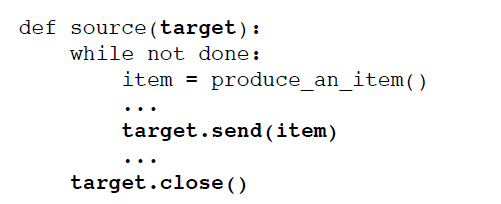
其中,target就是一个coroutine,当调用target.send()函数的时候,数据将会传入整个pipe。
既然pipeline有一个起点,同样的也就必须要有一个sink(end-point,也就是终点)

sink是收集接受coroutine传送过来的数据并对这些数据进行处理。sink通常的模式为:
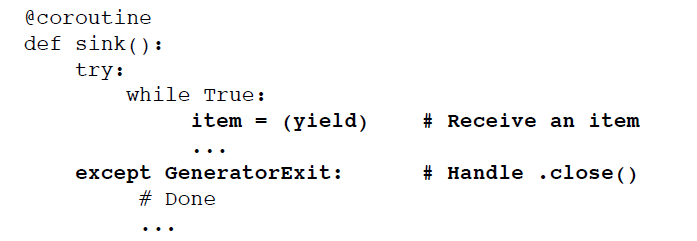
在前面讲述Generetor的文章中,我们用Generator实现了unix中的tail -f命令和tail -f | grep 命令,在这里,我们也用coroutine来实现这两个命令。
先来看看作为source的代码unix_tail_f_co()函数
 # A source that mimics Unix "tail -f"

 def unix_tail_f_co(thefile, target):

     '''

     target是一个coroutine

     '''

     thefile.seek(0, 2)  # 跳到文件末尾

     while True:

         line = thefile.readline()

         if not line:

             time.sleep(0.1)

             continue

         # 把数据发送给coroutine进行处理

         target.send(line)
在上面的代码中,可以看到,target是一个coroutine,函数每次读取一行数据,读取到之后,就调用target.send()函数,把数据发送给了target,由target接收进行下一步的处理。
现在来看看作为sink的printer_co()函数,这个sink很简单,就是简单地打印它收到的数据。
 # A sink just prints the lines

 @coroutine

 def printer_co():

     while True:

         # 在这个地方挂起,等待接收数据

         line = (yield)

         print line,
其中coroutine函数装饰器使我们在上一篇介绍coroutine的文章中定义的。从代码中可以看到,作为sink,print_co()函数有一个死循环,从第6行可以看到,在这个死循环中,
函数会一直挂起,等到数据的到来,然后每次接收到数据后,打印输出,然后再次挂起等待数据的到来。
现在可以把上面两个函数结合起来实现tail -f命令:
 f = open("access-log")

 unix_tail_f_co(f,printer_co())
代码首先打开一个文件f,f作为数据源,把f和printer_co()传递给unix_tail_f_co(),这就实现了一个pipeline,只不过在这个pipeline中,数据是直接发送给作为sink的printer_co()函数的,中间没有经过其他的coroutine。

在sink和source之间,可以根据需要,添加任何的coroutine,比如数据变换(transformation)、过滤(filter)和路由(routing)等
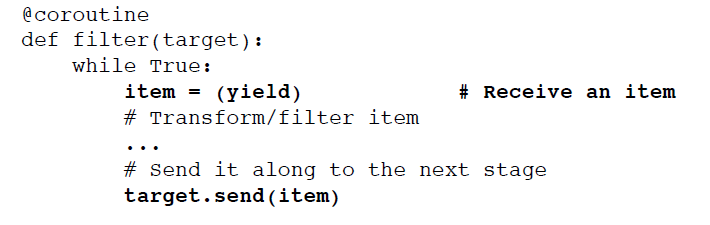
现在,我们添加一个coroutine,grep_filter_co(pattern,target),其中,target是一个coroutine
 @coroutine

 def grep_filter_co(pattern,target):

     while True:

         # 挂起,等待接收数据

         line = (yield)

         if pattern in line:

             # 接收到的数据如果符合要求,

             # 则发送给下一个coroutine进行处理

             target.send(line)
从代码中可以看到,grep_filter_co()有一个死循环,在循环中挂起等待接收数据,一旦接收到了数据,如果数据中存在pattern,则把接收到的数据发送给target,让target对数据进行下一步处理,然后再次等待接收数据并挂起。
同样的,现在把这三个函数组合起来,实现tail -f | grep命令,组成一个新的pipeline:
f = open("access-log")

unix_tail_f_co(f,grep_filter_co("python",printer_co()))
unix_tail_f_co()作为source,从f文件处每次读取一行数据,发送给grep_filter_co()这个coroutine,grep_filer_co()对接收到的数据进行过滤(filter):如果接收到的数据包含了"python"这个单词,就把数据发送给printer_co()进行处理,然后source再把下一行数据发送到pipeline中进行处理。

在前面也用Generator实现了tail -f | grep 命令,现在可以把两者做一个比较:
Generator实现的流程为:

而coroutine实现的流程为:

可以看出,Generator 在最后的的迭代过程中从pipe中获取数据,而coroutine通过send()函数把数据发送到pipeline中去。
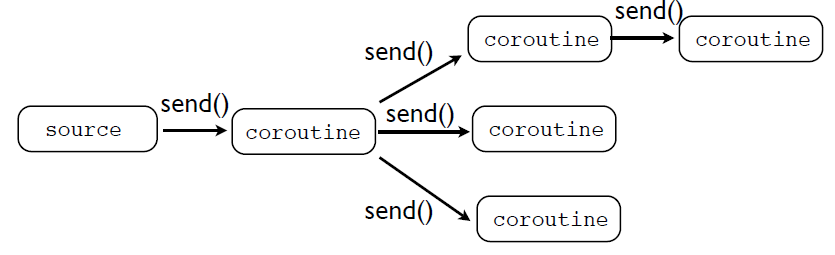
通过coroutine,可以把数据发送到不同的目的地,如下图:

下面我们来实现消息广播(Broadcasting)机制,首先要先定义一个函数broadcast_co(targets)


 # 把数据发送给多个不同的coroutine

 @coroutine

 def broadcast_co(targets):

     while True:

         # 挂起,等待接收数据

         item = (yield)

         for target in targets:

             # 接收到了数据,然后分别发送给不同的coroutine

             target.send(item)
broadcats_co()函数接受一个参数targets,这个参数是一个列表(list),其中的每一个成员都是coroutine,在一个死循环中,函数接收到数据之后,把数据依次发送给不同的coroutine进行处理,然后会挂起等待接收数据。
f = open("access-log")

unix_tail_f_co(f,

            broadcast_co([grep_filter_co('python',printer_co()),

                         grep_filter_c0('ply',printer_co()),

                         grep_filter_co('swig',printer_co())])

            )
unix_tail_f_co每次从f读取一行数据,发送给broadcast_co(),broadcast_co()会把接收到的数据依次发送给gerp_filter_co(),每个grep_filter_co()再会把数据发送给相应的printer_co()进行处理。
                        |---------------> grep_filter_co("python") ------> printer_co()

 unix_tail_f_co()--->broadcast_co() ----> grep_filter_co("ply") ---------> printer_co()

                        |---------------> grep_filter_co("swig")---------> printer_co()
需要注意的是:broadcast_co()会先把数据发送给grep_filter_co("python"),grep_filter_co("python")会把数据发送给printer_co(),当printer_co()执行后挂起再次等待接受数据时,执行权返回到grep_filter_co("python")函数,此时grep_filter_co("python")也会挂起等待接收数据,执行权回到broadcast_co()函数,此时broadcast_co()才会把消息发送给grep_filter_co("ply"),也只有当grep_filter_co("ply")执行完毕挂起之后,broadcast_co()才会接着把数据发送给下一个coroutine。
如果把上面的代码改成这样,就会有另外一种broadcast的模式:
f = open("access-log")

p = printer_co()

unix_tail_f_co(f,

              broadcast_co([grep_filter_co('python',p)),

                            grep_filter_co('ply',p),

                            grep_filter_co('swig',p)])

              )
此时,broadcast的模式为
                       |---------------> grep_filter_co("python") ---------->|

unix_tail_f_co()--->broadcast_co() ----> grep_filter_co("ply") ---------> printer_co()

                       |---------------> grep_filter_co("swig")------------->|
最后数据都会传送到同一个print_co()函数,也就是说最后数据的目的地为同一个。
好了,这篇讲解coroutine在模拟pipeline和控制dataflow上的应用已经完毕了,可以看出coroutine在数据路由方面有很强大的控制能力,可以把多个不同的处理方式组合在一起使用。
下一篇文章会讲解如何用coroutine是下班一个简单的多任务(Multitask)的操作系统,尽请期待O(∩_∩)O。
Python高级编程之生成器(Generator)与coroutine(三):coroutine与pipeline(管道)和Dataflow(数据流_的更多相关文章
- Python高级编程之生成器(Generator)与coroutine(二):coroutine介绍
原创作品,转载请注明出处:点我 上一篇文章Python高级编程之生成器(Generator)与coroutine(一):Generator中,我们介绍了什么是Generator,以及写了几个使用Gen ...
- Python高级编程之生成器(Generator)与coroutine(一):Generator
转载请注明出处:点我 这是一系列的文章,会从基础开始一步步的介绍Python中的Generator以及coroutine(协程)(主要是介绍coroutine),并且详细的讲述了Python中coro ...
- Python高级编程之生成器(Generator)与coroutine(四):一个简单的多任务系统
啊,终于要把这一个系列写完整了,好高兴啊 在前面的三篇文章中介绍了Python的Python的Generator和coroutine(协程)相关的编程技术,接下来这篇文章会用Python的corout ...
- python高级编程技巧
由python高级编程处学习 http://blog.sina.com.cn/s/blog_a89e19440101fb28.html Python列表解析语法[]和生成 器()语法类似 [expr ...
- 第十一章:Python高级编程-协程和异步IO
第十一章:Python高级编程-协程和异步IO Python3高级核心技术97讲 笔记 目录 第十一章:Python高级编程-协程和异步IO 11.1 并发.并行.同步.异步.阻塞.非阻塞 11.2 ...
- python高级编程之选择好名称:完
由于时间关系,python高级编程不在放在这边进行学习了,如果需要的朋友可以看下面的网盘进行下载 # # -*- coding: utf-8 -*- # # python:2.x # __author ...
- python高级编程之列表推导式
1. 一个简单的例子 在Python中,如果我们想修改列表中所有元素的值,可以使用 for 循环语句来实现. 例如,将一个列表中的每个元素都替换为它的平方: >>> L = [1, ...
- python高级编程:有用的设计模式3
# -*- coding: utf-8 -*-__author__ = 'Administrator'#python高级编程:有用的设计模式#访问者:有助于将算法从数据结构中分离出来"&qu ...
- python高级编程:有用的设计模式2
# -*- coding: utf-8 -*- __author__ = 'Administrator' #python高级编程:有用的设计模式 #代理 """ 代理对一 ...
随机推荐
- C#应用视频教程2.3 OPENGL虚拟仿真介绍
本节最重要的一个内容,就是让视野可以平移+旋转+缩放(就像打CS游戏一样以第一人称视角去观察物体,如果可能的话W,S,A,D四个按键控制人物移动,还有鼠标控制视角),本节最重要的一个概念就是设置观察视 ...
- Android反编译方法(class+xml)
ps:对于软件开发人员来说,保护代码安全也是比较重要的因素之一,不过目前来说Google Android平台选择了Java Dalvik VM的方式使其程序很容易破解和被修改,首先APK文件其实就是一 ...
- UNIX网络编程读书笔记:套接口选项
概述 有很多方法来获取和设置影响套接口的选项: getsockopt和setsockopt函数 fcntl函数 ioctl函数 getsockopt和setsockopt函数 这两个函数仅用于套接口. ...
- Python List+Tuple+Dict+Set小结
创建List:L = ['Adam', 'Lisa', 'Bart', 'Gechong', 'Kongming'] 显示List:L[0] 遍历List:print (L)和for循环 更新List ...
- ftp protocol
RFC http://www.w3.org/Protocols/rfc959/4_FileTransfer.html http://blog.chinaunix.net/uid-17238776-id ...
- js 向上取整、向下取整、四舍五入
js 向上取整.向下取整.四舍五入 CreateTime--2018年4月14日11:31:21 Author:Marydon // 1.只保留整数部分(丢弃小数部分) parseInt(5.12 ...
- Oracle url编码与解码
Oracle url编码与解码 CreateTime--2018年3月30日17:26:36 Author:Marydon 一.url编码 实现方式:utl_url.escape() 说明:utl ...
- Solr 4.0部署
http://www.blogjava.net/xiaohuzi2008/archive/2012/12/03/392373.html
- Windows下Python添加库(模块)路径
动态的添加库路径.在程序运行过程中修改sys.path的值,添加自己的库路径 import syssys.path.append(r'your_path') 在Python安装目录下的\Lib\sit ...
- Centos7 通过yum源安装nginx
通过rpm 添加yum源 rpm -Uvh http://nginx.org/packages/centos/7/noarch/RPMS/nginx-release-centos-7-0.el7.ng ...