
基于theano的多层感知机的实现
1.引言
一个多层感知机(Multi-Layer Perceptron,MLP)可以看做是,在逻辑回归分类器的中间加了非线性转换的隐层,这种转换把数据映射到一个线性可分的空间。一个单隐层的MLP就可以达到全局最优。
2.模型
一个单隐层的MLP可以表示如下:

一个隐层的MLP是一个函数:$f:R^{D}\rightarrow R^{L}$,其中 $D$ 是输入向量 $x$ 的大小,$L$是输出向量 $f(x)$ 的大小:
$f(x)=G(b^{(2)}+W^{(2)}(s(b^{(1)}+W^{(1)}))),$
向量$h(x)=s(b^{(1)}+W^{(1)})$构成了隐层,$W^{(1)}\in R^{D\times D_{h}}$ 是连接输入和隐层的权重矩阵,激活函数$s$可以是 $tanh(a)=(e^{a}-e^{-a})/(e^{a}+e^{-a})$ 或者 $sigmoid(a)=1/(1+e^{-a})$,但是前者通常会训练比较快。
在输出层得到:$o(x)=G(b^{(2)}+W^{(2)}h(x))$
为了训练MLP,所有参数 $\theta=\{W^{(2)},b^{(2)},W^{(1)},b^{\text{(1)}}\}.$ 用随机梯度下降法训练,参数的求导用反向传播算法来求。这里在顶层分类的时候用到了前面的逻辑回归的代码:
Python学习笔记之逻辑回归.
3.从逻辑回归到MLP
这里以单隐层MLP为例,当把数据由输入层映射到隐层之后,再加上一个逻辑回归层就构成了MLP.
 class HiddenLayer(object):

     def __init__(self, rng, input, n_in, n_out, W=None, b=None,

                  activation=T.tanh):

         """

         Typical hidden layer of a MLP: units are fully-connected and have

         sigmoidal activation function. Weight matrix W is of shape (n_in,n_out)

         and the bias vector b is of shape (n_out,).

         NOTE : The nonlinearity used here is tanh

         Hidden unit activation is given by: tanh(dot(input,W) + b)

         :type rng: numpy.random.RandomState

         :param rng: a random number generator used to initialize weights

         :type input: theano.tensor.dmatrix

         :param input: a symbolic tensor of shape (n_examples, n_in)

         :type n_in: int

         :param n_in: dimensionality of input

         :type n_out: int

         :param n_out: number of hidden units

         :type activation: theano.Op or function

         :param activation: Non linearity to be applied in the hidden

                            layer

         """

         self.input = input
权重的初始化依赖于激活函数,根据[Xavier10]证明显示,对于$tanh$激活函数,权重初始值应该从$[-\sqrt{\frac{6}{fan_{in}+fan_{out}}},\sqrt{\frac{6}{fan_{in}+fan_{out}}}]$区间内均匀采样得到,其中 $fan_{in}$ 是第$(i-1)$ 层的单元数量,$fan_{out}$ 是第 $i$ 层的单元数量,对于sigmoid函数,采样区间应该变为 $[-4\sqrt{\frac{6}{fan_{in}+fan_{out}}},4\sqrt{\frac{6}{fan_{in}+fan_{out}}}]$.这种初始化方式能保证在训练的初始阶段,通过激活函数能够使得信息有效地向上和向下传播。
 if W is None:

             W_values = numpy.asarray(

                 rng.uniform(

                     # 随机数位于[low,high)区间

                     low=-numpy.sqrt(6. / (n_in + n_out)),

                     high=numpy.sqrt(6. / (n_in + n_out)),

                     size=(n_in, n_out)

                 ),

                 # 类型设为 floatX 是为了在GPU上运行

                 dtype=theano.config.floatX

             )

             # 如果激活函数是 sigmoid,权重初始化要变大

             if activation == theano.tensor.nnet.sigmoid:

                 W_values *= 4

             # borrow = True 表示数据执行浅拷贝,增加效率

             W = theano.shared(value=W_values, name='W', borrow=True)

         if b is None:

             b_values = numpy.zeros((n_out,), dtype=theano.config.floatX)

             b = theano.shared(value=b_values, name='b', borrow=True)

         self.W = W

         self.b = b

         lin_output = T.dot(input, self.W) + self.b

         self.output = (

             lin_output if activation is None

             else activation(lin_output)

         )

         # parameters of the model

         self.params = [self.W, self.b]
在上面两步的基础上构建MLP:
 class MLP(object):

     """Multi-Layer Perceptron Class

     A multilayer perceptron is a feedforward artificial neural network model

     that has one layer or more of hidden units and nonlinear activations.

     Intermediate layers usually have as activation function tanh or the

     sigmoid function (defined here by a ``HiddenLayer`` class)  while the

     top layer is a softamx layer (defined here by a ``LogisticRegression``

     class).

     """

     def __init__(self, rng, input, n_in, n_hidden, n_out):

         """Initialize the parameters for the multilayer perceptron

         :type rng: numpy.random.RandomState

         :param rng: a random number generator used to initialize weights

         :type input: theano.tensor.TensorType

         :param input: symbolic variable that describes the input of the

         architecture (one minibatch)

         :type n_in: int

         :param n_in: number of input units, the dimension of the space in

         which the datapoints lie

         :type n_hidden: int

         :param n_hidden: number of hidden units

         :type n_out: int

         :param n_out: number of output units, the dimension of the space in

         which the labels lie

         """

         # Since we are dealing with a one hidden layer MLP, this will translate

         # into a HiddenLayer with a tanh activation function connected to the

         # LogisticRegression layer; the activation function can be replaced by

         # sigmoid or any other nonlinear function

         self.hiddenLayer = HiddenLayer(

             rng=rng,

             input=input,

             n_in=n_in,

             n_out=n_hidden,

             activation=T.tanh

         )

         # The logistic regression layer gets as input the hidden units

         # of the hidden layer

         self.logRegressionLayer = LogisticRegression(

             input=self.hiddenLayer.output,

             n_in=n_hidden,

             n_out=n_out

         )
为了防止过拟合,这里加上 L1 和 L2 正则项,即计算权重 $W^{(1)},W^{(2)}$ 的1范数和2范数:
   # L1 norm ; one regularization option is to enforce L1 norm to

         # be small

         self.L1 = (

             abs(self.hiddenLayer.W).sum()

             + abs(self.logRegressionLayer.W).sum()

         )

         # square of L2 norm ; one regularization option is to enforce

         # square of L2 norm to be small

         self.L2_sqr = (

             (self.hiddenLayer.W ** 2).sum()

             + (self.logRegressionLayer.W ** 2).sum()

         )

         # negative log likelihood of the MLP is given by the negative

         # log likelihood of the output of the model, computed in the

         # logistic regression layer

         self.negative_log_likelihood = (

             self.logRegressionLayer.negative_log_likelihood

         )

         # same holds for the function computing the number of errors

         self.errors = self.logRegressionLayer.errors

         # the parameters of the model are the parameters of the two layer it is

         # made out of

         self.params = self.hiddenLayer.params + self.logRegressionLayer.params
似然函数的值加上正则项构成损失函数:
 # the cost we minimize during training is the negative log likelihood of

     # the model plus the regularization terms (L1 and L2); cost is expressed

     # here symbolically

     cost = (

         classifier.negative_log_likelihood(y)

         + L1_reg * classifier.L1

         + L2_reg * classifier.L2_sqr

     )
4.Minist识别测试
 """

 This tutorial introduces the multilayer perceptron using Theano.

  A multilayer perceptron is a logistic regressor where

 instead of feeding the input to the logistic regression you insert a

 intermediate layer, called the hidden layer, that has a nonlinear

 activation function (usually tanh or sigmoid) . One can use many such

 hidden layers making the architecture deep. The tutorial will also tackle

 the problem of MNIST digit classification.

 .. math::

     f(x) = G( b^{(2)} + W^{(2)}( s( b^{(1)} + W^{(1)} x))),

 References:

     - textbooks: "Pattern Recognition and Machine Learning" -

                  Christopher M. Bishop, section 5

 """

 __docformat__ = 'restructedtext en'

 import os

 import sys

 import time

 import numpy

 import theano

 import theano.tensor as T

 from logistic_sgd import LogisticRegression, load_data

 # start-snippet-1

 class HiddenLayer(object):

     def __init__(self, rng, input, n_in, n_out, W=None, b=None,

                  activation=T.tanh):

         """

         Typical hidden layer of a MLP: units are fully-connected and have

         sigmoidal activation function. Weight matrix W is of shape (n_in,n_out)

         and the bias vector b is of shape (n_out,).

         NOTE : The nonlinearity used here is tanh

         Hidden unit activation is given by: tanh(dot(input,W) + b)

         :type rng: numpy.random.RandomState

         :param rng: a random number generator used to initialize weights

         :type input: theano.tensor.dmatrix

         :param input: a symbolic tensor of shape (n_examples, n_in)

         :type n_in: int

         :param n_in: dimensionality of input

         :type n_out: int

         :param n_out: number of hidden units

         :type activation: theano.Op or function

         :param activation: Non linearity to be applied in the hidden

                            layer

         """

         self.input = input

         # end-snippet-1

         # `W` is initialized with `W_values` which is uniformely sampled

         # from sqrt(-6./(n_in+n_hidden)) and sqrt(6./(n_in+n_hidden))

         # for tanh activation function

         # the output of uniform if converted using asarray to dtype

         # theano.config.floatX so that the code is runable on GPU

         # Note : optimal initialization of weights is dependent on the

         #        activation function used (among other things).

         #        For example, results presented in [Xavier10] suggest that you

         #        should use 4 times larger initial weights for sigmoid

         #        compared to tanh

         #        We have no info for other function, so we use the same as

         #        tanh.

         if W is None:

             W_values = numpy.asarray(

                 rng.uniform(

                     # 随机数位于[low,high)区间

                     low=-numpy.sqrt(6. / (n_in + n_out)),

                     high=numpy.sqrt(6. / (n_in + n_out)),

                     size=(n_in, n_out)

                 ),

                 # 类型设为 floatX 是为了在GPU上运行

                 dtype=theano.config.floatX

             )

             # 如果激活函数是 sigmoid,权重初始化要变大

             if activation == theano.tensor.nnet.sigmoid:

                 W_values *= 4

             # borrow = True 表示数据执行浅拷贝,增加效率

             W = theano.shared(value=W_values, name='W', borrow=True)

         if b is None:

             b_values = numpy.zeros((n_out,), dtype=theano.config.floatX)

             b = theano.shared(value=b_values, name='b', borrow=True)

         self.W = W

         self.b = b

         lin_output = T.dot(input, self.W) + self.b

         self.output = (

             lin_output if activation is None

             else activation(lin_output)

         )

         # parameters of the model

         self.params = [self.W, self.b]

 # start-snippet-2

 class MLP(object):

     """Multi-Layer Perceptron Class

     A multilayer perceptron is a feedforward artificial neural network model

     that has one layer or more of hidden units and nonlinear activations.

     Intermediate layers usually have as activation function tanh or the

     sigmoid function (defined here by a ``HiddenLayer`` class)  while the

     top layer is a softamx layer (defined here by a ``LogisticRegression``

     class).

     """

     def __init__(self, rng, input, n_in, n_hidden, n_out):

         """Initialize the parameters for the multilayer perceptron

         :type rng: numpy.random.RandomState

         :param rng: a random number generator used to initialize weights

         :type input: theano.tensor.TensorType

         :param input: symbolic variable that describes the input of the

         architecture (one minibatch)

         :type n_in: int

         :param n_in: number of input units, the dimension of the space in

         which the datapoints lie

         :type n_hidden: int

         :param n_hidden: number of hidden units

         :type n_out: int

         :param n_out: number of output units, the dimension of the space in

         which the labels lie

         """

         # Since we are dealing with a one hidden layer MLP, this will translate

         # into a HiddenLayer with a tanh activation function connected to the

         # LogisticRegression layer; the activation function can be replaced by

         # sigmoid or any other nonlinear function

         self.hiddenLayer = HiddenLayer(

             rng=rng,

             input=input,

             n_in=n_in,

             n_out=n_hidden,

             activation=T.tanh

         )

         # The logistic regression layer gets as input the hidden units

         # of the hidden layer

         self.logRegressionLayer = LogisticRegression(

             input=self.hiddenLayer.output,

             n_in=n_hidden,

             n_out=n_out

         )

         # end-snippet-2 start-snippet-3

         # L1 norm ; one regularization option is to enforce L1 norm to

         # be small

         self.L1 = (

             abs(self.hiddenLayer.W).sum()

             + abs(self.logRegressionLayer.W).sum()

         )

         # square of L2 norm ; one regularization option is to enforce

         # square of L2 norm to be small

         self.L2_sqr = (

             (self.hiddenLayer.W ** 2).sum()

             + (self.logRegressionLayer.W ** 2).sum()

         )

         # negative log likelihood of the MLP is given by the negative

         # log likelihood of the output of the model, computed in the

         # logistic regression layer

         self.negative_log_likelihood = (

             self.logRegressionLayer.negative_log_likelihood

         )

         # same holds for the function computing the number of errors

         self.errors = self.logRegressionLayer.errors

         # the parameters of the model are the parameters of the two layer it is

         # made out of

         self.params = self.hiddenLayer.params + self.logRegressionLayer.params

         # end-snippet-3

 def test_mlp(learning_rate=0.01, L1_reg=0.00, L2_reg=0.0001, n_epochs=1000,

              dataset='mnist.pkl.gz', batch_size=20, n_hidden=500):

     """

     Demonstrate stochastic gradient descent optimization for a multilayer

     perceptron

     This is demonstrated on MNIST.

     :type learning_rate: float

     :param learning_rate: learning rate used (factor for the stochastic

     gradient

     :type L1_reg: float

     :param L1_reg: L1-norm's weight when added to the cost (see

     regularization)

     :type L2_reg: float

     :param L2_reg: L2-norm's weight when added to the cost (see

     regularization)

     :type n_epochs: int

     :param n_epochs: maximal number of epochs to run the optimizer

     :type dataset: string

     :param dataset: the path of the MNIST dataset file from

                  http://www.iro.umontreal.ca/~lisa/deep/data/mnist/mnist.pkl.gz

    """

     datasets = load_data(dataset)

     train_set_x, train_set_y = datasets[0]

     valid_set_x, valid_set_y = datasets[1]

     test_set_x, test_set_y = datasets[2]

     # compute number of minibatches for training, validation and testing

     n_train_batches = train_set_x.get_value(borrow=True).shape[0] / batch_size

     n_valid_batches = valid_set_x.get_value(borrow=True).shape[0] / batch_size

     n_test_batches = test_set_x.get_value(borrow=True).shape[0] / batch_size

     ######################

     # BUILD ACTUAL MODEL #

     ######################

     print '... building the model'

     # allocate symbolic variables for the data

     index = T.lscalar()  # index to a [mini]batch

     x = T.matrix('x')  # the data is presented as rasterized images

     y = T.ivector('y')  # the labels are presented as 1D vector of

                         # [int] labels

     rng = numpy.random.RandomState(1234)

     # construct the MLP class

     classifier = MLP(

         rng=rng,

         input=x,

         n_in=28 * 28,

         n_hidden=n_hidden,

         n_out=10

     )

     # start-snippet-4

     # the cost we minimize during training is the negative log likelihood of

     # the model plus the regularization terms (L1 and L2); cost is expressed

     # here symbolically

     cost = (

         classifier.negative_log_likelihood(y)

         + L1_reg * classifier.L1

         + L2_reg * classifier.L2_sqr

     )

     # end-snippet-4

     # compiling a Theano function that computes the mistakes that are made

     # by the model on a minibatch

     test_model = theano.function(

         inputs=[index],

         outputs=classifier.errors(y),

         givens={

             x: test_set_x[index * batch_size:(index + 1) * batch_size],

             y: test_set_y[index * batch_size:(index + 1) * batch_size]

         }

     )

     validate_model = theano.function(

         inputs=[index],

         outputs=classifier.errors(y),

         givens={

             x: valid_set_x[index * batch_size:(index + 1) * batch_size],

             y: valid_set_y[index * batch_size:(index + 1) * batch_size]

         }

     )

     # start-snippet-5

     # compute the gradient of cost with respect to theta (sotred in params)

     # the resulting gradients will be stored in a list gparams

     gparams = [T.grad(cost, param) for param in classifier.params]

     # specify how to update the parameters of the model as a list of

     # (variable, update expression) pairs

     # given two list the zip A = [a1, a2, a3, a4] and B = [b1, b2, b3, b4] of

     # same length, zip generates a list C of same size, where each element

     # is a pair formed from the two lists :

     #    C = [(a1, b1), (a2, b2), (a3, b3), (a4, b4)]

     updates = [

         (param, param - learning_rate * gparam)

         for param, gparam in zip(classifier.params, gparams)

     ]

     # compiling a Theano function `train_model` that returns the cost, but

     # in the same time updates the parameter of the model based on the rules

     # defined in `updates`

     train_model = theano.function(

         inputs=[index],

         outputs=cost,

         updates=updates,

         givens={

             x: train_set_x[index * batch_size: (index + 1) * batch_size],

             y: train_set_y[index * batch_size: (index + 1) * batch_size]

         }

     )

     # end-snippet-5

     ###############

     # TRAIN MODEL #

     ###############

     print '... training'

     # early-stopping parameters

     patience = 10000  # look as this many examples regardless

     patience_increase = 2  # wait this much longer when a new best is

                            # found

     improvement_threshold = 0.995  # a relative improvement of this much is

                                    # considered significant

     validation_frequency = min(n_train_batches, patience / 2)

                                   # go through this many

                                   # minibatche before checking the network

                                   # on the validation set; in this case we

                                   # check every epoch

     best_validation_loss = numpy.inf

     best_iter = 0

     test_score = 0.

     start_time = time.clock()

     epoch = 0

     done_looping = False

     # 迭代 n_epochs 次,每次迭代都将遍历训练集所有样本

     while (epoch < n_epochs) and (not done_looping):

         epoch = epoch + 1

         for minibatch_index in xrange(n_train_batches):

             minibatch_avg_cost = train_model(minibatch_index)

             # iteration number

             iter = (epoch - 1) * n_train_batches + minibatch_index

             # 训练一定的样本之后才进行交叉验证

             if (iter + 1) % validation_frequency == 0:

                 # compute zero-one loss on validation set

                 validation_losses = [validate_model(i) for i

                                      in xrange(n_valid_batches)]

                 this_validation_loss = numpy.mean(validation_losses)

                 print(

                     'epoch %i, minibatch %i/%i, validation error %f %%' %

                     (

                         epoch,

                         minibatch_index + 1,

                         n_train_batches,

                         this_validation_loss * 100.

                     )

                 )

                 # if we got the best validation score until now

                 # 如果交叉验证的误差比当前最小的误差还小,就在测试集上测试

                 if this_validation_loss < best_validation_loss:

                     # improve patience if loss improvement is good enough

                     # 如果改善很多,就在本次迭代中多训练一定数量的样本

                     if (

                         this_validation_loss < best_validation_loss *

                         improvement_threshold

                     ):

                         patience = max(patience, iter * patience_increase)

                     # 记录最小的交叉验证误差和相应的迭代数

                     best_validation_loss = this_validation_loss

                     best_iter = iter

                     # test it on the test set

                     test_losses = [test_model(i) for i

                                    in xrange(n_test_batches)]

                     test_score = numpy.mean(test_losses)

                     print(('     epoch %i, minibatch %i/%i, test error of '

                            'best model %f %%') %

                           (epoch, minibatch_index + 1, n_train_batches,

                            test_score * 100.))

             # 训练样本数超过 patience,即停止

             if patience <= iter:

                 done_looping = True

                 break

     end_time = time.clock()

     print(('Optimization complete. Best validation score of %f %% '

            'obtained at iteration %i, with test performance %f %%') %

           (best_validation_loss * 100., best_iter + 1, test_score * 100.))

     print >> sys.stderr, ('The code for file ' +

                           os.path.split(__file__)[1] +

                           ' ran for %.2fm' % ((end_time - start_time) / 60.))

 if __name__ == '__main__':

     test_mlp()
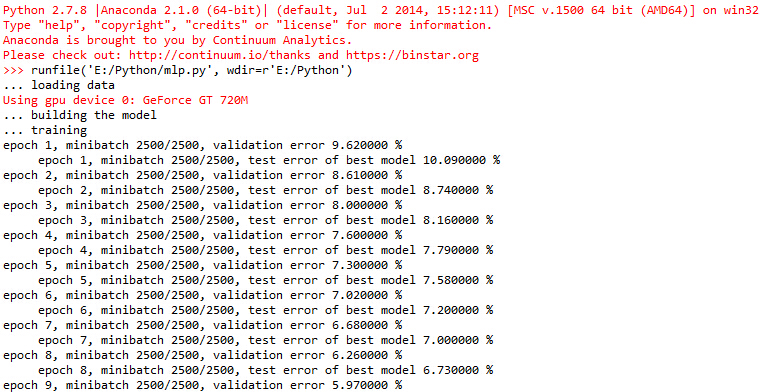
关于上面代码中的交叉验证:只有训练结果的交叉验证结果比上一次交叉验证结果好,才在测试集上进行测试!
训练过程截图:
学习内容来源:
http://deeplearning.net/tutorial/mlp.html#mlp
基于theano的多层感知机的实现的更多相关文章
- Theano3.4-练习之多层感知机
来自http://deeplearning.net/tutorial/mlp.html#mlp Multilayer Perceptron note:这部分假设读者已经通读之前的一个练习 Classi ...
- (数据科学学习手札44)在Keras中训练多层感知机
一.简介 Keras是有着自主的一套前端控制语法,后端基于tensorflow和theano的深度学习框架,因为其搭建神经网络简单快捷明了的语法风格,可以帮助使用者更快捷的搭建自己的神经网络,堪称深度 ...
- DeepLearning tutorial(3)MLP多层感知机原理简介+代码详解
本文介绍多层感知机算法,特别是详细解读其代码实现,基于python theano,代码来自:Multilayer Perceptron,如果你想详细了解多层感知机算法,可以参考:UFLDL教程,或者参 ...
- MLP多层感知机
@author:wepon @blog:http://blog.csdn.net/u012162613/article/details/43221829 转载:http://blog.csdn.net ...
- (数据科学学习手札34)多层感知机原理详解&Python与R实现
一.简介 机器学习分为很多个领域,其中的连接主义指的就是以神经元(neuron)为基本结构的各式各样的神经网络,规范的定义是:由具有适应性的简单单元组成的广泛并行互连的网络,它的组织能够模拟生物神经系 ...
- TensorFlow学习笔记7-深度前馈网络(多层感知机)
深度前馈网络(前馈神经网络,多层感知机) 神经网络基本概念 前馈神经网络在模型输出和模型本身之间没有反馈连接;前馈神经网络包含反馈连接时,称为循环神经网络. 前馈神经网络用有向无环图表示. 设三个函数 ...
- Alink漫谈(十四) :多层感知机 之 总体架构
Alink漫谈(十四) :多层感知机 之 总体架构 目录 Alink漫谈(十四) :多层感知机 之 总体架构 0x00 摘要 0x01 背景概念 1.1 前馈神经网络 1.2 反向传播 1.3 代价函 ...
- Alink漫谈(十五) :多层感知机 之 迭代优化
Alink漫谈(十五) :多层感知机 之 迭代优化 目录 Alink漫谈(十五) :多层感知机 之 迭代优化 0x00 摘要 0x01 前文回顾 1.1 基本概念 1.2 误差反向传播算法 1.3 总 ...
- Tensorflow 2.0 深度学习实战 —— 详细介绍损失函数、优化器、激活函数、多层感知机的实现原理
前言 AI 人工智能包含了机器学习与深度学习,在前几篇文章曾经介绍过机器学习的基础知识,包括了监督学习和无监督学习,有兴趣的朋友可以阅读< Python 机器学习实战 >.而深度学习开始只 ...
随机推荐
- Linux内核分析——第六周学习笔记20135308
第六周 进程的描述和进程的创建 一.进程描述符task_struct数据结构 1.操作系统三大功能 进程管理 内存管理 文件系统 2.进程控制块PCB——task_struct 也叫进程描述符,为了管 ...
- 转发npm发布包的过程
老板,来个npm账号! 因为你的包是要放在npm上的,所以,没有npm的账号,根本什么活都干不了. 在npm上注册一个账号是很简单的,随便填一下用户名密码邮箱,然后人家就会发个邮件给你,然后就注册成功 ...
- [2017BUAA软工]个人阅读作业+总结
阅读作业 没有银弹 No Silver Bullet - Essence and Accidents of Software Engineering - Brooks 在这篇论文中,作者阐述了软件的四 ...
- Linux下使用NTFS格式移动硬盘
https://zhidao.baidu.com/question/66517344.html https://zhidao.baidu.com/question/586036510.html htt ...
- [转帖]LNMP组件安装
https://lnmp.org/install.html 系统需求: CentOS/RHEL/Fedora/Debian/Ubuntu/Raspbian/Deepin/Aliyun/Amazon/M ...
- [转帖]DRAM芯片战争,跨越40年的生死搏杀
DRAM芯片战争,跨越40年的生死搏杀 超级工程一览 ·2017-08-20 12:50·半导体行业观察 阅读:1.4万 来源:内容来自超级工程一览 , 谢谢. DRAM是动态随机存储器的意思,也就是 ...
- dx、aapt工具
1.DX命令: Dalvik虚拟机不能直接运行Java代码编译出来的文件,只能运行.dex文件,所以需要将.class,.jar等文件通过DX工具转换成.dex文件. 2.AAPT命令 一个Andro ...
- 贝云cms内容管理系统(thinkphp5.0开源cms管理系统)
byCms包含文章,图片,下载,视频模型,基于thinkphp5.0.9,可无缝升级至thinkphp.1.0,是一套简单,易用的内容管理系统,旨在帮助开发者节约web应用后台开发时间和精力,以最快的 ...
- delphi Form属性设置 设置可实现窗体无最大化,并且不能拖大拖小
以下设置可实现窗体无最大化,并且不能拖大拖小BorderIcon 设为---biMax[False] biHelp [False]BorderStyle 设为---bsSingle 参考------- ...
- python自动化之调试
#####调试 #####查看日志与断言 ''' 抛出异常使用raise语句.在代码中,raise语句包含以下部分: (1)raise关键字; (2)对Exception函数的调用; (3)传递给Ex ...