
xadmin系列之django的url分发的方式
一、先介绍一下我们自己的urls中是如何进行路由分发的
一、一级路由
urlpatterns = [

    url(r'^upload/', views.upload,name="upload"),

    url(r'^article-site/(?P<auther>\w+)', views.article_site,name="article"),

    url(r'^login/', views.login,name="bbs_login"),

    url(r'^index/', views.index,name="bbs_index"),

    url(r'^register/', views.register,name="bbs_register"),

    url(r'^logout/', views.logout, name="bbs_logout"),

    url(r'^up_down/', views.up_down,name="up_down"),

    url(r'^add_comment/', views.add_comment,name="add_comment"),

    url(r'^comment_tree/(?P<nid>\d+)', views.comment_tree,name="comment_tree"),

    url(r'^(?P<name>\w+)/$', views.blog,name="bbs_blog"),

    url(r'^(?P<name>\w+)/(?P<tid>\d+)/$', views.article),

]
二、二级路由
from django.conf.urls import include
url(r'^app1/',include("app1.urls")),
三、路由分发,这里还可以里面在嵌套一层
    url(r'^cui/', (

        [url(r'^test1/', test.test1),

         url(r'^test2/', test.test2),

         url(r'^test3/', test.test3),

         ]

        ,None,None)),
二、下面看下django的admin是如何进行路由分发的
django的admin就是用上面的第三种方式实现urls的分发
先掌握一个知识点
a、通过表的对象去获取表的名称,这里需要注意,获取到的表名是全小写的
from app1.models import Article

Article._meta.model_name

'article'
b、通过表的对象获取该表所属的app的名称
Article._meta.app_label

'app1'
下面我们用路由分发的方式进行分发,我们要一个类似这样的url
cui/app的名称/表的名称/add/ -------增加
cui/app的名称/表的名称/list/ --------查看
cui/app的名称/表的名称/1/change----编辑
cui/app的名称/表的名称/1/del-----删除

下面看下我们定义的函数geturls函数,这个函数的主要的目的就是获取表的名称和表所属的app的名称
def geturls():

    temp = []

    for model,admin_class in admin.site._registry.items():

        # 通过表的对象获取表的名称

        model_name = model._meta.model_name

        # 通过表的对象获取表的app的名称

        app_name = model._meta.app_label

        temp.append(

            url(r'^{app_name}/{model_name}/'.format(app_name=app_name,model_name=model_name), (geturlsoperation(),None,None))

        )

    return temp
这里我们为上面用到的admin.site._registry这个函数呢?我们看下源码
在admin.site文件中最后返回了一个对象,我们导入admin.site就相当于导入了一个AdminSite的对象,而这个对象和我们前面学的非常的相似,他就是一个单实例的对象
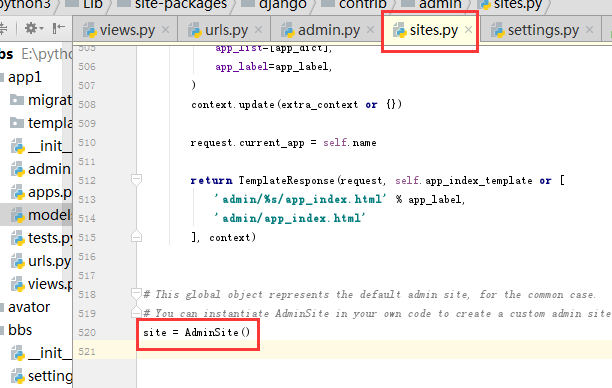
我们看下AdminSite这个类的
class AdminSite(object):

    """

    An AdminSite object encapsulates an instance of the Django admin application, ready

    to be hooked in to your URLconf. Models are registered with the AdminSite using the

    register() method, and the get_urls() method can then be used to access Django view

    functions that present a full admin interface for the collection of registered

    models.

    """

    # Text to put at the end of each page's <title>.

    site_title = ugettext_lazy('Django site admin')

    # Text to put in each page's <h1>.

    site_header = ugettext_lazy('Django administration')

    # Text to put at the top of the admin index page.

    index_title = ugettext_lazy('Site administration')

    # URL for the "View site" link at the top of each admin page.

    site_url = '/'

    _empty_value_display = '-'

    login_form = None

    index_template = None

    app_index_template = None

    login_template = None

    logout_template = None

    password_change_template = None

    password_change_done_template = None

    def __init__(self, name='admin'):

        self._registry = {}  # model_class class -> admin_class instance

        self.name = name

        self._actions = {'delete_selected': actions.delete_selected}

        self._global_actions = self._actions.copy()

        all_sites.add(self)
这里我们可以看到_registry是一个字典,我们在看下AdminSite这个类的register这个函数是如何使用这个变量的
    def register(self, model_or_iterable, admin_class=None, **options):

        """

        Registers the given model(s) with the given admin class.

        The model(s) should be Model classes, not instances.

        If an admin class isn't given, it will use ModelAdmin (the default

        admin options). If keyword arguments are given -- e.g., list_display --

        they'll be applied as options to the admin class.

        If a model is already registered, this will raise AlreadyRegistered.

        If a model is abstract, this will raise ImproperlyConfigured.

        """

        if not admin_class:

            admin_class = ModelAdmin

        if isinstance(model_or_iterable, ModelBase):

            model_or_iterable = [model_or_iterable]

        for model in model_or_iterable:

            if model._meta.abstract:

                raise ImproperlyConfigured(

                    'The model %s is abstract, so it cannot be registered with admin.' % model.__name__

                )

            if model in self._registry:

                raise AlreadyRegistered('The model %s is already registered' % model.__name__)

            # Ignore the registration if the model has been

            # swapped out.

            if not model._meta.swapped:

                # If we got **options then dynamically construct a subclass of

                # admin_class with those **options.

                if options:

                    # For reasons I don't quite understand, without a __module__

                    # the created class appears to "live" in the wrong place,

                    # which causes issues later on.

                    options['__module__'] = __name__

                    admin_class = type("%sAdmin" % model.__name__, (admin_class,), options)

                # Instantiate the admin class to save in the registry

                self._registry[model] = admin_class(model, self)
这里就是一个字典,字典的k表的对象,v是这个表的对象对应的admin_class,admin_class其实就是我们注册的时候的类
class ad(admin.ModelAdmin):

    def manyTomany(self):

        return mark_safe("<a>删除</a>")

    list_display = ["content","article",manyTomany]

    # 控制admin显示某张标签的那些字段

    # 这里我们还可以自定义一个字段,函数名就是字段的名称,函数的值就是字段的返回值

    list_editable = ["article"]

    # 定义那些字段可以在编辑,可以表的页面直接编辑

    list_display_links = ["content","article"]

    # 控制那些字段可以点击进入某张表的详情

admin.site.register(models.ArticleDetail,ad)
就是我们这个ad
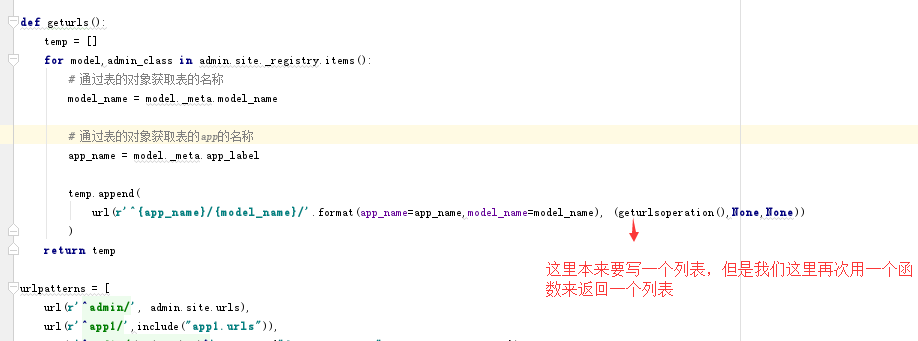
我们在看下geturlsoperation这个函数,他就是返回我们的增删改查的
def geturlsoperation():

    temp = []

    temp.append(

        url(r'^$',test.list_view)

    )

    temp.append(

        url(r'^add/$',test.add_view)

    )

    temp.append(

        url(r'^(?P<cid>\d+)/change/$',test.change_view)

    )

    temp.append(

        url(r'^(?P<did>\d+)/del/$',test.del_view)

    )

    return temp
xadmin系列之django的url分发的方式的更多相关文章
- django的url分发封装
h2, body>h3, body>h4, body>h1{ padding: 10px; background-color: #4cae4c; text-align: center ...
- Django学习之十一:真正理解Django的路由分发和反解url原理
目录 URL Dispatcher 简介 模式概念 对比URLPattern 与 URLResolver (多态的体现) 构建子路由几种方式 反解url算法逻辑 URL Dispatcher 简介 d ...
- django url分发,视图,模板回顾
Django基础轮廓 MTV+controller 一 url分发系统: 1 简单使用 url(r'^articles/2003/$', views.special_case_2003), # spe ...
- Django url分发到工程里
因为我们建立了Django后 ,url是在mysite下的全局对象 因为我们实际项目里不可能只有一个工程 而全放在全局里去分发url 会让代码耦合度提高,代码量大后会造成维护困难.这时候我们把url分 ...
- Django路由配置之子路由include(URL分发)
子路由include(URL分发) 在一个项目中可能存在多个应用,为了方便区分和管理,在项目的总路由urls.py中会进行路由分发: (1)项目总路由导入from django.conf.urls ...
- day53:django:URL别名/反向解析&URL分发&命名空间&ORM多表操作修改/查询
目录 1.URL别名&反向解析 2.URL分发&命名空间 3.ORM多表操作-修改 4.ORM多表操作-查询 4.1 基于对象的跨表查询 4.2 基于双下划线的跨表查询 4.3 聚合查 ...
- day 82 URL分发
一 .admin 流程 (1) 启动 autodiscover_modules('admin', register_to=site) (2) 注册 单例模式 admin.site=AdminSite( ...
- Django的URL调度
1.URLconf (URL configuration):(Django版本1.11.20,其它版本可能各有差异.) 在Django中Python后端与前端URL进行交互,是通过一个名为urlcon ...
- Django的URL路由系统
一. URL配置 URL配置就像Django所支撑网站的目录.它的本质是URL与要为该URL调用的视图之间的映射表.你就是以这种方式告诉Django,对于哪个URL调用的这段代码. 基本格式 from ...
随机推荐
- css3 制作一个遮罩
思路:1.显示两块图片,2.图片区域(初始隐藏),3.鼠标移入,遮罩显示,此时遮住图片,4.鼠标移出,遮罩恢复初始状态 用到两个css3 属性:transtion ,transform 用法: 1. ...
- vue:再vue-cli项目中使用window以及调用window上的方法
一: 1:在main.js中 Vue.prototype.myfunction = function() {/*你的自定义Vue方法*/} 2:在mounted(或其他生命周期中) 或者 method ...
- The Google File System——论文详解(转)
“Google文件存储系统(GFS)是构建在廉价服务器之上的大型分布式系统.它将服务器故障视为正常现象,通过软件方式自动容错,在保证系统可用性和可靠性同时,大大降低系统成本. GFS是Google整个 ...
- ORACLE问题定位基本方法
在使用ORACLE过程中经常会碰到启动或者访问失败的问题.碰到这些问题该如何解决? 1.仔细阅读报错提示信息,不要扫一眼感觉似曾相识,凭经验就开始上手解决.因为相同的现象可能是不同的原因引发的. 2. ...
- Java 指针or引用?
由一个问题引出:Java到底是传引用还是传值? 如果是传引用,那么为何badSwap函数并没有如预想的那样交换变量? public void badSwap(int var1, int var2) { ...
- 关于jsp基本语法:第一章节
今天我学习了关于JSP基本语法的一些知识点. JSP全名是 Java server pages,其根本是一个简化的Servlet设计,实现了在java当中使用HTML标签.JSP是一种动态网页技术,标 ...
- Hosts
Hosts "C:\Windows\System32\drivers\etc\hosts" [最新]2018 hosts 持续更新[更新于:2018-11-13] 本页面WordP ...
- set 转 enumeration
- Python自动化运维开发实战 三、python文件类型
导语: python常用的有3种文件类型 1. 源代码 py 2. 字节代码 pyc 3. 优化代码 pyo 源代码: python源代码的文件以”py"为扩展名,由python程序解释,不 ...
- 学JS的心路历程-闭包closure
闭包是是纯函式语言的一个特性,也是JS的一个关键性的特色,虽然不了解也能开发程序,但我们不是这种人对吧? 闭包不仅可以减少某些高阶功能的代码数量和复杂度,并且可以让我们做到原本无法做的复杂功能.听到这 ...