
python的内存回收机制即gc模块讲解
最后容易造成内存问题的通常就是全局单例、全局缓存、长期存活的对象
引用计数(主要), 标记清除, 分代收集(辅助)
引用计数为0则会被gc回收。标记删除可以解决循环引用的问题。分代:0代--年轻代;1代--中年代;2代--老年代,存活越久被回收的频率越低。
通过gc机制基本解决内存回收的问题。
不要轻易实现对象的__del__方法,和循环引用一起使用容易造成内存泄露,无法回收
gc模块包括如下函数和属性:

gc.disable()关闭自动的垃圾回收,改为手动;
gc.get_count()查看0、1、2代的数量(创建的对象数量-销毁的对象数量)
gc.get_threshold()查看0、1、2代的阈值
gc.collect(*args, **kwargs)手动执行垃圾回收,参数可以为0、1、2,表示回收指定代的垃圾;没有参数,表示0、1、2代全部回收,返回不可达的对象数量,不可达的对象也是要被清楚的对象,会被标记清除
gc.set_debug(DEBUG_COLLECTABLE|DEBUG_LEAK|DEBUG_SAVEALL|DEBUG_STATS|DEBUG_UNCOLLECTABLE) 把所有的debug开关打开。估计后端的C语音是根据8个bit位来判断debug开关功能的。
sys.getrefcount(a)查看a的引用计数
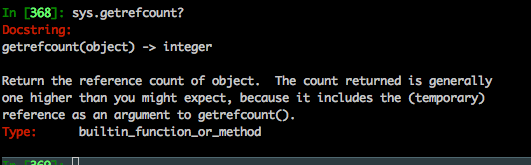
直接查看源代码说明:
def is_tracked(*args, **kwargs): # real signature unknown
"""
Returns true if the object is tracked by the garbage collector.
Simple atomic objects will return false.
"""
pass
所以a=2没有被tracked,a=[2,2]被tracked

# encoding: utf-

# module gc

# from (built-in)

# by generator 1.146

"""

This module provides access to the garbage collector for reference cycles.

enable() -- Enable automatic garbage collection.

disable() -- Disable automatic garbage collection.

isenabled() -- Returns true if automatic collection is enabled.

collect() -- Do a full collection right now.

get_count() -- Return the current collection counts.

get_stats() -- Return list of dictionaries containing per-generation stats.

set_debug() -- Set debugging flags.

get_debug() -- Get debugging flags.

set_threshold() -- Set the collection thresholds.

get_threshold() -- Return the current the collection thresholds.

get_objects() -- Return a list of all objects tracked by the collector.

is_tracked() -- Returns true if a given object is tracked.

get_referrers() -- Return the list of objects that refer to an object.

get_referents() -- Return the list of objects that an object refers to.

freeze() -- Freeze all tracked objects and ignore them for future collections.

unfreeze() -- Unfreeze all objects in the permanent generation.

get_freeze_count() -- Return the number of objects in the permanent generation.

"""

# no imports

# Variables with simple values

DEBUG_COLLECTABLE =

DEBUG_LEAK =

DEBUG_SAVEALL =

DEBUG_STATS =

DEBUG_UNCOLLECTABLE =

# functions

def collect(*args, **kwargs): # real signature unknown

    """

    Run the garbage collector.

    With no arguments, run a full collection.  The optional argument

    may be an integer specifying which generation to collect.  A ValueError

    is raised if the generation number is invalid.

    The number of unreachable objects is returned.

    """

    pass

def disable(*args, **kwargs): # real signature unknown

    """ Disable automatic garbage collection. """

    pass

def enable(*args, **kwargs): # real signature unknown

    """ Enable automatic garbage collection. """

    pass

def freeze(*args, **kwargs): # real signature unknown

    """

    Freeze all current tracked objects and ignore them for future collections.

    This can be used before a POSIX fork() call to make the gc copy-on-write friendly.

    Note: collection before a POSIX fork() call may free pages for future allocation

    which can cause copy-on-write.

    """

    pass

def get_count(*args, **kwargs): # real signature unknown

    """ Return a three-tuple of the current collection counts. """

    pass

def get_debug(*args, **kwargs): # real signature unknown

    """ Get the garbage collection debugging flags. """

    pass

def get_freeze_count(*args, **kwargs): # real signature unknown

    """ Return the number of objects in the permanent generation. """

    pass

def get_objects(*args, **kwargs): # real signature unknown

    """ Return a list of objects tracked by the collector (excluding the list returned). """

    pass

def get_referents(*objs): # real signature unknown; restored from __doc__

    """

    get_referents(*objs) -> list

    Return the list of objects that are directly referred to by objs.

    """

    return []

def get_referrers(*objs): # real signature unknown; restored from __doc__

    """

    get_referrers(*objs) -> list

    Return the list of objects that directly refer to any of objs.

    """

    return []

def get_stats(*args, **kwargs): # real signature unknown

    """ Return a list of dictionaries containing per-generation statistics. """

    pass

def get_threshold(*args, **kwargs): # real signature unknown

    """ Return the current collection thresholds. """

    pass

def isenabled(*args, **kwargs): # real signature unknown

    """ Returns true if automatic garbage collection is enabled. """

    pass

def is_tracked(*args, **kwargs): # real signature unknown

    """

    Returns true if the object is tracked by the garbage collector.

    Simple atomic objects will return false.

    """

    pass

def set_debug(*args, **kwargs): # real signature unknown

    """

    Set the garbage collection debugging flags.

      flags

        An integer that can have the following bits turned on:

          DEBUG_STATS - Print statistics during collection.

          DEBUG_COLLECTABLE - Print collectable objects found.

          DEBUG_UNCOLLECTABLE - Print unreachable but uncollectable objects

            found.

          DEBUG_SAVEALL - Save objects to gc.garbage rather than freeing them.

          DEBUG_LEAK - Debug leaking programs (everything but STATS).

    Debugging information is written to sys.stderr.

    """

    pass

def set_threshold(threshold0, threshold1=None, threshold2=None): # real signature unknown; restored from __doc__

    """

    set_threshold(threshold0, [threshold1, threshold2]) -> None

    Sets the collection thresholds.  Setting threshold0 to zero disables

    collection.

    """

    pass

def unfreeze(*args, **kwargs): # real signature unknown

    """

    Unfreeze all objects in the permanent generation.

    Put all objects in the permanent generation back into oldest generation.

    """

    pass

# classes

class __loader__(object):

    """

    Meta path import for built-in modules.

        All methods are either class or static methods to avoid the need to

        instantiate the class.

    """

    @classmethod

    def create_module(cls, *args, **kwargs): # real signature unknown

        """ Create a built-in module """

        pass

    @classmethod

    def exec_module(cls, *args, **kwargs): # real signature unknown

        """ Exec a built-in module """

        pass

    @classmethod

    def find_module(cls, *args, **kwargs): # real signature unknown

        """

        Find the built-in module.

                If 'path' is ever specified then the search is considered a failure.

                This method is deprecated.  Use find_spec() instead.

        """

        pass

    @classmethod

    def find_spec(cls, *args, **kwargs): # real signature unknown

        pass

    @classmethod

    def get_code(cls, *args, **kwargs): # real signature unknown

        """ Return None as built-in modules do not have code objects. """

        pass

    @classmethod

    def get_source(cls, *args, **kwargs): # real signature unknown

        """ Return None as built-in modules do not have source code. """

        pass

    @classmethod

    def is_package(cls, *args, **kwargs): # real signature unknown

        """ Return False as built-in modules are never packages. """

        pass

    @classmethod

    def load_module(cls, *args, **kwargs): # real signature unknown

        """

        Load the specified module into sys.modules and return it.

            This method is deprecated.  Use loader.exec_module instead.

        """

        pass

    def module_repr(module): # reliably restored by inspect

        """

        Return repr for the module.

                The method is deprecated.  The import machinery does the job itself.

        """

        pass

    def __init__(self, *args, **kwargs): # real signature unknown

        pass

    __weakref__ = property(lambda self: object(), lambda self, v: None, lambda self: None)  # default

    """list of weak references to the object (if defined)"""

    __dict__ = None # (!) real value is ''

# variables with complex values

callbacks = []

garbage = []

__spec__ = None # (!) real value is ''
参考:
1、https://foofish.net/python-gc.html
2、
python的内存回收机制即gc模块讲解的更多相关文章
- 【Python】 垃圾回收机制和gc模块
垃圾回收机制和gc模块 Py的一个大好处,就是灵活的变量声明和动态变量类型.虽然这使得学习py起来非常方便快捷,但是同时也带来了py在性能上的一些不足.其中相关内存比较主要的一点就是py不会对已经销毁 ...
- python的内存回收机制
变量相当于门牌号,当门牌没有了,即函数的引用都没有调用了,内存的数据就会被清除掉. python内有个定时器,定期的会刷新,如果发现内存中数据被引用了,就会被回收,这个就是内存的回收机制 ...
- Python垃圾回收机制及gc模块详解:内存泄露的例子
标记清理是用来解决循环引用的.分代回收针对所有的新创建即进入0代的对象和进入1.2代的对象..这样就解释了python“引用计数为主.标记清理+分代回收为辅”的垃圾回收原理,因为循环引用毕竟是少数情况 ...
- Python之美[从菜鸟到高手]--Python垃圾回收机制及gc模块详解
http://blog.csdn.net/yueguanghaidao/article/details/11274737
- python 的内存回收,及深浅Copy详解
一.python中的变量及引用 1.1 python中的不可变类型: 数字(num).字符串(str).元组(tuple).布尔值(bool<True,False>) 接下来我们讲完后你就 ...
- 详解python的垃圾回收机制
python的垃圾回收机制 一.引子 我们定义变量会申请内存空间来存放变量的值,而内存的容量是有限的,当一个变量值没有用了(简称垃圾)就应该将其占用的内存空间给回收掉,而变量名是访问到变量值的唯一方式 ...
- python中垃圾回收机制
Python垃圾回收机制详解 一.垃圾回收机制 Python中的垃圾回收是以引用计数为主,分代收集为辅.引用计数的缺陷是循环引用的问题.在Python中,如果一个对象的引用数为0,Python虚拟 ...
- python的垃圾回收机制和析构函数__del__
析构函数__del__定义:在类里定义,如果不定义,Python 会在后台提供默认析构函数. 析构函数__del__调用: A.使用del 显式的调用析构函数删除对象时:del对象名: class F ...
- python之垃圾回收机制
一.前言 Python 是一门高级语言,使用起来类似于自然语言,开发的时候自然十分方便快捷,原因是Python在背后为我们默默做了很多事情,其中一件就是垃圾回收,来解决内存管理,内存泄漏的问题. 内存 ...
随机推荐
- LoadRunner中的随机数
LoadRunner中的随机数 Action() { int i; ]; srand(time(NULL)); i=rand()%; lr_save_datetime("%m%d%H%M%S ...
- CROC 2016 - Elimination Round (Rated Unofficial Edition) E - Intellectual Inquiry dp
E - Intellectual Inquiry 思路:我自己YY了一个算本质不同子序列的方法, 发现和网上都不一样. 我们从每个点出发向其后面第一个a, b, c, d ...连一条边,那么总的不同 ...
- 深入理解Git - Git底层对象
前篇: 深入理解Git - 一切皆commit 如何从稍微底层一点的角度,从底层实现理解一切皆commit ? 配合希沃白板课件食用,效果更佳: [希沃白板5]课件分享 : <Git 进阶 - ...
- @NamedEntityGraphs --JPA按实体类对象参数中的字段排序问题得解决方法
JPA按实体类对象参数中的字段排序问题得解决方法@Entity @Table(name="complaints") @NamedEntityGraphs({ @NamedEntit ...
- 打开tcp_tw_recycle引起的一次投诉分析
背景: 我们有个基于oauth2.0协议给第三方授权以及信息的业务,年前对接入层.业务层做了次迁移.业务架构简单介绍下: lvs接入---> nginx ---> tomcat 问题: ...
- Mysql表连接查询
原文地址: https://www.cnblogs.com/qiuqiuqiu/p/6442791.html 1.内联接(典型的联接运算,使用像 = 或 <> 之类的比较运算符).包括相等 ...
- laya IDE 初始化设置
切换到 编辑模式(显示UI的界面)--按F9--- 修改 资源发布目录为 bin/
- 【WIN10】判斷程序運行在哪個平台
其中的一個方法是: string x = AnalyticsInfo.VersionInfo.DeviceFamily; 判斷 x 的值,有”Windows.Mobile“,”Windows.Des ...
- 阿里云腾讯云服务器ubuntu多域名配置
1.将域名A记录解析到服务器的公网 IP 地址,把www也添加A记录到公网ip 2.ubuntu系统修改hosts文件,hosts文件目录为/etc/hosts,可以用vim编辑 sudo vim ...
- BZOJ.4516.[SCOI2016]幸运数字(线性基 点分治)
题目链接 线性基可以\(O(log^2)\)暴力合并.又是树上路径问题,考虑点分治. 对于每个点i求解 LCA(u,v)==i 时的询问(u,v),只需求出这个点到其它点的线性基后,暴力合并. LCA ...