
CodeForces1006E- Military Problem
E. Military Problem
time limit per test
3 seconds
memory limit per test
256 megabytes
input
standard input
output
standard output
In this problem you will have to help Berland army with organizing their command delivery system.
There are nn officers in Berland army. The first officer is the commander of the army, and he does not have any superiors. Every other officer has exactly one direct superior. If officer aa is the direct superior of officer bb, then we also can say that officer bb is a direct subordinate of officer aa.
Officer xx is considered to be a subordinate (direct or indirect) of officer yy if one of the following conditions holds:
- officer yy is the direct superior of officer xx;
- the direct superior of officer xx is a subordinate of officer yy.
For example, on the picture below the subordinates of the officer 33 are: 5,6,7,8,95,6,7,8,9.
The structure of Berland army is organized in such a way that every officer, except for the commander, is a subordinate of the commander of the army.
Formally, let's represent Berland army as a tree consisting of nn vertices, in which vertex uu corresponds to officer uu. The parent of vertex uucorresponds to the direct superior of officer uu. The root (which has index 11) corresponds to the commander of the army.
Berland War Ministry has ordered you to give answers on qq queries, the ii-th query is given as (ui,ki)(ui,ki), where uiui is some officer, and kiki is a positive integer.
To process the ii-th query imagine how a command from uiui spreads to the subordinates of uiui. Typical DFS (depth first search) algorithm is used here.
Suppose the current officer is aa and he spreads a command. Officer aa chooses bb — one of his direct subordinates (i.e. a child in the tree) who has not received this command yet. If there are many such direct subordinates, then aa chooses the one having minimal index. Officer aa gives a command to officer bb. Afterwards, bb uses exactly the same algorithm to spread the command to its subtree. After bb finishes spreading the command, officer aa chooses the next direct subordinate again (using the same strategy). When officer aa cannot choose any direct subordinate who still hasn't received this command, officer aa finishes spreading the command.
Let's look at the following example:
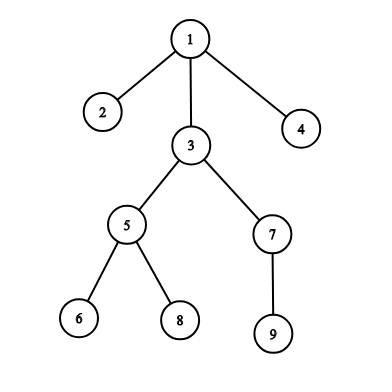
If officer 11 spreads a command, officers receive it in the following order: [1,2,3,5,6,8,7,9,4][1,2,3,5,6,8,7,9,4].
If officer 33 spreads a command, officers receive it in the following order: [3,5,6,8,7,9][3,5,6,8,7,9].
If officer 77 spreads a command, officers receive it in the following order: [7,9][7,9].
If officer 99 spreads a command, officers receive it in the following order: [9][9].
To answer the ii-th query (ui,ki)(ui,ki), construct a sequence which describes the order in which officers will receive the command if the uiui-th officer spreads it. Return the kiki-th element of the constructed list or -1 if there are fewer than kiki elements in it.
You should process queries independently. A query doesn't affect the following queries.
Input
The first line of the input contains two integers nn and qq (2≤n≤2⋅105,1≤q≤2⋅1052≤n≤2⋅105,1≤q≤2⋅105) — the number of officers in Berland army and the number of queries.
The second line of the input contains n−1n−1 integers p2,p3,…,pnp2,p3,…,pn (1≤pi<i1≤pi<i), where pipi is the index of the direct superior of the officer having the index ii. The commander has index 11 and doesn't have any superiors.
The next qq lines describe the queries. The ii-th query is given as a pair (ui,kiui,ki) (1≤ui,ki≤n1≤ui,ki≤n), where uiui is the index of the officer which starts spreading a command, and kiki is the index of the required officer in the command spreading sequence.
Output
Print qq numbers, where the ii-th number is the officer at the position kiki in the list which describes the order in which officers will receive the command if it starts spreading from officer uiui. Print "-1" if the number of officers which receive the command is less than kiki.
You should process queries independently. They do not affect each other.
Example
input
Copy
9 6

1 1 1 3 5 3 5 7

3 1

1 5

3 4

7 3

1 8

1 9
output
Copy
3

6

8

-1

9

4
题解:记录每个节点的时间戳和其有几个子节点即可;DFS
AC代码为:
#include<bits/stdc++.h>
using namespace std;
const int maxn = 2e5 + 10;
int n, m, a, b, c = 1, d;
bool vis[maxn] = { false };
vector<int> graph[maxn];
int level[maxn],pos[maxn],child[maxn];
int dfs(int src)
{
vis[src] = true;
pos[c] = src;
level[src] = c++;
int temp = 1;
for (int i = 0; i<graph[src].size(); i++)
{
if (!vis[graph[src][i]]) temp += dfs(graph[src][i]);
}
return child[src] = temp;
}
int main()
{
cin >> n >> m;
for (int i = 2; i <= n; i++)
{
cin >> a;
graph[a].push_back(i);
}
dfs(1);
while (m--)
{
cin >> a >> b;
if (child[a]<b) cout << -1 << endl;
else cout << pos[level[a] + b - 1] << endl;
}
return 0;
}
CodeForces1006E- Military Problem的更多相关文章
- Military Problem CodeForces 1006E (dfs序)
J - Military Problem CodeForces - 1006E 就是一道dfs序的问题 给定一个树, 然后有q次询问. 每次给出u,k, 求以u为根的子树经过深搜的第k个儿子,如果一个 ...
- CodeForces 1006E Military Problem(DFS,树的选择性遍历)
http://codeforces.com/contest/1006/problem/E 题意: 就是给出n,m,共n个点[1,n],m次询问.第二行给出n-1个数a[i],2<=i<=n ...
- Codeforces Round #498 (Div. 3)--E. Military Problem
题意问,这个点的然后求子树的第i个节点. 这道题是个非常明显的DFS序: 我们只需要记录DFS的入DFS的时间,以及出DFS的时间,也就是DFS序, 然后判断第i个子树是否在这个节点的时间段之间. 最 ...
- Military Problem CodeForces - 1006E(dfs搜一下 标记一下)
题意: 就是有一颗树 然后每次询问 父结点 的 第k个结点是不是他的子嗣...是的话就输出这个子嗣..不是 就输出-1 解析: 突然想到后缀数组的sa 和 x的用法..就是我们可以用一个id标记当前 ...
- Codeforces Round #498 (Div. 3) E. Military Problem (DFS)
题意:建一颗以\(1\)为根结点的树,询问\(q\)次,每次询问一个结点,问该结点的第\(k\)个子结点,如果不存在则输出\(-1\). 题解:该题数据范围较大,需要采用dfs预处理的方法,我们从结点 ...
- 树&图 记录
A - Lake Counting POJ - 2386 最最最最最基础的dfs 挂这道题为了提高AC率(糖水不等式 B - Paint it really, really dark gray Cod ...
- Codeforces Div3 #498 A-F
. A. Adjacent Replacement ...
- Codeforces Round #498 (Div. 3) 简要题解
[比赛链接] https://codeforces.com/contest/1006 [题解] Problem A. Adjacent Replacements [算法] 将序列中的所有 ...
- DFS序专题
牛客专题之DFS序 简介 dfs序: 每个节点在dfs深度优先遍历中的进出栈的时间序列,也就是tarjan算法中的dfn数组. 画个图理解一下: 这棵树的dfs序:1 3 2 4 2 5 6 7 6 ...
随机推荐
- T-SQL, Part II: IMAGE/TEXT Insert
To insert data to IMAGE/TEXT (both keywords are recommend to replace with nvarbinary(MAX)/nvarchar(M ...
- [设置] notepad++快捷设置之——用Finger Text实现自动补全代码
1.我参考的设置方法:https://www.e-learn.cn/content/qita/2368404 和 http://www.itdaan.com/blog/2017/09/13/f7 ...
- vscode加入到鼠标右键
新建.reg的文件,复制下面代码,然后运行 D:\\软件\\VsCode\\Microsoft VS Code\\Code.exe路径改为自己的,必须是两个 \\ 才能生效 Windows Regis ...
- vant-ui的van-area使用
由于官方例子中并没有太多详情,因此记录之,方便以后使用. 1.配置 :area-list="areaList",以初始化全部省市区的数据,其中area.js文件在官方可以下载,放于 ...
- vim常用插件使用方法整理【持续更】
nerdtree 和编辑文件一样,通过h j k l移动光标定位切换工作台和目录 ctr+w+h 光标focus左侧树形目录,ctrl+w+l 光标focus右侧文件显示窗口. ctrl+w+w,光标 ...
- 使用TensorRT对caffe和pytorch onnx版本的mnist模型进行fp32和fp16 推理 | tensorrt fp32 fp16 tutorial with caffe pytorch minist model
本文首发于个人博客https://kezunlin.me/post/bcdfb73c/,欢迎阅读最新内容! tensorrt fp32 fp16 tutorial with caffe pytorch ...
- Python 编程语言要掌握的技能之一:使用数字与字符串的技巧
最佳实践 1. 少写数字字面量 “数字字面量(integer literal)” 是指那些直接出现在代码里的数字.它们分布在代码里的各个角落,比如代码 del users[0] 里的 0 就是一个数字 ...
- windows系统两个网卡如何同时使用?内网和外网共用,配置教程
有些企业的网络分为内网和外网,一般内网不能访问Internet,但是又不提供外网,自己有上外网的需求,所以可能会用到双网卡,无线网卡+有线网卡或者有线+有线... 本文就是为了解决此问题,主要的做法就 ...
- setBounds方法,与setLayout(null)
首先把相关容器的布局方式设为 setLayout(null); 然后调用组件的 setBounds() 方法 设置button的位置为(100,100) 长宽分别为 60,25 jButton.se ...
- 插槽在父组件和子组件间的使用(vue3.0推荐)
子组件: 父组件: 插槽在父组件和子组件间的使用(vue3.0推荐):在外面加一个template模板