
How To Mine Bitcoins 比特币挖矿
linux 下查看 gpu 的信息: sudo lshw -C display
windows下查看cuda信息:In directory C:\Program Files\NVIDIA Corporation\NVSMI there is an utility nvidia-smi.exe it can query lots of different stats about your GPUs. To list all GPUs in your system run it with -L option.
比较有名的矿池:币网的矿池、比特币中国的矿池、鱼池F2Pool。
如果你不知道哪种货币最适合开采,有一个名为“Multipool”的矿池,它会在最赚钱的加密货币之间自动切换。Multipool更新每隔30分钟,随着时间的推移,你会看到,账户在多个币种分配过程中平衡增长。当然,如果你需要,它也会让你选择,仅挖一种货币。
其他需要考虑的因素是,矿池将从您挖掘的币中,收取多少费用。典型值的范围从1%到10%。然而,也有一些矿池不扣除任何费用(译者:例如GHash.io)。
Mining bitcoins – a process that helps manage bitcoin transactions as well as create new “wealth” – is the new Beanie Babies. Luckily for us, however, bitcoins seem to be going up in value and should maintain their value over time, unlike your mint condition Tiny the stuffed Chihuahua.
But how do you get bitcoins? You can begin by buying them outright, but the market is currently wild. At $188 per coin, the direction of the bitcoin is anyone’s guess right now and, unlike equities, these things don’t split. In short, you should probably mine. But what is bitcoin mining?
Think of it as work done by groups of people to find large prime numbers or trying keys to decrypt a file. You can read a lot more about it here but just understand that for every block mined you get 25 coins or, at current rates, $4,722.25. Currently a single bitcoin is valued at $188, an alarming result that is probably caused by money movements related to Cyprus and a general bubble-like excitement over the platform in general. In fact, many wager that the DDOS attacks on many bitcoin-related services are direct action by hackers to inject instability in order to reduce the price.
As it stands, mining solo is very nearly deprecated. The process of finding blocks is now so popular and the difficulty of finding a block so high that it could take over three years to generate any coins. While you could simply set a machine aside and have it run the algorithms endlessly, the energy cost and equipment deprecation will eventually cost more than the actual bitcoins are worth.
Pooled mining, however, is far more lucrative. Using a service like “Slush’s pool” (more on that later) you can split the work among a ground of people. Using this equation:
While this is simplified, it is basically how the system works. You work for shares in a block and when complete you get a percentage of the block based on the number of workers alongside you, less fees. Using this method, I have been able to raise about $1.50 over the weekend by running a dormant PC. The astute among you will note that I probably used twice that amount of electricity.
Being a neophile, I’m surprised it took me so long to start mining. My buddy Tom explained how to set up a pooled mining account so I thought it would be interesting to share the instructions.
1. Get a wallet. You can either store your wallet locally or store it online. Coinbase.com is an online wallet that is surprisingly simple to set up. Wallets require you to use or download a fairly large blockchain file – about 6GB – so downloading and updating a local wallet may be a non-starter. Like all wealth storage mediums, keeping your bitcoins “local” is probably a better idea than trusting a web service, but that’s a matter of private preference. There is no preferred wallet type and there are obvious trade-offs to both. Privacy advocates would probably say a local wallet is best.
You can download a local wallet here but make sure you keep a copy of your data backed up.
Once you’ve created a wallet, you get an address like this: 1BEkUGADFbrEShQb9Xr4pKPtM8jAyiNQsJ. This, without the period, is a direct way to send bitcoins to your wallet. Make a note of your address. In Coinbase, the wallet address found under linked accounts.
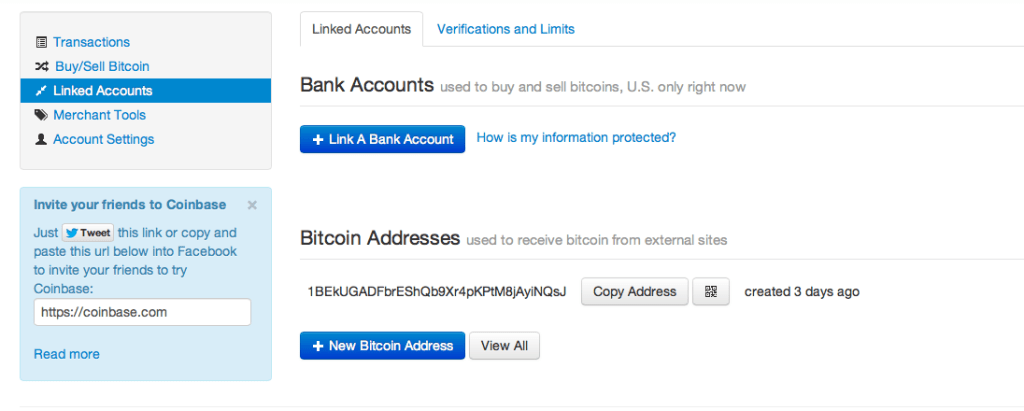
2. Join a pool. To mine in a pool you have to work with a group of other miners on available blocks. The most popular is Slush’s Pool found here. You can also try guilds like BTC Guild as well as a number of other options. Each of the pools is characterized mostly by the fees they charge per block – 2% for Slush’s pool, for example – and the number of users. Pools with fewer users could also have a slower discovery time but pools with many users usually result in smaller payments.
How can you be sure the pool owner doesn’t steal all your bitcoins? You can’t. However, as one pool owner, Slush, notes:
For simplicity’s sake, I’m using Slush’s Pool and have created three workers. First, create a pool login. Then add workers. The workers are sub-accounts with their own passwords and are usually identified by [yourlogin].[workername]. I have three workers running, currently – one on my iMac and two on my old PC.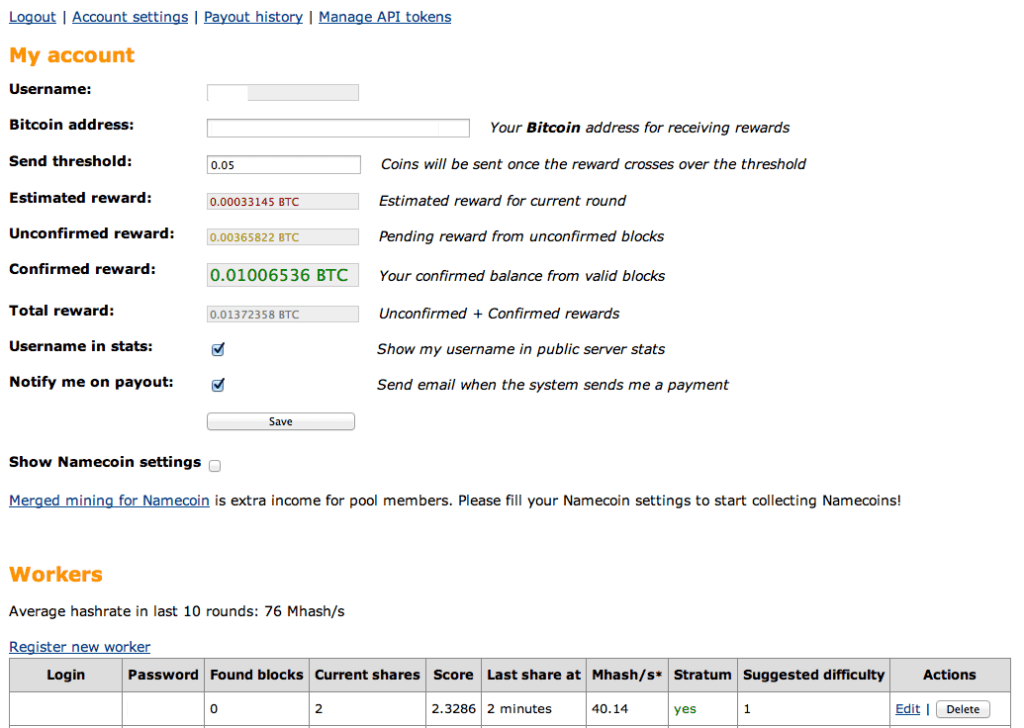
You must create workers to mine. The instructions are very
straightforward for most services so don’t become overwhelmed. Like any
online club, you can dig deeply into the subculture surround bitcoin as
you gain experience. I like to think of it as a financial MMORPG.
Also be sure to enter your wallet address into the pool information. This will ensure you get your bitcoins.
3. Get a miner. There are a number of mining options
for multiple platforms although OSX users may find themselves in a bit
of a pickle. Miners use spare GPU cycles to power the mining operation,
much like services like SETI@Home uses spare cycles for finding
intelligent life. Miners, on the other hand, use these cycles to help
handle peer-to-peer processes associated with bitcoins. Thus by doing
“work” you are maintaining the network as well.
GUIMiner is the
simplest solution for Windows users as it allows you to create miners
using almost all standard graphics cards. You can download it here. 50Miner is also a popular solution. Both require you to enter your worker info and pool and they’ll start mining.
Linux users can run miners like CGMiner. An excellent guide to installing a miner on Ubuntu is available here. (也可以试试 bitminter 和 GUIminer, bitminter it has an easy to use Java app for mining or GUIminer, both are much easier to use.)
OS X users can use DiabloMiner,
a two-year old command-line program that will mine using OpenCL. Sadly,
it uses deprecated calls to Bitcoin and is quite a bit slower. As a
result, you need to run your own proxy, Stratum,
that allows Diablo to connect with services like Slush’s pool. Both of
these programs usually run without issue on OS X although you may need
to install OpenCL for OSX.
To mine I’ve created a script that I run in Terminal that simply runs
the proxy in the background and then connects Diablo. Note the last two
arguments are necessary for Mountain Lion.
./DiabloMiner-OSX.sh -u WORKERNAME -p WORKERPASSWORD -o localhost -r 8332 -w 64 -na
RPCMiner
is far easier to run – you simply click an icon and enter some data –
and both have very rudimentary, text-based interfaces. Running Diablo on
my iMac has not had much effect on application performance under OS X
although it does slow down my Windows 8 machine considerably.
4. Keep your mind on your money. Bitcoins are
baffling in that they are wildly simple to use and mine. Speculators,
then, would probably be able to throw hundreds of machines at the
problem and gather bitcoins like raindrops, right? Wrong. As more
bitcoins are found, they become more difficult to find. This profitability calculator
will help you understand what you’re up against but understand that
this isn’t a sure thing. I’ve run my systems for a weekend and seen a
mere $1.50 – enough for a coke – but other users may have improved
hardware and methods to succeed. In short, if it costs more to run your
hardware than you gain in bitcoins, you’re probably doing something
wrong.
Good luck in your journey and enjoy your first foray into this wild and wooly world.
Download the software
Depending on which equipment you choose, you will need to run software to make use of it. Typically when using GPUs and FPGAs, you will need a host computer running two things: the standard bitcoin client, and the mining software.
Standard bitcoin client
This softwareconnects your computer to the network and enables it to interact with the bitcoin clients, forwarding transactions and keeping track of the block chain. It will take some time for it to download the entire bitcoin block chain so that it can begin. The bitcoin client effectively relays information between your miner and the bitcoin network.
Bitcoin mining software
The bitcoin mining software is what instructs the hardware to do the hard work, passing through transaction blocks for it to solve. There are a variety of these available, depending on your operating system. They are available for Windows, Mac OS X, and others.
You may well need mining software for your ASIC miner, too, although some newer models promise to ship with everything pre-configured, including a bitcoin address, so that all you need to do is plug it in the wall.
One smart developer even produced a mining operating system designed to run on the Raspberry Pi, a low-cost credit card-sized Linux computer designed to consume very small amounts of power. This could be used to power a USB-connected ASIC miner.
Join a pool
Now, you're all set up. Good for you. I bet you thought you were going to be mining more bitcoins than the Federal Reserve prints dollars, didn't you? Sadly not. You will stand little chance of success mining bitcoins unless you work with other people. You can find out more about that in our upcoming guide on how to join a mining pool.
Join a Bitcoin Mining Pool
While it is possible to mine for Bitcoins on your own it is not something I would recommend doing. Solo mining requires an incredible amount of processing power which most people don't have access to.
Pooled mining allows miners to group up to solve blocks and earn Bitcoins together. Each miner that joins the pool earns shares for the work they contribute.
Each time the pool finds a block (currently worth 25 BTC) the Bitcoins earned are divided among the users in the pool based on how many shares they earned in the particular round.
There are many different mining pools you can join, each pool has their on pros and cons. As you learn more about Bitcoins you will be able to make a more educated decision of which pool is best for you.
I recommend joining the Eclipse Mining Consortium because it has some great features and is easy to use.
How To Mine Bitcoins 比特币挖矿的更多相关文章
- 莱特币ltc在linux下的多种挖矿方案详解
莱特币ltc在linux下的多种挖矿方案详解 4.0.1 Nvidia显卡Linux驱动Nvidia全部驱动:http://www.nvidia.cn/Download/index.aspx?lang ...
- 比特币 Bitcoin 是什么,我勒个去,哈耶克果然超前——货币的非国有化,容我思量一下【转载+整理】
原文地址 比特币矿业史(上):故事的开始,CPU 时代 比特币矿业史(中):群众的觉醒 ,GPU 时代 比特币矿业史(下):巨头的诞生 ,ASIC 时代 本文内容 引子 0 序 1 故事的开始 : C ...
- 挖矿程序minerd入侵分析和解决办法
现在比特币的价格涨得很高,所以现在有黑客专门制造挖矿木马来诱导网友,从而达到控制电脑上的显卡来挖掘比特币.为什么木马要控制电脑中的显卡呢?因为显卡挖掘虚拟货币比特币的效率远比 CPU 要高.如果你是一 ...
- 什么是比特币(bitcoin)
一.什么是比特币? 比特币是一种由开源的P2P软件产生的电子货币,是一种网络虚拟货币.比特币使用遍布整个P2P网络节点的分布式数据库来记录货币的交易,并使用密码学的设计来确保货币流通各个环节安全性.比 ...
- 为什么用GPU挖比特币?
http://www.leiphone.com/gpubitcoin.html 呵呵,这么红火的东东,不了解就长不了见识. 转一下两个东东,这挖矿机天天在算什么内容,还有,当前为什么GPU比CPU有优 ...
- [C#]使用 C# 编写自己的区块链挖矿算法
[C#] 使用 C# 编写自己区块链的挖矿算法 文章原文来自:Code your own blockchain mining algorithm in Go! ,原始文章通过 Go 语言来实现的,这里 ...
- 一、Bitcoin比特币与BlockChain区块链技术
一.比特币历史 2008 年 10 月 31 日,一个网名叫中本聪(英文翻译过来滴)的家伙发布比特币唯一的白皮书:<Bitcoin:A Peer-to-PeerElectronic Cash S ...
- Bitcoin挖矿
目录 为什么要挖矿? 比特币挖矿 为什么要挖矿? 增加恶意行为的成本 增加记账权力,获取相应的奖励 比特币挖矿 每开采210000个区块,挖矿奖励减半 2009年1月-2012年11月,奖励50BTC ...
- 国内比特币bitcoin交易平台
火币网: www.huobi.com 比特币中国: www.btcchina.com okcoin: www.okcoin.cn 中国比特币: www.chbtc.com 比特币交易 ...
随机推荐
- android大扫盲之SurfaceView,SurfaceHolder,SurfaceHolder.CallBack
最近接触到了SurfaceView,SurfaceHolder,SurfaceHolder.CallBack,一直不求其解,现在来粗浅认识一下它们. 先看一下官方的定义: 1.SurfaceView ...
- 怎样用Javascript定义一个类
其实Javascript中没有类这个定义,但是有类这个概念.很多人都写过这样的代码,对,没错,就是如下代码,清晰的不能再清晰了,就是一个关键字 function,然后定义一个方法名,方法名后紧跟一对括 ...
- Socket无连接简单实例
使用无连接的套接字,我们能够在自我包含的数据包里发送消息,采用独立的读函数读取消息,读取的消息是使用独立的发送函数发送的.但是UDP数据包不能保证可靠传输,存在许多的因素,比如网络繁忙等等,都有可能阻 ...
- JavaScript------去掉Array中重复值
转载: http://blog.csdn.net/teresa502/article/details/7926796 代码: // 删除数组中重复数据 function removeDuplElem( ...
- BZOJ 1089 SCOI2003 严格n元树 动态规划+高精度
题目大意:定义一棵深度为d的严格n元树为根的深度为0,最深的节点深度为d,且每一个非叶节点都有恰好n个子节点的树 给定n和d,求深度为d的严格n元树一共同拥有多少种 此题的递推部分并不难 首先我们设深 ...
- Emulator Error: Could not load OpenGLES emulation library: Could not load DLL!
Copy the file below from SDK\tools\lib to SDK\tools. libEGL_translator.dlllibGLES_CM_translator.dlll ...
- memset和memcpy函数、atoi函数
memset void *memset(void *s,int c,size_t n) 总的作用:将已开辟内存空间 s 的首 n 个字节的值设为值 c.如下: // 1.将已开辟内存空间s的首n个字节 ...
- ubuntu下code::blocks编译运行一个简单的gtk+2.0项目
在具体的操作之前,首先需要安装一些必要的软件.ubuntu下默认安装了gcc,不过缺少必要的Header file,可以在命令行中输入下面的指令安装build-essential套件:sudo apt ...
- redis基础----->redis的基本使用(一)
这里我们就在虚拟机中安装redis,并且使用java和python实现简单的操作.深情是我承担不起的重担,情话只是偶尔兑现的谎言. redis的使用 下载地址:https://redis.io/.安装 ...
- LeetCode——Count Complete Tree Nodes
Description: Given a complete binary tree, count the number of nodes. In a complete binary tree ever ...