
Looksery Cup 2015 Editorial
下面是题解,做的不好。下一步的目标是rating涨到 1800,没打过几次cf
A. Face Detection
Author: Monyura
One should iterate through each 2x2 square and check if it is possible to rearrange letters in such way they they form the word "face". It could be done i.e. by sorting all letters from the square in alphabetic order and comparing the result with the word "acef"(sorted letters of word "face").
B. Looksery Party
Author: Igor_Kudryashov
In any cases there is such set of people that if they come on party and send messages to their contacts then each employee receives the number of messages that is different from what Igor pointed. Let's show how to build such set. There are 2 cases.
There are no zeros among Igor's numbers. So if nobody comes on party then each employee receives 0 messages and, therefore, the desired set is empty.
There is at least one zero. Suppose Igor thinks that i-th employee will receive 0 messages. Then we should add i-th employee in the desired set. He will send messages to his contacts and will receive 1 message from himself. If we add other employees in the desired set then the number of messages that i-th employee will receive will not decrease so we can remove him from considering. Igor pointed some numbers for people from contact list of i-th employee and because they have already received one message we need to decrease these numbers by one. After that we can consider the same problem but with number of employees equals to n - 1. If the remaining number of employees is equal to 0 then the desired set is built.
C. The Game Of Parity
Author: olpetOdessaONU
If n = k no moves may be done. The winner is determined with starting parity of citizens' number. Otherwise let's see that the player making the last move may guarantee his victory, if there are both odd and even cities when he makes the move. He just selects the city of which parity he should burn to obtain required parity. So, his enemy's target is to destroy all the cities of some one type. Sometimes the type does matter, sometimes doesn't. It depends on the player's name and the parity of k. So the problem's solution consists in checking if "non-last" player's moves number (n - k) / 2 is enough to destroy all the odd or even cities. If Stannis makes the last move and k is odd, Daenerys should burn all the odd or all the even cities. If k is even, Daenerys should burn all the odd cities. If Daenerys makes the last move and k is even, Stannis has no chance to win. If k is odd, Stannis should burn all the even cities.
D. Haar Features
Author: Monyura
This problem had a complicated statement but it is very similar to the real description of the features. Assume that we have a solution. It means we have a sequence of prefix-rectangles and coefficients to multiply. We can sort that sequence by the bottom-right corner of the rectangle and feature's value wouldn't be changed. Now we could apply our operations from the last one to the first. To calculate the minimum number of operations we will iterate through each pixel starting from the bottom-right in any of the column-major or raw-major order. For each pixel we will maintain the coefficient with which it appears in the feature's value. Initially it is 0 for all. If the coefficient of the current cell is not equal to + 1 for W and - 1 for B we increment the required amount of operations. Now we should make coefficient to have a proper value. Assume that it has to be X( - 1 or + 1 depends on the color) but current coefficient of this pixel is C. Then we should anyway add this pixel's value to the feature's value with the coefficient X - C. But the only way to add this pixel's value now(after skipping all pixels that have not smaller index of both row and column) is to get sum on the prefix rectangle with the bottom-left corner in this pixel. Doing this addition we also add X - C to the coefficient of all pixels in prefix-rectangle. This solution could be implemented as I describe above in O(n2m2) or O(nm).
Also I want to notice that in real Haar-like features one applies them not to the whole image but to the part of the image. Anyway, the minimum amount of operations could be calculated in the same way.
E. Sasha Circle
Authors: Krasnokutskiy, 2222
Coming soon
F. Yura and Developers
Authors: Rubanenko
Let's consider following solution:
Let f(l, r) be the solution for [l, r] subarray. It's easy to see that f(1, n) is the answer for the given problem. How should one countf(l, r)? Let m be an index of the maximum value over subarray [l, r]. All the good segments can be divided into two non-intersecting sets: those that contain m and those that don't. To count the latter we can call f(l, m - 1) and f(m + 1, r). We are left with counting the number of subarrays that contain m, i.e. the number of pairs (i, j) such that l ≤ i < m < j ≤ r and g(i, m - 1) + g(m + 1, j)%k = 0(g(s, t) defines as + as + 1 + ... + at). Let s be the sequence of partial sums of the given array, i.e. si = a1 + a2 + ... + ai. For every j we are interested in the number of such i that sj - si - am%k = 0, so if we iterate over every possible j, then we are interested in number ofi that si = sj - am(modk) and l ≤ i < m. So we are left with simple query over the segment problem of form "how many numbers equal tox and belong to a given segment (l, r)". It can be done in O(q + k) time and memory, where q is the number of generated queries. Model solution processes all the queries in offline mode, using frequency array.
One can notice that in the worst case we can generate O(n2) queries which doesn't fit into TL or ML. However, we can choose which is faster: iterate over all possible j or i. In both cases we get an easy congruence which ends up as a query described above. If we iterate only over the smaller segment, every time we "look at" the element w it moves to a smaller segment which is at least two times smaller than the previous one. So, every element will end up in 1-element length segment where recursion will meet it's base in O(log(n))"looking at" this element.
The overall complexity is O(n × log(n) + k).
G. Happy Line
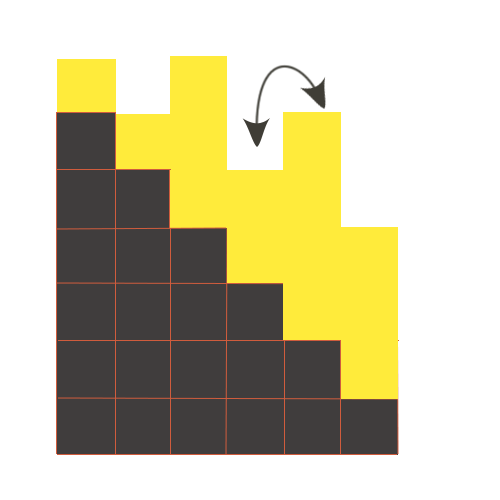
Let's reformulate the condition in terms of a certain height the towers, which will be on the stairs. Then an appropriate amount of money of a person in the queue is equal to the height of the tower with the height of the step at which the tower stands. And the process of moving in the queue will be equivalent to raising a tower on the top step, and the one in whose place it came up — down. As shown in the illustrations. Then, it becomes apparent that to make all of the tower on the steps to be sorted, it is enough to sort the tower without the height of step it stays. Total complexity of sorting is O(nlog(n)).

H. Degenerate Matrix
Author: Igor_Kudryashov
The rows of degenerate matrix are linear dependent so the matrix B can be written in the following way:

Suppose

Let's assume that elements of the first row of matrix A are coordinates of point a0 on two-dimensional plane and the elements of the second row are coordinates of point a1. Assume that the rows of matrix B are also coordinates of points b0 and b1. Let's note that in this case the line that is passing through points b0 and b1 is also passing through point (0, 0).
Let's find the answer — the number d — by using binary search. Suppose we are considering some number d0. We need to check if there is such matrix B that

In geometric interpretation it means that point b0 are inside the square which center is point a0 and length of side is 2·d0. In the same way the point b1 are inside the square which center is point a1 and length of side is 2·d0. So we need to check if there is a line that is passing through point (0, 0) and is crossing these squares. In order to do this we should consider every vertex of the first square, build the line that is passing through the chosen vertex and the center of coordinate plane and check if it cross any side of the other square. Afterwards we should swap the squares and check again. Finally if there is a desired line we need to reduce the search area and to expand otherwise.
Looksery Cup 2015 Editorial的更多相关文章
- Looksery Cup 2015 A. Face Detection 水题
A. Face Detection Time Limit: 20 Sec Memory Limit: 256 MB 题目连接 http://codeforces.com/contest/549/pro ...
- Looksery Cup 2015 B. Looksery Party 暴力
B. Looksery Party Time Limit: 20 Sec Memory Limit: 256 MB 题目连接 http://codeforces.com/contest/549/pro ...
- Looksery Cup 2015 D. Haar Features 暴力
D. Haar Features Time Limit: 20 Sec Memory Limit: 256 MB 题目连接 http://codeforces.com/contest/549/prob ...
- Looksery Cup 2015 H. Degenerate Matrix 数学
H. Degenerate Matrix Time Limit: 20 Sec Memory Limit: 256 MB 题目连接 http://codeforces.com/contest/549/ ...
- Looksery Cup 2015 F - Yura and Developers 单调栈+启发式合并
F - Yura and Developers 第一次知道单调栈搞出来的区间也能启发式合并... 你把它想想成一个树的形式, 可以发现确实可以启发式合并. #include<bits/stdc+ ...
- codeforces Looksery Cup 2015 H Degenerate Matrix
The determinant of a matrix 2 × 2 is defined as follows: A matrix is called degenerate if its determ ...
- Looksery Cup 2015 C. The Game Of Parity —— 博弈
题目链接:http://codeforces.com/problemset/problem/549/C C. The Game Of Parity time limit per test 1 seco ...
- codeforces Looksery Cup 2015 D. Haar Features
The first algorithm for detecting a face on the image working in realtime was developed by Paul Viol ...
- codeforces Looksery Cup 2015 H Degenerate Matrix 二分 注意浮点数陷阱
#include <cstdio> #include <cstring> #include <algorithm> #include <string> ...
随机推荐
- 模拟select样式,自定义下拉列表为树结构
效果图如下: 首先,需要用到的库jQuery,zTree(官网API:http://www.treejs.cn/v3/api.php) 注意:因为zTree是基于jQuery的,所以应该先引入jQue ...
- Android 如何打造Android自定义的下拉列表框控件
一.概述 Android中的有个原生的下拉列表控件Spinner,但是这个控件有时候不符合我们自己的要求, 比如有时候我们需要类似windows 或者web网页中常见的那种下拉列表控件,类似下图这样的 ...
- codeforces 540 B School Marks【贪心】
题意:一共n个数,给出其中k个数,要求这n个数的中位数为y,这n个数的和不超过x,补全剩下的n-k个数 先统计给出的k个数里面比中位数小的数, 如果cnt<=n/2,说明中位数还没有出现,把这n ...
- WLAN 基础架构功能
WLAN 基础架构功能 Android WLAN 框架可帮助用户连接到优质 WLAN 网络(在有可用 WLAN 网络且需要连接到这类网络的情况下).Android 可通过多种方式来实现这一点: 打开网 ...
- Debian9.5 系统配置持久化iptables规则
RedHat和SUSE系列下有比较好用的iptables管理工具,可以像控制服务进程一样来对防火墙进行管理及控制,Debian系发行版默认不开启iptables,当然也没有与之相关的能直接管理的工具了 ...
- core组件进阶
访问图像像素 存储方式 BGR连续存储有助于提升图像扫描速度. isContinuous()判断是否是连续存储. 颜色空间缩减 仅用这些颜色中具有代表性的很小的部分,就足以达到同样的效果. 将现有颜色 ...
- 怎么打开/查看MySQL的SQL记录
mysql在执行sql的时候会在日志当中记录很多信息,当然包括执行的所有语句.下面以使用navicat for mysql为例,来展示一下如何打开/查看MySQL的SQL记录: 打开navicat f ...
- struts2怎么返回一个字符串给jsp?(使用json)
我们都知道使用servlet时可以直接用PrintWriter对象的print方法来向页面传送一些字符串(可以是html标签和内容),然后在用RequestDispatcher来转向网页 虽Strut ...
- [React Native] Use the SafeAreaView Component in React Native for iPhone X Compatibility
In this lesson, you will learn how to use the SafeAreaView component to avoid the sensor cluster (th ...
- Android资源之图像资源(状态图像资源)
在上一篇博文中.我主要解说了XML图像资源中的图层资源,在此图像资源博文中我会给大家陆续解说XMl图像资源的图像状态资源.图像级别资源.淡入淡出资源.嵌入图像资源.剪切图像资源和外形资源. 1.图像状 ...