
SpringBoot整合aspectj实现面向切面编程(即AOP)
前言
“面向切面编程”,这样的名字并不是非常容易理解,且容易产生一些误导。但在实际业务中,AOP有着广泛的用途,比如日志记录,性能统计,安全控制,事务处理,异常处理等等。
举些栗子
场景1、现有一个系统,已经运行了几个月,项目经理想要
统计每个接口的耗时情况,用来分析系统性能,进而重构代码进行优化;
场景2、有一个管理后台,存在一些修改、删除的敏感操作,产品经理为了减少风险要求每一次的修改、删除操作都需要记录在数据库中,不仅要
记录操作人,还要记录入参出参;
场景3、由于系统在运行中,不可避免的会出现一些异常,但是一出现异常就会有很多报错日志,但这些日志是不能返回给前端的,需要
统一处理这些异常,返回前端的只能是“系统出现一些小问题”这样的文案;
...
难点分析&解决方案
上面的场景都是真实存在的需求,但是如果不能统一处理的话,基本都是一改一大片,除了对业务代码有很强的侵入性,而且难以保证不出问题。
所以为了解决这种需求,AspectJ框架应运而生。不过SpringBoot官方也推出了 Spring AOP, 具体对比我就不赘述了,详细对比可以参https://www.jianshu.com/p/872d3dbdc2ca
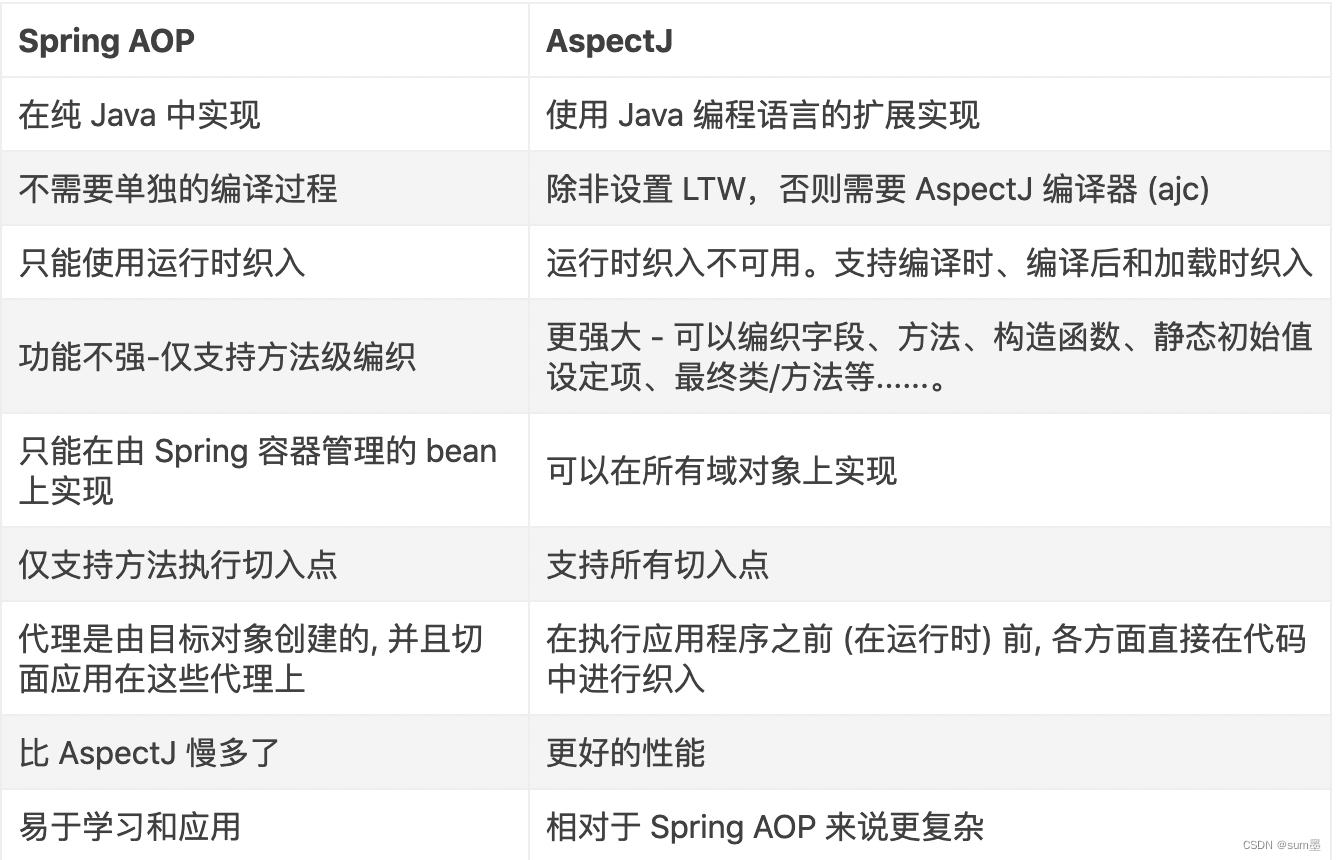
开发步骤
1、引入依赖
<dependency>

	<groupId>org.aspectj</groupId>

	<artifactId>aspectjweaver</artifactId>

	<version>1.9.5</version>

</dependency>
2、创建切面类并加上@Component注解
这一步相当于把切面类的管理权交给了Spring容器,让Spring容器负责该对象的创建与销毁,我们负责使用就行。
3、指定@Pointcut,可以是方法也可以是注解
这里说一下Pointcut execution规则
任意公共方法的执行:
execution(public * *(..))
public可以省略, 第一个* 代表方法的任意返回值 第二个参数代表任意包+类+方法 (..)任意参数任何一个以“set”开始的方法的执行:
execution(* set*(..))UserService接口的任意方法:
execution(* com.example.springbootaop.UserService.*(..))定义在com.coffee.service包里的任意方法的执行:
execution(* com.example.springbootaop.*.*(..))
第一个 .* 代表任意类, 第二个 .* 代表人以方法定义在service包和所有子包里的任意类的任意方法的执行:
execution(* com.example.springbootaop.service..*.*(..))
..* 代表任意包或者子包定义在com.example.springbootaop包和所有子包里的UserService类的任意方法的执行:
execution(* com.example.springbootaop..UserService.*(..))")
4、五大通知注解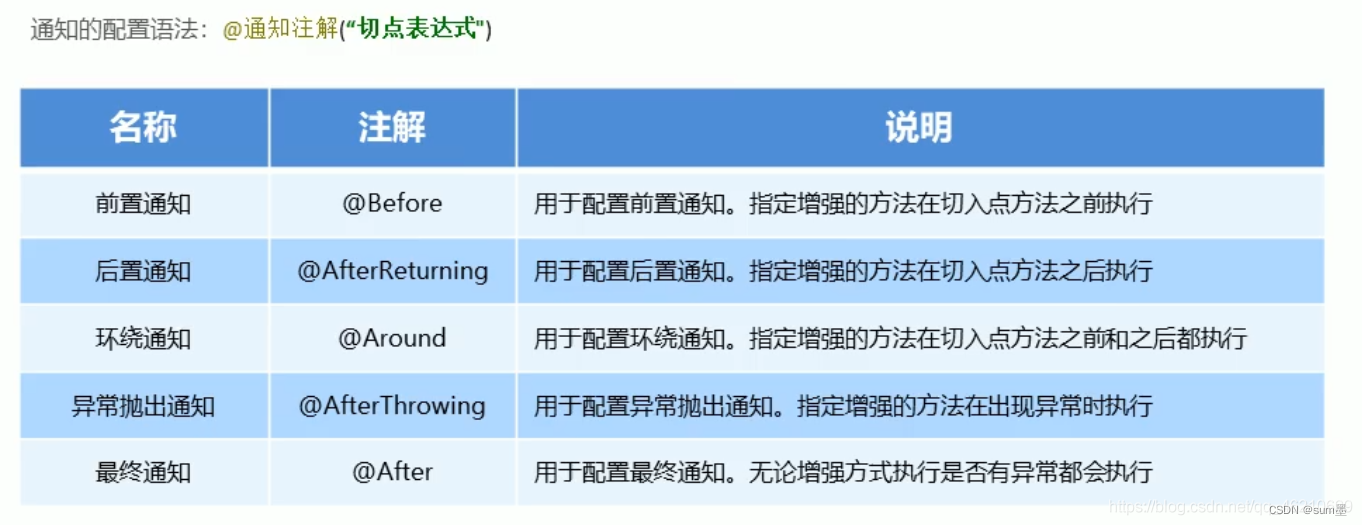
尝试一下
1、配置文件
SpringBoot项目pom.xml
<?xml version="1.0" encoding="UTF-8"?>

<project xmlns="http://maven.apache.org/POM/4.0.0" xmlns:xsi="http://www.w3.org/2001/XMLSchema-instance"

         xsi:schemaLocation="http://maven.apache.org/POM/4.0.0 https://maven.apache.org/xsd/maven-4.0.0.xsd">

    <modelVersion>4.0.0</modelVersion>

    <parent>

        <groupId>org.springframework.boot</groupId>

        <artifactId>spring-boot-starter-parent</artifactId>

        <version>2.7.1</version>

        <relativePath/> <!-- lookup parent from repository -->

    </parent>

    <groupId>com.example</groupId>

    <artifactId>SpringBoot-aop</artifactId>

    <version>0.0.1-SNAPSHOT</version>

    <name>SpringBoot-aop</name>

    <description>Demo project for Spring Boot</description>

    <properties>

        <java.version>1.8</java.version>

    </properties>

    <dependencies>

        <dependency>

            <groupId>org.springframework.boot</groupId>

            <artifactId>spring-boot-starter-web</artifactId>

        </dependency>

        <dependency>

            <groupId>org.aspectj</groupId>

            <artifactId>aspectjweaver</artifactId>

            <version>1.9.5</version>

        </dependency>

        <dependency>

            <groupId>org.springframework.boot</groupId>

            <artifactId>spring-boot-starter-test</artifactId>

            <scope>test</scope>

        </dependency>

    </dependencies>

    <build>

        <plugins>

            <plugin>

                <groupId>org.springframework.boot</groupId>

                <artifactId>spring-boot-maven-plugin</artifactId>

            </plugin>

        </plugins>

    </build>

</project>
2、项目代码
项目结构
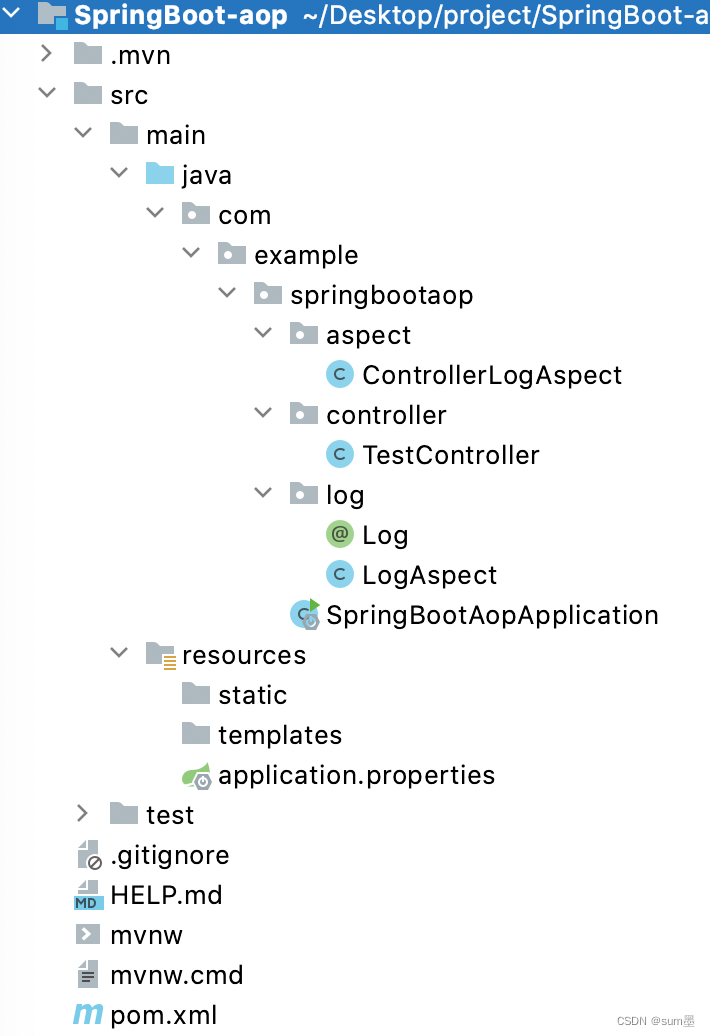
SpringBootAopApplication.java
import org.springframework.boot.SpringApplication;

import org.springframework.boot.autoconfigure.SpringBootApplication;

@SpringBootApplication

public class SpringBootAopApplication {

    public static void main(String[] args) {

        SpringApplication.run(SpringBootAopApplication.class, args);

    }

}
TestController.java
import com.example.springbootaop.log.Log;

import org.springframework.web.bind.annotation.GetMapping;

import org.springframework.web.bind.annotation.PostMapping;

import org.springframework.web.bind.annotation.RequestMapping;

import org.springframework.web.bind.annotation.RestController;

import java.util.Map;

@RestController

@RequestMapping("/aop")

public class TestController {

    @GetMapping("/a")

    @Log(desc = "接口a的描述")

    public String a() {

        return "我是接口a";

    }

    @GetMapping("/b")

    @Log(desc = "接口b的描述")

    public String b(String param1) {

        System.out.println("打印参数:" + param1);

        return "我是接口b";

    }

    @PostMapping("/c")

    @Log(desc = "接口c的描述")

    public String c(Map<String, String> stringMap) {

        System.out.println("打印参数:" + stringMap);

        return "我是接口c";

    }

}
ControllerLogAspect.java
import org.aspectj.lang.ProceedingJoinPoint;

import org.aspectj.lang.annotation.Around;

import org.aspectj.lang.annotation.Aspect;

import org.aspectj.lang.annotation.Pointcut;

import org.slf4j.Logger;

import org.slf4j.LoggerFactory;

import org.springframework.core.annotation.Order;

import org.springframework.stereotype.Component;

import org.springframework.web.context.request.RequestAttributes;

import org.springframework.web.context.request.RequestContextHolder;

import org.springframework.web.context.request.ServletRequestAttributes;

import javax.servlet.http.HttpServletRequest;

@Aspect

@Component

@Order(1)

public class ControllerLogAspect {

    private static final Logger LOG = LoggerFactory.getLogger(ControllerLogAspect.class);

    @Pointcut("execution(* com.example.springbootaop.controller..*.*(..))")

    private void controllerMethod() {

    }

    @Around("controllerMethod()")

    public Object doAround(ProceedingJoinPoint joinPoint) throws Throwable {

        RequestAttributes ra = RequestContextHolder.getRequestAttributes();

        ServletRequestAttributes sra = (ServletRequestAttributes) ra;

        HttpServletRequest request = sra.getRequest();

        // 获取请求相关信息

        String url = request.getRequestURL().toString();

        String method = request.getMethod();

        String uri = request.getRequestURI();

        String params = request.getQueryString();

        LOG.info("url:[{}];method:[{}];uri:[{}];params:[{}]", url, method, uri, params);

        return joinPoint.proceed();

    }

}
Log.java
import java.lang.annotation.ElementType;

import java.lang.annotation.Retention;

import java.lang.annotation.RetentionPolicy;

import java.lang.annotation.Target;

@Target(ElementType.METHOD)

@Retention(RetentionPolicy.RUNTIME)

public @interface Log {

    String desc() default "";

}
LogAspect.java
import org.aspectj.lang.ProceedingJoinPoint;

import org.aspectj.lang.annotation.Around;

import org.aspectj.lang.annotation.Aspect;

import org.aspectj.lang.annotation.Pointcut;

import org.aspectj.lang.reflect.MethodSignature;

import org.slf4j.Logger;

import org.slf4j.LoggerFactory;

import org.springframework.core.annotation.Order;

import org.springframework.stereotype.Component;

import java.lang.reflect.Method;

@Aspect

@Component

@Order(2)

public class LogAspect {

    private static final Logger LOG = LoggerFactory.getLogger(LogAspect.class);

    @Pointcut("@annotation(com.example.springbootaop.log.Log)")

    private void pointCut() {

    }

    @Around("pointCut()")

    public Object doAround(ProceedingJoinPoint joinPoint) throws Throwable {

        MethodSignature signature = (MethodSignature) joinPoint.getSignature();

        Method method = signature.getMethod();

        //获取注解

        Log logAnnotation = method.getAnnotation(Log.class);

        LOG.info("当期方法的注解为:[{}]", logAnnotation.desc());

        return joinPoint.proceed();

    }

}
3、项目总结
上面的项目使用了两种切面
(1)ControllerLogAspect
ControllerLogAspect会扫描com.example.springbootaop.controller包下所有的方法,这种方式可以用在性能统计、事务处理等场景。
(2)Log注解 + LogAspect
这种方式扫描的不再是某个包,而是某个注解,Pointcut代码如下
@Pointcut("@annotation(com.example.springbootaop.log.Log)")

    private void pointCut() {

    }
配合注解一起使用,更加清晰且灵活,每一个方法都可以配置自己的信息,这种一般会用在日志记录、异常处理等场景。
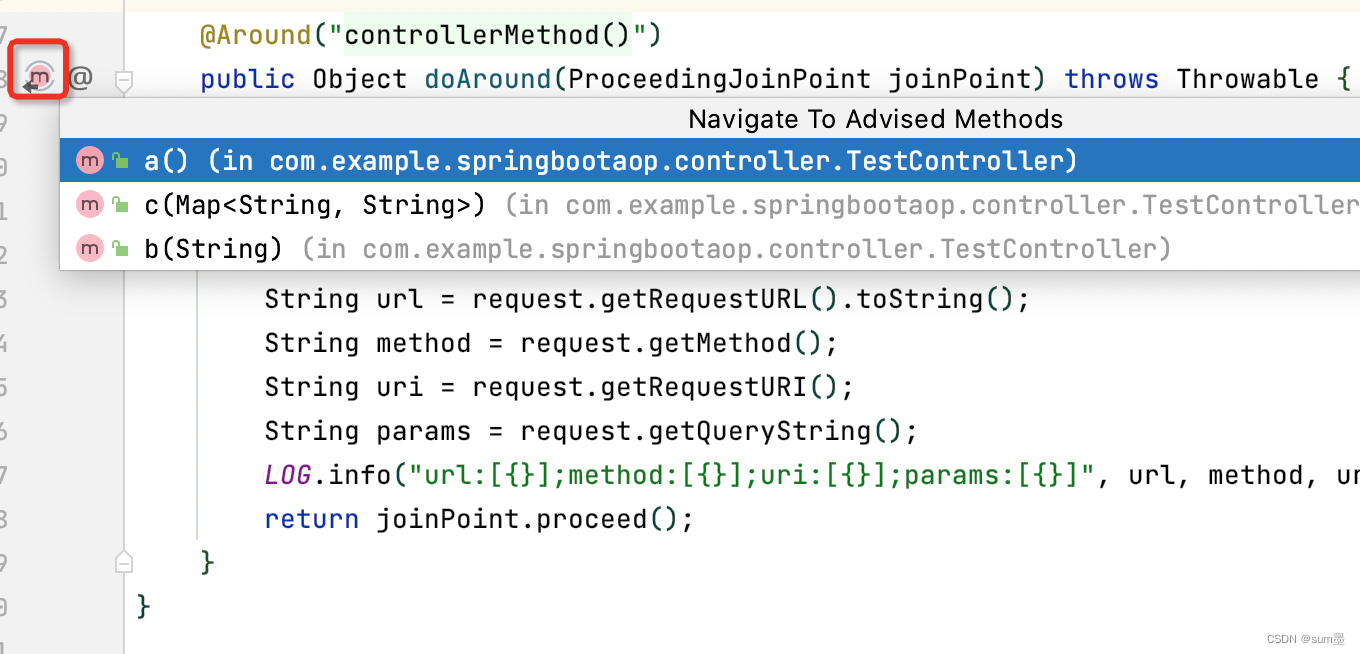
在idea中如果是切面的话,出现如下图标,点击就可以看到所有被切入的方法:
SpringBoot整合aspectj实现面向切面编程(即AOP)的更多相关文章
- 依赖注入(DI)有助于应用对象之间的解耦,而面向切面编程(AOP)有助于横切关注点与所影响的对象之间的解耦(转good)
依赖注入(DI)有助于应用对象之间的解耦,而面向切面编程(AOP)有助于横切关注点与所影响的对象之间的解耦.所谓横切关注点,即影响应用多处的功能,这些功能各个应用模块都需要,但又不是其主要关注点,常见 ...
- Spring——面向切面编程(AOP)详解
声明:本博客仅仅是一个初学者的学习记录.心得总结,其中肯定有许多错误,不具有参考价值,欢迎大佬指正,谢谢!想和我交流.一起学习.一起进步的朋友可以加我微信Liu__66666666 这是简单学习一遍之 ...
- Spring(三)面向切面编程(AOP)
在直系学长曾经的指导下,参考了直系学长的博客(https://www.cnblogs.com/WellHold/p/6655769.html)学习Spring的另一个核心概念--面向切片编程,即AOP ...
- Spring 面向切面编程(AOP)
Spring 系列教程 Spring 框架介绍 Spring 框架模块 Spring开发环境搭建(Eclipse) 创建一个简单的Spring应用 Spring 控制反转容器(Inversion of ...
- 面向切面编程(AOP)及其作用
在OOP设计中,它导致了大量代码的重复,而不利于各个模块的重用. 1.面向切面编程(AOP) 面向切面编程(AOP)就是对软件系统不同关注点的分离,开发者通过拦截方法调用并在方法调用前后添加辅助代码. ...
- C# 中使用面向切面编程(AOP)中实践代码整洁
1. 前言 最近在看<架构整洁之道>一书,书中反复提到了面向对象编程的 SOLID 原则(在作者的前一本书<代码整洁之道>也是被大力阐释),而面向切面编程(Aop)作为面向对象 ...
- C# 中使用面向切面编程(AOP)中实践代码整洁(转)
出处:https://www.cnblogs.com/chenug/p/9848852.html 1. 前言 最近在看<架构整洁之道>一书,书中反复提到了面向对象编程的 SOLID 原则( ...
- (转存)面向切面编程(AOP)的理解
面向切面编程(AOP)的理解 标签: aop编程 2010-06-14 20:17 45894人阅读 评论(11) 收藏 举报 分类: Spring(9) 在传统的编写业务逻辑处理代码时,我们通常 ...
- 面向切面编程 (AOP )
什么是面向切面编程? 面向切面编程就是(AOP --- aspect-oriented programming), 在百科上说: 面向切面编程,通过预编译方式和运行期动态代理实现程序功能的统一维护的一 ...
- 解耦与分离 —— 面向切面编程(AOP)
家里的电表总结起来有两大特性: 电视机需要(电量管理),空调需要(电量管理),热水器也需要电量管理,即一组对象都需要某一功能特性: 电视机根据信号输出画面,空调吹出冷风,热水器将水加热,这些业务功能的 ...
随机推荐
- [转帖]Run Grafana behind a reverse proxy
On this page Introduction Configure NGINX Configure HAProxy Configure IIS Configure Traefik Summary ...
- [转帖]Oracle 创建和查看DBLink 的方法
https://www.cnblogs.com/zhouzangood/articles/4612441.html 1.如果需要创建全局 DBLink,则需要先确定用户有创建 dblink 的权限: ...
- 【转帖】SmartNIC — TSO、GSO、LRO、GRO 技术
目录 文章目录 目录 TSO(TCP Segmentation Offload) GSO(Generic Segmentation Offload) LRO(Large Receive Offload ...
- Redis命令监控与简单分析
Redis命令监控与简单分析 前言 为了能够快速识别分析redis的命令 自己在环境上面进行了一些简单的跟踪以及脚本 这里不全是进行metrics, 细致到具体的命令分析 脚本部分-1 mkdir - ...
- [转帖]记录一次spring-boot程序内存泄露排查
现象 spring boot项目jvm启动配置-Xms4g -Xmx4g,然而很不幸的是程序所占的内存越来越高,都达到了12个多G,只能临时重启服务 常用命令 jstat -class PID jst ...
- Oracle Linux7 与Oracle Linux8 下载rpm包的位置
Oracle Linux 7 http://yum.oracle.com/repo/OracleLinux/OL7/latest/x86_64/index.html 索引页 http://yum.or ...
- 学习MySQL,创建表,数据类型
连接本地mysql语句 mysql -hlocalhost -uroot -proot MySQL通用语法 DDL数据库操作 DDL:数据定义语言,用来定义数据库对象(数据库,表,字段) 查询所有数据 ...
- 如何去掉 node.js 获取MySQL数据产生的RowDataPacket
如何去掉 node.js 获取MySQL数据产生的RowDataPacket 利用JSON.stringify()把对象转为对象字符串,可去掉RowDataPacket. router.post('/ ...
- vue中$once的使用
$once 可以给组件实例绑定一个自定义事件,但该事件只能被触发一次,触发之后随即被移除 $once的简单使用 <template> <div> <button @cli ...
- 详解Promise.race()可以解决多个异步请求那个请求先返回
Promise.race([]);接受一个参数,由promise组成的一个数组: 它的返回结果是promise对象: 它的结果和状态由什么去决定呢? 由第一个改变Promise状态的对象去决定:若是返 ...