
IoU与非极大值抑制(NMS)的理解与实现
1. IoU(区域交并比)
计算IoU的公式如下图,可以看到IoU是一个比值,即交并比。
在分子中,我们计算预测框和ground-truth之间的重叠区域;
分母是并集区域,或者更简单地说,是预测框和ground-truth所包含的总区域。
重叠区域和并集区域的比值,就是IoU。

1.1 为什么使用IoU来评估目标检测器
与分类任务不同,我们预测的bounding box的坐标需要去匹配ground-truth的坐标,而坐标完全匹配基本是不现实的。因此,我们需要定义一个评估指标,奖励那些与ground-truth匹配较好(重叠较大)的预测框。
1.2 IoU的python实现
def bb_intersection_over_union(boxA, boxB):
# determine the (x, y)-coordinates of the intersection rectangle
# 画个图会很明显,x左、y上取大的,x右、y下取小的,刚好对应交集
xA = max(boxA[0], boxB[0])
yA = max(boxA[1], boxB[1])
xB = min(boxA[2], boxB[2])
yB = min(boxA[3], boxB[3])
# compute the area of intersection rectangle
# 计算交集部分面积
interArea = max(0, xB - xA + 1) * max(0, yB - yA + 1)
# compute the area of both the prediction and ground-truth rectangles
# 计算预测值和真实值的面积
boxAArea = (boxA[2] - boxA[0] + 1) * (boxA[3] - boxA[1] + 1)
boxBArea = (boxB[2] - boxB[0] + 1) * (boxB[3] - boxB[1] + 1)
# compute the intersection over union by taking the intersection
# area and dividing it by the sum of prediction + ground-truth
# areas - the interesection area
# 计算IoU,即 交/(A+B-交)
iou = interArea / float(boxAArea + boxBArea - interArea)
# return the intersection over union value
return iou
2. 非极大化抑制(NMS)
2.1 算法思想
所谓非极大值抑制:先假设有6个输出的矩形框(即proposal_clip_box),根据分类器类别分类概率做排序,从小到大分别属于车辆的概率(scores)分别为A、B、C、D、E、F。
(1)从最大概率矩形框F开始,分别判断A~E与F的重叠度IOU是否大于某个设定的阈值;
(2)假设B、D与F的重叠度超过阈值,那么就扔掉B、D;并标记第一个矩形框F,是我们保留下来的。
(3)从剩下的矩形框A、C、E中,选择概率最大的E,然后判断E与A、C的重叠度,重叠度大于一定的阈值,那么就扔掉;并标记E是我们保留下来的第二个矩形框。

就这样一直重复,找到所有被保留下来的矩形框。
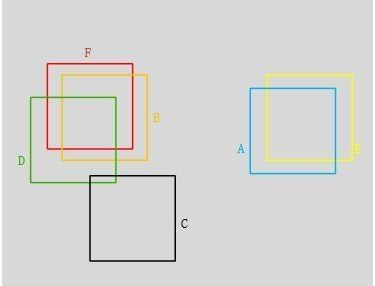
如上图F与BD重合度较大,可以去除BD。AE重合度较大,我们删除A,保留scores较大的E。C和其他重叠都小保留C。最终留下了C、E、F三个。
2.2 python实现
1.无条件保留置信度最高的框;
2.删除与保留框IOU大于阈值的候选框;
 # --------------------------------------------------------

 # Fast R-CNN

 # Copyright (c) 2015 Microsoft

 # Licensed under The MIT License [see LICENSE for details]

 # Written by Ross Girshick

 # --------------------------------------------------------

 import numpy as np

 def py_cpu_nms(dets, thresh):

     """Pure Python NMS baseline."""

     x1 = dets[:, 0]

     y1 = dets[:, 1]

     x2 = dets[:, 2]

     y2 = dets[:, 3]

     scores = dets[:, 4]

     areas = (x2 - x1 + 1) * (y2 - y1 + 1)

     order = scores.argsort()[::-1]

     keep = []

     while order.size > 0:

         i = order[0]

         keep.append(i)

         xx1 = np.maximum(x1[i], x1[order[1:]])

         yy1 = np.maximum(y1[i], y1[order[1:]])

         xx2 = np.minimum(x2[i], x2[order[1:]])

         yy2 = np.minimum(y2[i], y2[order[1:]])

         w = np.maximum(0.0, xx2 - xx1 + 1)

         h = np.maximum(0.0, yy2 - yy1 + 1)

         inter = w * h

         ovr = inter / (areas[i] + areas[order[1:]] - inter)

         inds = np.where(ovr <= thresh)[0]

         order = order[inds + 1]

     return keep
3. soft-NMS
soft NMS提出尤其对密集物体检测的检测效果有一定的提升作用
绝大部分目标检测方法,最后都要用到 NMS-非极大值抑制进行后处理。 通常的做法是将检测框按得分排序,然后保留得分最高的框,同时删除与该框重叠面积大于一定比例的其它框。
这种贪心式方法存在如下图所示的问题: 红色框和绿色框是当前的检测结果,二者的得分分别是0.95和0.80。如果按照传统的NMS进行处理,首先选中得分最高的红色框,然后绿色框就会因为与之重叠面积过大而被删掉。
另一方面,NMS的阈值也不太容易确定,设小了会出现下图的情况(绿色框因为和红色框重叠面积较大而被删掉),设置过高又容易增大误检。

soft NMS算法的大致思路为:M为当前得分最高框,bi 为待处理框,bi 和M的IOU越大,bi 的得分si 就下降的越厉害。
算法结构如图所示:
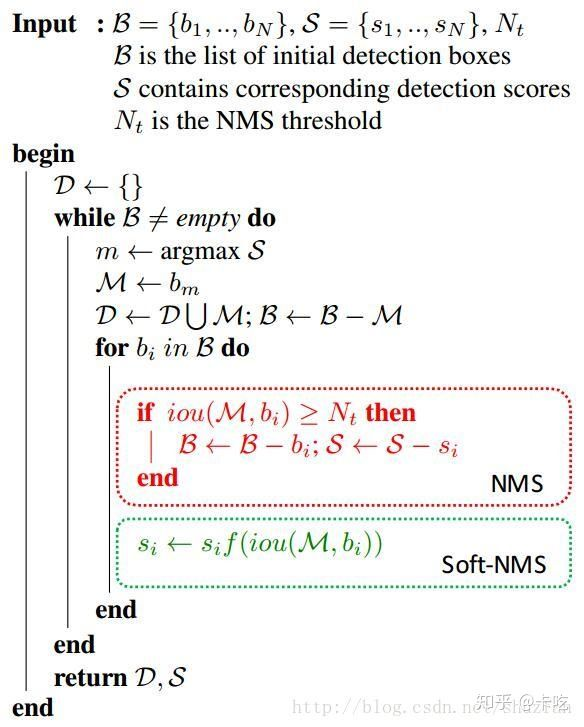
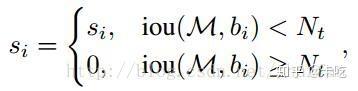
NMS中:
soft NMS中:
(1)线性加权:

(2)高斯加权:
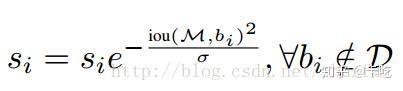
soft NMS仍然有问题:其阈值仍然需要手工设定
soft nms 代码实现:
# coding:utf-8

import numpy as np

def soft_nms(boxes, sigma=0.5, Nt=0.1, threshold=0.001, method=1):

    N = boxes.shape[0]

    pos = 0

    maxscore = 0

    maxpos = 0

    for i in range(N):

        maxscore = boxes[i, 4]

        maxpos = i

        tx1 = boxes[i,0]

        ty1 = boxes[i,1]

        tx2 = boxes[i,2]

        ty2 = boxes[i,3]

        ts = boxes[i,4]

        pos = i + 1

    # get max box

        while pos < N:

            if maxscore < boxes[pos, 4]:

                maxscore = boxes[pos, 4]

                maxpos = pos

            pos = pos + 1

    # add max box as a detection

        boxes[i,0] = boxes[maxpos,0]

        boxes[i,1] = boxes[maxpos,1]

        boxes[i,2] = boxes[maxpos,2]

        boxes[i,3] = boxes[maxpos,3]

        boxes[i,4] = boxes[maxpos,4]

    # swap ith box with position of max box

        boxes[maxpos,0] = tx1

        boxes[maxpos,1] = ty1

        boxes[maxpos,2] = tx2

        boxes[maxpos,3] = ty2

        boxes[maxpos,4] = ts

        tx1 = boxes[i,0]

        ty1 = boxes[i,1]

        tx2 = boxes[i,2]

        ty2 = boxes[i,3]

        ts = boxes[i,4]

        pos = i + 1

    # NMS iterations, note that N changes if detection boxes fall below threshold

        while pos < N:

            x1 = boxes[pos, 0]

            y1 = boxes[pos, 1]

            x2 = boxes[pos, 2]

            y2 = boxes[pos, 3]

            s = boxes[pos, 4]

            area = (x2 - x1 + 1) * (y2 - y1 + 1)

            iw = (min(tx2, x2) - max(tx1, x1) + 1)

            if iw > 0:

                ih = (min(ty2, y2) - max(ty1, y1) + 1)

                if ih > 0:

                    ua = float((tx2 - tx1 + 1) * (ty2 - ty1 + 1) + area - iw * ih)

                    ov = iw * ih / ua #iou between max box and detection box

                    if method == 1: # linear

                        if ov > Nt:

                            weight = 1 - ov

                        else:

                            weight = 1

                    elif method == 2: # gaussian

                        weight = np.exp(-(ov * ov)/sigma)

                    else: # original NMS

                        if ov > Nt:

                            weight = 0

                        else:

                            weight = 1

                    boxes[pos, 4] = weight*boxes[pos, 4]

                    print(boxes[:, 4])

            # if box score falls below threshold, discard the box by swapping with last box

            # update N

                    if boxes[pos, 4] < threshold:

                        boxes[pos,0] = boxes[N-1, 0]

                        boxes[pos,1] = boxes[N-1, 1]

                        boxes[pos,2] = boxes[N-1, 2]

                        boxes[pos,3] = boxes[N-1, 3]

                        boxes[pos,4] = boxes[N-1, 4]

                        N = N - 1

                        pos = pos - 1

            pos = pos + 1

    keep = [i for i in range(N)]

    return keep

boxes = np.array([[100, 100, 150, 168, 0.63],[166, 70, 312, 190, 0.55],[221, 250, 389, 500, 0.79],[12, 190, 300, 399, 0.9],[28, 130, 134, 302, 0.3]])

keep = soft_nms(boxes)

print(keep)
参考链接:
https://zhuanlan.zhihu.com/p/47189358
https://zhuanlan.zhihu.com/p/70768666
https://blog.csdn.net/leviopku/article/details/80886386
IoU与非极大值抑制(NMS)的理解与实现的更多相关文章
- IOU和非极大值抑制
如何判断对象检测算法运作良好呢? 一.交并比(Intersection over union,IoU) 是产生的候选框(candidate bound)与原标记框(ground truth bound ...
- 第二十七节,IOU和非极大值抑制
你如何判断对象检测算法运作良好呢?在这一节中,你将了解到并交比函数,可以用来评价对象检测算法. 一 并交比(Intersection over union ) 在对象检测任务中,你希望能够同时定位对象 ...
- 非极大值抑制(NMS)
非极大值抑制顾名思义就是抑制不是极大值的元素,搜索局部的极大值.这个局部代表的是一个邻域,邻域有两个参数可变,一个是邻域的维数,二是邻域的大小.这里不讨论通用的NMS算法,而是用于在目标检测中提取分数 ...
- pytorch实现yolov3(4) 非极大值抑制nms
在上一篇里我们实现了forward函数.得到了prediction.此时预测出了特别多的box以及各种class probability,现在我们要从中过滤出我们最终的预测box. 理解了yolov3 ...
- 非极大值抑制(Non-Maximum Suppression,NMS)
概述 非极大值抑制(Non-Maximum Suppression,NMS),顾名思义就是抑制不是极大值的元素,可以理解为局部最大搜索.这个局部代表的是一个邻域,邻域有两个参数可变,一是邻域的维数,二 ...
- 目标检测 非极大值抑制(Non-Maximum Suppression,NMS)
非极大值抑制(Non-Maximum Suppression,NMS),顾名思义就是抑制不是极大值的元素,可以理解为局部最大搜索.也可以理解为只取置信度最高的一个识别结果. 举例:  如图所示,现在 ...
- 非极大值抑制(NMS)
转自:https://www.cnblogs.com/makefile/p/nms.html 概述 非极大值抑制(Non-Maximum Suppression,NMS),顾名思义就是抑制不是极大值的 ...
- 非极大值抑制Non-Maximum Suppression(NMS)
非极大值抑制(Non-Maximum Suppression,NMS) 概述 非极大值抑制(Non-Maximum Suppression,NMS),顾名思义就是抑制不是极大值的元素,可以理解为局 ...
- Non-Maximum Suppression,NMS非极大值抑制
Non-Maximum Suppression,NMS非极大值抑制概述非极大值抑制(Non-Maximum Suppression,NMS),顾名思义就是抑制不是极大值的元素,可以理解为局部最大搜索. ...
随机推荐
- [LeetCode] 658. Find K Closest Elements 寻找K个最近元素
Given a sorted array, two integers k and x, find the k closest elements to x in the array. The resul ...
- 2条最佳实践App疯狂增长逻辑
2条最佳实践App疯狂增长逻辑 1.不断打造和强化产品的不可或缺属性 产品的核心价值是什么?对你的客户来言,为什么是你? 2.等待“阿哈时刻” 进入快速推广 用户使用产品眼前一亮的时刻,是用户真正发现 ...
- layui.dropdown.js
前 在 layui 框架下做了一个小组件,是下拉框功能,当然也可以很好的变成其他组件,前提你会修改. 还需要更多的完善.后期(我也不清楚会是啥时候会优化)
- Vue双向绑定原理(我尽量写的。简洁)
先问自己两个问题: 1.app.message修改数据的时候,Vue内部是如何监听message数据发生改变的 使用Object.defineProperty ->监听对象属性的改变 2.当数据 ...
- iOS组件化实现方案
作者原文iOS组件化 - 路由架构从0到1实战 合伙呀 1.CTMediator作为路由中间件 2.基础UI组件以pod形式引入,并且能够独立运行调试 3.基础工具组件以pod形式引入,并且能够独立 ...
- why’s kafka so fast
As we all know that Kafka is very fast, much faster than most of its competitors. So what’s the reas ...
- Matlab中添加语音处理(voicebox)工具箱
系统环境 win10+Matlab2017b 下载voicebox工具箱 官方下载:http://www.ee.ic.ac.uk/hp/staff/dmb/voicebox/voicebox.zip ...
- 解决mac/win双系统,mac原生读写NTFS分区重启后失效的问题
安装mac/win双系统,然后在mac下启用原生的NTFS分区读写功能,并将分区创建桌面快捷方式后,会发现有时候进入win后再进mac,原来创建的分区桌面快捷方式是白色的图标,并且分区也无法打开,这个 ...
- EWS:邮箱的一个开放的接口服务
https://3gstudent.github.io/3gstudent.github.io/Exchange-Web-Service(EWS)%E5%BC%80%E5%8F%91%E6%8C%87 ...
- angular 监听离开页面执行相关操作
$scope.$on("$destroy", function() { //...})