
201871010108-高文利《面向对象程序设计(java)》第七周学习总结
|
项目 |
内容 |
|
这个作业属于哪个课程 |
<任课教师博客主页链接> https://www.cnblogs.com/nwnu-daizh/ |
|
这个作业的要求在哪里 |
<作业链接地址> https://www.cnblogs.com/nwnu-daizh/p/11654436.html |
|
作业学习目标 |
|
实验内容和步骤
实验1:(20分)
在“System.out.println(...);”语句处按注释要求设计代码替换...,观察代码录入中IDE提示,以验证四种权限修饰符的用法。
package Parent1;

class Parent {

	private String p1 = "这是Parent的私有属性";

	public String p2 = "这是Parent的公有属性";

	protected String p3 = "这是Parent受保护的属性";

	String p4 = "这是Parent的默认属性";

	private void pMethod1() {

		System.out.println("我是Parent用private修饰符修饰的方法");

	}

	public void pMethod2() {

		System.out.println("我是Parent用public修饰符修饰的方法");

	}

	protected void pMethod3() {

		System.out.println("我是Parent用protected修饰符修饰的方法");

	}

	void pMethod4() {

		System.out.println("我是Parent无修饰符修饰的方法");

	}

}

class Son extends Parent{

	private String s1 = "这是Son的私有属性";

	public String s2 = "这是Son的公有属性";

	protected String s3 = "这是Son受保护的属性";

	String s4 = "这是Son的默认属性";

	public void sMethod1() {

		System.out.println(p4);//分别尝试显示Parent类的p1、p2、p3、p4值

		System.out.println("我是Son用public修饰符修饰的方法");

	}

	private void sMethod2() {

		System.out.println("我是Son用private修饰符修饰的方法");

	}

	protected void sMethod() {

		System.out.println("我是Son用protected修饰符修饰的方法");

	}

	void sMethod4() {

		System.out.println("我是Son无修饰符修饰的方法");

	}

}

public class Demo {

	public static void main(String[] args) {

		Parent parent=new Parent();

		Son son=new Son();

		son.pMethod3();	//分别尝试用parent调用Paren类的方法、用son调用Son类的方法

	}

}
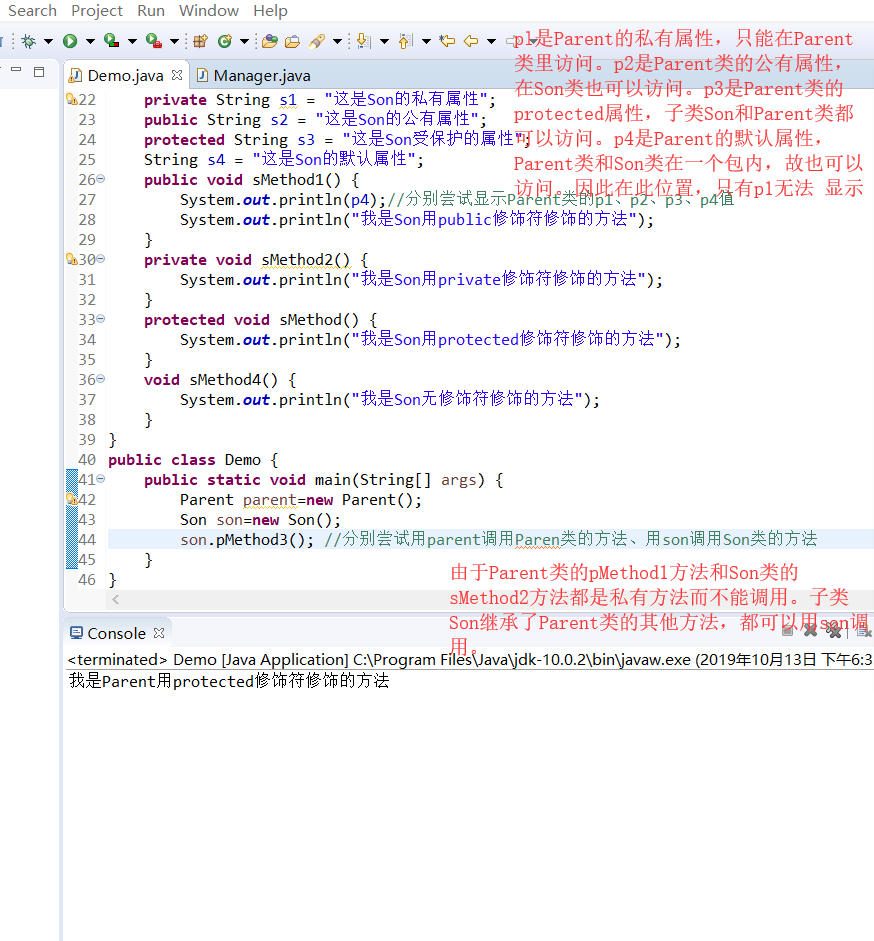
实验2:测试程序1(15分)
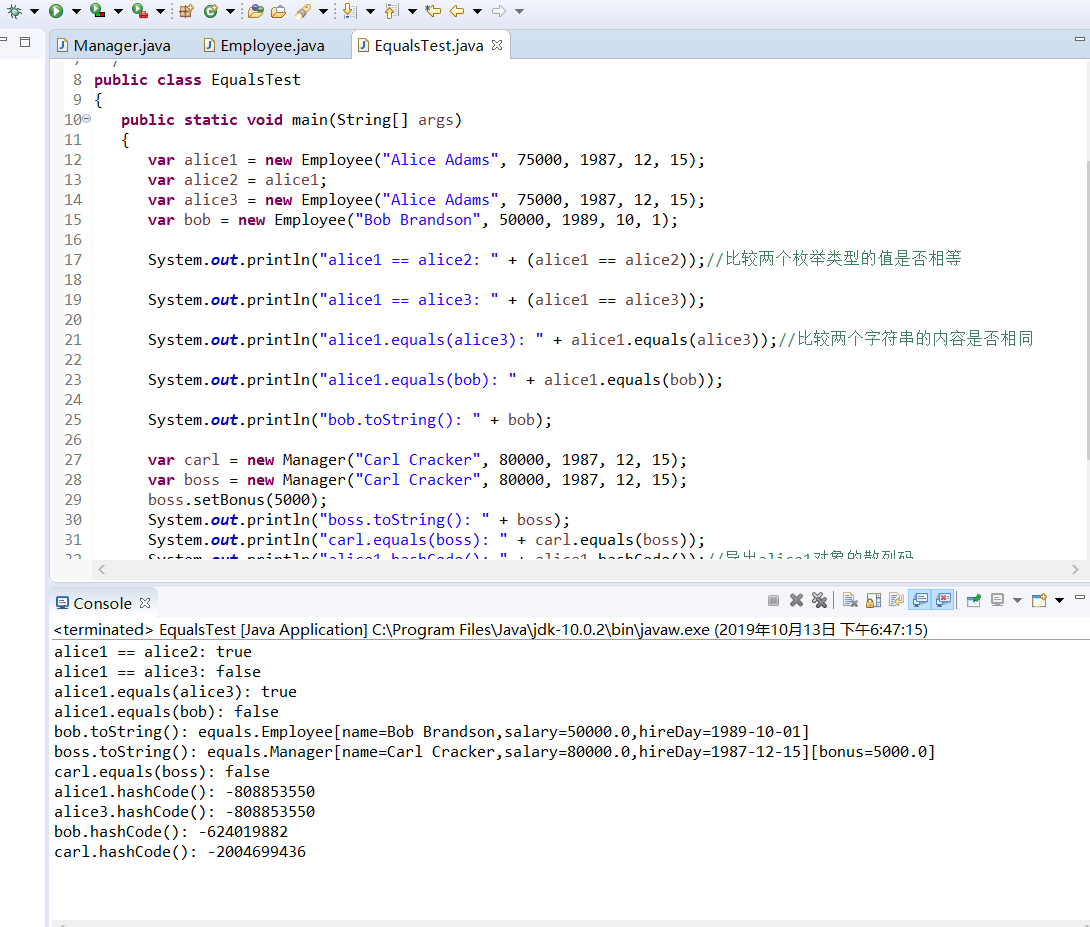
运行教材程序5-8、5-9、5-10,结合程序运行结果理解程序(教材174页-177页);
删除程序中Employee类、Manager类中的equals()、hasCode()、toString()方法,背录删除方法,在代码录入中理解类中重写Object父类方法的技术要点。
EqualsTest.java
package equals;

/**

 * This program demonstrates the equals method.

 * @version 1.12 2012-01-26

 * @author Cay Horstmann

 */

public class EqualsTest

{

   public static void main(String[] args)

   {

      var alice1 = new Employee("Alice Adams", 75000, 1987, 12, 15);

      var alice2 = alice1;

      var alice3 = new Employee("Alice Adams", 75000, 1987, 12, 15);

      var bob = new Employee("Bob Brandson", 50000, 1989, 10, 1);

      System.out.println("alice1 == alice2: " + (alice1 == alice2));//比较两个枚举类型的值是否相等

      System.out.println("alice1 == alice3: " + (alice1 == alice3));

      System.out.println("alice1.equals(alice3): " + alice1.equals(alice3));//比较两个字符串的内容是否相同

      System.out.println("alice1.equals(bob): " + alice1.equals(bob));

      System.out.println("bob.toString(): " + bob);

      var carl = new Manager("Carl Cracker", 80000, 1987, 12, 15);

      var boss = new Manager("Carl Cracker", 80000, 1987, 12, 15);

      boss.setBonus(5000);

      System.out.println("boss.toString(): " + boss);

      System.out.println("carl.equals(boss): " + carl.equals(boss));

      System.out.println("alice1.hashCode(): " + alice1.hashCode());//导出alice1对象的散列码

      System.out.println("alice3.hashCode(): " + alice3.hashCode());

      System.out.println("bob.hashCode(): " + bob.hashCode());

      System.out.println("carl.hashCode(): " + carl.hashCode());

   }

}
Employee.java
package equals;

import java.time.*;

import java.util.Objects;

public class Employee

{

   private String name;

   private double salary;

   private LocalDate hireDay;

   public Employee(String name, double salary, int year, int month, int day)

   {

      this.name = name;

      this.salary = salary;

      hireDay = LocalDate.of(year, month, day);

   }

   public String getName()

   {

      return name;

   }

   public double getSalary()

   {

      return salary;

   }

   public LocalDate getHireDay()

   {

      return hireDay;

   }

   public void raiseSalary(double byPercent)

   {

      double raise = salary * byPercent / 100;

      salary += raise;

   }

@Override

public int hashCode() {

	// TODO Auto-generated method stub

	return Objects.hash(name, salary, hireDay);

}

@Override

public boolean equals(Object otherObject) {

	// TODO Auto-generated method stub

    if (this == otherObject) return true;

    if (otherObject == null) return false;

    if (getClass() != otherObject.getClass()) return false;

    var other = (Employee) otherObject;

    return Objects.equals(name, other.name)

       && salary == other.salary && Objects.equals(hireDay, other.hireDay);

}

@Override

public String toString() {

	// TODO Auto-generated method stub

	return getClass().getName() + "[name=" + name + ",salary=" + salary + ",hireDay="

    + hireDay + "]";

}

}
Manager.java
package equals;

public class Manager extends Employee//子类Manager继承父类Employee

{

   private double bonus;

   public Manager(String name, double salary, int year, int month, int day)

   {

      super(name, salary, year, month, day);//调用父类构造器

      bonus = 0;

   }

   public double getSalary()

   {

      double baseSalary = super.getSalary();//调用父类方法

      return baseSalary + bonus;

   }

   public void setBonus(double bonus)

   {

      this.bonus = bonus;

   }

@Override

public int hashCode() {

	// TODO Auto-generated method stub

	return java.util.Objects.hash(super.hashCode(), bonus);

}

@Override

public boolean equals(Object otherObject) {

	// TODO Auto-generated method stub

    if (!super.equals(otherObject)) return false;

    var other = (Manager) otherObject;

    // super.equals checked that this and other belong to the same class

    return bonus == other.bonus;

}

@Override

public String toString() {

	// TODO Auto-generated method stub

	return super.toString() + "[bonus=" + bonus + "]";

}

}
实验2:测试程序2(15分)
l在elipse IDE中调试运行程序5-11(教材182页),结合程序运行结果理解程序;
掌握ArrayList类的定义及用法;
在程序中相关代码处添加新知识的注释;
设计适当的代码,测试ArrayList类的set()、get()、remove()、size()等方法的用法。
ArrayListTest.java
package arrayList;

import java.util.*;

/**

 * This program demonstrates the ArrayList class.

 * @version 1.11 2012-01-26

 * @author Cay Horstmann

 */

public class ArrayListTest

{

   public static void main(String[] args)

   {

      // 用Employee对象填充staff数组列表

      var staff = new ArrayList<Employee>();

      staff.add(new Employee("Carl Cracker", 75000, 1987, 12, 15));//把元素添加到数组列表的末尾

      staff.add(new Employee("Harry Hacker", 50000, 1989, 10, 1));

      staff.add(new Employee("Tony Tester", 40000, 1990, 3, 15));

      // for each循环

      for (Employee e : staff)

         e.raiseSalary(5);

      // 输出所有Employee对象的信息

      for (Employee e : staff)

         System.out.println("name=" + e.getName() + ",salary=" + e.getSalary() + ",hireDay="

            + e.getHireDay());

   }

}
Employee.java
package arrayList;

import java.time.*;

public class Employee

{

   private String name;

   private double salary;

   private LocalDate hireDay;

   public Employee(String name, double salary, int year, int month, int day)

   {

      this.name = name;

      this.salary = salary;

      hireDay = LocalDate.of(year, month, day);

   }

   public String getName()

   {

      return name;

   }

   public double getSalary()

   {

      return salary;

   }

   public LocalDate getHireDay()

   {

      return hireDay;

   }

   public void raiseSalary(double byPercent)

   {

      double raise = salary * byPercent / 100;

      salary += raise;

   }

}
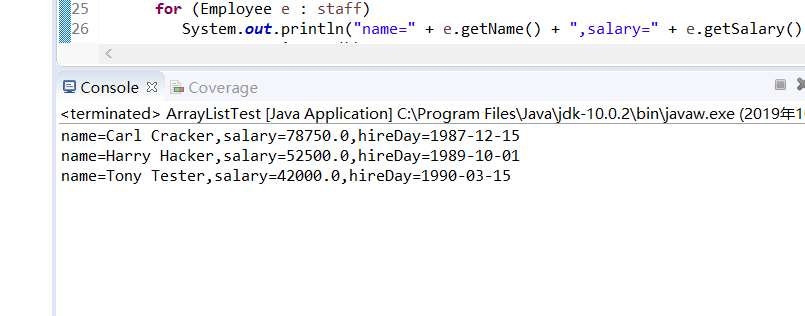
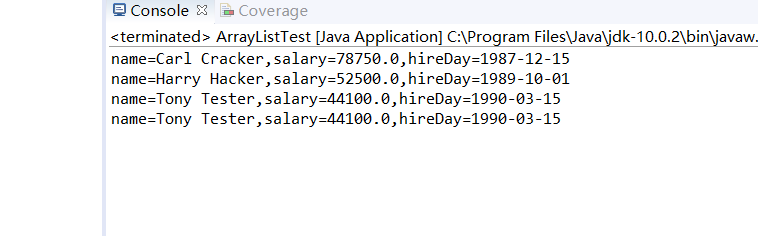
在ArrayListTest.java中添加
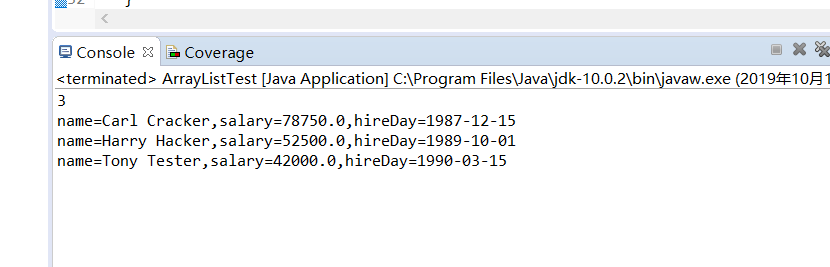
Employee b=staff.remove(1);//移除第一个位置上存放的对象,并将后面的元素向前移

System.out.println(staff.size());//返回当前数组列表中的元素个数
Employee a=new Employee("Wang",10000,1999,2,15);
staff.set(1, a);//将a放入数组列表的第1个位置,将这个位置原有的内容覆盖

Employee b=staff.get(2);//得到第二个位置的元素值
staff.add(b);//并将得到的元素值追加在数组列表的末尾
实验2:测试程序3(15分)
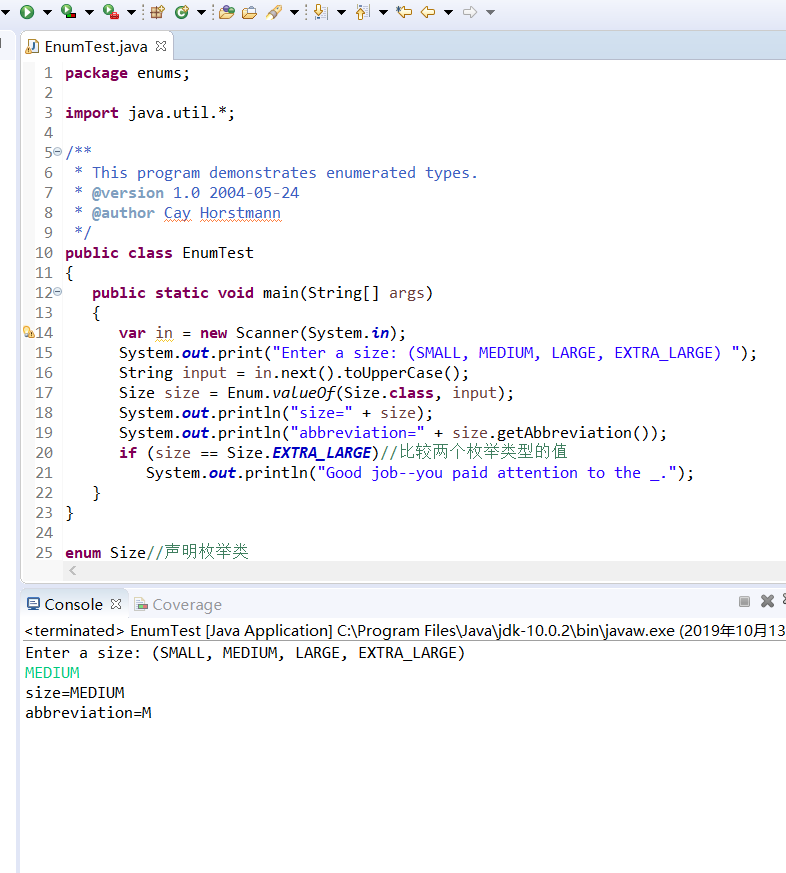
编辑、编译、调试运行程序5-12(教材189页),结合运行结果理解程序;
掌握枚举类的定义及用法;
在程序中相关代码处添加新知识的注释;
删除程序中Size枚举类,背录删除代码,在代码录入中掌握枚举类的定义要求。
package enums;

import java.util.*;

/**

 * This program demonstrates enumerated types.

 * @version 1.0 2004-05-24

 * @author Cay Horstmann

 */

public class EnumTest

{

   public static void main(String[] args)

   {

      var in = new Scanner(System.in);

      System.out.print("Enter a size: (SMALL, MEDIUM, LARGE, EXTRA_LARGE) ");

      String input = in.next().toUpperCase();

      Size size = Enum.valueOf(Size.class, input);

      System.out.println("size=" + size);

      System.out.println("abbreviation=" + size.getAbbreviation());

      if (size == Size.EXTRA_LARGE)//比较两个枚举类型的值

         System.out.println("Good job--you paid attention to the _.");

   }

}

enum Size//声明枚举类

{

	   SMALL("S"), MEDIUM("M"), LARGE("L"), EXTRA_LARGE("XL");

	   private Size(String abbreviation) { this.abbreviation = abbreviation; }

	   public String getAbbreviation() { return abbreviation; }

	   private String abbreviation;

}
实验2:测试程序4(5分)
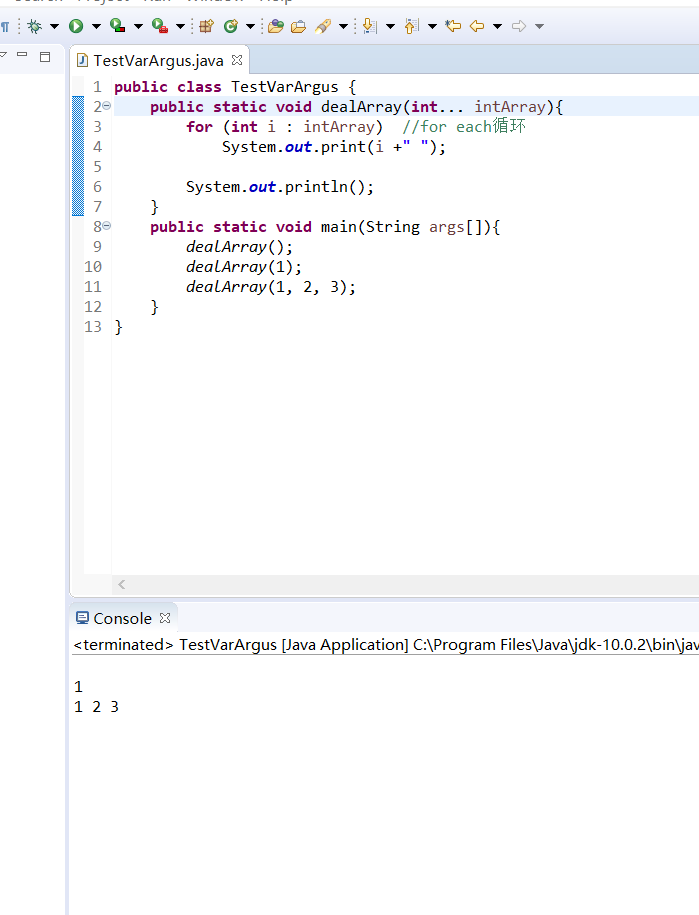
public class TestVarArgus {

    public static void dealArray(int... intArray){  参数数量可变

        for (int i : intArray)  //for each循环

            System.out.print(i +" ");

        System.out.println();

    }

    public static void main(String args[]){

        dealArray();

        dealArray(1);

        dealArray(1, 2, 3);

    }

}
实验3:编程练习(10分)
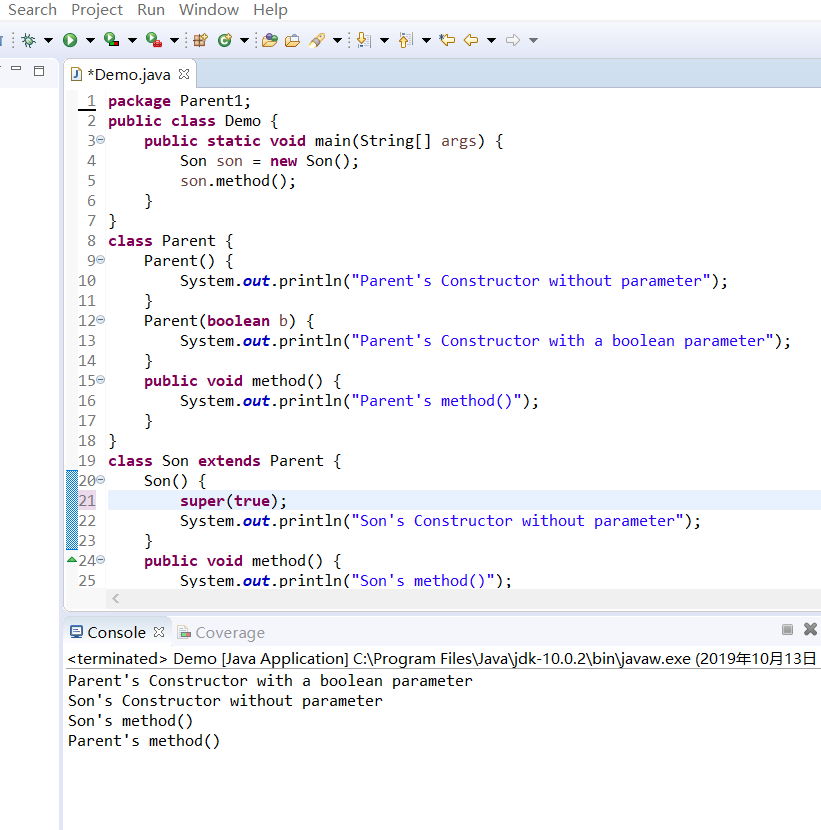
package Parent1;

public class Demo {

	public static void main(String[] args) {

		Son son = new Son();

		son.method();

	}

}

class Parent {

	Parent() {

		System.out.println("Parent's Constructor without parameter");

	}

	Parent(boolean b) {

		System.out.println("Parent's Constructor with a boolean parameter");

	}

	public void method() {

		System.out.println("Parent's method()");

	}

}

class Son extends Parent {

	Son() {

        super(true);

        System.out.println("Son's Constructor without parameter");

    }

    public void method() {

        System.out.println("Son's method()");

        super.method();

    }

}
实验总结:在本周的学习下,更深层次的学习了继承,理解并运用。以及object类。通过实验课老师及学长的讲解,对私有属性,公有属性,protected属性,默认属性四种属性的理解以及应用。
object类作为所有类的父类,不能在拓展父类,以及不能在拓展子类的final类。泛型数组列表和枚举类的学习。
201871010108-高文利《面向对象程序设计(java)》第七周学习总结的更多相关文章
- 201771010134杨其菊《面向对象程序设计java》第九周学习总结
第九周学习总结 第一部分:理论知识 异常.断言和调试.日志 1.捕获 ...
- 扎西平措 201571030332《面向对象程序设计 Java 》第一周学习总结
<面向对象程序设计(java)>第一周学习总结 正文开头: 项目 内容 这个作业属于哪个课程 https://www.cnblogs.com/nwnu-daizh/ 这个作业的要求在哪里 ...
- 201871010132-张潇潇《面向对象程序设计(java)》第一周学习总结
面向对象程序设计(Java) 博文正文开头 项目 内容 这个作业属于哪个课程 https://www.cnblogs.com/nwnu-daizh/ 这个作业的要求在哪里 https://www.cn ...
- 杨其菊201771010134《面向对象程序设计Java》第二周学习总结
第三章 Java基本程序设计结构 第一部分:(理论知识部分) 本章主要学习:基本内容:数据类型:变量:运算符:类型转换,字符串,输入输出,控制流程,大数值以及数组. 1.基本概念: 1)标识符:由字母 ...
- 201871010115——马北《面向对象程序设计JAVA》第二周学习总结
项目 内容 这个作业属于哪个课程 https://www.cnblogs.com/nwnu-daizh/ 这个作业的要求在哪里 https://www.cnblogs.com/nwnu-daizh/p ...
- 201871010132——张潇潇《面向对象程序设计JAVA》第二周学习总结
项目 内容 这个作业属于哪个课程 https://www.cnblogs.com/nwnu-daizh/ 这个作业的要求在哪里 https://www.cnblogs.com/nwnu-daizh/p ...
- 201777010217-金云馨《面向对象程序设计(Java)》第二周学习总结
项目 内容 这个作业属于哪个课程 https://www.cnblogs.com/nwnu-daizh/ 这个作业的要求在哪里 https://www.cnblogs.com/nwnu-daizh/p ...
- 201871010124 王生涛《面向对象程序设计JAVA》第一周学习总结
项目 内容 这个作业属于哪个课程 https://www.cnblogs.com/nwnu-daizh/ 这个作业的要求在哪里 https://edu.cnblogs.com/campus/xbsf/ ...
- 201771010123汪慧和《面向对象程序设计Java》第二周学习总结
一.理论知识部分 1.标识符由字母.下划线.美元符号和数字组成, 且第一个符号不能为数字.标识符可用作: 类名.变量名.方法名.数组名.文件名等.第二部分:理论知识学习部分 2.关键字就是Java语言 ...
- 201521123061 《Java程序设计》第七周学习总结
201521123061 <Java程序设计>第七周学习总结 1. 本周学习总结 2. 书面作业 ArrayList代码分析 1.1 解释ArrayList的contains源代码 贴上源 ...
随机推荐
- pyplot中的一些函数
from matplotlib import pyplot as plt plt.ylabel(‘Grade’) : y轴的名称 plt.xlabel(‘Grade’) : x轴的名称 plt.tit ...
- markdown 编辑格式
# h1## h2### h3#### h4##### h5###### h6 *em* **strong** ***斜体加粗*** ~~待删除~~ 无序列表,用 * + - 都可以表示,[可以用四个 ...
- Django views 中的装饰器
关于装饰器 示例: 有返回值的装饰器:判断用户是否登录,如果登录继续执行函数,否则跳回登录界面 def auth(func): def inner(request, *args, **kwargs): ...
- 快速傅立叶变换(FFT)
多项式 系数表示法 设\(f(x)\)为一个\(n-1\)次多项式,则 \(f(x)=\sum\limits_{i=0}^{n-1}a_i*x_i\) 其中\(a_i\)为\(f(x)\)的系数,用这 ...
- Mybatis中的Mapper.xml映射文件sql查询接收多个参数
我们都知道,在Mybatis中的Mapper.xml映射文件可以定制动态SQL,在dao层定义的接口中定义的参数传到xml文件中之后,在查询之前mybatis会对其进行动态解析,通常使用#{}接收 ...
- Java Scanner 类——获取用户的输入
创建Scanner对象语法 Scanner scan = new Scanner(System.in); 使用next()获取输入的字符串 import java.util.Scanner; publ ...
- laravel 广播细节讲解
1.应用场景 1.通知(Notification) 或 信号(Signal) 2.通知是最简单的示例,也最经常用到.信号也可看作是通知的一种展现形式,只不过信号没有UI而已. 3.Activity S ...
- ADO.NET中的5个主要对象
1.Connection:主要是开启程序和数据库之间的连接.没有利用连接对象将数据库打开,是无法从数据库中取得数据的. Close和Dispose的区别,Close以后还可以Open,Dispose以 ...
- C 函数指针、回调函数
参考链接:https://www.runoob.com/cprogramming/c-fun-pointer-callback.html 函数指针 函数指针就是执行函数的指针,他可以像正常函数一样去调 ...
- LinuxShell——特殊符号
LinuxShell——特殊符号 摘要:本文主要学习了Shell命令中具有特殊功能的一些符号. 多命令执行 顺序执行“;” 如果使用“;”连接多条命令,那么这些命令会依次执行,但是各命令之间没有任何逻 ...