
利用树的先序和后序遍历打印 os 中的目录树


struct Tree;

typedef struct Tree *Tree;

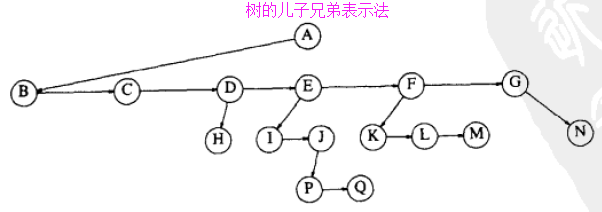
// we adopt child-sibling notation

struct Tree

{

    ElementType value;

    Tree firstChild;

    Tree nextSibling;

};

#include <stdio.h>

#include <malloc.h>

#define ElementType char

#define Error(str) printf("\n error: %s \n",str)

struct Tree;

typedef struct Tree *Tree;

Tree createTree();

Tree makeEmpty(Tree t);

Tree insert(ElementType e, Tree t);

// we adopt child-sibling notation

struct Tree

{

    ElementType value;

    Tree firstChild;

    Tree nextSibling;

};

// create a tree with root node

Tree createTree()

{

    Tree t;

    t = (Tree)malloc(sizeof(struct Tree));

    if(!t) {

        Error("out of space, from func createTree");

        return NULL;

    }

    t->firstChild = NULL;

    t->nextSibling = NULL;

    t->value = '/';

    return t;

}

// make the tree empty

Tree makeEmpty(Tree t)

{

    if(t){

        makeEmpty(t->firstChild);

        makeEmpty(t->nextSibling);

        free(t);

    }

    return NULL;

}

//

Tree insert(ElementType e, Tree parent)

{

    Tree child;

    Tree newSibling;

    if(!parent){

        Error("for parent tree node is empty , you cannot insert one into the parent node, from func insert");

        return NULL;

    }

    newSibling = (Tree)malloc(sizeof(struct Tree));

    if(!newSibling) {

        Error("out of space, from func insert");

        return NULL;

    }

    newSibling->value = e;

    newSibling->nextSibling = NULL;

    newSibling->firstChild = NULL;// building the node with value e over

    child = parent->firstChild;

    if(!child) {

        parent->firstChild = newSibling;

        return parent;

    }

    while(child->nextSibling)

        child = child->nextSibling; // find the last child of parent node

    child->nextSibling = newSibling;

    return parent;

}

// find the tree root node with value equaling to e

Tree find(ElementType e, Tree root)

{

    Tree temp;

    if(root == NULL)

        return NULL;

    if(root->value == e)

        return root;

    temp = find(e, root->firstChild);

    if(temp)

        return temp;

    else

        return     find(e, root->nextSibling);

}

// analog print directories and files name in the tree, which involves preorder traversal.

void printPreorder(int depth, Tree root)

{

    int i;

    if(root) {

        for(i = ; i < depth; i++)

            printf("    ");

        printf("%c\n", root->value);

        printPreorder(depth + , root->firstChild);

        printPreorder(depth, root->nextSibling);

    }

}

int main()

{

    Tree tree;

    tree = createTree();

    printf("\n test for insert 'A' 'B' into the parent '/' and 'C' 'D' into the parent 'A' \n");

    insert('A', tree);

    insert('B', find('/', tree));

    insert('C', find('A', tree));

    insert('D', find('A', tree));

    printPreorder(, tree);

    printf("\n test for insert 'E' 'F' into the parent '/'  \n");

    insert('E', find('/', tree));

    insert('F', find('/', tree));

    printPreorder(, tree);

    printf("\n test for insert 'G' 'H' into the parent 'E' and 'I' into the parent 'H' and even 'J' 'K' into the parent 'I' \n");

    insert('G', find('E', tree));

    insert('H', find('E', tree));

    insert('I', find('H', tree));

    insert('J', find('I', tree));

    insert('K', find('I', tree));

    printPreorder(, tree);

    return ;

}

#include <stdio.h>

#include <malloc.h>

#define ElementType char

#define Error(str) printf("\n error: %s \n",str)

struct Tree;

typedef struct Tree *Tree;

Tree createTree();

Tree makeEmpty(Tree t);

Tree insert(ElementType e, Tree t);

// we adopt child-sibling notation

struct Tree

{

    ElementType value;

    Tree firstChild;

    Tree nextSibling;

};

// create a tree with root node

Tree createTree()

{

    Tree t;

    t = (Tree)malloc(sizeof(struct Tree));

    if(!t) {

        Error("out of space, from func createTree");

        return NULL;

    }

    t->firstChild = NULL;

    t->nextSibling = NULL;

    t->value = '/';

    return t;

}

// make the tree empty

Tree makeEmpty(Tree t)

{

    if(t){

        makeEmpty(t->firstChild);

        makeEmpty(t->nextSibling);

        free(t);

    }

    return NULL;

}

//

Tree insert(ElementType e, Tree parent)

{

    Tree child;

    Tree newSibling;

    if(!parent){

        Error("for parent tree node is empty , you cannot insert one into the parent node, from func insert");

        return NULL;

    }

    newSibling = (Tree)malloc(sizeof(struct Tree));

    if(!newSibling) {

        Error("out of space, from func insert");

        return NULL;

    }

    newSibling->value = e;

    newSibling->nextSibling = NULL;

    newSibling->firstChild = NULL;// building the node with value e over

    child = parent->firstChild;

    if(!child) {

        parent->firstChild = newSibling;

        return parent;

    }

    while(child->nextSibling)

        child = child->nextSibling; // find the last child of parent node

    child->nextSibling = newSibling;

    return parent;

}

// find the tree root node with value equaling to e

Tree find(ElementType e, Tree root)

{

    Tree temp;

    if(root == NULL)

        return NULL;

    if(root->value == e)

        return root;

    temp = find(e, root->firstChild);

    if(temp)

        return temp;

    else

        return     find(e, root->nextSibling);

}

// analog print directories and files name in the tree, which involves postorder traversal.

void printPostorder(int depth, Tree root)

{

    int i;

    if(root) {

        printPostorder(depth + , root->firstChild);

        for(i = ; i < depth; i++)

            printf("    ");

        printf("%c\n", root->value);

        printPostorder(depth, root->nextSibling);

    }

}

int main()

{

    Tree tree;

    tree = createTree();

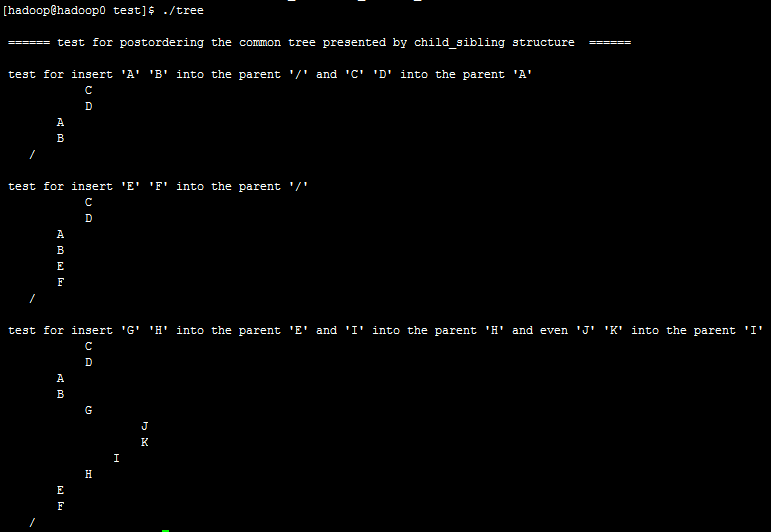
    printf("\n ====== test for postordering the common tree presented by child_sibling structure  ====== \n");

    printf("\n test for insert 'A' 'B' into the parent '/' and 'C' 'D' into the parent 'A' \n");

    insert('A', tree);

    insert('B', find('/', tree));

    insert('C', find('A', tree));

    insert('D', find('A', tree));

    printPostorder(, tree);

    printf("\n test for insert 'E' 'F' into the parent '/'  \n");

    insert('E', find('/', tree));

    insert('F', find('/', tree));

    printPostorder(, tree);

    printf("\n test for insert 'G' 'H' into the parent 'E' and 'I' into the parent 'H' and even 'J' 'K' into the parent 'I' \n");

    insert('G', find('E', tree));

    insert('H', find('E', tree));

    insert('I', find('H', tree));

    insert('J', find('I', tree));

    insert('K', find('I', tree));

    printPostorder(, tree);

    return ;

}
利用树的先序和后序遍历打印 os 中的目录树的更多相关文章
- 树的三种DFS策略(前序、中序、后序)遍历
之前刷leetcode的时候,知道求排列组合都需要深度优先搜索(DFS), 那么前序.中序.后序遍历是什么鬼,一直傻傻的分不清楚.直到后来才知道,原来它们只是DFS的三种不同策略. N = Node( ...
- 二叉排序树的构造 && 二叉树的先序、中序、后序遍历 && 树的括号表示规则
二叉排序树的中序遍历就是按照关键字的从小到大顺序输出(先序和后序可没有这个顺序) 一.以序列 6 8 5 7 9 3构建二叉排序树: 二叉排序树就是中序遍历之后是有序的: 构造二叉排序树步骤如下: 插 ...
- JAVA下实现二叉树的先序、中序、后序、层序遍历(递归和循环)
import java.util.HashMap; import java.util.LinkedList; import java.util.Map; import java.util.Queue; ...
- ZT 二叉树先序,中序,后序遍历非递归实现
二叉树先序,中序,后序遍历非递归实现 分类: 数据结构及算法2012-04-28 14:30 8572人阅读 评论(6) 收藏 举报 structc 利用栈实现二叉树的先序,中序,后序遍历的非递归操作 ...
- Java实现二叉树的先序、中序、后序、层序遍历(递归和非递归)
二叉树是一种非常重要的数据结构,很多其它数据结构都是基于二叉树的基础演变而来的.对于二叉树,有前序.中序以及后序三种遍历方法.因为树的定义本身就是递归定义,因此采用递归的方法去实现树的三种遍历不仅容易 ...
- 【数据结构与算法】二叉树的 Morris 遍历(前序、中序、后序)
前置说明 不了解二叉树非递归遍历的可以看我之前的文章[数据结构与算法]二叉树模板及例题 Morris 遍历 概述 Morris 遍历是一种遍历二叉树的方式,并且时间复杂度O(N),额外空间复杂度O(1 ...
- 二叉树的前序和中序得到后序 hdu1710
今天看学长发过来的资料上面提到了中科院机试会有一个二叉树的前序中序得到后序的题目.中科院的代码编写时间为一个小时,于是在七点整的时候我开始拍这个题目.这种类型完全没做过,只有纸质实现过,主体代码半个小 ...
- LeetCode二叉树的前序、中序、后序遍历(递归实现)
本文用递归算法实现二叉树的前序.中序和后序遍历,提供Java版的基本模板,在模板上稍作修改,即可解决LeetCode144. Binary Tree Preorder Traversal(二叉树前序遍 ...
- [Swift]LeetCode106. 从中序与后序遍历序列构造二叉树 | Construct Binary Tree from Inorder and Postorder Traversal
Given inorder and postorder traversal of a tree, construct the binary tree. Note:You may assume that ...
随机推荐
- [LeetCode] Path Sum II 深度搜索
Given a binary tree and a sum, find all root-to-leaf paths where each path's sum equals the given su ...
- 洛谷 P1372 又是毕业季I[数论/神坑规律题]
题目描述 为了把毕业晚会办得更好,老师想要挑出默契程度最大的k个人参与毕业晚会彩排.可是如何挑呢?老师列出全班同学的号数1,2,……,n,并且相信k个人的默契程度便是他们的最大公约数(这不是迷信哦~) ...
- 洛谷 P1426 小鱼会有危险吗【模拟/题意理解】
题目描述 有一次,小鱼要从A处沿直线往右边游,小鱼第一秒可以游7米,从第二秒开始每秒游的距离只有前一秒的98%.有个极其邪恶的猎人在距离A处右边s米的地方,安装了一个隐蔽的探测器,探测器左右x米之内是 ...
- 离线安装ATOM插件
refer to https://blog.csdn.net/ytangdigl/article/details/75168695 cd ~/.atom/packages git clone http ...
- iOS 动画笔记 (一)
你也肯定喜欢炫酷的动画! 在APP中,动画就是一个点睛之笔!可以给用户增加一些独特的体验感,估计也有许多的和我一样的,看着那些觉得不错的动画,也就只能流口水的孩子,毕竟可能不知道从哪里下手去写!动画学 ...
- jvm 简单描述
java零基础入门-面向对象篇(一) 基础类型和引用类型 友情提示:本章开始可能会有部分较深入的内容,不说又不行,说了又很难解释清楚,因为里面的技术细节实在太多太复杂,所以我会屏蔽部分技术细节,只展示 ...
- Scala之Future超时
最近在开发中使用akka http进行请求,返回的是一个future,并且要对future进行超时设置,不知怎么设置,因此学习了下. 一.Future阻塞 首先,scala中的future不支持内置超 ...
- Dedecms 数据库结构分析
本文主要是为了今后对Dedecms做二次开发所写.安装后dedecms的数据库结构,如(图1)所示, 安装后的dedecms一共有 86 张数据表. 主要数据结构表 dede_addonarticle ...
- Web编程前端之7:web.config详解 【转】
http://www.cnblogs.com/alvinyue/archive/2013/05/06/3063008.html 声明:这篇文章是摘抄周公(周金桥)的<asp.net夜话> ...
- 访问C指针的指针
#include <stdio.h> #include <stdlib.h> int main(int argc,char **argv){ void* vp; void** ...