
AES CBC/CTR 加解密原理
So, lets look at how CBC works first. The following picture shows the encryption when using CBC (in this case, using AES as the cipher).

Basically, Cipher-Block-Chaining means that previous to putting the cleartext data block into the cipher itself (AES, DES, Triple-DES, …) it is XORed with the previous cipher block. This works fine for all but the first cleartext block, as – of course – there is no previous cipher block. So, the encrypting entity chooses a random value of block size (8bytes for DES, 16bytes for AES) to use in the first XOR. This value is the so-called Initialization Vector or IV. The following picture depicts the decryption using CBC.

Basically, the decryption works very similarily to encryption. This time, the ciphertext block is put through the decryption routine and is then XORed with the previous ciphertext block. Also, for the first block, we use the IV again. The important thing to understand at this point is the following. If, for some reason, we can deduce what comes out of the AES block in the first cipher (what is denoted here as the Intermediary Message (IM)), we can produce any “plain text” we want. Why can we do that? Well, CBC uses the IV to XOR the IM and we usually control this. So, for each byte of message we want to “generate”, we choose the IV as follows:
IV[n] = IM[n] ^ DesiredMessage[n]
If you wonder how you might deduce the IM, look up “padding oracles” on Google.
As both DES and AES are block ciphers, the length of the given input must always be a multiple of the block size. As messages might not fit this condition, the plaintext is padded to a multiple of block size. However, the decrypting entity must somehow know, how much padding was append to the original cleartext. There a multiple ways of doing this, we will focus on PKCS5 as it was needed in this challenge.
PKCS5 encodes a padding of n bytes by filling the all of the padded “slots” with n. Basically, if we have only one byte padding, the last byte will be 1. If we have e.g. 5 bytes padding, the last 5 bytes will all be set to 5. Please note, that padding must always be provided. Thus, if the message actually had a length which was a multiple of the block size, there will be exactly one block added to the message. For 8byte ciphers like DES, we then have a block of length 8b filled completely with 8s.
AES CBC加解密原理
CBC加解密原理如下图所示, 图片来源维基百科

CBC加密原理:明文跟向量异或,再用KEY进行加密,结果作为下个BLOCK的初始化向量。解密原理:使用密钥先对密文解密,解密后再同初始向量异或得到明文。
CBC需要对明文块大小进行Padding(补位),由于前后加密的相关性,只能实施串行化动作,无法并行运算。另外,CBC需要参量:密钥和初始化向量。
AES CTR加解密原理
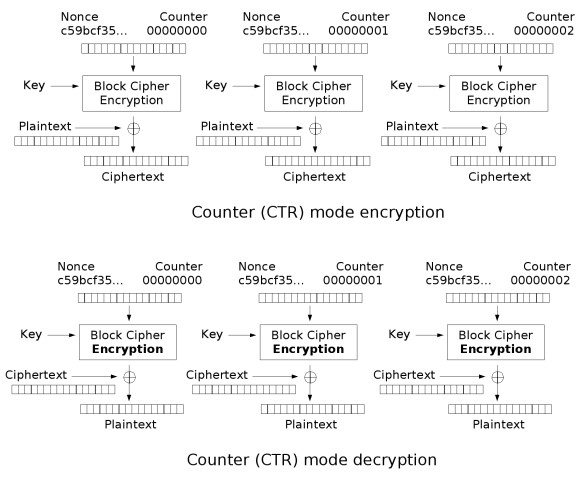
CTR加密原理:用密钥对输入的计数器加密,然后同明文异或得到密文。解密原理:用密钥对输入计数器加密,然后同密文异或得到明文。
CTR不需要Padding,而且采用了流密钥方式加解密,适合于并行运算,CTR涉及参量:Nounce随机数、Counter计数器和密钥。Nounce随机数和Counter计数器整体可看作计数器,因为只要算法约定好,就可以回避掉串行化运算。
参考资料:
http://zh.wikipedia.org/wiki/高级加密标准
http://zh.wikipedia.org/zh/块密码的工作模式
AES CBC/CTR 加解密原理的更多相关文章
- Java 使用AES/CBC/PKCS7Padding 加解密字符串
介于java 不支持PKCS7Padding,只支持PKCS5Padding 但是PKCS7Padding 和 PKCS5Padding 没有什么区别要实现在java端用PKCS7Padding填充, ...
- python 实现 AES CBC模式加解密
AES加密方式有五种:ECB, CBC, CTR, CFB, OFB 从安全性角度推荐CBC加密方法,本文介绍了CBC,ECB两种加密方法的python实现 python 在 Windows下使用AE ...
- JAVA AES CBC PKCS5Padding加解密
package com.hzxc.groupactivity.util; /** * Created by hdwang on 2019/1/17. */ import org.slf4j.Logge ...
- C++ 和 java 使用 AES CBC 128 加解密
Java 使用jce, code: import javax.crypto.Cipher; import javax.crypto.spec.IvParameterSpec; import javax ...
- openssl:AES CBC PKCS5 加解密 (C/GOLANG)
#include <openssl/aes.h> /* AES_CBC_PKCS5_Encrypt * 入参: * src:明文 * srcLen:明文长度 * key:密钥 长度只能是1 ...
- 手机号的 AES/CBC/PKCS7Padding 加解密
前言:接口中上次的手机号码和密码是传入的加密的,模拟自动化的时候也需要先对数据进行加密 1.各种语言实现 网上已经各种语言实现好的AES加密,可以点击查看:http://outofmemory.cn/ ...
- node.js 实现 AES CTR 加解密
node.js 实现 AES CTR 加解密 node aesctr 前言 由于最近我们在做一款安全的文件分享 App, 所有文件均需要使用 aes ctr 来进行加密,aes key 还有一整套完整 ...
- python 实现 AES ECB模式加解密
AES ECB模式加解密使用cryptopp完成AES的ECB模式进行加解密. AES加密数据块分组长度必须为128比特,密钥长度可以是128比特.192比特.256比特中的任意一个.(8比特 == ...
- Spring Boot 实现配置文件加解密原理
Spring Boot 配置文件加解密原理就这么简单 背景 接上文<失踪人口回归,mybatis-plus 3.3.2 发布>[1] ,提供了一个非常实用的功能 「数据安全保护」 功能,不 ...
随机推荐
- 玩转Hook——Android权限管理功能探讨(一)
随着Android设备上的隐私安全问题越来越被公众重视,恶意软件对用户隐私,尤其是对电话.短信等私密信息的威胁日益突出,各大主流安全软件均推出了自己的隐私行为监控功能,在root情况下能有效防止恶意软 ...
- PHP-Redis操作
/*1.Connection*/ $redis = new Redis(); $redis->connect('127.0.0.1',6379,1);//短链接,本地host,端口为6379,超 ...
- C++--------------------------------指针和数组替换使用原因
马上要考试了,复习数据结构中,对C的指针不太了解,在严蔚敏<数据结构(C语言版)>中,发现p22定义顺序存储结构: typedef srtuct{ ElemType *elem; //存储 ...
- HDU 1005 Number Sequence (模拟)
题目链接 Problem Description A number sequence is defined as follows: f(1) = 1, f(2) = 1, f(n) = (A * f( ...
- 洛谷 P1478 陶陶摘苹果(升级版)
本萌新第一次发布题解,若有不严谨处请谅解. 我看了前面几位大佬的手笔,表示自己还是比较钟爱桶排序的.它非常简易直接,还省时间,尤其对于这类题目占用的的空间也很小. 我们看到题目下面的说明:xi< ...
- 【译】SQLskills SQL101:Trace Flags、ERRORLOG、Update Statistics
最近阅读SQLskills SQL101,将Erin Stellato部分稍作整理.仅提取自己感兴趣的知识点,详细内容请阅读原文. 一.Trace Flags推荐开启三个跟踪标记1118.3023.3 ...
- Three.js基础探寻三——透视投影照相机
本篇主要介绍Three.js照相机中的透视投影照相机. 上一篇:正交投影照相机 5.透视投影照相机构造函数 透视投影照相机(Perspective Camera)的构造函数是: THREE.Persp ...
- TCP长连接和短连接的区别【转】
转自:https://www.cnblogs.com/onlysun/p/4520553.html 当网络通信时采用TCP协议时,在真正的读写操作之前,server与client之间必须建立一个连接, ...
- pwd、ln和重定向命令
pwd命令 命令功能: 使用pwd命令可以显示当前的工作目录,该命令很简单,直接输入pwd即可,后面不带参数. pwd命令以绝对路径的方式显示用户当前工作目录.命令将当前目录的全路径名称(从根 ...
- h5手势密码开发(使用jq)
直接上代码: 目录结构: 本次开用到的技术jq,以及引入的jq插件jquery.gesture.password.min.js index.html <!DOCTYPE html> < ...