
pku 2488 A Knight's Journey (搜索 DFS)
| Time Limit: 1000MS | Memory Limit: 65536K | |
| Total Submissions: 28697 | Accepted: 9822 |
Description
 Background
 The knight is getting bored of seeing the same black and white squares again and again and has decided to make a journey
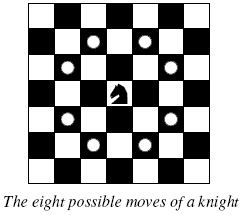
around the world. Whenever a knight moves, it is two squares in one direction and one square perpendicular to this. The world of a knight is the chessboard he is living on. Our knight lives on a chessboard that has a smaller area than a regular 8 * 8 board,
but it is still rectangular. Can you help this adventurous knight to make travel plans?
Problem
Find a path such that the knight visits every square once. The knight can start and end on any square of the board.
Input
how many different square numbers 1, . . . , p exist, q describes how many different square letters exist. These are the first q letters of the Latin alphabet: A, . . .
Output
followed by an empty line. The path should be given on a single line by concatenating the names of the visited squares. Each square name consists of a capital letter followed by a number.
If no such path exist, you should output impossible on a single line.
Sample Input
3

1 1

2 3

4 3
Sample Output
Scenario #1:

A1

Scenario #2:

impossible

Scenario #3:

A1B3C1A2B4C2A3B1C3A4B2C4
#include <cstdio>

#include <cstdlib>

#include <stack>

#include <cstring>

using namespace std;

const int MAX = 9;

const int dirx[8]={-1,1,-2,2,-2,2,-1,1},diry[8]={-2,-2,-1,-1,1,1,2,2};

typedef struct Point{

    int x,y;

}point;

int p,q,n;

bool visit[MAX][MAX];

point pre[MAX][MAX];

bool mark;

stack<int> stx,sty;

void printPath(int x,int y){

    stx.push(x);

    sty.push(y);

    int tx,ty;

    tx = pre[x][y].x;

    ty = pre[x][y].y;

    while(tx!=-1){

        stx.push(tx);

        sty.push(ty);

        x = pre[tx][ty].x;

        y = pre[tx][ty].y;

        tx = x;

        ty = y;

    }

    while(!stx.empty()){

        printf("%c%d",sty.top()-1+'A',stx.top());

        stx.pop();

        sty.pop();

    }

    printf("\n\n");

}

void dfs(int x,int y,int len){

    if(mark)return;

    if(len==p*q){

        printPath(x,y);

        mark = true;

        return;

    }

    int i,tx,ty;

    for(i=0;i<8;++i){

        tx = x+dirx[i];

        ty = y+diry[i];

        if(tx<1 || tx>p || ty<1 || ty>q)continue;

        if(visit[tx][ty])continue;

        pre[tx][ty].x = x;

        pre[tx][ty].y = y;

        visit[tx][ty] = true;

        dfs(tx,ty,len+1);

        visit[tx][ty] = false;

    }

}

int main()

{

    //freopen("in.txt","r",stdin);

    //(Author : CSDN iaccepted)

    int i;

    scanf("%d",&n);

    for(i=1;i<=n;++i){

        printf("Scenario #%d:\n",i);

        scanf("%d %d",&p,&q);

        memset(visit,0,sizeof(visit));

        mark = false;

        pre[1][1].x = -1;

        pre[1][1].y = -1;

        visit[1][1] = true;

        dfs(1,1,1);

        visit[1][1] = false;

        if(!mark){

            printf("impossible\n\n");

        }

    }

    return 0;

}
题目意思:象棋中的马在一张棋盘上是否能不反复的走全然部格子。假设能走完输出走的路径(以字典序),假设没有一种走法能达到这种目标,则输出impossible。
思路就是DFS 搜下去,当走过的格子数达到格子总数时就打印路径。所以要用一个数组记录每一个定点的前驱节点。
pku 2488 A Knight's Journey (搜索 DFS)的更多相关文章
- poj 2488 A Knight's Journey(dfs+字典序路径输出)
转载请注明出处:http://blog.csdn.net/u012860063?viewmode=contents 题目链接:http://poj.org/problem? id=2488 ----- ...
- POJ 2488 A Knight's Journey
A Knight's Journey Time Limit: 1000MS Memory Limit: 65536K Total Submissions: 29226 Accepted: 10 ...
- POJ 2488-A Knight's Journey(DFS)
A Knight's Journey Time Limit: 1000MS Memory Limit: 65536K Total Submissions: 31702 Accepted: 10 ...
- poj2488--A Knight's Journey(dfs,骑士问题)
A Knight's Journey Time Limit: 1000MS Memory Limit: 65536K Total Submissions: 31147 Accepted: 10 ...
- DFS深搜——Red and Black——A Knight's Journey
深搜,从一点向各处搜找到全部能走的地方. Problem Description There is a rectangular room, covered with square tiles. Eac ...
- POJ 2488 -- A Knight's Journey(骑士游历)
POJ 2488 -- A Knight's Journey(骑士游历) 题意: 给出一个国际棋盘的大小,判断马能否不重复的走过所有格,并记录下其中按字典序排列的第一种路径. 经典的“骑士游历”问题 ...
- POJ2488-A Knight's Journey(DFS+回溯)
题目链接:http://poj.org/problem?id=2488 A Knight's Journey Time Limit: 1000MS Memory Limit: 65536K Tot ...
- POJ 2243 简单搜索 (DFS BFS A*)
题目大意:国际象棋给你一个起点和一个终点,按骑士的走法,从起点到终点的最少移动多少次. 求最少明显用bfs,下面给出三种搜索算法程序: // BFS #include<cstdio> #i ...
- 【算法入门】深度优先搜索(DFS)
深度优先搜索(DFS) [算法入门] 1.前言深度优先搜索(缩写DFS)有点类似广度优先搜索,也是对一个连通图进行遍历的算法.它的思想是从一个顶点V0开始,沿着一条路一直走到底,如果发现不能到达目标解 ...
随机推荐
- body.clientHeight与documentElement.clientHeight
body上的clientHeight会对着内容区域的高度变化而变化,当内容只有100px,则body上只有100px被撑起,返回的clientHeight为100: documentElement.c ...
- 使用weinre远程调试
1.调试环境: 1)使用nodejs搭建调试服务器: 先安装node,然后使用npm安装weinre,在node.js安装目录输入以下命令 npm install weinre 2)需要wifi环境和 ...
- js数组遍历some,foreach,map,filter,every对比
1. [...].some(ck)函数 ---- 某个一个为true,则为true 对数组中每个元素执行一次ck函数,知道某个元素返回true,则直接返回true.如果都返回f ...
- .Net高级进阶,在复杂的业务逻辑下,如何以最简练的代码,最直观的编写事务代码?
本文将通过场景例子演示,来通俗易懂的讲解在复杂的业务逻辑下,如何以最简练的代码,最直观的编写事务代码. 通过一系列优化最终达到两个效果,1.通过代码块来控制事务(分布式事务),2.通过委托优化Tran ...
- cocos2d导入iOS原生项目
最近公司最新发下任务让融合一个cocos2dx写的游戏项目融合进现有项目,当看到要求时内心瞬间无数羊驼奔腾.------ 虽说内心是拒绝的,但是任务已经派发就必须要完成啊.所以在网上搜了大量的融入教程 ...
- mac下安装HTMLTestRunner
HTMLTestRunner是Python标准库unittest模块的一个扩展.它生成易于使用的HTML测试报告. 1.下载HTMLTestRunner.py模块地址 http://tungwaiyi ...
- 【开源】canvas图像裁剪、压缩、旋转
前言 前段时间遇到了一个移动端对图像进行裁剪.压缩.旋转的需求. 考虑到已有各轮子的契合度都不高,于是自己重新造了一个轮子. 关于图像裁剪.压缩 在HTML5时代,canvas的功能已经非常强大了,可 ...
- java对象拷贝和复制
参考文章:http://blog.csdn.net/XIAXIA__/article/details/41652057 解决问题:深拷贝.浅拷贝 和普通的对象赋值有什么区别? 对象复制 例如:Pers ...
- IIFE(立即执行函数表达式)
我们经常会看到这样的写法: ;(fuction () { // do something })() 这就是一个简单的IIFE(立即执行函数表达式,immediately-invoked functio ...
- 关于事件mouseover ,mouseout ,mouseenter,mouseleave的区别
轮播中大多会选择mouseover和mouseout 这个时候是没有任何问题的 但当遇到有css3动画的时候,会发现移入移出过快 动画还没加载完成就需要执行下一个动画,完了动画样式就错乱了. 这时候 ...