
pku 2488 A Knight's Journey (搜索 DFS)
| Time Limit: 1000MS | Memory Limit: 65536K | |
| Total Submissions: 28697 | Accepted: 9822 |
Description
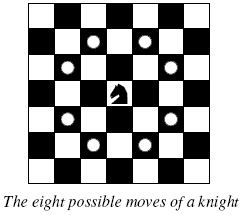 Background
 The knight is getting bored of seeing the same black and white squares again and again and has decided to make a journey
around the world. Whenever a knight moves, it is two squares in one direction and one square perpendicular to this. The world of a knight is the chessboard he is living on. Our knight lives on a chessboard that has a smaller area than a regular 8 * 8 board,
but it is still rectangular. Can you help this adventurous knight to make travel plans?
Problem
Find a path such that the knight visits every square once. The knight can start and end on any square of the board.
Input
how many different square numbers 1, . . . , p exist, q describes how many different square letters exist. These are the first q letters of the Latin alphabet: A, . . .
Output
followed by an empty line. The path should be given on a single line by concatenating the names of the visited squares. Each square name consists of a capital letter followed by a number.
If no such path exist, you should output impossible on a single line.
Sample Input
3

1 1

2 3

4 3
Sample Output
Scenario #1:

A1

Scenario #2:

impossible

Scenario #3:

A1B3C1A2B4C2A3B1C3A4B2C4
#include <cstdio>

#include <cstdlib>

#include <stack>

#include <cstring>

using namespace std;

const int MAX = 9;

const int dirx[8]={-1,1,-2,2,-2,2,-1,1},diry[8]={-2,-2,-1,-1,1,1,2,2};

typedef struct Point{

    int x,y;

}point;

int p,q,n;

bool visit[MAX][MAX];

point pre[MAX][MAX];

bool mark;

stack<int> stx,sty;

void printPath(int x,int y){

    stx.push(x);

    sty.push(y);

    int tx,ty;

    tx = pre[x][y].x;

    ty = pre[x][y].y;

    while(tx!=-1){

        stx.push(tx);

        sty.push(ty);

        x = pre[tx][ty].x;

        y = pre[tx][ty].y;

        tx = x;

        ty = y;

    }

    while(!stx.empty()){

        printf("%c%d",sty.top()-1+'A',stx.top());

        stx.pop();

        sty.pop();

    }

    printf("\n\n");

}

void dfs(int x,int y,int len){

    if(mark)return;

    if(len==p*q){

        printPath(x,y);

        mark = true;

        return;

    }

    int i,tx,ty;

    for(i=0;i<8;++i){

        tx = x+dirx[i];

        ty = y+diry[i];

        if(tx<1 || tx>p || ty<1 || ty>q)continue;

        if(visit[tx][ty])continue;

        pre[tx][ty].x = x;

        pre[tx][ty].y = y;

        visit[tx][ty] = true;

        dfs(tx,ty,len+1);

        visit[tx][ty] = false;

    }

}

int main()

{

    //freopen("in.txt","r",stdin);

    //(Author : CSDN iaccepted)

    int i;

    scanf("%d",&n);

    for(i=1;i<=n;++i){

        printf("Scenario #%d:\n",i);

        scanf("%d %d",&p,&q);

        memset(visit,0,sizeof(visit));

        mark = false;

        pre[1][1].x = -1;

        pre[1][1].y = -1;

        visit[1][1] = true;

        dfs(1,1,1);

        visit[1][1] = false;

        if(!mark){

            printf("impossible\n\n");

        }

    }

    return 0;

}
题目意思:象棋中的马在一张棋盘上是否能不反复的走全然部格子。假设能走完输出走的路径(以字典序),假设没有一种走法能达到这种目标,则输出impossible。
思路就是DFS 搜下去,当走过的格子数达到格子总数时就打印路径。所以要用一个数组记录每一个定点的前驱节点。
pku 2488 A Knight's Journey (搜索 DFS)的更多相关文章
- poj 2488 A Knight's Journey(dfs+字典序路径输出)
转载请注明出处:http://blog.csdn.net/u012860063?viewmode=contents 题目链接:http://poj.org/problem? id=2488 ----- ...
- POJ 2488 A Knight's Journey
A Knight's Journey Time Limit: 1000MS Memory Limit: 65536K Total Submissions: 29226 Accepted: 10 ...
- POJ 2488-A Knight's Journey(DFS)
A Knight's Journey Time Limit: 1000MS Memory Limit: 65536K Total Submissions: 31702 Accepted: 10 ...
- poj2488--A Knight's Journey(dfs,骑士问题)
A Knight's Journey Time Limit: 1000MS Memory Limit: 65536K Total Submissions: 31147 Accepted: 10 ...
- DFS深搜——Red and Black——A Knight's Journey
深搜,从一点向各处搜找到全部能走的地方. Problem Description There is a rectangular room, covered with square tiles. Eac ...
- POJ 2488 -- A Knight's Journey(骑士游历)
POJ 2488 -- A Knight's Journey(骑士游历) 题意: 给出一个国际棋盘的大小,判断马能否不重复的走过所有格,并记录下其中按字典序排列的第一种路径. 经典的“骑士游历”问题 ...
- POJ2488-A Knight's Journey(DFS+回溯)
题目链接:http://poj.org/problem?id=2488 A Knight's Journey Time Limit: 1000MS Memory Limit: 65536K Tot ...
- POJ 2243 简单搜索 (DFS BFS A*)
题目大意:国际象棋给你一个起点和一个终点,按骑士的走法,从起点到终点的最少移动多少次. 求最少明显用bfs,下面给出三种搜索算法程序: // BFS #include<cstdio> #i ...
- 【算法入门】深度优先搜索(DFS)
深度优先搜索(DFS) [算法入门] 1.前言深度优先搜索(缩写DFS)有点类似广度优先搜索,也是对一个连通图进行遍历的算法.它的思想是从一个顶点V0开始,沿着一条路一直走到底,如果发现不能到达目标解 ...
随机推荐
- Xcode修改个性化注释
1.首先找到Xcode进入包内容 2.依次进入/Applications/Xcode.app/Contents/Developer/Platforms/iPhoneOS.platform/Develo ...
- OpenCV畸变校正源代码分析
图像算法中会经常用到摄像机的畸变校正,有必要总结分析OpenCV中畸变校正方法,其中包过普通针孔相机模型和鱼眼相机模型fisheye两种畸变校正方法. 普通相机模型畸变校正函数针对OpenCV中的cv ...
- Java--Socket通信(双向)
新建两个工程,一个客户端,一个服务端,先启动服务端再启动客户端两个工程的读写操作线程类基本上完全相同 服务端: import java.io.BufferedReader; import java.i ...
- fs-max、file-nr和nofile的关系
1. file-max /proc/sys/fs/file-max: 这个文件决定了系统级别所有进程可以打开的文件描述符的数量限制,如果内核中遇到VFS: file-max limit <num ...
- [认证授权] 5.OIDC(OpenId Connect)身份认证授权(扩展部分)
在上一篇[认证授权] 4.OIDC(OpenId Connect)身份认证授权(核心部分)中解释了OIDC的核心部分的功能,即OIDC如何提供id token来用于认证.由于OIDC是一个协议族,如果 ...
- python进阶------进程线程(五)
Python中的IO模型 同步(synchronous) IO和异步(asynchronous) IO,阻塞(blocking) IO和非阻塞(non-blocking)IO分别是什么,到底有什么区别 ...
- python基础-------模块与包(二)
sys模块.logging模块.序列化 一.sys模块 sys.argv 命令行参数List,第一个元素是程序本身路径 sys.exit(n) 退出程序,正常退出时e ...
- Python 标准库 urllib2 的使用细节(转)
http://www.cnblogs.com/yuxc/archive/2011/08/01/2123995.html http://blog.csdn.net/wklken/article/deta ...
- SpringMVC---CookieValue
配置文件承接一二章 @CookieValue的作用 用来获取Cookie中的值 1.value:参数名称 2.required:是否必须 3.defaultValue:默认值 原网址:https:// ...
- JavaScript的兼容
兼容总结 如果两个都是属性,用逻辑 || 做兼容 如果有一个是方法,用三元做兼容 如果多个属性或方法,封装函数做兼容 获取class属性值的兼容 function getClass (obj){ if ...