
Fishnet(计算几何)
| Time Limit: 1000MS | Memory Limit: 10000K | |
| Total Submissions: 1642 | Accepted: 1051 |
Description
In order to catch fish, he began to make a kind of fishnet by cutting the long thread into short threads and fixing them at pegs on the square wood-frame. He wanted to know the sizes of the meshes of the fishnet to see whether he could catch small fish as well as large ones.
The wood frame is perfectly square with four thin edges on meter long: a bottom edge, a top edge, a left edge, and a right edge. There are n pegs on each edge, and thus there are 4n pegs in total. The positions of pegs are represented by their (x,y)-coordinates. Those of an example case with n=2 are depicted in figures below. The position of the ith peg on the bottom edge is represented by (ai,0). That on the top edge, on the left edge and on the right edge are represented by (bi,1), (0,ci) and (1,di), respectively. The long thread is cut into 2n threads with appropriate lengths. The threads are strained between (ai,0) and (bi,1),and between (0,ci) and (1,di) (i=1,...,n).
You should write a program that reports the size of the largest mesh among the (n+1)2 meshes of the fishnet made by fixing the threads at the pegs. You may assume that the thread he found is long enough to make the fishnet and the wood-frame is thin enough for neglecting its thickness. 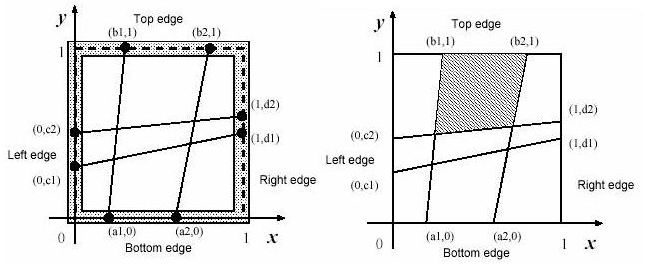
Input
n
a1 a2 ... an
b1 b2 ... bn
c1 c2 ... cn
d1 d2 ... dn
you may assume 0 < n <= 30, 0 < ai,bi,ci,di < 1
Output
Sample Input
2

0.2000000 0.6000000

0.3000000 0.8000000

0.1000000 0.5000000

0.5000000 0.6000000

2

0.3333330 0.6666670

0.3333330 0.6666670

0.3333330 0.6666670

0.3333330 0.6666670

4

0.2000000 0.4000000 0.6000000 0.8000000

0.1000000 0.5000000 0.6000000 0.9000000

0.2000000 0.4000000 0.6000000 0.8000000

0.1000000 0.5000000 0.6000000 0.9000000

2

0.5138701 0.9476283

0.1717362 0.1757412

0.3086521 0.7022313

0.2264312 0.5345343

1

0.4000000

0.6000000

0.3000000

0.5000000

0
Sample Output
0.215657

0.111112

0.078923

0.279223

0.348958

题意:在一个边长为1的正方形(如图)的四个边上分别插入n个点,上和下,左和右分别对应点相连构成若干个线段,这些线段相交之后构成若干个四边形,问最大的那个四边形的面积;
先将对应点连起来构成线段,求出各个交点,这样就可以根据叉乘求出每个四边形的面积,比较之后得出最大的。我开始存输入的点的坐标时用的一位数组,结果找四边形对应顶点时就很麻烦,还是没想全面。改成二维数组后,p[i][j]就表示第i行第j个点的坐标,这样找四边形顶点坐标就好找了;
 #include<stdio.h>

 #include<string.h>

 #include<math.h>

 const double eps = 1e-;

 int cmp(double x)

 {

     if(fabs(x) < eps)

         return ;

     if(x > ) return ;

     return -;

 }

 struct point

 {

     double x,y;

     point(){}

     point(double a,double b):x(a),y(b) {}

     friend point operator - (const point &a, const point &b)

     {

         return point(a.x-b.x,a.y-b.y);

     }

     friend point operator * (const double &a, const point &b)

     {

         return point(a*b.x,a*b.y);

     }

     friend point operator / (const point &a, const double &b)

     {

         return point(a.x/b,a.y/b);

     }

 }p[][];//p[i][j]存第i行第j列交点处的点的坐标;

 struct line

 {

     point a,b;

     line (){}

     line(point x, point y):a(x),b(y) {}

 }L[][];//存线段;

 double det(const point &a, const point &b)

 {

     return a.x * b.y - a.y * b.x;

 }

 bool parallel(line a,line b)

 {

     return !cmp(det(a.a-a.b,b.a-b.b));

 }

 bool line_make_point(line a,line b,point &res)

 {

     if(parallel(a,b)) return false;

     double s1 = det(a.a-b.a,b.b-b.a);

     double s2 = det(a.b-b.a,b.b-b.a);

     res = (s1*a.b-s2*a.a)/(s1-s2);

     return true;

 }

 double area(point a[])

 {

     double sum = ;

     a[] = a[];

     for(int i = ; i < ; i++)

         sum += det(a[i+],a[i]);

     return sum/;

 }

 int main()

 {

     int n;

     while(~scanf("%d",&n) && n)

     {

         for(int i = ; i <= n; i++)

         {

             scanf("%lf",&p[][i].x);

             p[][i].y = ;

         }

         p[][].x = ;

         p[][].y = ;

         p[][n+].x = ;

         p[][n+].y = ;

         for(int i = ; i <= n; i++)

         {

             scanf("%lf",&p[n+][i].x);

             p[n+][i].y = ;

         }

         p[n+][].x = ;

         p[n+][].y = ;

         p[n+][n+].x = ;

         p[n+][n+].y = ;

         for(int i = ; i <= n; i++)

         {

             scanf("%lf",&p[i][].y);

             p[i][].x = ;

         }

         for(int i = ; i <= n; i++)

         {

             scanf("%lf",&p[i][n+].y);

             p[i][n+].x = ;

         }

         for(int i = ; i <= n; i++)

         {

             L[i][].a = p[][i];

             L[i][].b = p[n+][i];

         }

         for(int i = ; i <= n; i++)

         {

             L[][i].a = p[i][];

             L[][i].b = p[i][n+];

         }

         for(int i = ; i <= n; i++)

         {

             for(int j = ; j <= n; j++)

                 line_make_point(L[][i],L[j][],p[i][j]);//横着第i条线段与竖着第j条线段的交点保存在p[i][j]中

         }

         double max = eps;

         for(int i = ; i <= n+; i++)

         {

             for(int j = ; j <= n+; j++)

             {

                 point t[];

                 t[] = p[i][j-];

                 t[] = p[i][j];

                 t[] = p[i-][j];

                 t[] = p[i-][j-];//顺时针四个点的坐标;

                 double sum = area(t);

                 if(sum > max)

                     max = sum;

             }

         }

         printf("%.6lf\n",max);

     }

     return ;

 }
Fishnet(计算几何)的更多相关文章
- POJ 1408 Fishnet【枚举+线段相交+叉积求面积】
题目: http://poj.org/problem?id=1408 http://acm.hust.edu.cn/vjudge/contest/view.action?cid=22013#probl ...
- ACM/ICPC 之 计算几何入门-叉积-to left test(POJ2318-POJ2398)
POJ2318 本题需要运用to left test不断判断点处于哪个分区,并统计分区的点个数(保证点不在边界和界外),用来做叉积入门题很合适 //计算几何-叉积入门题 //Time:157Ms Me ...
- HDU 2202 计算几何
最大三角形 Time Limit: 5000/2000 MS (Java/Others) Memory Limit: 32768/32768 K (Java/Others)Total Submi ...
- ACM 计算几何中的精度问题(转)
http://www.cnblogs.com/acsmile/archive/2011/05/09/2040918.html 计算几何头疼的地方一般在于代码量大和精度问题,代码量问题只要平时注意积累模 ...
- hdu 2393:Higher Math(计算几何,水题)
Higher Math Time Limit: 2000/1000 MS (Java/Others) Memory Limit: 32768/32768 K (Java/Others)Total ...
- sdut 2603:Rescue The Princess(第四届山东省省赛原题,计算几何,向量旋转 + 向量交点)
Rescue The Princess Time Limit: 1000ms Memory limit: 65536K 有疑问?点这里^_^ 题目描述 Several days ago, a b ...
- [知识点]计算几何I——基础知识与多边形面积
// 此博文为迁移而来,写于2015年4月9日,不代表本人现在的观点与看法.原始地址:http://blog.sina.com.cn/s/blog_6022c4720102vxaq.html 1.前言 ...
- POJ 1106 Transmitters(计算几何)
题目链接 切计算几何,感觉计算几何的算法还不熟.此题,枚举线段和圆点的直线,平分一个圆 #include <iostream> #include <cstring> #incl ...
- TYVJ计算几何
今天讲了计算几何,发几道水水的tyvj上的题解... 计算几何好难啊!@Mrs.General....怎么办.... 这几道题都是在省选之前做的,所以前面的Point运算啊,dcmp啊,什么什么的,基 ...
随机推荐
- SSL 错误
javax.net.ssl.SSLException: Unrecognized SSL message, plaintext connection? at com.sun.net.ssl.in ...
- [转] How to dispatch a Redux action with a timeout?
How to dispatch a Redux action with a timeout? Q I have an action that updates notification state of ...
- Xcode6 viewDidLoad 中View的subviews 为空
Xcode 6 中勾选using size Classes 方法,在ViewDidLoad 方法中调用outlet 的一个myView.subviews 会为空,而myView 不会为空. stor ...
- 委托、 Lambda表达式和事件——Lambda表达式
/* * 由SharpDevelop创建. * 用户: David Huang * 日期: 2015/7/30 * 时间: 16:32 */ using System; namespace Lambd ...
- PHP面向对象的基本写法(区别于java)
<?php /** * 这是一个人的对象 */ class ClassName { public $name; public $age; public $sex; public static $ ...
- JS & JQuery 动态添加 select option
因为是转载文章 在此标明出处,以前有文章是转的没标明的请谅解,因为有些已经无法找到出处,或者与其它原因. 如有冒犯请联系本人,或删除,或标明出处. 因为好的文章,以前只想收藏,但连接有时候会失效,所以 ...
- Spring_DI利用set方法赋值Demo
Person.java public class Person { private Long pid; private String pname; private Student student; p ...
- 线程取消 (pthread_cancel)
线程取消(pthread_cancel) 基本概念pthread_cancel调用并不等待线程终止,它只提出请求.线程在取消请求(pthread_cancel)发出后会继续运行,直到到达某个取消点(C ...
- 【POJ2912】【并查集】Rochambeau
Description N children are playing Rochambeau (scissors-rock-cloth) game with you. One of them is th ...
- 【JQuery学习历程】2.JQuery选择器
基本选择器 选择器 描述 返回 示例 #id 根据给定的id匹配元素 单个元素 $("#myId") .class 根据给定的class类匹配元素 集合元素 $(".my ...