
JAVA定时任务Timer
故事起因
因业务需要,写了一个定时任务Timer,任务将在每天的凌晨2点执行,代码顺利码完,一切就绪,开始测试。运行程序,为了节省时间,将系统时间调整为第二天凌晨1点59分,看着秒针滴答滴答的转动,期盼着到2点时程序能正确运行,正暗暗欣喜之时,时间滑过2点,但是程序没有任何反应,啊哦,难道是我程序写错了。悲剧。
二次测试
首先检查自己写的程序没有什么问题。再次测试,先将时间调整为1点59分,打上断点,再运行程序,2点到来,程序运行到断点处,一步一步往下走,一切正常。为何,刚刚不是还是不能运行吗。又重复测试了几次,发现一个规律,先调整好时间后再运行程序一切正常,但是先运行程序再调整时间就什么没有任何反应。没办法了,只能研究一下JDK的Timer源码,看看内部有什么玄机。
了解内幕
我们先看看类的关系,见下图:
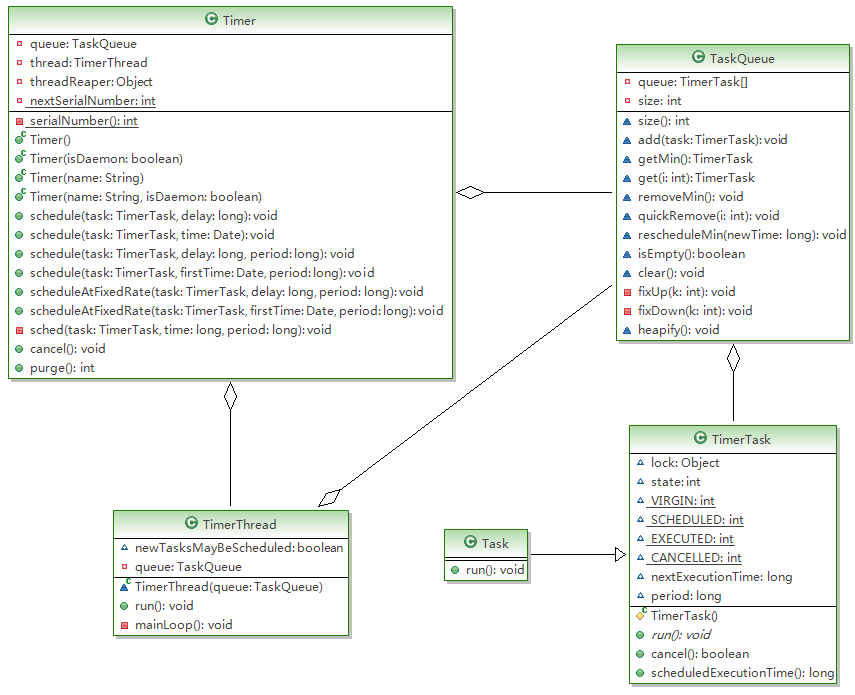
图1
其中Task是我自己写的任务类,这个类需要继承TimerTask,并且实现run()抽象方法,需要将任务执行的相关代码写在run方法中。
 public class Task extends TimerTask {

     @Override

     public void run() {

         System.out.println("do task...");

     }

 }
执行任务的方法如下:
 public class TimerManager {

    public TimerManager() {

       ……

       Timer timer = new Timer();

       Task task = new Task();

       // 安排指定的任务在指定的时间开始进行重复的固定延迟执行。

       timer.schedule(task, date, ConfigData.getDeltaTime() * 1000);

    }

 }
在执行任务的时候,我们只跟Timer打交道,所以先来了解一下Timer.
Timer的构造函数如下,又调用了自己的另一个构造函数 :
 public Timer() {

         this("Timer-" + serialNumber());

 }

 public Timer(String name) {

         thread.setName(name);

         thread.start();

 }
到了这一步,我们需要了解thread是个什么玩意儿,我们来看看他的定义:
private TimerThread thread = new TimerThread(queue);
此时我们需要了解的对象成了TimerThread了,顺藤摸瓜,接着往下看吧:
 class TimerThread extends Thread {

     boolean newTasksMayBeScheduled = true;

     private TaskQueue queue;

     TimerThread(TaskQueue queue) {

         this.queue = queue;

     }

     public void run() {

         try {

             mainLoop();

         } finally {

             // Someone killed this Thread, behave as if Timer cancelled

             synchronized(queue) {

                 newTasksMayBeScheduled = false;

                 queue.clear();  // Eliminate obsolete references

             }

         }

     }

     /**

      * The main timer loop.  (See class comment.)

      */

     private void mainLoop() {

         while (true) {

             try {

                 TimerTask task;

                 boolean taskFired;

                 synchronized(queue) {

                     // Wait for queue to become non-empty

                     while (queue.isEmpty() && newTasksMayBeScheduled)

                         queue.wait();

                     if (queue.isEmpty())

                         break; // Queue is empty and will forever remain; die

                     // Queue nonempty; look at first evt and do the right thing

                     long currentTime, executionTime;

                     task = queue.getMin();

                     synchronized(task.lock) {

                         if (task.state == TimerTask.CANCELLED) {

                             queue.removeMin();

                             continue;  // No action required, poll queue again

                         }

                         currentTime = System.currentTimeMillis();

                         executionTime = task.nextExecutionTime;

                         if (taskFired = (executionTime<=currentTime)) {

                             if (task.period == 0) { // Non-repeating, remove

                                 queue.removeMin();

                                 task.state = TimerTask.EXECUTED;

                             } else { // Repeating task, reschedule

                                 queue.rescheduleMin(

                                   task.period<0 ? currentTime   - task.period

                                                 : executionTime + task.period);

                             }

                         }

                     }

                     if (!taskFired) // Task hasn't yet fired; wait

                         queue.wait(executionTime - currentTime);

                 }

                 if (taskFired) // Task fired; run it, holding no locks

                     task.run();

             } catch(InterruptedException e) {

             }

         }

     }

 }
我们可以看到TimerThread主要就是mianLoop()方法,在mainLoop方法中有这么两行代码:
 while (queue.isEmpty() && newTasksMayBeScheduled)

     queue.wait();
当我们 new Timer(),然后两次调用Timer()的构造函数,并调用thread.start()时,就到了mainLoop方法的这两行代码了,此时的queue.isEmpty()为true,所以线程就wait在这个地方了。什么时候将他notify呢?我们接着往下看我们自己的代码,new Timer(),new Task()之后就到了下面的这行代码了:
timer.schedule(task, date, ConfigData.getDeltaTime() * 1000);
继续摸索一下timer.schedule()是怎么工作的:
 public void schedule(TimerTask task, Date firstTime, long period) {

         if (period <= 0)

             throw new IllegalArgumentException("Non-positive period.");

         sched(task, firstTime.getTime(), -period);

 }

      private void sched(TimerTask task, long time, long period) {

         if (time < 0)

             throw new IllegalArgumentException("Illegal execution time.");

         synchronized(queue) {

             if (!thread.newTasksMayBeScheduled)

                 throw new IllegalStateException("Timer already cancelled.");

             synchronized(task.lock) {

                 if (task.state != TimerTask.VIRGIN)

                     throw new IllegalStateException(

                         "Task already scheduled or cancelled");

                 task.nextExecutionTime = time;

                 task.period = period;

                 task.state = TimerTask.SCHEDULED;

             }

             queue.add(task);

             if (queue.getMin() == task)

                 queue.notify();

         }

     }
当我们跟踪到方法sched时可以看到,这方法中设置了任务的下一次执行时间为传入的时间task.nextExecutionTime = time,然后把添加任务到队列中并notify队列。
到了这里我们要回到之前的wait位置了:
 while (queue.isEmpty() && newTasksMayBeScheduled)

     queue.wait();
现在queue.isEmpty()为false了,得继续往下运行,
 currentTime = System.currentTimeMillis();

 executionTime = task.nextExecutionTime;

 if (taskFired = (executionTime<=currentTime))
程序取得当前的时间和任务下一次执行的时间,比较如果执行的时间还未到则任务执行为false,即taskFired=false。
 if (!taskFired) // Task hasn't yet fired; wait

     queue.wait(executionTime - currentTime);
所以程序为进入wait状态,要wait多久呢?时间为executionTime – currentTime
而如果当前执行程序的时间在任务执行的时间之后了,则任务执行为true,即taskFired=true。
 if (taskFired) // Task fired; run it, holding no locks

     task.run();
任务立即会被执行。
豁然开朗
到这里我们就清楚了为什么之前的测试是那样一个现象,当我们先运行程序再将时间调整为1点59分后,程序一直处于queue.wait(executionTime - currentTime)状态,需要wait的时间为executionTime – currentTime,所以刚过2点时程序是不会马上运行的,必须要等待 executionTime – currentTime的时间后才能执行任务。
JAVA定时任务Timer的更多相关文章
- Java定时任务Timer、TimerTask与ScheduledThreadPoolExecutor详解
定时任务就是在指定时间执行程序,或周期性执行计划任务.Java中实现定时任务的方法有很多,本文从从JDK自带的一些方法来实现定时任务的需求. 一.Timer和TimerTask Timer和Tim ...
- 详解java定时任务---Timer篇
一.简介 在java的jdk中提供了Timer.TimerTask两个类来做定时任务. Timer是一种定时器工具,用来在一个后台线程计划执行指定任务,而TimerTask一个抽象类,它的子 ...
- java定时任务Timer与ScheduledExecutorService<转>
在我们编程过程中如果需要执行一些简单的定时任务,无须做复杂的控制,我们可以考虑使用JDK中的Timer定时任务来实现.下面LZ就其原理.实例以及Timer缺陷三个方面来解析java Timer定时器. ...
- java定时任务Timer/scheduleAtFixedRate
Timer类是用来执行任务的类,定时器 scheduleAtFixedRate模式可以用,在这个模式下,Timer会尽量的让任务在一个固定的频率下运行. 参考:http://swiftlet.net/ ...
- Java基础--定时任务Timer
Java基础--定时任务Timer 一.Timer介绍 java.util.Timer java.util.TimerTask Timer是一个定时器类,通过该类可以为指定的定时任务进行配置.Time ...
- Java 中Timer和TimerTask 定时器和定时任务使用的例子
转自:http://blog.csdn.net/kalision/article/details/7692796 这两个类使用起来非常方便,可以完成我们对定时器的绝大多数需求 Timer类是用来执行任 ...
- Java基础--定时任务Timer(转载)
Java基础--定时任务Timer 一.Timer介绍 java.util.Timer java.util.TimerTask Timer是一个定时器类,通过该类可以为指定的定时任务进行配置.Time ...
- Java之旅--定时任务(Timer、Quartz、Spring、LinuxCron)
在Java中,实现定时任务有多种方式,本文介绍4种,Timer和TimerTask.Spring.QuartZ.Linux Cron. 以上4种实现定时任务的方式,Timer是最简单的,不需要任何框架 ...
- Java定时任务:利用java Timer类实现定时执行任务的功能
一.概述 在java中实现定时执行任务的功能,主要用到两个类,Timer和TimerTask类.其中Timer是用来在一个后台线程按指定的计划来执行指定的任务. TimerTask一个抽象类,它的子类 ...
随机推荐
- pycharm-->github / github-->pycharm
一.pycharm -->发布到--> github:1.github 账号密码 https://github.com/2.git 下载安装 https://git-scm.com/3.配 ...
- App doesn't auto-start an app when booting the device in Android
From Android 3.1, newly installed apps are always put into a "stopped" state and the only ...
- rem根元素的定义规则
<script> !function(a) { function b() { var b = g.getBoundingClientRect().width; var winpix=1; ...
- c++ 11 bind function
Year 2011陈 良乔C++11 FAQ std::function 和 std::bind 标准库函数bind()和function()定义于头文件中(该头文件还包括许多其他函数对象),用于处理 ...
- Django CSRF cookie not set.错误
post提交表单报错: Forbidden (403) CSRF verification failed. Request aborted. You are seeing this message b ...
- java多线程总结(二)
线程一般有6个状态: 新建状态:NEW 可运行状态:RUNNABLE 休眠状态:TIMED_WAITING 等待状态:WAITING 阻塞状态:BLOCKED 终止状态“TERMINATED 当我们使 ...
- blogCMS整理
一.在urls中写路由 二.返回登录页面(login.html中写前端代码) - username(用户名) - password(密码) - validCode(验证码) -submit(提交按钮) ...
- Xamrin开发安卓笔记(二)
http://www.cnblogs.com/minCS/p/4112617.html Xamrin开发安卓笔记(二) 安装篇 Xamrin开发安卓笔记(一) 昨天调理一天AAPT.EXE 被推出 ...
- 3. Longest Substring Without Repeating Characters(最长子串,双指针+hash)
Given a string, find the length of the longest substring without repeating characters. Examples: Giv ...
- DB 数据同步到数据仓库的架构与实践
背景 在数据仓库建模中,未经任何加工处理的原始业务层数据,我们称之为ODS(Operational Data Store)数据.在互联网企业中,常见的ODS数据有业务日志数据(Log)和业务DB数据( ...