
Deep Learning Specialization 笔记
1. numpy中的几种矩阵相乘:
# x1: axn, x2:nxb

np.dot(x1, x2): axn * nxb

np.outer(x1, x2): nx1*1xn    # 实质为: np.ravel(x1)*np.ravel(x2)

np.multiply(x1, x2): [[x1[0][0]*x2[0][0], x1[0][1]*x2[0][1], ...]
2. Bugs' hometown
Many software bugs in deep learning come from having matrix/vector dimensions that don't fit. If you can keep your matrix/vector dimensions straight you will go a long way toward eliminating many bugs.
3. Common steps for pre-processing a new dataset are:
- Figure out the dimensions and shapes of the problem (m_train, m_test, num_px, ...)
- Reshape the datasets such that each example is now a vector of size (num_px \* num_px \* 3, 1)
- "Standardize" the data
4. Unstructured data:
Unstructured data is a generic label for describing data that is not contained in a database or some other type of data structure . Unstructured data can be textual or non-textual. Textual unstructured data is generated in media like email messages, PowerPoint presentations, Word documents, collaboration software and instant messages. Non-textual unstructured data is generated in media like JPEG images, MP3 audio files and Flash video files
5. Chapter of Activation Function:
Choice of activation function:
- If output is either 0 or 1 -- sigmoid for the output layer and the other units on ReLU.
- Except for the output layer, tanh does better than sigmoid.
- ReLU ---level up--> leaky ReLU.
Why are ReLU and leaky ReLU often superior to sigmoid and tanh?
-- The derivatives of the former ones is much bigger than 0, so the learning would be much faster.
A linear hidden layer is more or less useless, yet the activation function is a exception.
6. Regularization:
Initially, \(J(w, b) = \frac{1}{m} * \sum_{i=1}^{m}{L({\hat{Y}^(i), y^{(i)}}) + \frac{\lambda}{2*m}||w||_2^2}\)
L2 regularization: \(\frac{\lambda}{2*m}\sum_{j=1}^{n_x}||w_j||^2 = \frac{\lambda}{2*m}||w||_2\)
One aspect that tanh is better thatn sigmoid(in terms of regularization) -- When x is very close to 0, the derivative of tanh(x) is almost linear, while that of the sigmoid(x) is alomst 0.
Dropout:
Method: Make certain values of weights be zeros randomly, just like -- W= np.multiply(W, C), where C is a 0-1 array.
Matters need attention: Don't use dropout in test procedure -- Time costly, result randomly.
Work principle:
Intuition: Can't rely on any one feature, so have to spread out weights(shrinking weights).
Besides, you can set different rates of "Dropout", like lower ones on more complex layer, which are called "key prop".
- Data augmentation:
Do some operation on your data images, such as flipping, rotation, zooming, etc, without changing their labels, in order to prevent from over-fitting on some aspects, such as the direction of faces, the size of cats.
- Early stopping.
7. Solution to "gradient vanishing or exploding":
Set WL = np.random.randn(shape) * np.sqrt(\(\frac{2}{n^{[L-1]}}\)) if activation_function == "ReLU"
else: np.random.randn(shape) * np.sqrt(\(\frac{1}{n^{[L-1]}}\)) or np.sqrt(\(\sqrt{\frac{2}{n^{[L-1]}+n^{[L]}}}\))(Xavier initialization)
8. Gradient Checking:
for i in range(len(\(\theta\))):
to check if (d\(\theta_{approx}[i] = \frac{J(\theta_1, \theta_2, ..., \theta_i+\epsilon, ...) - J(\theta_1, \theta_2, ..., \theta_i-\epsilon, ...)}{2\epsilon}\)) ?= \(d\theta[i] = \frac{\partial{J}}{\partial{\theta_i}}\)
<==> \(d\theta_{approx} ?= d\theta\)
<==> \(\frac{||d\theta_{approx} - d\theta||_2}{||d\theta_{approx}||_2+||d\theta||_2}\) in an accent range: \(10^{-7}\) is great, and \(10^{-3}\) is wrong.
Tips:
- Only to debug, instead of training.
- If algorithm fails grad check, look at components(\(db^{[L]}, dw^{[L]}\)) to try to identify bug.
- Remember regularization.
- Doesn't work together with dropout.
- Run at random initialization; perhaps again after some training.
9. Exponentially weighted averages:
Definition: let \(V_{t} = {\beta}V_{t-1} + (1 - \beta)\theta_t\) (_V_s are the averages, and the _\(\theta\)_s are the initial discrete data).
and \(V_{t} = \frac{V_{t}}{1 - {\beta}^t}\) (To correct initial bias).
Usage: when it comes to this situation: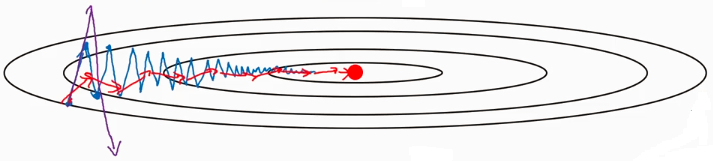
Since the average of the distance vertical movement is almost zeros, you can use EWA to average it, prevent it from divergence.
On iteration t:
Compute dW on the current mini-batch
\(v_{dW} = {\beta}v_{dW} + (1 - \beta)dW\)
\(v_{db} = {\beta}v_{db} + (1 - \beta)db\)
\(W = W - {\alpha}v_{dW}, b = b - {\alpha}v_{db}\)
Hyperparameters: \(\alpha\), \({\beta}(=0.9)\)
Deep Learning Specialization 笔记的更多相关文章
- Deep Learning论文笔记之(四)CNN卷积神经网络推导和实现(转)
Deep Learning论文笔记之(四)CNN卷积神经网络推导和实现 zouxy09@qq.com http://blog.csdn.net/zouxy09 自己平时看了一些论文, ...
- Deep Learning论文笔记之(八)Deep Learning最新综述
Deep Learning论文笔记之(八)Deep Learning最新综述 zouxy09@qq.com http://blog.csdn.net/zouxy09 自己平时看了一些论文,但老感觉看完 ...
- Deep Learning论文笔记之(六)Multi-Stage多级架构分析
Deep Learning论文笔记之(六)Multi-Stage多级架构分析 zouxy09@qq.com http://blog.csdn.net/zouxy09 自己平时看了一些 ...
- 【deep learning学习笔记】注释yusugomori的DA代码 --- dA.h
DA就是“Denoising Autoencoders”的缩写.继续给yusugomori做注释,边注释边学习.看了一些DA的材料,基本上都在前面“转载”了.学习中间总有个疑问:DA和RBM到底啥区别 ...
- Deep Learning论文笔记之(一)K-means特征学习
Deep Learning论文笔记之(一)K-means特征学习 zouxy09@qq.com http://blog.csdn.net/zouxy09 自己平时看了一些论文,但老感 ...
- Deep Learning论文笔记之(三)单层非监督学习网络分析
Deep Learning论文笔记之(三)单层非监督学习网络分析 zouxy09@qq.com http://blog.csdn.net/zouxy09 自己平时看了一些论文,但老感 ...
- Spectral Norm Regularization for Improving the Generalizability of Deep Learning论文笔记
Spectral Norm Regularization for Improving the Generalizability of Deep Learning论文笔记 2018年12月03日 00: ...
- Deep Learning论文笔记之(四)CNN卷积神经网络推导和实现
https://blog.csdn.net/zouxy09/article/details/9993371 自己平时看了一些论文,但老感觉看完过后就会慢慢的淡忘,某一天重新拾起来的时候又好像没有看过一 ...
- [置顶]
Deep Learning 学习笔记
一.文章来由 好久没写原创博客了,一直处于学习新知识的阶段.来新加坡也有一个星期,搞定签证.入学等杂事之后,今天上午与导师确定了接下来的研究任务,我平时基本也是把博客当作联机版的云笔记~~如果有写的不 ...
随机推荐
- SQL函数知识点
SQL函数知识点 SQL题目(一) 1.查询部门编号为10的员工信息 select*from emp where empno=10; 2.查询年薪大于3万的人员的姓名与部门编号 select enam ...
- 微博CacheService架构浅析 对底层协议进行适配
https://mp.weixin.qq.com/s/wPR0j2bmHBF6z0ZjTlz_4A 麦俊生 InfoQ 2014-04-21 微博作为国内最大的社交媒体网站之一,每天承载着亿万用户的服 ...
- Win+R 快速启动程序
将某个程序的可执行C:\Program Files\Oracle\VirtualBox\VirtualBox.exe 或其快捷键 放入 某个自建的快捷键集合文件夹,可以自定义命名 如 vb 将其添加到 ...
- 回归(Regression)
回归(Regression) 生活中的很多事物之间是相互影响的,如商品的质量跟用户的满意度密切相关.而回归分析是要分析两个事物间的因果关系,即哪一个是自变量和因变量,以及自变量和因变量之间的关系:回归 ...
- JavaWeb——JSP内置对象application,JSP属性范围
application application语法 application对象 JSP属性范围 范围的分类 page request session application pagecontext延伸 ...
- MacOS Big Sur开HiDPI
我自己的环境: 开启hidpi的目的是为了让显示更加细腻,代价是缩小了显示范围. 自己在网上看了很多帖子,也尝试了几种,有些方法已经不再适合Big Sur系统了,所以本文提供一种可用的,在Big Su ...
- 【从零开始撸一个App】RecyclerView的使用
目标 前段时间打造了一款简单易用功能全面的图片上传组件,现在就来将上传的图片以图片集的形式展现到App上.出于用户体验考虑,加载新图片采用[无限]滚动模式,Android平台上我们优选Recycler ...
- 环境变量设置,为什么要设置,tomcat的为什么不用设置?
在学习JAVA的过程中,涉及到多个环境变量(environment variable)的概念,如PATH.正确地配置这些环境变量,是能够顺利学习.开发的前提.而经常出现的问题是:有的学习者能够按照提示 ...
- 【Spring-Security】Re01 入门上手
一.所需的组件 SpringBoot项目需要的POM依赖: <dependency> <groupId>org.springframework.boot</groupId ...
- k8s 调度 GPU
最近公司有项目想在 k8s 集群中运行 GPU 任务,于是研究了一下.下面是部署的步骤. 1. 首先得有一个可以运行的 k8s 集群. 集群部署参考 kubeadm安装k8s 2. 准备 GPU 节点 ...