
4.3 Writing a Grammar
4.3 Writing a Grammar
Grammars are capable of describing most, but not all, of the syntax of programming languages. For instance, the requirement that identifiers be declared before they are used, cannot be described by a context-free grammar. Therefore, the sequences of tokens accepted by a parser form a superset of the programming language; subsequent phases of the compiler must analyze the output of the parser to ensure compliance with rules that are not checked by the parser.
This section begins with a discussion of how to divide work between a lexical analyzer and a parser. We then consider several transformations that could be applied to get a grammar more suitable for parsing. One technique can eliminate ambiguity in the grammar, and other techniques | left-recursion elimination and left factoring | are useful for rewriting grammars so they become suitable for top-down parsing. We conclude this section by considering some programming language constructs that cannot be described by any grammar.
4.3.1 Lexical Versus Syntactic Analysis
As we observed in Section 4.2.7, everything that can be described by a regular expression can also be described by a grammar. We may therefore reasonably ask: “Why use regular expressions to define the lexical syntax of a language?” There are several reasons.
1. Separating the syntactic structure of a language into lexical and non-lexical parts provides a convenient way of modularizing the front end of a compiler into two manageable-sized components.
2. The lexical rules of a language are frequently quite simple, and to describe them we do not need a notation as powerful as grammars.
3. Regular expressions generally provide a more concise and easier-to-understand notation for tokens than grammars.
4. More efficient lexical analyzers can be constructed automatically from regular expressions than from arbitrary grammars.
There are no firm guidelines as to what to put into the lexical rules, as opposed to the syntactic rules. Regular expressions are most useful for describing the structure of constructs such as identifiers, constants, keywords, and white space. Grammars, on the other hand, are most useful for describing nested structures such as balanced parentheses, matching begin-end’s, corresponding if-then-else’s, and soon. These nested structures cannot be described by regular expressions.
4.3.2 Eliminating Ambiguity
Sometimes an ambiguous grammar can be rewritten to eliminate the ambiguity. As an example, we shall eliminate the ambiguity from the following “dangling-else” grammar:
|
stmt |
→ if expr then stmt | if expr then stmt else stmt | other
|
(4.14)
|
Here “other” stands for any other statement. According to this grammar, the compound conditional statement
|
if E1 then S1 else if E2 then S2 else S3 |
|
|
|
Figure 4.8: Parse tree for a conditional statement |
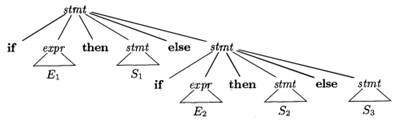
has the parse tree shown in Fig. 4.8. 1 Grammar (4.14) is ambiguous since the string
|
if E1 then if E2 then S1 else S2 |
(4.15) |
has the two parse trees shown in Fig. 4.9.
|
|
|
|
|
Figure 4.9: Two parse trees for an ambiguous sentence |
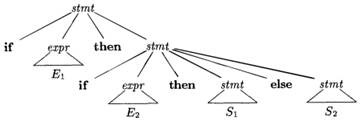
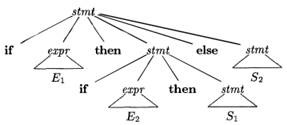
In all programming languages with conditional statements of this form, the first parse tree is preferred. The general rule is, “Match each else with the closest unmatched then.”2 This disambiguating rule can theoretically be incorporated directly into a grammar, but in practice it is rarely built into the productions.
|
1 The subscripts on E and S are just to distinguish different occurrences of the same nonterminal, and do not imply distinct nonterminals. 2 We should note that C and its derivatives are included in this class. Even though the C family of languages do not use the keyword then, its role is played by the closing parenthesis for the condition that follows if. |
Example 4.16: We can rewrite the dangling-else grammar (4.14) as the following unambiguous grammar. The idea is that a statement appearing between a then and an else must be “matched”; that is, the interior statement must not end with an unmatched or open then. A matched statement is either an if-then-else statement containing no open statements or it is any other kind of unconditional statement. Thus, we may use the grammar in Fig. 4.10. This grammar generates the same strings as the dangling-else grammar (4.14), but it allows only one parsing for string (4.15); namely, the one that associates each else with the closest previous unmatched then. □
|
stmt |
→ matched stmt | open stmt |
|
matched_stmt |
→ if expr then matched stmt else matched stmt | other |
|
open_stmt |
→ if expr then stmt | if expr then matched stmt else open stmt |
|
Figure 4.10: Unambiguous grammar for if-then-else statements |
|
4.3.3 Elimination of Left Recursion
A grammar is left recursive if it has a nonterminal A such that there is a derivation A=+>Aα for some string α. Top-down parsing methods cannot handle left-recursive grammars, so a transformation is needed to eliminate left recursion. In Section 2.4.5, we discussed immediate left recursion, where there is a production of the form A → Aα. Here, we study the general case. In Section 2.4.5, we showed how the left-recursive pair of productions A → Aα | β could be replaced by the non-left-recursive productions:
A →βA’
A’ → αA’ | ϵ
without changing the strings derivable from A. This rule by itself suffices for many grammars.
Example 4.17: The non-left-recursive expression grammar (4.2), repeated here,
E → T E’
E’ → + T E’
T → F T’
T’ → * F T’
F → (E) | id
is obtained by eliminating immediate left recursion from the expression grammar (4.1). The left-recursive pair of productions E → E + T | T are replaced by E → T E’ and E’ → + T E’ | ϵ. The new productions for T and T’ are obtained similarly by eliminating immediate left recursion. □
Immediate left recursion can be eliminated by the following technique, which works for any number of A-productions. First, group the productions as
A → A α1 | A α2 | … | A αm |β1 |β2 | … |βn
where no βi begins with an A. Then, replace the A-productions by
A → β1 A’ | β2 A’ | … | βn A’
A’ → α1 A’ |α2 A’ | … | αm A’ | ϵ
The nonterminal A generates the same strings as before but is no longer left recursive. This procedure eliminates all left recursion from the A and A’ productions (provided no αi is ϵ), but it does not eliminate left recursion involving derivations of two or more steps. For example, consider the grammar
|
S → A a | b A → A c | S d | ϵ |
(4.18) |
The nonterminal S is left recursive because S ⇒ Aa ⇒ Sda, but it is not immediately left recursive.
Algorithm 4.19, below, systematically eliminates left recursion from a grammar. It is guaranteed to work if the grammar has no cycles (derivations of the form A =+>A) or ϵ-productions (productions of the form A →ϵ). Cycles can be eliminated systematically from a grammar, as can ϵ-productions (see Exercises 4.4.6 and 4.4.7).
Algorithm 4.19: Eliminating left recursion.
INPUT: Grammar G with no cycles or ϵ-productions.
OUTPUT: An equivalent grammar with no left recursion.
METHOD: Apply the algorithm in Fig. 4.11 to G. Note that the resulting non-left-recursive grammar may have ϵ-productions. □
|
1) |
arrange the nonterminals in some order A1, A2, …,An. |
|
2) |
for ( each i from 1 to n ) { |
|
3) |
for ( each j from 1 to i-1 ) { |
|
4) |
replace each production of the form Ai → Ajγ by the productions Ai → δ1γ |δ2γ | … |δkγ, where Aj → δ1 |δ2 | … |δk are all current Aj-productions |
|
5) |
} |
|
6) |
eliminate the immediate left recursion among the Ai-productions |
|
7) |
} |
|
Figure 4.11: Algorithm to eliminate left recursion from a grammar |
|
The procedure in Fig. 4.11 works as follows. In the first iteration for i = 1, the outer for-loop of lines (2) through (7) eliminates any immediate left recursion among A1-productions. Any remaining A1 productions of the form A1 → Alα must therefore have l > 1. After the i-1st iteration of the outer for-loop, all nonterminals Ak, where k < i, are “cleaned”; that is, any production Ak → Alα, must have l > k. As a result, on the ith iteration, the inner loop of lines (3) through (5) progressively raises the lower limit in any production Ai → Amα, until we have m≥i. Then, eliminating immediate left recursion for the Ai productions at line (6) forces m to be greater than i.
Example 4.20: Let us apply Algorithm 4.19 to the grammar (4.18). Technically, the algorithm is not guaranteed to work, because of the ϵ-production, but in this case, the production A →ϵ turns out to be harmless.
We order the nonterminals S, A. There is no immediate left recursion among the S -productions, so nothing happens during the outer loop for i = 1. For i = 2, we substitute for S in A → S d to obtain the following A-productions.
A → A c | A a d | b d | ϵ
Eliminating the immediate left recursion among these A-productions yields the following grammar.
S → A a | b
A → b d A’ | A’
A’ → c A’ | a d A’ | ϵ
□
4.3.4 Left Factoring
Left factoring is a grammar transformation that is useful for producing a grammar suitable for predictive, or top-down, parsing. When the choice between two alternative A-productions is not clear, we may be able to rewrite the productions to defer the decision until enough of the input has been seen that we can make the right choice.
For example, if we have the two productions
|
stmt |
→ if expr then stmt else stmt | if expr then stmt |
on seeing the input if, we cannot immediately tell which production to choose to expand stmt. In general, if A → αβ1 |αβ2 are two A-productions, and the input begins with a nonempty string derived from α, we do not know whether to expand A to αβ1 or αβ2. However, we may defer the decision by expanding A to A’. Then, after seeing the input derived from α, we expand A’ to β1 or to β2. That is, left-factored, the original productions become
A → A’
A’ → β1 | β2
Algorithm 4.21: Left factoring a grammar.
INPUT: Grammar G.
OUTPUT: An equivalent left-factored grammar.
METHOD: For each nonterminal A, find the longest prefix common to two or more of its alternatives. If α ≠ ϵ i.e., there is a nontrivial common prefix | replace all of the A-productions A →αβ1 |αβ2 | … |αβn | γ, where represents all alternatives that do not begin with α, by
A → αA’ | γ
A’ → β1 |β2 | … |βn
Here A 0 is a new nonterminal. Repeatedly apply this transformation until no two alternatives for a nonterminal have a common prefix. □
Example 4.22: The following grammar abstracts the “dangling-else” problem:
|
S → i E t S | i E t S e S | a E → b |
(4.23) |
Here, i, t, and e stand for if, then, and else; E and S stand for “conditional expression” and “statement.” Left-factored, this grammar becomes:
|
S → i E t S S’ | a S’ → e S | ϵ E → b |
(4.24) |
Thus, we may expand S to iEtSS’ on input i, and wait until iEtS has been seen to decide whether to expand S’ to eS or to ϵ. Of course, these grammars are both ambiguous, and on input e, it will not be clear which alternative for S’ should be chosen. Example 4.33 discusses a way out of this dilemma. □
4.3.5 Non-Context-Free Language Constructs
A few syntactic constructs found in typical programming languages cannot be specified using grammars alone. Here, we consider two of these constructs, using simple abstract languages to illustrate the difficulties.
Example 4.25: The language in this example abstracts the problem of checking that identifiers are declared before they are used in a program. The language consists of strings of the form wcw, where the first w represents the declaration of an identifier w, c represents an intervening program fragment, and the second w represents the use of the identifier.
The abstract language is L1 = {wcw | w is in (a|b)*}. L1 consists of all words composed of a repeated string of a’s and b’s separated by c, such as aabcaab. While it is beyond the scope of this book to prove it, the non-context-freedom of L1 directly implies the non-context-freedom of programming languages like C and Java, which require declaration of identifiers before their use and which allow identifiers of arbitrary length.
For this reason, a grammar for C or Java does not distinguish among identifiers that are different character strings. Instead, all identifiers are represented by a token such as id in the grammar. In a compiler for such a language, the semantic-analysis phase checks that identifiers are declared before they are used. □
Example 4.26: The non-context-free language in this example abstracts the problem of checking that the number of formal parameters in the declaration of a function agrees with the number of actual parameters in a use of the function. The language consists of strings of the form anbmcndm. (Recall an means a written n times.) Here an and bm could represent the formal-parameter lists of two functions declared to have n and m arguments, respectively, while cn and dm represent the actual-parameter lists in calls to these two functions.
The abstract language is L2 = { anbmcndm | n≥1 and m≥1}. That is, L2 consists of strings in the language generated by the regular expression a*b*c*d* such that the number of a’s and c’s are equal and the number of b’s and d’s are equal. This language is not context free.
Again, the typical syntax of function declarations and uses does not concern itself with counting the number of parameters. For example, a function call in C-like language might be specified by
|
stmt |
→ id ( expr_list ) |
|
expr_list |
→ expr_list , expr | expr |
with suitable productions for expr. Checking that the number of parameters in a call is correct is usually done during the semantic-analysis phase. □
4.3 Writing a Grammar的更多相关文章
- SH Script Grammar
http://linux.about.com/library/cmd/blcmdl1_sh.htm http://pubs.opengroup.org/onlinepubs/9699919799/ut ...
- Writing a simple Lexer in PHP/C++/Java
catalog . Comparison of parser generators . Writing a simple lexer in PHP . phc . JLexPHP: A PHP Lex ...
- Writing the first draft of your science paper — some dos and don’ts
Writing the first draft of your science paper — some dos and don’ts 如何起草一篇科学论文?经验丰富的Angel Borja教授告诉你 ...
- 写出完美论文的十个技巧10 Tips for Writing the Perfect Paper
10 Tips for Writing the Perfect Paper Like a gourmet meal or an old master painting, the perfect col ...
- Example of Formalising a Grammar for use with Lex & Yacc
Here is a sample of a data-file that we want to try and recognise. It is a list of students and info ...
- Preparation for MCM/ICM Writing
Preparation for MCM/ICM Writing -- by Chance Zhang $1^{st}ed$ key words: MCM/ICM, format, phrases, t ...
- Spring Enable annotation – writing a custom Enable annotation
原文地址:https://www.javacodegeeks.com/2015/04/spring-enable-annotation-writing-a-custom-enable-annotati ...
- Writing to a MySQL database from SSIS
Writing to a MySQL database from SSIS 出处 : http://blogs.msdn.com/b/mattm/archive/2009/01/07/writin ...
- Writing Clean Code 读后感
最近花了一些时间看了这本书,书名是 <Writing Clean Code ── Microsoft Techniques for Developing Bug-free C Programs& ...
随机推荐
- 关于latch: cache buffers chains的sql优化
前段时间,优化了一些耗buffer比较多的sql,但是CPU使用率还是没下来 . 查看操作系统CPU使用率 查看awr,发现又有一条超级耗性能的sql冒出来了. 该SQL每次执行耗费3e多个buffe ...
- 每日命令:(12)sar
sar(System Activity Reporter系统活动情况报告)是目前 Linux 上最为全面的系统性能分析工具之一,可以从多方面对系统的活动进行报告, 包括:文件的读写情况.系统调用的使用 ...
- linux纯字符界面不支持中文
[2017-01-17] linux纯字符界面不支持中文
- C++解决大数组问题
今天写一个C++小程序,竟然出现:"VS 未经处理的异常: 0xC00000FD: Stack overflow" 查了一下,普通数组变量是在堆栈中保存的,而堆栈空间有限,故出此错 ...
- 如何抓取崩溃的log日志
4.手机录屏工具的推荐 Andriod:录屏大师,易录屏等等. iOS:AirPlayer,iTools. 5.如何抓取崩溃的log日志? android闪退获取日志方法: 1.下载adb工具包 2. ...
- Leetcode 214.最短回文串
最短回文串 给定一个字符串 s,你可以通过在字符串前面添加字符将其转换为回文串.找到并返回可以用这种方式转换的最短回文串. 示例 1: 输入: "aacecaaa" 输出: &qu ...
- 数据库 SQL SQL转义
SQL转义 @author ixenos 前言 类似文件分隔符在不同系统的实现不同,我们需要一个中间的转义字符来作为接口,各厂商再具体实现 而SQL的转义语法主要为了支持各种数据库普遍支持的特性,但各 ...
- AndroidSweetSheet:ViewPager的实现(2)
AndroidSweetSheet:ViewPager的实现(2) 附录文章9说明了AndroidSweetSheet典型的列表样式实现,本文写一个例子,说明AndroidSweetSheet以 ...
- 关于oracle 压缩表
这周客户的问题非常多,总是说我的数据不对.于是我对数据梳理了以后发现以前认为是重复数据的,其实并不是,而是我忽略了一个维度.那么这样一来,我们的周详单表就会有500多万的数据.一个月按照4周计算,就要 ...
- Linux下汇编语言学习笔记13 ---
这是17年暑假学习Linux汇编语言的笔记记录,参考书目为清华大学出版社 Jeff Duntemann著 梁晓辉译<汇编语言基于Linux环境>的书,喜欢看原版书的同学可以看<Ass ...