
企业搜索引擎开发之连接器connector(二十四)
本人在上文中提到,连接器实现了两种事件依赖的机制 ,其一是我们手动操作连接器实例时;其二是由连接器的自动更新机制
上文中分析了连接器的自动更新机制,即定时器执行定时任务
那么,如果我们手动操作连接器实例时,是怎么发出事件更新连接器实例的呢
通过eclipse开发工具,追踪调用ChangeDetector接口的detect()方法的方法
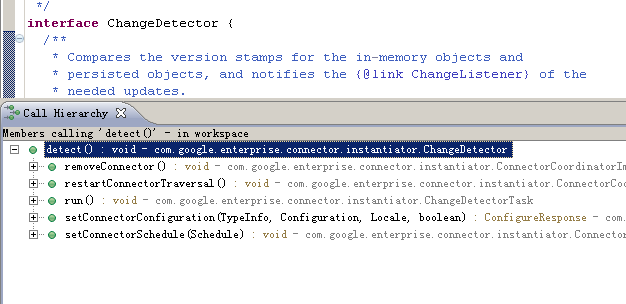
ChangeDetectorTask类的run方法里面调用我们再上文中已经分析了,其他方法便是ConnectorCoordinatorImpl实例对象的方法
即ConnectorCoordinatorImpl实例对象的如下方法,分别调用了ChangeDetector接口的detect()方法
/**

   * 移除连接器实例

   * Removes this {@link Connector} instance.  Halts traversals,

   * removes the Connector instance from the known connectors,

   * and removes the Connector's on-disk representation.

   */

  /* @Override */

  public void removeConnector() {

    synchronized(this) {

      resetBatch();

      if (instanceInfo != null) {

        instanceInfo.removeConnector();

      }

    }

    // This must not be called while holding the lock.

    changeDetector.detect();

  }

/**

   * 重启遍历

   * Retraverses the {@link Connector}'s content from scratch.

   * Halts any traversal in progress and removes any saved traversal state,

   * forcing the Connector to retraverse the Repository from its start.

   */

  /* @Override */

  public void restartConnectorTraversal() throws ConnectorNotFoundException {

    // To avoid deadlock, this method calls InstanceInfo's getters and setters,

    // rather than the local ones.

    synchronized(this) {

      resetBatch();                               // Halt any traversal.

      getInstanceInfo().setConnectorState(null);  // Discard the checkpoint.

      // If Schedule was 'run-once', re-enable it to run again.  But watch out -

      // empty disabled Schedules could look a bit like a run-once Schedule.

      Schedule schedule = getInstanceInfo().getConnectorSchedule();

      if (schedule != null && schedule.isDisabled() &&

            schedule.getRetryDelayMillis() == -1 &&

            schedule.nextScheduledInterval() != -1) {

          schedule.setDisabled(false);

          getInstanceInfo().setConnectorSchedule(schedule);

      }

    }

    // TODO: Remove this if we switch completely to JDBC PersistentStore.

    // FileStore doesn't notice the deletion of a file that did not exist.

    if (lister != null) {

      connectorCheckpointChanged(null);

    }

    // This must not be called while holding the lock.

    changeDetector.detect();

  }

/**

   * 设置配置信息

   * Sets the {@link Configuration} for this {@link ConnectorCoordinator}.

   * If this {@link ConnectorCoordinator} supports persistence this will

   * persist the new Configuration.

   */

  /* @Override */

  public ConfigureResponse setConnectorConfiguration(TypeInfo newTypeInfo,

      Configuration configuration, Locale locale, boolean update)

      throws ConnectorNotFoundException, ConnectorExistsException,

      InstantiatorException {

    LOGGER.info("Configuring connector " + name);

    String typeName = newTypeInfo.getConnectorTypeName();

    Preconditions.checkArgument(typeName.equals(configuration.getTypeName()),

        "TypeInfo must match Configuration type");

    ConfigureResponse response = null;

    synchronized(this) {

      resetBatch();

      if (instanceInfo != null) {

        if (!update) {

          throw new ConnectorExistsException();

        }

        if (typeName.equals(typeInfo.getConnectorTypeName())) {

          configuration =

              new Configuration(configuration, getConnectorConfiguration());

          response = resetConfig(instanceInfo.getConnectorDir(), typeInfo,

              configuration, locale);

        } else {

          // An existing connector is being given a new type - drop then add.

          // TODO: This shouldn't be called from within the synchronized block

          // because it will kick the change detector.

          removeConnector();

          response = createNewConnector(newTypeInfo, configuration, locale);

          if (response != null) {

            // TODO: We need to restore original Connector config. This is

            // necessary once we allow update a Connector with new ConnectorType.

            // However, when doing so consider: createNewConnector could have

            // thrown InstantiatorException as well.  Also, you need to kick

            // the changeDetector (but not in this synchronized block).

            LOGGER.severe("Failed to update Connector configuration.");

            //    + " Restoring original Connector configuration.");

          }

        }

      } else {

        if (update) {

          throw new ConnectorNotFoundException();

        }

        response = createNewConnector(newTypeInfo, configuration, locale);

      }

    }

    if (response == null) {

      // This must not be called while holding the lock.

      changeDetector.detect();

    } else {

      return new ExtendedConfigureResponse(response, configuration.getXml());

    }

    return response;

  }

/**

   * 设置定时调度

   * Sets the traversal {@link Schedule} for the {@link Connector}.

   *

   * @param connectorSchedule Schedule to store or null to unset any existing

   *        Schedule.

   * @throws ConnectorNotFoundException if the connector is not found

   */

  /* @Override */

  public void setConnectorSchedule(Schedule connectorSchedule)

      throws ConnectorNotFoundException {

    synchronized(this) {

      // Persistently store the new schedule.

      getInstanceInfo().setConnectorSchedule(connectorSchedule);

    }

    // This must not be called while holding the lock.

    changeDetector.detect();

  }
接下来ChangeDetector接口的detect()方法其实又调用了自身的实现ConnectorCoordinatorImpl实例对象的实现ChangeHandler接口的方法
ConnectorCoordinatorImpl-->ChangeDetector的detect()-->ChangeListener的相关方法-->ChangeHandler(ConnectorCoordinatorImpl实例对象)的相关方法
所以手动操作与自动更新机制实际上是殊途同归,最后都是调用了ChangeHandler(ConnectorCoordinatorImpl实例对象)的相关方法
---------------------------------------------------------------------------
本系列企业搜索引擎开发之连接器connector系本人原创
转载请注明出处 博客园 刺猬的温驯
本人邮箱: chenying998179@163#com (#改为.)
本文链接 http://www.cnblogs.com/chenying99/p/3776515.html
企业搜索引擎开发之连接器connector(二十四)的更多相关文章
- 企业搜索引擎开发之连接器connector(十九)
连接器是基于http协议通过推模式(push)向数据接收服务端推送数据,即xmlfeed格式数据(xml格式),其发送数据接口命名为Pusher Pusher接口定义了与发送数据相关的方法 publi ...
- 企业搜索引擎开发之连接器connector(十八)
创建并启动连接器实例之后,连接器就会基于Http协议向指定的数据接收服务器发送xmlfeed格式数据,我们可以通过配置http代理服务器抓取当前基于http协议格式的数据(或者也可以通过其他网络抓包工 ...
- 企业搜索引擎开发之连接器connector(十六)
本人有一段时间没有接触企业搜索引擎之连接器的开发了,连接器是涉及企业搜索引擎一个重要的组件,在数据源与企业搜索引擎中间起一个桥梁的作用,类似于数据库之JDBC,通过连接器将不同数据源的数据适配到企业搜 ...
- 企业搜索引擎开发之连接器connector(二十九)
在哪里调用监控器管理对象snapshotRepositoryMonitorManager的start方法及stop方法,然后又在哪里调用CheckpointAndChangeQueue对象的resum ...
- 企业搜索引擎开发之连接器connector(二十八)
通常一个SnapshotRepository仓库对象对应一个DocumentSnapshotRepositoryMonitor监视器对象,同时也对应一个快照存储器对象,它们的关联是通过监视器管理对象D ...
- 企业搜索引擎开发之连接器connector(二十六)
连接器通过监视器对象DocumentSnapshotRepositoryMonitor从上文提到的仓库对象SnapshotRepository(数据库仓库为DBSnapshotRepository)中 ...
- 企业搜索引擎开发之连接器connector(二十五)
下面开始具体分析连接器是怎么与连接器实例交互的,这里主要是分析连接器怎么从连接器实例获取数据的(前面文章有涉及基于http协议与连接器的xml格式的交互,连接器对连接器实例的设置都是通过配置文件操作的 ...
- 企业搜索引擎开发之连接器connector(二十二)
下面来分析线程执行类,线程池ThreadPool类 对该类的理解需要对java的线程池比较熟悉 该类引用了一个内部类 /** * The lazily constructed LazyThreadPo ...
- 企业搜索引擎开发之连接器connector(二十)
连接器里面衔接数据源与数据推送对象的是QueryTraverser类对象,该类实现了Traverser接口 /** * Interface presented by a Traverser. Used ...
随机推荐
- 管道和FIFO 二
前面我们学习了一下进程,我们知道多,进程间的地址空间相对独立.进程与进程间不能像线程间通过全局变量通信. 如果想进程间通信,就需要其他机制. 常用的进程间通信方式有这几种 A.传 ...
- [模板]ST表浅析
ST表,稀疏表,用于求解经典的RMQ问题.即区间最值问题. Problem: 给定n个数和q个询问,对于给定的每个询问有l,r,求区间[l,r]的最大值.. Solution: 主要思想是倍增和区间d ...
- [转][Dapper]SQL 经验集
condition.Append(" AND ChineseName like @name"); p.Add("@name", "%" + ...
- Zookeeper客户端 CuratorFramework使用
CuratorFramework使用 跟着实例学习ZooKeeper的用法: Curator框架应用 ZooKeeper客户端Curator使用一 创建连接
- elasticsearch 官方入门 及 API
https://www.elastic.co/guide/en/elasticsearch/reference/current/_basic_concepts.html 入门地址 ElasticSea ...
- Partition does not start on physical sector boundary
今天给一块硬盘分区,用fdisk按照默认步骤执行,遇到这个问题: [root@bogon ~]# fdisk /dev/sdfDevice contains neither a valid DOS p ...
- Spring主从数据源动态切换
参考文档: http://uule.iteye.com/blog/2126533 http://lanjingling.github.io/2016/02/15/spring-aop-dynamicd ...
- java HttpClient 获取页面Cookie信息
HttpClient client = new HttpClient(); GetMethod get=new GetMethod("http://www.baidu.com"); ...
- Visual Studio 使用Web Deploy发布项目
工具:Web Deploy 3.6 点击下载 (强烈推荐使用独立的Web Deploy 安装包安装) 使用 Web Platform Installer 安装 Web Deploy(3.5,3.6都安 ...
- LUA table.sort的问题,数组与表的区别
t = { [] = , [] = , [] = , [] = , } t1 = { , , , , } t2 = { 'a', 'b','d','c', } function cmp(v1, v2) ...