
最简最快了解RPC核心流程
本文主要以最简易最快速的方式介绍RPC调用核心流程,文中以Dubbo为例。同时,会写一个简易的RPC调用代码,方便理解和记忆核心组件和核心流程。
1、核心思想
RPC调用过程中,最粗矿的核心组件3个:Registry、Provider、Consumer。最粗矿的流程4个:注册、订阅、通知、调用。最简单的流程图就1个:
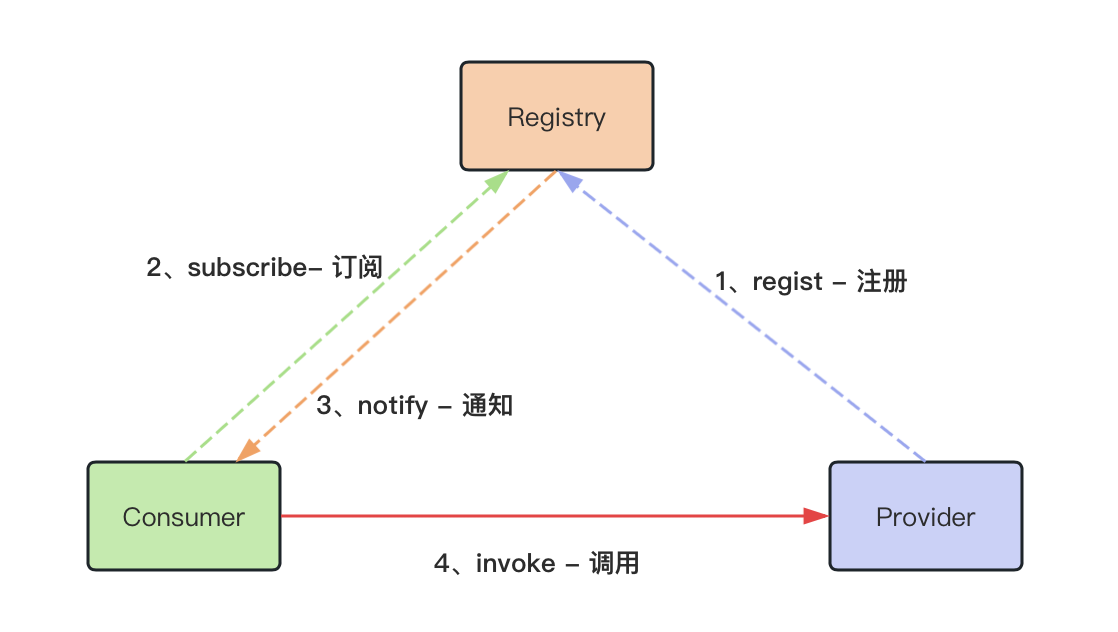
本文会继续细粒度地拆解以上流程,拆解之前,请牢记这段话:
RPC调用,不管中间流程多么复杂,不管代码多么复杂,所有的努力也只为做2件事情:
- 在Consumer端,将ReferenceConfig配置的类转换成Proxy代理。
- 在Provider端,将ServiceConfig配置的类转换成Proxy代理。
2、核心组件
为了能在Consumer端和Provider端生成各自的Proxy代理,并且发起调用和响应,需要如下核心组件:
- Registry:注册中心,主要是为了实现 Provider接口注册、Consumer订阅接口、接口变更通知、接口查找等功能。
- Proxy:服务代理,核心中的核心,一切的努力都是为了生成合适的Proxy服务代理。
- Consumer的Proxy:Consumer端根据
ReferenceConfig生成Proxy,此Proxy主要用于找到合适的Provider接口,然后发起网络调用。 - Provider的Proxy:Provider端根据
ServiceConfig生成Proxy,此Proxy主要作用是通过类似反射的方法调用本地代码,再将结果返回给Consumer。
- Consumer的Proxy:Consumer端根据
- Protocol:服务协议,它相当于一个中间层,用于与注册中心打交道 和 封装 RPC 调用。它在初始化时会创建
Client模块 与 服务端建立连接,也会生成用于远程调用的Invoker。 - Cluster:服务集群,主要用于路由、负载均衡、服务容错等。
- Invoker:服务调用者。
- Consumer的服务调用者主要是利用
Client模块发起远程调用,然后等待Provider返回结果。 - Provider的服务调用者主要是根据接收到的消息利用反射生成本地代理,然后执行方法,再将结果返回到Consumer。
- Consumer的服务调用者主要是利用
- Client:客户端模块,默认是Netty实现,主要用于客户端和服务端通讯(主要是服务调用),比如将请求的接口、参数、请求ID等封装起来发给Server端。
- Server:服务端模拟,默认是Netty实现。主要是用于客户端和服务端通讯。
3、核心流程
3.1、Consumer流程
流程:
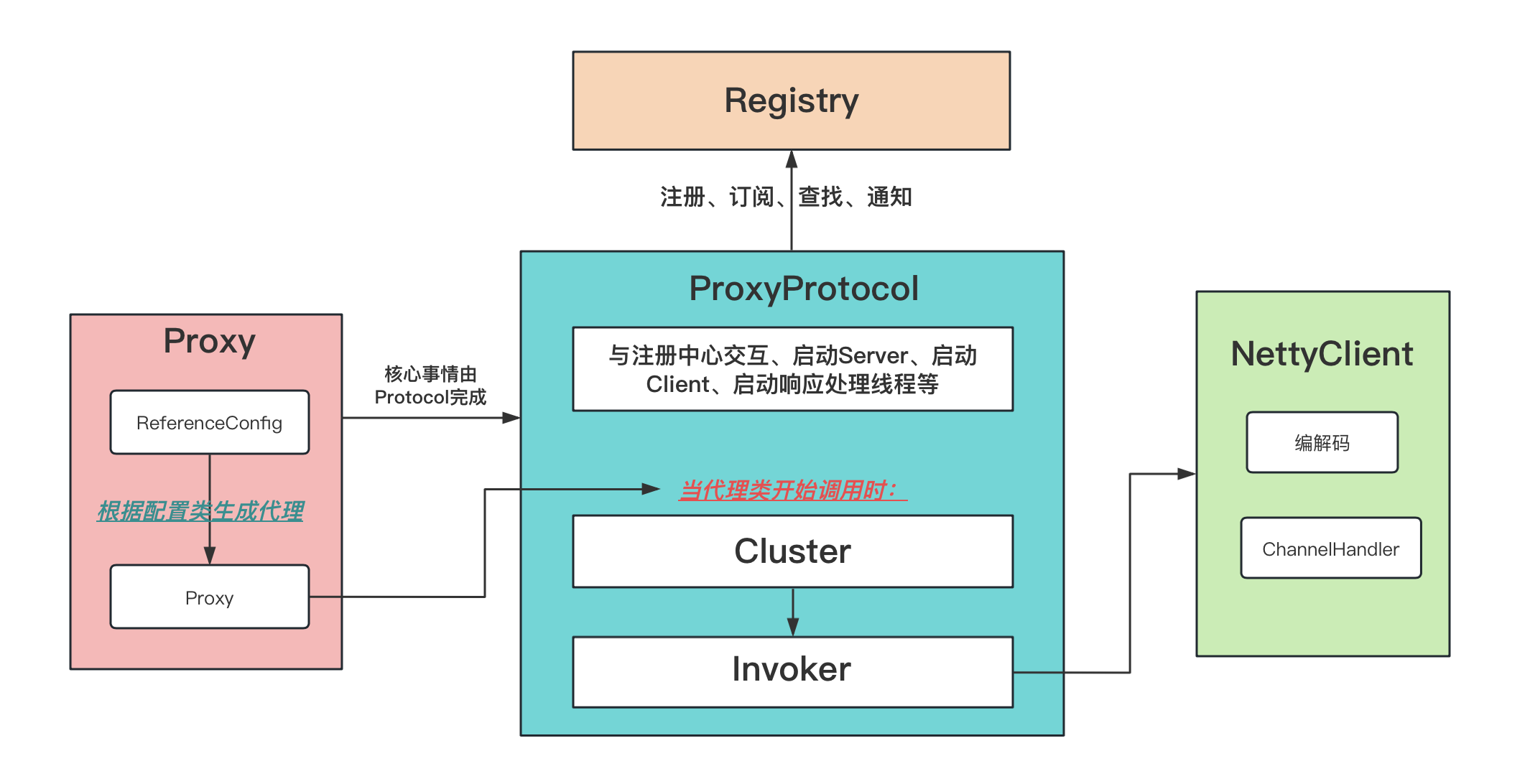
Consumer的流程实际上就是一个从ReferenceConfig 生成Proxy代理的过程。核心事情由Protocol完成。
- 根据
ReferenceConfig生成代理 - 注册到注册中心、订阅注册中心事件
- 建立NettyClient,并且与NettyServer建立连接
- 生成客户端的ClientInvoker
- 选择负载均衡和集群容错
- ClientInvoker发起网络调用和等待结果
流程图:
3.2、Provider流程
流程:
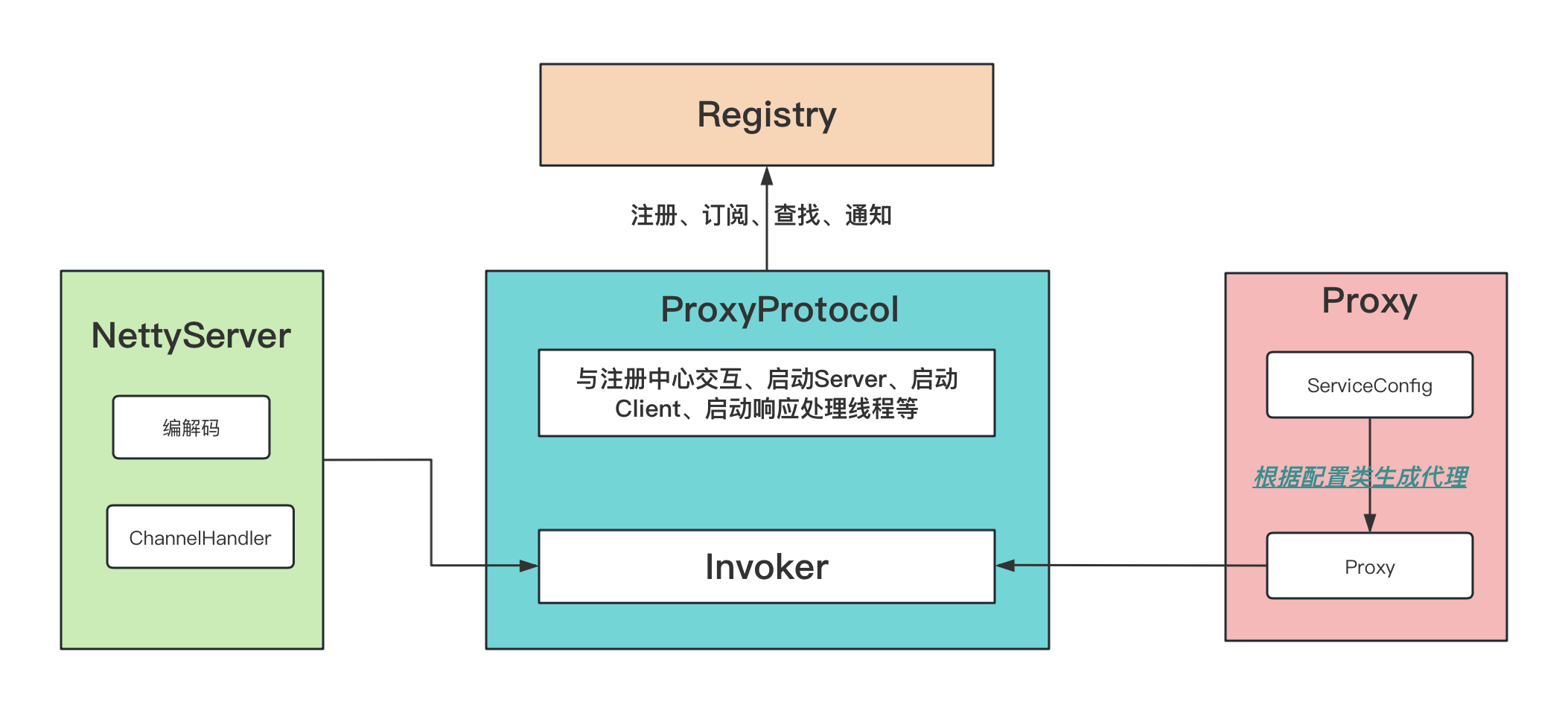
Provider的流程实际上就是个从ServiceConfig生成Proxy代理的过程。核心事情由PorxyProtocol完成。
- 根据
ServiceConfig生成本地代理 - 注册到注册中心
- 启动NettyServer等待客户端连接
- 生成服务端Invoker
- Invoker监听调用请求
- 接收到请求后新建任务丢入到线程池去执行
- 执行时会生成本地代理执行(比如通过反射去调用具体的方法),再将返回结果写出去
流程图:
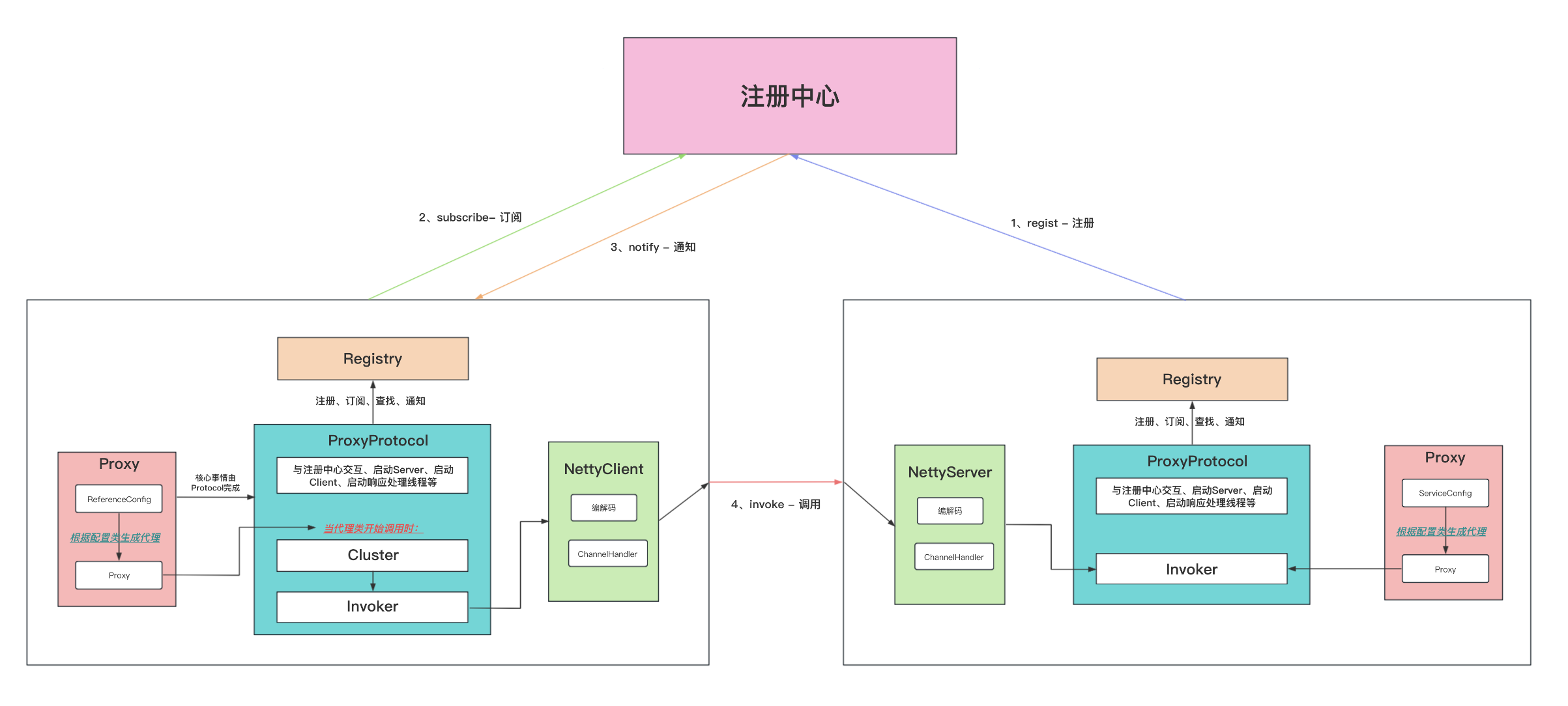
3.3、整体流程图
4、简易代码实现
4.1、核心代码介绍
客户端Proxy
/**

 * 获取代理Service

 */

@SuppressWarnings("unchecked")

public <T> T getService(Class clazz) throws Exception {

    return (T) Proxy.newProxyInstance(getClass().getClassLoader(), new Class[]{clazz}, new InvocationHandler() {

        @Override

        public Object invoke(Object proxy, Method method, Object[] args) throws Throwable {

            String methodName = method.getName();

            if ("equals".equals(methodName) || "hashCode".equals(methodName)) {

                throw new IllegalAccessException("不能访问" + methodName + "方法");

            }

            if ("toString".equals(methodName)) {

                return clazz.getName() + "#" + methodName;

            }

            List<RegistryInfo> registryInfoList = interfaceMethodsRegistryInfoMap.get(clazz);

            if (registryInfoList == null) {

                throw new RuntimeException("无法找到对应的服务提供者");

            }

            LoadBalancer loadBalancer = new RandomLoadBalancer();

            RegistryInfo registryInfo = loadBalancer.choose(registryInfoList);

            ChannelHandlerContext ctx = registryChannelMap.get(registryInfo);

            String identity = InvokeUtils.buildInterfaceMethodIdentify(clazz, method);

            String requestId;

            synchronized (ProxyProtocol.this) {

                requestIdWorker.increment();

                requestId = String.valueOf(requestIdWorker.longValue());

            }

            ClientInvoker clientInvoker = new DefaultClientInvoker(method.getReturnType(), ctx, requestId, identity);

            inProcessInvokerMap.put(identity + "#" + requestId, clientInvoker);

            return clientInvoker.invoke(args);

        }

    });

}
服务端Proxy
private class RpcInvokerTask implements Runnable {

    private RpcRequest rpcRequest;

    public RpcInvokerTask(RpcRequest rpcRequest) {

        this.rpcRequest = rpcRequest;

    }

    @Override

    public void run() {

        try {

            ChannelHandlerContext ctx = rpcRequest.getCtx();

            String interfaceIdentity = rpcRequest.getInterfaceIdentity();

            String requestId = rpcRequest.getRequestId();

            Map<String, Object> parameterMap = rpcRequest.getParameterMap();

            //interfaceIdentity组成:接口类+方法+参数类型

            Map<String, String> interfaceIdentityMap = string2Map(interfaceIdentity);

            //拿出是哪个类

            String interfaceName = interfaceIdentityMap.get("interface");

            Class interfaceClass = Class.forName(interfaceName);

            Object o = interfaceInstanceMap.get(interfaceClass);

            //拿出是哪个方法

            Method method = interfaceMethodMap.get(interfaceIdentity);

            //反射执行

            Object result = null;

            String parameterStr = interfaceIdentityMap.get("parameter");

            if (parameterStr != null && parameterStr.length() > 0) {

                String[] parameterTypeClasses = parameterStr.split(",");//接口方法参数参数可能有多个,用,号隔开

                Object[] parameterInstance = new Object[parameterTypeClasses.length];

                for (int i = 0; i < parameterTypeClasses.length; i++) {

                    parameterInstance[i] = parameterMap.get(parameterTypeClasses[i]);

                }

                result = method.invoke(o, parameterInstance);

            } else {

                result = method.invoke(o);

            }

            //将结果封装成rcpResponse

            RpcResponse rpcResponse = RpcResponse.create(JSONObject.toJSONString(result), interfaceIdentity, requestId);

            //ctx返回执行结果

            String resultStr = JSONObject.toJSONString(rpcResponse) + DELIMITER_STR;

            ByteBuf byteBuf = Unpooled.copiedBuffer(resultStr.getBytes());

            ctx.writeAndFlush(byteBuf);

            System.out.println("响应给客户端:" + resultStr);

        } catch (Exception e) {

            e.printStackTrace();

        }

    }

}
Protocol
public ProxyProtocol(String registryUrl, List<ServiceConfig> serviceConfigList, List<ReferenceConfig> referenceConfigList, int port) throws Exception {

    this.serviceConfigList = serviceConfigList == null ? new ArrayList<>() : serviceConfigList;

    this.registryUrl = registryUrl;

    this.port = port;

    this.referenceConfigList = referenceConfigList == null ? new ArrayList<>() : referenceConfigList;

    //1、初始化注册中心

    initRegistry(this.registryUrl);

    //2、将服务注册到注册中心

    InetAddress addr = InetAddress.getLocalHost();

    String hostName = addr.getHostName();

    String hostAddr = addr.getHostAddress();

    registryInfo = new RegistryInfo(hostName, hostAddr, this.port);

    doRegistry(registryInfo);

    //3、初始化nettyServer,启动nettyServer

    if (!this.serviceConfigList.isEmpty()) {

        nettyServer = new NettyServer(this.serviceConfigList, this.interfaceMethodMap);

        nettyServer.init(this.port);

    }

    //如果是客户端引用启动,则初始化处理线程

    if (!this.referenceConfigList.isEmpty()) {

        initProcessor();

    }

}
客户端Invoker
@Override

public T invoke(Object[] args) {

    JSONObject jsonObject = new JSONObject();

    jsonObject.put("interfaces", identity);

    JSONObject param = new JSONObject();

    if (args != null) {

        for (Object obj : args) {

            param.put(obj.getClass().getName(), obj);

        }

    }

    jsonObject.put("parameter", param);

    jsonObject.put("requestId", requestId);

    String msg = jsonObject.toJSONString() + Constants.DELIMITER_STR;

    System.out.println("发送给服务端JSON为:" + msg);

    ByteBuf byteBuf = Unpooled.copiedBuffer(msg.getBytes());

    ctx.writeAndFlush(byteBuf);

    wait4Result();

    return result;

}

private void wait4Result() {

    synchronized (this) {

        try {

            wait();

        } catch (InterruptedException e) {

            e.printStackTrace();

        }

    }

}

@Override

public void setResult(String result) {

    synchronized (this) {

        this.result = (T) JSONObject.parseObject(result, returnType);

        notifyAll();

    }

}
服务端Invoker
@Override

public void channelRead(ChannelHandlerContext ctx, Object msg) throws Exception {

    String message = (String) msg;

    System.out.println("提供者收到消息:" + message);

    //解析消费者发来的消息

    RpcRequest rpcRequest = RpcRequest.parse(message, ctx);

    //接受到消息,启动线程池处理消费者发过来的请求

    threadPoolExecutor.execute(new RpcInvokerTask(rpcRequest));

}

/**

 * 处理消费者发过来的请求

 */

private class RpcInvokerTask implements Runnable {

    private RpcRequest rpcRequest;

    public RpcInvokerTask(RpcRequest rpcRequest) {

        this.rpcRequest = rpcRequest;

    }

    @Override

    public void run() {

        try {

            ChannelHandlerContext ctx = rpcRequest.getCtx();

            String interfaceIdentity = rpcRequest.getInterfaceIdentity();

            String requestId = rpcRequest.getRequestId();

            Map<String, Object> parameterMap = rpcRequest.getParameterMap();

            //interfaceIdentity组成:接口类+方法+参数类型

            Map<String, String> interfaceIdentityMap = string2Map(interfaceIdentity);

            //拿出是哪个类

            String interfaceName = interfaceIdentityMap.get("interface");

            Class interfaceClass = Class.forName(interfaceName);

            Object o = interfaceInstanceMap.get(interfaceClass);

            //拿出是哪个方法

            Method method = interfaceMethodMap.get(interfaceIdentity);

            //反射执行

            Object result = null;

            String parameterStr = interfaceIdentityMap.get("parameter");

            if (parameterStr != null && parameterStr.length() > 0) {

                String[] parameterTypeClasses = parameterStr.split(",");//接口方法参数参数可能有多个,用,号隔开

                Object[] parameterInstance = new Object[parameterTypeClasses.length];

                for (int i = 0; i < parameterTypeClasses.length; i++) {

                    parameterInstance[i] = parameterMap.get(parameterTypeClasses[i]);

                }

                result = method.invoke(o, parameterInstance);

            } else {

                result = method.invoke(o);

            }

            //将结果封装成rcpResponse

            RpcResponse rpcResponse = RpcResponse.create(JSONObject.toJSONString(result), interfaceIdentity, requestId);

            //ctx返回执行结果

            String resultStr = JSONObject.toJSONString(rpcResponse) + DELIMITER_STR;

            ByteBuf byteBuf = Unpooled.copiedBuffer(resultStr.getBytes());

            ctx.writeAndFlush(byteBuf);

            System.out.println("响应给客户端:" + resultStr);

        } catch (Exception e) {

            e.printStackTrace();

        }

    }

}
Client
EventLoopGroup group = new NioEventLoopGroup();

try {

    Bootstrap bootstrap = new Bootstrap();

    bootstrap.group(group)

            .channel(NioSocketChannel.class)

            .option(ChannelOption.TCP_NODELAY, true)

            .handler(new ChannelInitializer() {

                @Override

                protected void initChannel(Channel ch) throws Exception {

                    ch.pipeline().addLast(new DelimiterBasedFrameDecoder(1024 * 1024, Constants.DELIMITER));

                    ch.pipeline().addLast(new StringDecoder());

                    ch.pipeline().addLast(new NettyClientHandler());

                    System.out.println("initChannel - " + Thread.currentThread().getName());

                }

            });

    ChannelFuture cf = bootstrap.connect(ip, port).sync();

//            cf.channel().closeFuture().sync();

    System.out.println("客户端启动成功");

} catch (Exception e) {

    e.printStackTrace();

    group.shutdownGracefully();

}
Server
public NettyServer(List<ServiceConfig> serviceConfigList, Map<String, Method> interfaceMethodMap) {

    this.serviceConfigList = serviceConfigList;

    this.interfaceMethodMap = interfaceMethodMap;

}

public int init(int port) throws InterruptedException {

    EventLoopGroup bossGroup = new NioEventLoopGroup();

    EventLoopGroup workerGroup = new NioEventLoopGroup();

    ServerBootstrap bootstrap = new ServerBootstrap();

    bootstrap.group(bossGroup, workerGroup)

            .channel(NioServerSocketChannel.class)

            .option(ChannelOption.SO_BACKLOG, 1024)

            .childHandler(new ChannelInitializer() {

                @Override

                protected void initChannel(Channel channel) throws Exception {

                    channel.pipeline().addLast(new DelimiterBasedFrameDecoder(1024 * 1024, DELIMITER));

                    channel.pipeline().addLast(new StringDecoder());

                    channel.pipeline().addLast(new RpcInvokeHandler(serviceConfigList, interfaceMethodMap));

                }

            });

    ChannelFuture cf = bootstrap.bind(port).sync();

    System.out.println("启动NettyServer,端口为:" + port);

    return port;

}
4.2、项目地址
5、总结
本文主要以Dubbo为例介绍了RPC调用核心流程,同时,写了个简易的RPC调用代码。
记住以上的流程图即可搞明白整个调用流程。然后再记住最核心的2句话:
- 所有的努力都是为了能在Consumer端和Provider端生成功能丰富的Proxy。核心事情由Protocol完成。
- 核心的5个部件:Registry、Proxy、Protocol、Invoker、Client、Server。
本篇完结!欢迎点赞 关注 收藏!!!
原文链接:https://mp.weixin.qq.com/s/9fF2weLLBR7SChOxPEEqEA
======>>>>>> 关于我 <<<<<<======

最简最快了解RPC核心流程的更多相关文章
- dubbo核心流程一览
整体设计 图中从下至上分为十层,各层均为单向依赖,右边的黑色箭头代表层之间的依赖关系,每一层都可以剥离上层被复用,其中,Service 和 Config 层为 API,其它各层均为 SPI. Serv ...
- 2017.3.31 spring mvc教程(二)核心流程及配置详解
学习的博客:http://elf8848.iteye.com/blog/875830/ 我项目中所用的版本:4.2.0.博客的时间比较早,11年的,学习的是Spring3 MVC.不知道版本上有没有变 ...
- Nginx核心流程及模块介绍
Nginx核心流程及模块介绍 1. Nginx简介以及特点 Nginx简介: Nginx (engine x) 是一个高性能的web服务器和反向代理服务器,也是一个IMAP/POP3/SMTP服务器 ...
- paip.刮刮卡砸金蛋抽奖概率算法跟核心流程.
paip.刮刮卡砸金蛋抽奖概率算法跟核心流程. #---抽奖算法需要满足的需求如下: 1 #---抽奖核心流程 1 #---问题???更好的算法 2 #---实际使用的扩展抽奖算法(带奖品送完判断和每 ...
- iOS-动画效果(首尾式动画,代码快动画,核心动画,序列帧动画)
一.各个动画的优缺点 1.首尾动画:如果只是修改空间的属性,使用首尾动画比较方便,如果在动画结束后做后续处理,就不是那么方面了. 2.核心动画:有点在于对后续的处理方便. 3.块动画: (1)在实际的 ...
- 实例模拟struts核心流程
Struts,经典框架之一,每个java web 开发人员都应该晓得它的大名.这里,我就用一个简单实例来模拟一下struts的核心流程.具体实例如下: 主界面: 点击提交后,程序根据具体的actio ...
- ibatis源码学习1_整体设计和核心流程
背景介绍ibatis实现之前,先来看一段jdbc代码: Class.forName("com.mysql.jdbc.Driver"); String url = "jdb ...
- KVM Run Process之KVM核心流程
在"KVM Run Process之Qemu核心流程"一文中讲到Qemu通过KVM_RUN调用KVM提供的API发起KVM的启动,从这里进入到了内核空间执行,本文主要讲述内核中KV ...
- 【Spring专场】「IOC容器」不看源码就带你认识核心流程以及运作原理
这是史上最全面的Spring的核心流程以及运作原理的分析指南 [Spring核心专题]「IOC容器篇」不看繁琐的源码就带你浏览Spring的核心流程以及运作原理 [Spring核心专题]「AOP容器篇 ...
- 【Spring专场】「MVC容器」不看源码就带你认识核心流程以及运作原理
前提回顾 之前已经写了很多问斩针对于SpringMVC的的执行原理和核心流程,在此再进行冗余介绍就没有任何意义了,所以我们主要考虑的就是针对于SpringMVC还没但大框架有介绍的相关内容解析分析和说 ...
随机推荐
- [转帖]linux中的set -e 与set -o pipefail
https://www.cnblogs.com/xingmuxin/p/8431970.html 1.set -e "Exit immediately if a simple command ...
- Harbor镜像仓库的导出与整理之二
Harbor镜像仓库的导出与整理之二 背景 前几天参照大神的blog进行了一下harbor的镜像列表的获取与下载. 当时发现一个很诡异的问题. 实际上镜像仓库里面的镜像很多. 但是导出和列表里面的却很 ...
- [转帖]通过配置优化KingbaseES服务器性能
目录 1. 概述 2. 数据库应用类型 3. 服务器参数 3.1. max_connections 3.2. shared_buffers 3.3. effective_cache_size 3.4. ...
- [转贴]中国铁塔发布2020年中期财报:营收、利润双增,高效支撑5G规模建设
中国铁塔发布2020年中期财报:营收.利润双增,高效支撑5G规模建设 https://tech.sina.com.cn/roll/2020-08-11/doc-iivhuipn8046256.sh ...
- 从 WebStorm 转到 VSCode!使用一周体验报告
前言 最近我的 Jetbrains 开源项目授权到期了,想要续订的时候发现 Jetbrains 提高了开源项目申请门槛,我的 StarBlog 项目因为名字里包含 blog 这个词无法申请,虽然我在 ...
- 小白学k8s(1)二进制部署k8s
二进制部署k8s 前言 准备工作 关闭防火墙 关闭 swap 分区 关闭 SELinux 更新系统时间 秘钥免密码 设置主机名称 服务器角色 安装etcd 创建证书 生成证书 部署Etcd 在Node ...
- 【Jmeter】基础介绍-详细
最近做压测时使用到Jmeter,为什么用它,之前也做过部分压测,不是很系统,使用的是Apache Bench,虽然效率高,但是功能比较简单,不太适合本次压测场景,另外Jmeter能更好的利用压测机的多 ...
- Redis 数据库配置与应用
Redis 是一个key-value存储系统.Redis是一个开源的使用ANSI C语言编写.遵守BSD协议.支持网络.可基于内存亦可持久化的日志型.Key-Value数据库,并提供多种语言的API. ...
- 遥感图像处理笔记之【Land use/Land cover classification with Deep Learning】
遥感图像处理学习(1) 前言 遥感图像处理方向的学习者可以参考或者复刻 本文初编辑于2023年12月14日CSDN平台 2024年1月24日搬运至本人博客园平台 文章标题:Land use/Land ...
- IDEA破解(无限重启激活时间版)
下载地址[将下载的目录打成zip压缩包后使用]:「ide-eval-resetter」https://www.aliyundrive.com/s/UFHpDX5d6Xv 点击链接保存,或者复制本段内容 ...