
何时/如何使用 std::enable_shared_from_this<T>?
要点回顾
- 继承自
std::enable_shared_from_this<T>的类能够在其自身实例中通过std::shared_from_this方法创建一个指向自己的std::shared_ptr<T>智能指针。 - 从一个裸指针创建多个
std::shared_ptr<T>实例会造成严重的后果,其行为是未定义的。 std::enable_shared_from_this<T>实际包含了一个用于指向对象自身的std::weak_ptr<T>指针。
引言
本文介绍 std::enable_shared_from_this 及 std::shared_from_this 的基本概念和使用方法。
定义 std::enable_shared_from_this
以下内容是 cppreference.com 上关于 std::enable_shared_from_this 的定义和说明:
Defined in header < memory >
template< class T > class enable_shared_from_this; (since C++11)
std::enable_shared_from_thisallows an object t that is currently managed by astd::shared_ptrnamed ptto safely generate additional std::shared_ptr instancespt1, pt2, ... that all share ownership of t with pt.Publicly inheriting from
std::enable_shared_from_this<T>provides the type T with a member functionshared_from_this. If an object t of type T is managed by astd::shared_ptr<T>named pt, then callingT::shared_from_thiswill return a newstd::shared_ptr<T>that shares ownership of t with pt.
简单来说就是,继承自 std::enable_shared_from_this<T> 的类能够在其自身实例中通过 std::shared_from_this 方法创建一个指向自己的 std::shared_ptr<T> 智能指针。
想要理解 std::enable_shared_from_this<T>,首先得知道为什么需要 std::enable_shared_from_this<T>,请看下文。
使用 std::enable_shared_from_this<T>
为什么需要 std::enable_shared_from_this<T>? 我们从一个例子讲起,会更容易一些。
假定有一个类 Processor, 它的作用是异步处理数据并且存储到数据库。当 Processor 接收到数据时,它通过一个定制的 Executor 类型来异步处理数据:
class Executor {

public:

 //Executes a task asynchronously

 void

 execute(const std::function<void(void)>& task);

 //....

private:

 /* Contains threads and a task queue */

};

class Processor {

public:

 //...

 //Processes data asynchronously. (implemented later)

 void processData(const std::string& data);

private:

 //Called in an Executor thread

 void doProcessAndSave(const std::string& data) {

    //1. Process data

    //2. Save data to DB

 }

 //.. more fields including a DB handle..

 Executor* executor;

};
Client 类包含了一个 std::shared_ptr<Processor> 实例,Processor 从 Client 类接收数据:
class Client {

public:

 void someMethod() {

  //...

  processor->processData("Some Data");

  //..do something else

 }

private:

 std::shared_ptr<Processor> processor;

};
以上示例中,Executor 是一个线程池,用于执行任务队列中的任务。
在 Processor::processData 中,我们需要传递一个(指针)函数(lambda 函数)给 Executor 来执行异步操作。该 lambda 函数调用 Processor::doProcessAndSave 以完成实际的数据处理工作。因此,该 lambda 函数需要捕获一个 Processor 对象的引用/指针。我们可以这样做:
void Processor::processData(const std::string& data) {

 executor->execute([this, data]() { //<--Bad Idea

   //Executes in an Executor thread asynchronously

   //'this' could be invalid here.

   doProcessAndSave(data);

 });

}
然而,因为种种原因,Client 可能会随时重置 std::shared_ptr<Processor>,这可能导致 Processor 的实例被析构。因此,在执行 execute 函数时或者在执行之前,上述代码中捕获的 this 指针随时可能会变为无效指针。
怎么办?
我们可以通过在 lambda 函数中捕获并保留一个指向当前对象本身的 std::shared_ptr<Processor> 实例来防止 Processor 对象被析构。
下图展示了示例代码的交互逻辑:
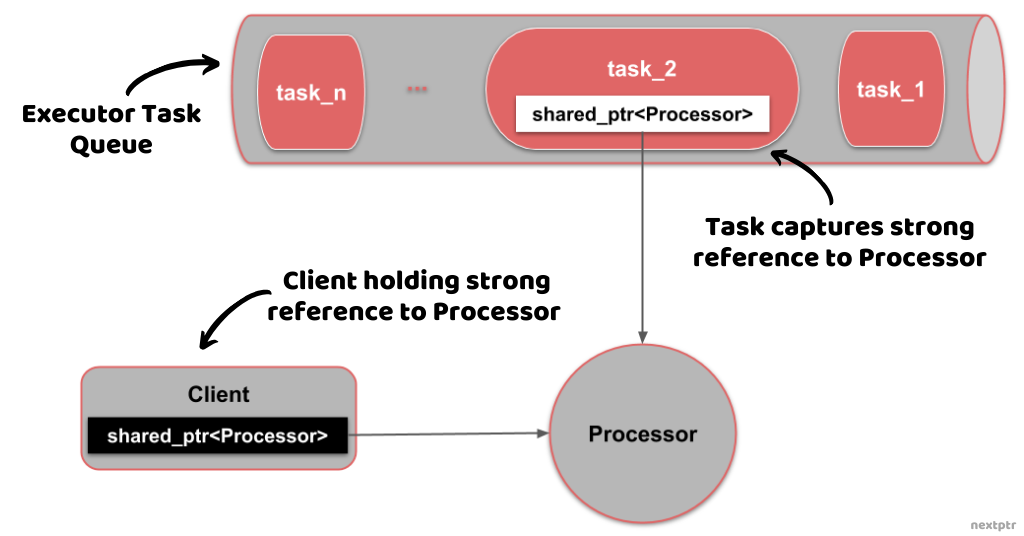
那么,在 Processor 实例中通过 shared_ptr(this) 创建一个智能指针呢?其行为是未定义的!
std::shared_ptr<T> 允许我们安全地访问和管理对象的生命周期。多个 std::shared_ptr<T> 实例通过一个共享控制块结构(a shared control block structure)来管理对象的生命周期。一个控制块维护了一个引用计数,及其他必要的对象本身的信息。
void good() {

 auto p{new int(10)}; //p is int*

 std::shared_ptr<int> sp1{p};

 //Create additional shared_ptr from an existing shared_ptr

 auto sp2{sp1}; //OK. sp2 shares control block with sp1

}
从一个裸指针创建一个 std::shared_ptr<T> 会创建一个新的控制块。从一个裸指针创建多个 std::shared_ptr<T> 实例会造成严重的后果:
void bad() {

 auto p{new int(10)};

 std::shared_ptr<int> sp1{p};

 std::shared_ptr<int> sp2{p}; //! Undefined Behavior

}
因此,我们需要一个机制能够达到我们的目的(捕获并保留一个指向当前对象本身的 std::shared_ptr<Processor> 实例)。
这就是 std::enable_shared_from_this<T> 存在的意义,以下是修改后的类 Processor 实现:
class Processor : public std::enable_shared_from_this<Processor> {

 //..same as above...

};

void Processor::processData(const std::string& data) {

 //shared_from_this() returns a shared_ptr<Processor>

 //  to this Processor

 executor->execute([self = shared_from_this(), data]() {

   //Executes in an Executor thread asynchronously

   //'self' is captured shared_ptr<Processor>

   self->doProcessAndSave(data); //OK.

 });

}
self = shared_from_this() 传递的是一个合法的 std::shared_ptr<Processor> 实例,合法的类 Processor 对象的引用。
深入 std::enable_shared_from_this<T> 内部
std::enable_shared_from_this<T> 的实现类似:
template<class T>

class enable_shared_from_this {

 mutable weak_ptr<T> weak_this;

public:

 shared_ptr<T> shared_from_this() {

  return shared_ptr<T>(weak_this);

 }

 //const overload

 shared_ptr<const T> shared_from_this() const {

  return shared_ptr<const T>(weak_this);

 }

 //..more methods and constructors..

 //there is weak_from_this() also since C++17

 template <class U> friend class shared_ptr;

};
enable_shared_from_this 包含了一个 std::weak_ptr<T> 指针,这正是函数 shared_from_this 返回的内容。注意,为什么不是 std::shared_ptr<T>? 因为对象包含自身的计数引用会导致对象永远不被释放,从而发生内存泄漏。上述代码中 weak_this 会在类对象被 std::shared_ptr<T> 引用时赋值,也就是std::shared_ptr<T> 实例的构造函数中赋值,这也是为什么类 enable_shared_from_this 的最后,其被声明成为了 shared_ptr 的友元。
总结
到此,关于 std::enable_shared_from_this<T> 的介绍就结束了。
引用
https://en.cppreference.com/w/cpp/memory/enable_shared_from_this
https://www.nextptr.com/tutorial/ta1414193955/enable_shared_from_this-overview-examples-and-internals
何时/如何使用 std::enable_shared_from_this<T>?的更多相关文章
- 为什么使用enable_shared_from_this——shared_ptr两类错误
在使用C++实现弱回调时,订阅者应当维护一系列发布者的weak_ptr,而发布者注册回调时要传出this的shared_ptr指针,流行的实现方法是使用std::enable_shared_from_ ...
- enable_shared_from_this类的作用和实现
使用举例 实际中, 经常需要在一个被shared_ptr管理的对象的内部获取自己的shared_ptr. 比如: 通过this指针来构造一个shared_ptr, 如下: struct Bad { v ...
- 如何用enable_shared_from_this 来得到指向自身的shared_ptr 及对enable_shared_from_this 的理解
在看<Linux多线程服务端编程:使用muduo C++网络库> 的时候,在说到如何防止在将对象的 this 指针作为返回值返回给了调用者时可能会造成的 core dump.需使用 ena ...
- C++11新特性之十:enable_shared_from_this
enable_shared_from_this是一个模板类,定义于头文件<memory>,其原型为: template< class T > class enable_shar ...
- std::weak_ptr
weak_ptr 是一种不控制对象生命周期的智能指针, 它指向一个 shared_ptr 管理的对象. 进行该对象的内存管理的是那个强引用的 shared_ptr. weak_ptr只是提供了对管理对 ...
- enable_shared_from_this
头文件<memory> enable_shared_from_this是一个模板类. 使用场景:需要把自己类对象作为参数传给其他函数时,就需要传递一个指向自身的share_ptr. str ...
- enable_shared_from_this用法分析
一.背景 在为什么需要异步编程文章末尾提到,"为了使socket和缓冲区(read或write)在整个异步操作的生命周期一直保持活动,我们需要采取特殊的保护措施.你的连接类需要继承自enab ...
- C++11新特性:enable_shared_from_this
enable_shared_from_this是一个模板类,定义于头文件<memory>,其原型为:template< class T > class enable_share ...
- C++11 新特性:enable_shared_from_this
enable_shared_from_this是一个模板类,定义于头文件<memory>,其原型为:template< class T > class enable_share ...
- C++11笔记<一>
目录: 1.std::share_ptr智能指针: 2.std::tr1::function模板类: 3.stringstream: 4.set/vector/map: 5.static_cast&l ...
随机推荐
- [GPT] AI大模型背景下,小模型还有优势吗?
在AI大模型背景下,小的模型仍然具有一些优势. 以下是一些可能的优势: 速度和效率:相比于大模型,小模型需要更少的计算资源和时间,能够更快地完成训练和预测,并且能够在较低的硬件配置上运行. 灵活性 ...
- Rancher管理K8s集群(14)
一.Rancher介绍 1.1 Rancher简介 Rancher 是一个开源的企业级多集群 Kubernetes 管理平台,实现了 Kubernetes 集群在混合云+本地 数据中心的集中部署与管理 ...
- VGA显示图片
VGA显示图片 1. VGA显示图片的原理 图片比之前显示的色块和字符的数据量大,所以使用rom来存储图片.用到ROM IP.可以存放mif和hex格式,需要先把图片转换成mif格式. 2. 如何制作 ...
- 如何将本地项目第一次同步到gitee远程
一,Gitee账号的注册/登录 在gitee登录入口输入相关信息进行注册登录https://gitee.com/signup#lang=zh-CN 二,本地安装git客户端并配置用户信息 1.Git ...
- 【OpenVINO™】使用OpenVINO™ C# API 部署 YOLO-World实现实时开放词汇对象检测
YOLO-World是一个融合了实时目标检测与增强现实(AR)技术的创新平台,旨在将现实世界与数字世界无缝对接.该平台以YOLO(You Only Look Once)算法为核心,实现了对视频中物体的 ...
- rpc 和 http的区别
- WEB服务与NGINX(21)- nginx 的fastcgi反向代理功能
目录 1. NGINX实现fastcgi反向代理 1.1 fastcgi概述 1.2 nginx实现fastcgi相关参数 1.3 nginx与php-fpm部署在一台服务器 1.3.1 php服务器 ...
- CentOS加载yum源时报错 [Errno 14] HTTP Error 404 - Not Found Trying other mirror.
报错内容: [root@192 yum.repos.d]# yum repolist Loaded plugins: fastestmirror, product-id, search-disable ...
- cesium教程6-用entity绘制点线面label和billboard广告牌
注意:billboard显示的图片是立体的,会跟随角度而变化的. pinBuilder.fromText()用于创建自定义地图图钉 完整示例代码: <!DOCTYPE html> < ...
- windows下安装Psycopg2,用于python连接postgresql
1.首先,下载Windows版的Psycopg2.进入https://pypi.python.org/pypi/psycopg2/ ,在下载文件列表中选择psycopg2-2.7.4-cp33-cp3 ...