
JUC并发编程(1)—CompletableFuture详解
@
最近在学习juc并发编程,于是决定汇总一下并发编程中常用方法,常见问题以及常见考题,今天是第一章—CompletableFuture
CompletableFuture介绍
CompletableFuture是jdk8版本开始出现的类。目的是为了应用于并发编程状态下遇到的各种场景。CompletableFuture实现了CompletionStage接口和Future接口,对Java7及以前Future接口做了大量的扩展,增加了许多常用方法,增加了异步会点、流式处理、多个Future组合处理的能力,使Java在处理多任务的协同工作时更加顺畅便利。
首先得学会看懂几个函数式接口的特性!!!(重点)
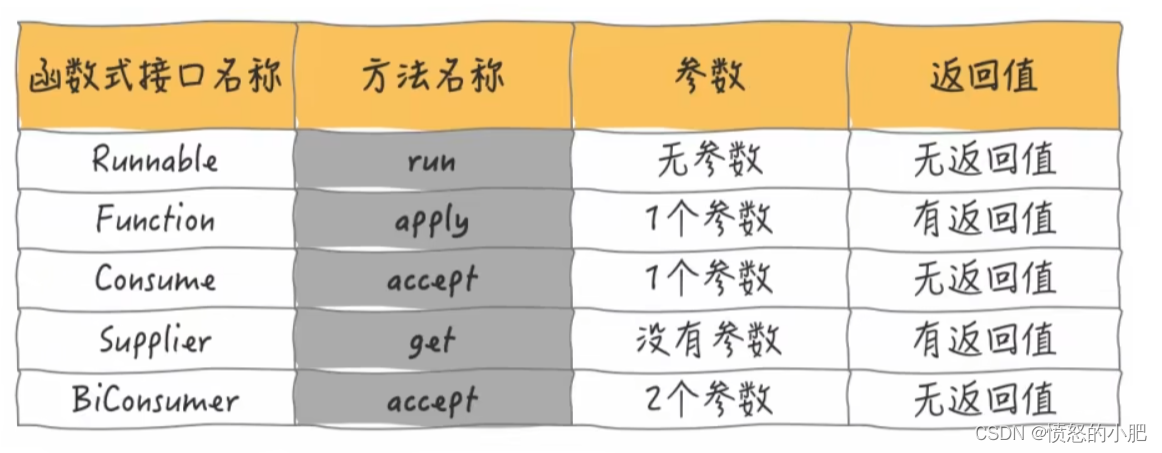
1.创建异步任务
//runAsync方法不支持返回值

public static CompletableFuture<Void> runAsync(Runnable runnable)

public static CompletableFuture<Void> runAsync(Runnable runnable, Executor executor)

//supplyAsync可以支持返回值

public static <U> CompletableFuture<U> supplyAsync(Supplier<U> supplier)

public static <U> CompletableFuture<U> supplyAsync(Supplier<U> supplier, Executor executor)
CompletableFuture创建异步任务主要分为两个方法runAsync和supplyAsync
其中
- runAsync方法不支持返回值
- supplyAsync可以支持返回值(常用)
- 没有指定Executor的方法会使用ForkJoinPool.commonPool() 作为它的线程池执行异步代码。如果指定线程池,则使用指定的线程池运行。
下面是四种创建方式
public class CompletableFutureTest {

   public static void main(String[] args) throws Exception{

       ThreadPoolExecutor executor = new ThreadPoolExecutor(

      			5,5,5

               TimeUnit.MINUTES,

               new LinkedBlockingQueue<>(10));

       CompletableFuture future1=CompletableFuture.runAsync(()->{

       System.out.println(Thread.currentThread().getName()+"*********future1 coming in");

       });

       //这里获取到的值是null,无返回值

       System.out.println(future1.get());

       CompletableFuture<Void> future2 = CompletableFuture.runAsync(() -> {

           //ForkJoinPool.commonPool-worker-9

           System.out.println(Thread.currentThread().getName() + "\t" + "*********future2 coming in");

       }, executor);

       CompletableFuture<Integer> future3 =CompletableFuture.supplyAsync(()-> {

           //pool-1-thread-1

           System.out.println(Thread.currentThread().getName() + "\t" + "future3带有返回值");

           return "abc";

       });

       System.out.println(future3.get());

       CompletableFuture<Integer> future4 = CompletableFuture.supplyAsync(() -> {

           System.out.println(Thread.currentThread().getName() + "\t" + "future4带有返回值");

           return "abc";

       }, executor);

       System.out.println(future4.get());

       //关闭线程池

       executor.shutdown();

   }

}
2.CompletableFuture API
①. 获得结果和触发计算(get、getNow、join、complete)
获得结果和触发计算(get、getNow、join、complete)
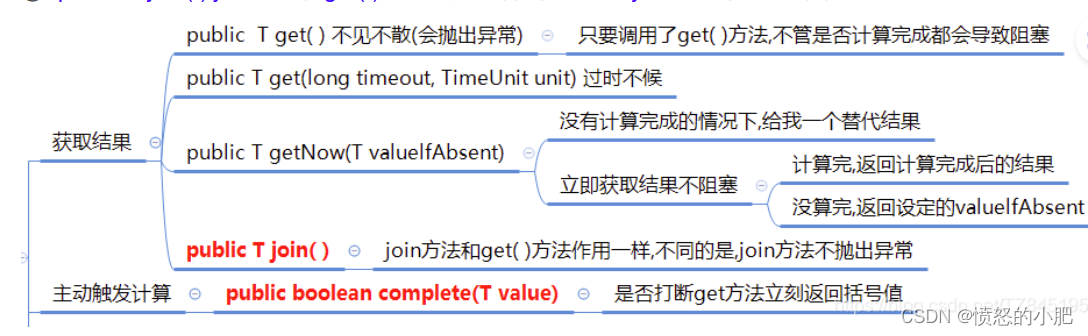
- public T get( ):不见不散(会抛出异常) 只要调用了get( )方法,不管是否计算完成都会导致阻塞
- public T get(long timeout, TimeUnit unit):过时不候
- public T getNow(T valuelfAbsent):没有计算完成的情况下,给我一个替代结果计算完,返回计算完成后的结果、没算完,返回设定的valuelfAbsent
- public T join( ):join方法和get( )方法作用一样,唯一区别是join方法编译时不需要手动抛异常
- public CompletableFuture thenApply:计算结果存在依赖关系,这两个线程串行化,由于存在依赖关系(当前步错,不走下一步),当前步骤有异常的话就叫停
- public CompletableFuture handle(BiFunction<? super T, Throwable, ? extends U> fn):有异常也可以往下一步走,根据带的异常参数可以进一步处理
- whenComplete:是执行当前任务的线程执行继续执行whenComplete的任务
- whenCompleteAsync:是执行把whenCompleteAsync这个任务继续提交给线程池来进行执行
②. 对计算结果进行处理(thenApply、handle)
- public CompletableFuture thenApply:计算结果存在依赖关系,这两个线程串行化由于存在依赖关系(当前步错,不走下一步),当前步骤有异常的话就叫停
- public CompletableFuture handle(BiFunction<? super T, Throwable, ? extends U> fn):有异常也可以往下一步走,根据带的异常参数可以进一步处理
- whenComplete:是执行当前任务的线程执行继续执行whenComplete的任务
- whenCompleteAsync:是执行把whenCompleteAsync这个任务继续提交给线程池来进行执行

     CompletableFuture<Integer> future = CompletableFuture.supplyAsync(() -> {

         try { TimeUnit.SECONDS.sleep(1);  } catch (InterruptedException e) {e.printStackTrace();}

         return 1;

     }).thenApply(s->{

         System.out.println("-----1");

         //如果加上int error=1/0; 由于存在依赖关系(当前步错,不走下一步),当前步骤有异常的话就叫停

         //int error=1/0;

         return s+1;

     }).thenApply(s->{

         System.out.println("-----2");

         return s+2;

     }).whenComplete((v,e)->{

         if(e==null){

             System.out.println("result-----"+v);

         }

     }).exceptionally(e->{

         e.printStackTrace();

         return null;

     });

     System.out.println(Thread.currentThread().getName()+"\t"+"over....");

     try { TimeUnit.SECONDS.sleep(3);  } catch (InterruptedException e) {e.printStackTrace();}

		CompletableFuture.supplyAsync(() -> {

            return 1;

        }).handle((f,e) -> {

            System.out.println("-----1");

            return f + 2;

        }).handle((f,e) -> {

            System.out.println("-----2");

            int error=1/0;

            return f + 3;

        }).handle((f,e) -> {

            System.out.println("-----3");

            return f + 4;

        }).whenComplete((v, e) -> {

            if (e == null) {

                System.out.println("----result: " + v);

            }

        }).exceptionally(e -> {

            e.printStackTrace();

            return null;

        }).join());
③. 对计算结果进行消费(thenRun、thenAccept、thenApply)
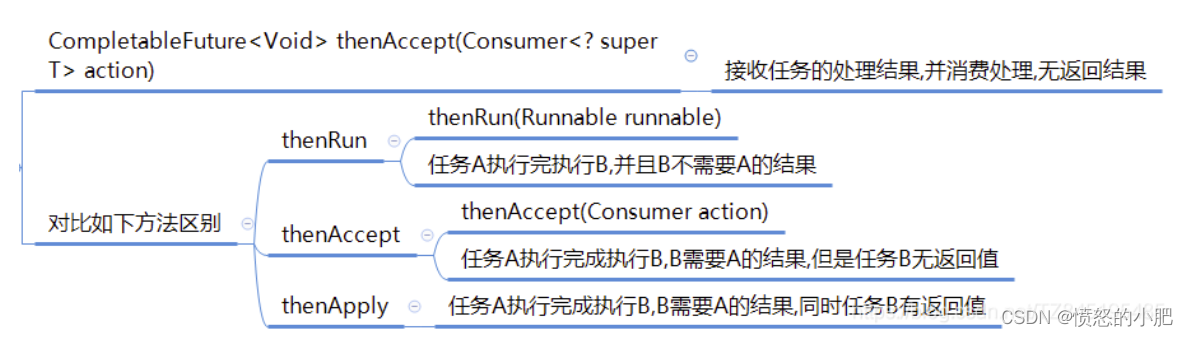
- thenRun(Runnable runnable)
任务A执行完执行B,并且B不需要A的结果 - CompletableFutur thenAccept(Consumer<? super T> action)
任务A执行完成执行B,B需要A的结果,但是任务B无返回值 - public CompletableFuture thenApply(Function<? super T,? extends U> fn)
4. 线程串行化方法
带了Async的方法表示的是:会重新在线程池中启动一个线程来执行任务
public <U> CompletableFuture<U> thenApply(Function<? super T,? extends U> fn)

public <U> CompletableFuture<U> thenApplyAsync(Function<? super T,? extends U> fn)

public <U> CompletableFuture<U> thenApplyAsync(Function<? super T,? extends U> fn, Executor executor)

public CompletableFuture<Void> thenAccept(Consumer<? super T> action)

public CompletableFuture<Void> thenAcceptAsync(Consumer<? super T> action)

public CompletableFuture<Void> thenAcceptAsync(Consumer<? super T> action,Executor executor)

public CompletableFuture<Void> thenRun(Runnable action)

public CompletableFuture<Void> thenRunAsync(Runnable action)

public CompletableFuture<Void> thenRunAsync(Runnable action,Executor executor)
④. 对计算速度进行选用(applyToEither、acceptEither、runAfterEither)
- public CompletableFuture applyToEither(CompletionStage<? extends T> other, Function<? super T, U> fn)
这个方法表示的是,谁完成任务完成的快就返回谁的结果

- 两任务组合,一个完成
applyToEither:两个任务有一个执行完成,获取它的返回值,处理任务并有新的返回值
acceptEither:两个任务有一个执行完成,获取它的返回值,处理任务,没有新的返回值
runAfterEither:两个任务有一个执行完成,不需要获取 future 的结果,处理任务,也没有返回值
⑤. 对计算结果进行合并(thenCombine、thenAcceptBoth、runAfterBoth)
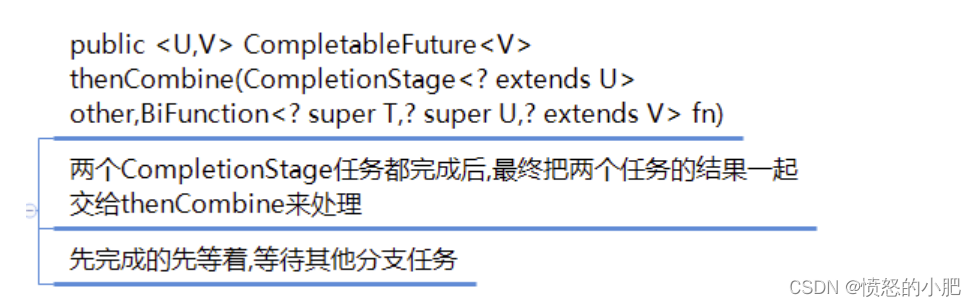
- public <U,V> CompletableFuture thenCombine(CompletionStage<? extends U> other,BiFunction<? super T,? super U,? extends V> fn)
两个CompletionStage任务都完成后,最终把两个任务的结果一起交给thenCombine来处理先完成的先等着,等待其他分支任务
⑥. 多任务组合(allOf、anyOf)
- allOf:等待所有任务完成
(public static CompletableFuture allOf(CompletableFuture<?>... cfs)) - anyOf:只要有一个任务完成
(public static CompletableFuture anyOf(CompletableFuture<?>... cfs))
实战演练
案例说明:电商比价需求
同一款产品,同时搜索出同款产品在各大电商的售价;
同一款产品,同时搜索出本产品在某一个电商平台下,各个入驻门店的售价是多少
出来结果希望是同款产品的在不同地方的价格清单列表,返回一个List
in jd price is 88.05
in pdd price is 86.11
in taobao price is 90.43
(String类型)
代码示例
public class test1 {

    public ExecutorService executorService = new ThreadPoolExecutor(40,100,100,TimeUnit.MINUTES,new ArrayBlockingQueue<>(10000));

    public static List<mall> list = Arrays.asList(

            new mall("jd"),

            new mall("tmall"),

            new mall("taobao"),

            new mall("pdd"),

            new mall("elm")

    );

    public static void main(String[] args) {

        showRes3(list,"mysql");

    }

    public static List<String> showRes(List<mall> list,String productName){

        long start = System.currentTimeMillis();

        List<String> collect = list.stream().map(mall -> String.format(productName + " in %s price is %.2f", mall.getName(), mall.getPrice(productName))).collect(Collectors.toList());

        collect.forEach(System.out::println);

        long end = System.currentTimeMillis();

        System.out.println("耗时:"+(end-start)+"秒");

        return collect;

    }

    public static List<String> showRes2(List<mall> list,String productName){

        long start = System.currentTimeMillis();

        List<String> collect = list.parallelStream().map(mall -> CompletableFuture.supplyAsync(() ->

                String.format(productName + " in %s price is %.2f", mall.getName(), mall.getPrice(productName))

        ).join()).collect(Collectors.toList());

        long end = System.currentTimeMillis();

        collect.forEach(System.out::println);

        System.out.println("耗时:"+(end-start)+"秒");

        return collect;

    }

    public static List<String> showRes3(List<mall> list,String productName){

        long start = System.currentTimeMillis();

        List<String> collect = list.stream().map(mall -> CompletableFuture.supplyAsync(() -> String.format(productName + " in %s price is %.2f", mall.getName(), mall.getPrice(productName))

        )).collect(Collectors.toList()).stream().map(s -> s.join()).collect(Collectors.toList());

        long end = System.currentTimeMillis();

        collect.forEach(System.out::println);

        System.out.println("耗时:"+(end-start)+"毫秒");

        return collect;

    }

}

class mall{

    private String name;

    public String getName() {

        return name;

    }

    public mall(String name) {

        this.name = name;

    }

    public double getPrice(String productName){

        try {

            TimeUnit.SECONDS.sleep(1);

        } catch (InterruptedException e) {

            throw new RuntimeException(e);

        }

        return ThreadLocalRandom.current().nextDouble()*2+productName.charAt(0);

    }

}
通过上面代码示例结果得知
通过异步线程方法耗时需要1000毫秒左右
而同步线程方法耗时需要5000毫秒
而且当商城店铺越来越多的时候,异步线程耗时不会增加,同步线程耗时会不断增加,异步的优势就显现出来了。
tips
在使用stream流的时候,如果使用的是集合的stream()方法,再使用异步线程时比如使用join()方法会出现串行,和上面方法三一样得使用两次stream流才能实现异步执行,相当于每一步都得使用stream流。
这个时候可以使用parallelStream并行流就可以解决这个问题
但是使用parallelStream会出现一些问题,所以并行流要谨慎使用!!!
并行流的陷阱
- 线程安全
由于并行流使用多线程,则一切线程安全问题都应该是需要考虑的问题,如:资源竞争、死锁、事务、可见性等等。 - 线程消费
在虚拟机启动时,我们指定了worker线程的数量,整个程序的生命周期都将使用这些工作线程;这必然存在任务生产和消费的问题,如果某个生产者生产了许多重量级的任务(耗时很长),那么其他任务毫无疑问将会没有工作线程可用;更可怕的事情是这些工作线程正在进行IO阻塞。
JUC并发编程(1)—CompletableFuture详解的更多相关文章
- 多线程JUC并发篇常见面试详解
@ 目录 1.JUC 简介 2.线程和进程 3.并非与并行 4.线程的状态 5.wait/sleep的区别 6.Lock 锁(重点) 1.Lock锁 2.公平非公平: 3.ReentrantLock ...
- Java 并发编程 | 线程池详解
原文: https://chenmingyu.top/concurrent-threadpool/ 线程池 线程池用来处理异步任务或者并发执行的任务 优点: 重复利用已创建的线程,减少创建和销毁线程造 ...
- 并发编程——IO模型详解
我是一个Python技术小白,对于我而言,多任务处理一般就借助于多进程以及多线程的方式,在多任务处理中如果涉及到IO操作,则会接触到同步.异步.阻塞.非阻塞等相关概念,当然也是并发编程的基础. ...
- Android并发编程之白话文详解Future,FutureTask和Callable
从最简单的说起Thread和Runnable 说到并发编程,就一定是多个线程并发执行任务.那么并发编程的基础是什么呢?没错那就是Thread了.一个Thread可以执行一个Runnable类型的对象. ...
- 从缓存入门到并发编程三要素详解 Java中 volatile 、final 等关键字解析案例
引入高速缓存概念 在计算机在执行程序时,以指令为单位来执行,每条指令都是在CPU中执行的,而执行指令过程中,势必涉及到数据的读取和写入. 由于程序运行过程中的临时数据是存放在主存(物理内存)当中的,这 ...
- 并发编程 || Java线程详解
通用线程模型 在很多研发当中,实际应用是基于一个理论再进行优化的.所以,在了解JVM规范中的Java线程的生命周期之前,我们可以先了解通用的线程生命周期,这有助于我们后续对JVM线程生命周期的理解. ...
- java 并发编程lock使用详解
浅谈Synchronized: synchronized是Java的一个关键字,也就是Java语言内置的特性,如果一个代码块被synchronized修饰了,当一个线程获取了对应的锁,执行代码块时,其 ...
- 跟着阿里p7一起学java高并发 - 第19天:JUC中的Executor框架详解1,全面掌握java并发核心技术
这是java高并发系列第19篇文章. 本文主要内容 介绍Executor框架相关内容 介绍Executor 介绍ExecutorService 介绍线程池ThreadPoolExecutor及案例 介 ...
- java高并发系列 - 第20天:JUC中的Executor框架详解2之ExecutorCompletionService
这是java高并发系列第20篇文章. 本文内容 ExecutorCompletionService出现的背景 介绍CompletionService接口及常用的方法 介绍ExecutorComplet ...
- Java网络编程和NIO详解开篇:Java网络编程基础
Java网络编程和NIO详解开篇:Java网络编程基础 计算机网络编程基础 转自:https://mp.weixin.qq.com/s/XXMz5uAFSsPdg38bth2jAA 我们是幸运的,因为 ...
随机推荐
- 在Transformers 中使用约束波束搜索引导文本生成
引言 本文假设读者已经熟悉文本生成领域波束搜索相关的背景知识,具体可参见博文 如何生成文本: 通过 Transformers 用不同的解码方法生成文本. 与普通的波束搜索不同,约束 波束搜索允许我们控 ...
- CSS3实现3D效果的图片墙
先来看一下效果:http://39.105.101.122/myhtml/CSS/transform_3D/img_3D.html 目前没有做IE的兼容,在谷歌浏览器里面可以看到效果 布局结构: &l ...
- Dash应用页面整体布局技巧
本文示例代码已上传至我的Github仓库:https://github.com/CNFeffery/dash-master 大家好我是费老师,对于刚上手dash应用开发的新手朋友来说,如何进行合理且美 ...
- AI 和 DevOps:实现高效软件交付的完美组合
AI 时代,DevOps 与 AI 共价结合.AI 由业务需求驱动,提高软件质量,而 DevOps 则从整体提升系统功能.DevOps 团队可以使用 AI 来进行测试.开发.监控.增强和系统发布.AI ...
- java.lang.IndexOutOfBoundsException
原因:一个ArrayList数组中没有元素,而你想获取第一个元素,运行是就会报此类型的错误 解决方案:用 array[] 的 .length 查看 数组的长度
- AOA定位技术原理
AOA定位技术是一种基于信号到达角度的定位方法,利用单一天线发射寻向讯号,而接收端的装置内建天线阵列, 当信号通过时, 会因阵列中接收到的不同距离, 产生相位差异, 进而计算出相对的信号方向:其原理如 ...
- 【Springboot】SpringBoot-Admin 服务监控+告警通知
SpringBoot-Admin 服务监控 简单介绍 Spring Boot Actuator 是 Spring Boot 自带的一个功能模块, 提供了一组已经开箱即用的生产环境下常用的特性和服务,比 ...
- 使用$test$plusargs提高RTL验收速度
0 前言 这段时间在整合一个小ip,因为要验证每个feature是否可行,需要用testbench + C语言的方式进行仿真验证,由于每种feature不仅要在C语言中修改寄存器配置,还要再testb ...
- Android Studio Giraffe安装与gradle配置
本机环境:win10专业版,64位,16G内存. 原先用的AS2.2,是很早之前在看<第一行代码Android(第2版)>的时候,按书里的链接下载安装的,也不用怎么配置.(PS:第一行代码 ...
- Dokcer学习之旅(2)——Dockerfile基础应用
什么是Dockerfile? 从docker commit 的学习中,我们可以了解到,镜像的定制实际上就是定制每一层所添加的配置.文件.如果我们可以把每一层修改.安装.构建.操作的命令都写入一个脚本, ...