
浅析java的浅拷贝和深拷贝
Java中任何实现了Cloneable接口的类都可以通过调用clone()方法来复制一份自身然后传给调用者。一般而言,clone()方法满足:
(1) 对任何的对象x,都有x.clone() !=x,即克隆对象与原对象不是同一个对象。
(2) 对任何的对象x,都有x.clone().getClass()==x.getClass(),即克隆对象与原对象的类型一样。
(3) 如果对象x的equals()方法定义恰当,那么x.clone().equals(x)应该成立。
 /**

     * Creates and returns a copy of this object.  The precise meaning

     * of "copy" may depend on the class of the object. The general

     * intent is that, for any object {@code x}, the expression:

     * <blockquote>

     * <pre>

     * x.clone() != x</pre></blockquote>

     * will be true, and that the expression:

     * <blockquote>

     * <pre>

     * x.clone().getClass() == x.getClass()</pre></blockquote>

     * will be {@code true}, but these are not absolute requirements.

     * While it is typically the case that:

     * <blockquote>

     * <pre>

     * x.clone().equals(x)</pre></blockquote>

     * will be {@code true}, this is not an absolute requirement.

     * <p>

     * By convention, the returned object should be obtained by calling

     * {@code super.clone}.  If a class and all of its superclasses (except

     * {@code Object}) obey this convention, it will be the case that

     * {@code x.clone().getClass() == x.getClass()}.

     * <p>

     * By convention, the object returned by this method should be independent

     * of this object (which is being cloned).  To achieve this independence,

     * it may be necessary to modify one or more fields of the object returned

     * by {@code super.clone} before returning it.  Typically, this means

     * copying any mutable objects that comprise the internal "deep structure"

     * of the object being cloned and replacing the references to these

     * objects with references to the copies.  If a class contains only

     * primitive fields or references to immutable objects, then it is usually

     * the case that no fields in the object returned by {@code super.clone}

     * need to be modified.

     * <p>

     * The method {@code clone} for class {@code Object} performs a

     * specific cloning operation. First, if the class of this object does

     * not implement the interface {@code Cloneable}, then a

     * {@code CloneNotSupportedException} is thrown. Note that all arrays

     * are considered to implement the interface {@code Cloneable} and that

     * the return type of the {@code clone} method of an array type {@code T[]}

     * is {@code T[]} where T is any reference or primitive type.

     * Otherwise, this method creates a new instance of the class of this

     * object and initializes all its fields with exactly the contents of

     * the corresponding fields of this object, as if by assignment; the

     * contents of the fields are not themselves cloned. Thus, this method

     * performs a "shallow copy" of this object, not a "deep copy" operation.

     * <p>

     * The class {@code Object} does not itself implement the interface

     * {@code Cloneable}, so calling the {@code clone} method on an object

     * whose class is {@code Object} will result in throwing an

     * exception at run time.

     *

     * @return     a clone of this instance.

     * @throws  CloneNotSupportedException  if the object's class does not

     *               support the {@code Cloneable} interface. Subclasses

     *               that override the {@code clone} method can also

     *               throw this exception to indicate that an instance cannot

     *               be cloned.

     * @see java.lang.Cloneable

     */

    protected native Object clone() throws CloneNotSupportedException;
首先来看看浅拷贝和深拷贝的定义:
浅拷贝:使用一个已知实例对新创建实例的成员变量逐个赋值,这个方式被称为浅拷贝。
深拷贝:当一个类的拷贝构造方法,不仅要复制对象的所有非引用成员变量值,还要为引用类型的成员变量创建新的实例,并且初始化为形式参数实例值。这个方式称为深拷贝
也就是说浅拷贝只复制一个对象,传递引用,不能复制实例。而深拷贝对对象内部的引用均复制,它是创建一个新的实例,并且复制实例。
对于浅拷贝当对象的成员变量是基本数据类型时,两个对象的成员变量已有存储空间,赋值运算传递值,所以浅拷贝能够复制实例。但是当对象的成员变量是引用数据类型时,就不能实现对象的复制了。
存在一个对象Person,代码如下:

public class Person {

    private String name;

    private String sex;

    private int age;

    public Person(String name,String sex,int age){

        this.name = name;

        this.sex = sex;

        this.age = age;

    }

    public Person(Person p){                   //拷贝构造方法,复制对象

        this.name = p.name;

        this.sex = p.sex;

        this.age = p.age;

    }

}
上面的对象Person有三个成员变量。name、sex、age。两个构造方法。第二个的参数为该对象,它称为拷贝构造方法,它将创建的新对象初始化为形式参数的实例值,通过它可以实现对象复制功能。
又有一个对象Asian,如下:
public class Asian {

    private String skin;

    Person person;

    public Asian(String skin,Person person){

        this.skin = skin;

        this.person = person;                    //引用赋值

    }

    public Asian(Asian asian){                 //拷贝构造方法,复制对象

        this(asian.skin,asian.person);

    }

}
上面对象也存在着两个成员变量,skin 和Person对象
对于person对象有如下:
Person p1 = new Person("李四","mam",23);

 Person p2 = new Person(P1);
当调用上面的语句时。P2对象将会对P1进行复制。执行情况如下如下图:

对于Asian对象有:
Asian a1 = new Asian("yellow",new Person("李四","mam",23));

Asian a2 = new Asian(a1);
New Asian(a1)执行Asian类的拷贝构造方法,由于对象赋值是引用赋值。使得a1和a2引用同一个对象
如下图:
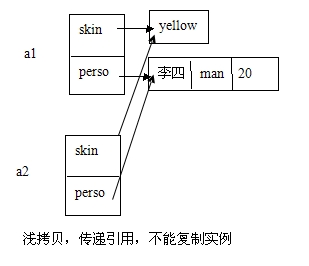
当a1执行某条可以改变该值的语句时,那么a1将会通过这个语句也可以改变a2对象的成员变量
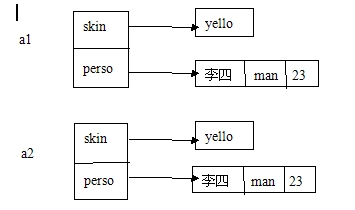
如果执行以下语句:a2.name = new Person(a1.name)
这时将会创建一个新的Person对象
如下图:
http://www.cnblogs.com/chenssy/p/3308489.html
浅析java的浅拷贝和深拷贝的更多相关文章
- Java的浅拷贝与深拷贝
Java的浅拷贝与深拷贝 Java中,所有的类都继承Object,Object中有clone方法,它被声明为了 protected ,所以我们但是如果要使用该方法就得重写且声明为public,必须在要 ...
- Java的浅拷贝与深拷贝总结
Java中的对象拷贝(Object Copy)指的是将一个对象的所有属性(成员变量)拷贝到另一个有着相同类类型的对象中去.举例说明:比如,对象A和对象B都属于类S,具有属性a和b.那么对对象A进行拷贝 ...
- 渐析java的浅拷贝和深拷贝
首先来看看浅拷贝和深拷贝的定义: 浅拷贝:使用一个已知实例对新创建实例的成员变量逐个赋值,这个方式被称为浅拷贝. 深拷贝:当一个类的拷贝构造方法,不仅要复制对象的所 ...
- Java中浅拷贝和深拷贝的区别
浅拷贝和深拷贝的定义: 浅拷贝: 被复制对象的所有变量都含有与原来的对象相同的值,而所有的对其他对象的引用仍然指向原来的对象.即对象的浅拷贝会对"主"对象进行拷贝,但不会复制主对象 ...
- 初始JAVA中浅拷贝和深拷贝
1. 简单变量的复制 public static void main(String[] args) { int a = 5; int b = a; System.out.println(a); Sys ...
- Java之浅拷贝与深拷贝
----?浅拷贝 --- 概念 被复制对象的所有变量都含有与原来的对象相同的值,而所有的对其他对象的引用仍然指向原来的对象.简单说,浅拷贝就是只复制所考虑的对象,而不复制它所引用的对象 --- 实现方 ...
- Java之浅拷贝和深拷贝
[概述] Java中的对象拷贝 ( Object Copy ) 是指将一个对象的所有属性(成员变量)拷贝到另一个有着相同类类型的对象中去.例如,对象 A 和对象 B 都属于类 S,具有属性 a 和 b ...
- java的浅拷贝和深拷贝(待解决)
1.什么是浅拷贝,什么是深拷贝? 2.storm的并行度问题,需要使用全局变量static ConcorrentHashMap,因为加了static,所有的线程只能拷贝该全局变量的一个唯一的副本,进行 ...
- 浅析java的深拷贝与浅拷贝
(转自:http://www.cnblogs.com/chenssy/p/3308489.html) 首先来看看浅拷贝和深拷贝的定义: 浅拷贝:使用一个已知实例对新创建实例的成员变量逐个赋值,这个方式 ...
随机推荐
- Hibernate MySQL 数据库 使用别名 报 Column * Not Found
使用Hibernate 查询MySQL数据表的时候报 Column Not Found ,原因是MySQL的驱动不支持别名, 解决方案如下,在连接参数中加上 useOldAliasMetadataBe ...
- Android Support Library更新到v22.1之AppCompat新特性
构建一个可以跑在不同版本 Android 平台的软件,是非常复杂和耗时的.为了解决这个问题,Android 推出了 Android Support Library (安卓兼容包),让新的UI控件也可以 ...
- perl 安装 ZooKeeper模块
1072 ./configure --libdir=/usr/lib 1073 make 1074 make install 1075 cpan ZooKeeper [root@wx03 c]# pe ...
- structure and interpretation of Computer programs -- Foreword
Foreword 前言 Educators, generals, dieticians, psychologists, and parents program. Armies, students ...
- 自己python程序的并行修改
遇到运算量大的程序,学习了下python并行运算的方法,在自己的程序上进行了修改,看看是否可以增加效率.原始代码是: import gt_apps as my_apps f=file('sample. ...
- java--实例成员 & 静态成员
class run{ static String str1 = "静态变量"; String str2 = "非静态变量"; public static voi ...
- Socket编程模式理解与对比
本文主要分析了几种Socket编程的模式.主要包括基本的阻塞Socket.非阻塞Socket.I/O多路复用.其中,阻塞和非阻塞是相对于套接字来说的,而其他的模式本质上来说是基于Socket的并发模式 ...
- mysql禁用autocommit,以及遇到的问题(转)
MySQL的autocommit(自动提交)默认是开启,其对mysql的性能有一定影响,举个例子来说,如果你插入了1000条数据,mysql会commit1000次的,如果我们把autocommit关 ...
- 基于visual Studio2013解决C语言竞赛题之0808打印链表
题目
- 关于运行robotium提示连接不上jar问题
robotium运行测试helloworld报错: java.lang.NoClassDefFoundError: com.jayway.android.robotium.solo.Solo at c ...