
STM32 F4 DAC DMA Waveform Generator
STM32 F4 DAC DMA Waveform Generator
Goal: generating an arbitrary periodic waveform using a DAC with DMA and TIM6 as a trigger.
Agenda:
- Modeling a waveform in MATLAB and getting the waveform data
- Studying the DAC, DMA, and TIM6 to see how it can be used to generate a waveform
- Coding and testing a couple of functions
%% Generating an n-bit sine wave

% Modifiable parameters: step, bits, offset

close; clear; clc;

points = ;                            % number of points between sin() to sin(*pi)

bits   = ;                             % -bit sine wave for -bit DAC

offset = ;                             % limiting DAC output voltage

t = :((*pi/(points-))):(*pi);        % creating a vector from  to *pi

y = sin(t);                              % getting the sine values

y = y + ;                               % getting rid of negative values (shifting up by )

y = y*((^bits-)-*offset)/+offset;    % limiting the range (+offset) to (^bits-offset)

y = round(y);                            % rounding the values

plot(t, y); grid                         % plotting for visual confirmation

fprintf('%d, %d, %d, %d, %d, %d, %d, %d, %d, %d, \n', y);

There's a trade-off between the sine wave resolution (number of points from sin(0) to sin(2*pi)), output frequency range, and precision of the output frequency (e.g. we want a 20kHz wave, but we can only get 19.8kHz or 20.2kHz because the step is 0.4kHz). The output frequency is a non-linear function with multiple variables. To complicate it further, some of these variables must be integers within 1 to 65535 range which makes it impossible to output certain frequencies precisely.
Although precise frequency control is terribly hard (if not impossible), one feature does stand out - ability to generate a periodic waveform of any shape.
Below is the code for mediocre range/precision/resolution but excellent versatility in terms of shaping the output waveform.
@input - uint16_t function[waveform_resolution]
@output - PA4 in analog configuration
@parameters - OUT_FREQ, SIN_RES
To tailor other parameters, study the DAC channel block diagram, electrical characteristics, timing diagrams, etc. To switch DAC channels, see memory map, specifically DAC DHRx register for DMA writes.
#include <stm32f4xx.h>

#include "other_stuff.h"

#define   OUT_FREQ          5000                                 // Output waveform frequency

#define   SINE_RES          128                                  // Waveform resolution

#define   DAC_DHR12R1_ADDR  0x40007408                           // DMA writes into this reg on every request

#define   CNT_FREQ          42000000                             // TIM6 counter clock (prescaled APB1)

#define   TIM_PERIOD        ((CNT_FREQ)/((SINE_RES)*(OUT_FREQ))) // Autoreload reg value

const uint16_t function[SINE_RES] = { , , , , , , , , , ,

                                      , , , , , , , , , ,

                                      , , , , , , , , , ,

                                      , , , , , , , , , ,

                                      , , , , , , , , , ,

                                      , , , , , , , , , ,

                                      , , , , , , , , , ,

                                      , , , , , , , , , ,

                                      , , , , , , , , , ,

                                      , , , , , , , , , ,

                                      , , , , , , , , , ,

                                      , , , , , , , , , ,

                                      , , , , , , ,  };

static void TIM6_Config(void);

static void DAC1_Config(void);

int main()

{

  GPIO_InitTypeDef gpio_A;

  RCC_AHB1PeriphClockCmd(RCC_AHB1Periph_GPIOA, ENABLE);

  RCC_APB1PeriphClockCmd(RCC_APB1Periph_DAC, ENABLE);

  RCC_AHB1PeriphClockCmd(RCC_AHB1Periph_DMA1, ENABLE);

  gpio_A.GPIO_Pin  = GPIO_Pin_4;

  gpio_A.GPIO_Mode = GPIO_Mode_AN;

  gpio_A.GPIO_PuPd = GPIO_PuPd_NOPULL;

  GPIO_Init(GPIOA, &gpio_A);

  TIM6_Config();

  DAC1_Config();

  while ()

  {

  }

}

static void TIM6_Config(void)

{

  TIM_TimeBaseInitTypeDef TIM6_TimeBase;

  RCC_APB1PeriphClockCmd(RCC_APB1Periph_TIM6, ENABLE);

  TIM_TimeBaseStructInit(&TIM6_TimeBase);

  TIM6_TimeBase.TIM_Period        = (uint16_t)TIM_PERIOD;

  TIM6_TimeBase.TIM_Prescaler     = ;

  TIM6_TimeBase.TIM_ClockDivision = ;

  TIM6_TimeBase.TIM_CounterMode   = TIM_CounterMode_Up;

  TIM_TimeBaseInit(TIM6, &TIM6_TimeBase);

  TIM_SelectOutputTrigger(TIM6, TIM_TRGOSource_Update);

  TIM_Cmd(TIM6, ENABLE);

}

static void DAC1_Config(void)

{

  DAC_InitTypeDef DAC_INIT;

  DMA_InitTypeDef DMA_INIT;

  DAC_INIT.DAC_Trigger        = DAC_Trigger_T6_TRGO;

  DAC_INIT.DAC_WaveGeneration = DAC_WaveGeneration_None;

  DAC_INIT.DAC_OutputBuffer   = DAC_OutputBuffer_Enable;

  DAC_Init(DAC_Channel_1, &DAC_INIT);

  DMA_DeInit(DMA1_Stream5);

  DMA_INIT.DMA_Channel            = DMA_Channel_7;

  DMA_INIT.DMA_PeripheralBaseAddr = (uint32_t)DAC_DHR12R1_ADDR;

  DMA_INIT.DMA_Memory0BaseAddr    = (uint32_t)&function;

  DMA_INIT.DMA_DIR                = DMA_DIR_MemoryToPeripheral;

  DMA_INIT.DMA_BufferSize         = SINE_RES;

  DMA_INIT.DMA_PeripheralInc      = DMA_PeripheralInc_Disable;

  DMA_INIT.DMA_MemoryInc          = DMA_MemoryInc_Enable;

  DMA_INIT.DMA_PeripheralDataSize = DMA_PeripheralDataSize_HalfWord;

  DMA_INIT.DMA_MemoryDataSize     = DMA_MemoryDataSize_HalfWord;

  DMA_INIT.DMA_Mode               = DMA_Mode_Circular;

  DMA_INIT.DMA_Priority           = DMA_Priority_High;

  DMA_INIT.DMA_FIFOMode           = DMA_FIFOMode_Disable;

  DMA_INIT.DMA_FIFOThreshold      = DMA_FIFOThreshold_HalfFull;

  DMA_INIT.DMA_MemoryBurst        = DMA_MemoryBurst_Single;

  DMA_INIT.DMA_PeripheralBurst    = DMA_PeripheralBurst_Single;

  DMA_Init(DMA1_Stream5, &DMA_INIT);

  DMA_Cmd(DMA1_Stream5, ENABLE);

  DAC_Cmd(DAC_Channel_1, ENABLE);

  DAC_DMACmd(DAC_Channel_1, ENABLE);

}
Using the code above we are supposed to get a 5kHz sine wave constructed with 128 points (for better quality, consider using more points).
Here's a picture of what we actually get (off by 25Hz, not too bad).
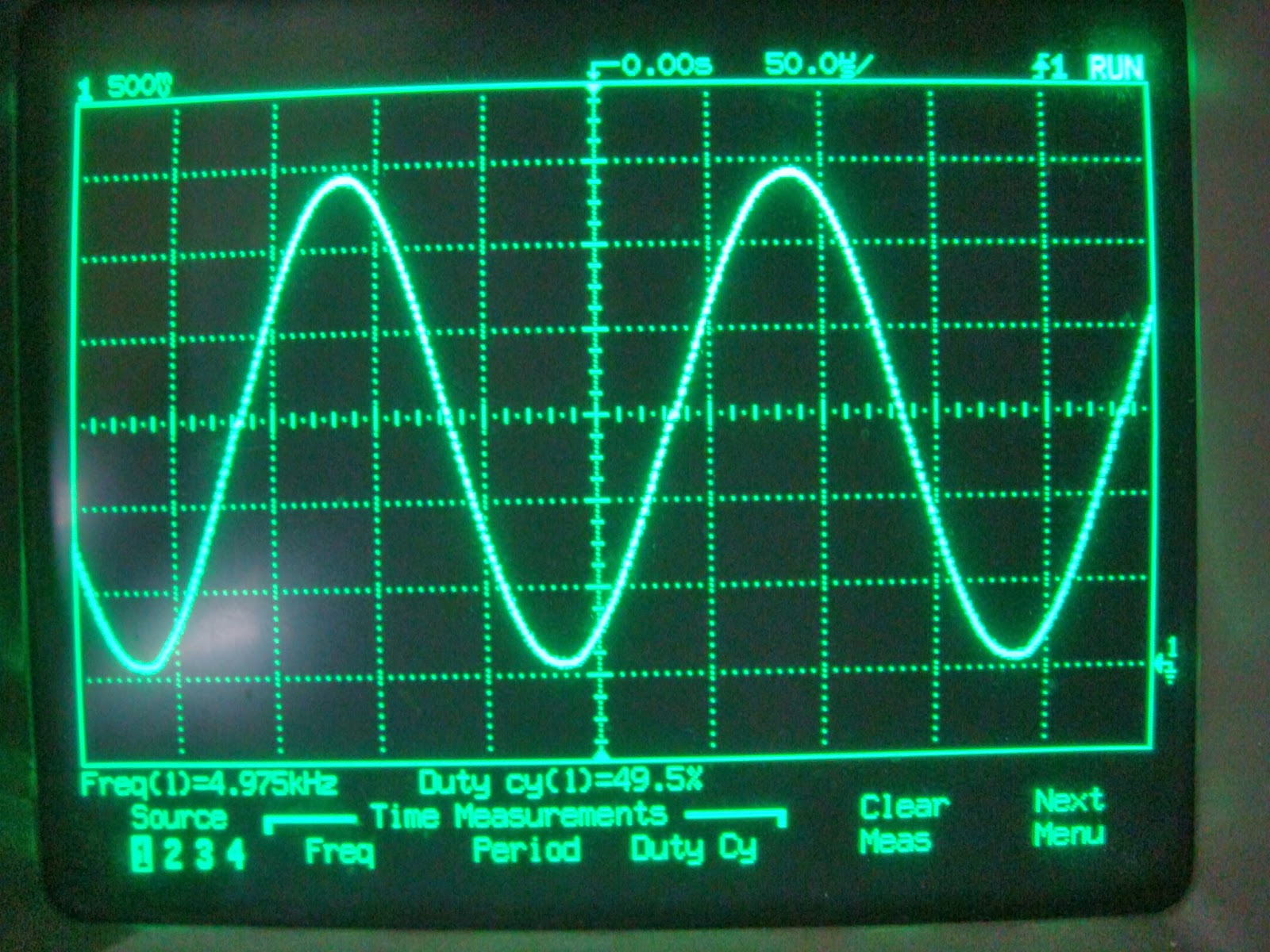
And here's the cool sinc(x) function. To generate other functions, model it in MATLAB, cast to 12-bit, STM32F4 does the rest.

STM32 F4 DAC DMA Waveform Generator的更多相关文章
- STM32 F4 ADC DMA Temperature Sensor
STM32 F4 ADC DMA Temperature Sensor Goal: detecting temperature variations using a temperature senso ...
- STM32之DAC君
如花说得好:呃呃呃.是俗话说得好:有了ADC,怎可少了DAC..我觉得奇怪.今天我开头就直奔主题了.我想了想,总结了一句话:孙悟空纵然有七十二变.无论是变成猫也好,变成狗也罢.始终还是会变回他本身.所 ...
- STM32之串口DMA接收不定长数据
STM32之串口DMA接收不定长数据 引言 在使用stm32或者其他单片机的时候,会经常使用到串口通讯,那么如何有效地接收数据呢?假如这段数据是不定长的有如何高效接收呢? 同学A:数据来了就会进入串口 ...
- STM32的USART DMA传输(转)
源:STM32的USART DMA传输 问题描述: 我有一个需求,AD采得一定数目的数据之后,由串口DMA发出,由于AD使用双缓冲,所以每次开始DMA的时候都需要重新设置开始的内存地址以及传输的数目( ...
- STM32 F4 Clock Sources
STM32 F4 Clock Sources Goal: routing clock sources to the microcontroller output pin (MCO1) High- ...
- STM32 F4 General-purpose Timers for Periodic Interrupts
STM32 F4 General-purpose Timers for Periodic Interrupts
- STM32 F4 SPI Accelerometer
STM32 F4 SPI Accelerometer
- STM32 F4 GPIO Modes
STM32 F4 GPIO Modes Goal: creating a visual summary of GPIO configuration modes. The summary at the ...
- 重学STM32---(六)DAC+DMA+TIM
这两天复习了DAC,DMA再加上把基本定时器TIM6和TIM7看了一下,打算写一个综合点的程序,,,就在网上找了一些关于DAC,DMA和定时器相关的程序,最终打算写了输出正弦波的程序... 由于没有示 ...
随机推荐
- iOS 6 & iOS 7 的适配笔记
iOS 6 & iOS 7 的适配 场景1: 没有NavigationController,同时根视图是UIView- (void)viewWillLayoutSubviews{ if ([[ ...
- win8开wifi共享无法使用的问题解决办法
相信现在不少人都安装了windows8操作系统,因为windows8这个全新的操作系统用起来 确实挺强大,包括漂亮的开始屏,但是不得不说这个系统的兼容性还是有待提高,所以win8我的 装了又卸,卸了又 ...
- python-super1
一.问题的发现与提出 一般子类在继承父类后,若子类覆盖了父类,则只执行子类,不执行父类.如果没有,则执行父类代码. 发现使用super()后,子类,父类都会执行,比较疑惑,记录学习,super知识点 ...
- Windows下设置oracle数据库定时备份
1编写备份脚本 echo backup oracle database...... echo %~dp0 set file_dir=%~dp0 echo backup time...... set & ...
- 深入理解C语言的函数调用过程 【转】
转自:http://blog.chinaunix.net/uid-25909619-id-4240084.html 原文地址:深入理解C语言的函数调用过程 作者:wjlkoorey258 本文 ...
- 解决Too many connections问题
有些人觉得,解决too many connections问题,灰非简单,down了mysql,修改my.cnf调大max_connections,好吧,你想法是没错的,这的确可以解决问题,但试问对于线 ...
- 解决MySQL忘记root密码
网上有很多关于忘记MySQL root密码的一些文章,里面都有写怎么去解决,但有时觉得写得太恶心,要么一字不漏的抄别人的,要么就说得不清不楚,好了,不吐槽了,以下是解决的整个过程. 首先我们要知道忘记 ...
- csu 1982:小M的移动硬盘(双向链表)
Description 最近小M买了一个移动硬盘来储存自己电脑里不常用的文件.但是他把这些文件一股脑丢进移动硬盘后,觉得这些文件似乎没有被很好地归类,这样以后找起来岂不是会非常麻烦? 小M最终决定要把 ...
- Linux系统运维笔记(五),CentOS 6.4安装java程序
Linux系统运维笔记(五),CentOS 6.4安装java程序 用eclipse编译通的java程序,现需要实施到服务器.实施步骤: 一,导出程序成jar包. 1,在主类编辑界面点右健,选 ru ...
- ajax和jsonp
ajax和jsonp 前言:ajax和jsonp可以与后台通信,获取数据和信息,但是又不用刷新整个页面,实现页面的局部刷新. 一.ajax 定义:一种发送http请求与后台进行异步通讯的技术. 原理: ...