
MapReduce分组
- 分组:相同key的value进行分组
例子:如下输入输出,右边的第一列没有重复值,第二列取得是当第一列相同时第二例取最大值
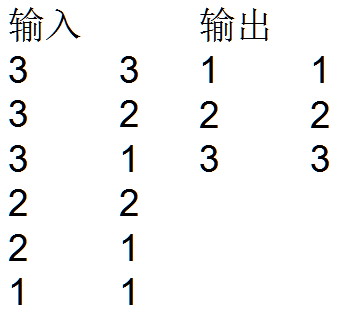
分析:首先确定<k3,v3>,k3的选择两种方式,
方法1.前两列都作为k3
方法2.两列分别是k3和v3,此种情况的k2和v2分别是那些,第一列为k2,第二列为v2,但是最后如何无法转化为k3,v3呢,思路是从v2s中取值最大的,此种情况不能取值。
第一部分:方法二达到任务目的
(1)自定义Mapper
 private static class MyMapper extends Mapper<LongWritable, Text, IntWritable, IntWritable>{

     IntWritable k2= new IntWritable();

     IntWritable v2= new IntWritable();

     @Override

     protected void map(LongWritable key, Text value,

             Mapper<LongWritable, Text, IntWritable, IntWritable>.Context context)

             throws IOException, InterruptedException {

            String[] splited = value.toString().split("\t");

            k2.set(Integer.parseInt(splited[0]));

            v2.set(Integer.parseInt(splited[1]));

            context.write(k2, v2);

     }

 }
(2)自定义Reduce
//按照k2進行排序,分組(分为3各组,reduce函数被调用3次,分几组调用几次)
//分组为3-{3,2,1}, 2-{2,1},1-{1}
 private static class MyReducer extends Reducer<IntWritable, IntWritable, IntWritable, IntWritable>{

     IntWritable v3 = new IntWritable();

     @Override

     protected void reduce(IntWritable k2, Iterable<IntWritable> v2s,

             Reducer<IntWritable, IntWritable, IntWritable, IntWritable>.Context context)

             throws IOException, InterruptedException {

         int max=Integer.MIN_VALUE;

         for (IntWritable v2 : v2s) {

             if (v2.get()>max) {

                 max=v2.get();

             }

         }

         //每个组求得一个最大值可得到结果的序列

         v3.set(max);

         context.write(k2, v3);

     }

 }
(3)组合MapReduce
 public static void main(String[] args) throws Exception {

     Job job = Job.getInstance(new Configuration(), GroupTest.class.getSimpleName());

     job.setJarByClass(GroupTest.class);

     //1.自定义输入路径

     FileInputFormat.setInputPaths(job, new Path(args[0]));

     //2.自定义mapper

     //job.setInputFormatClass(TextInputFormat.class);

     job.setMapperClass(MyMapper.class);

     //job.setMapOutputKeyClass(Text.class);

     //job.setMapOutputValueClass(TrafficWritable.class);

     //3.自定义reduce

     job.setReducerClass(MyReducer.class);

     job.setOutputKeyClass(IntWritable.class);

     job.setOutputValueClass(IntWritable.class);

     //4.自定义输出路径

     FileOutputFormat.setOutputPath(job, new Path(args[1]));

     //job.setOutputFormatClass(TextOutputFormat.class);//对输出的数据格式化并写入磁盘

     job.waitForCompletion(true);

 }
由此,完整的代码如下:
 package Mapreduce;

 import java.io.IOException;

 import org.apache.hadoop.conf.Configuration;

 import org.apache.hadoop.fs.Path;

 import org.apache.hadoop.io.IntWritable;

 import org.apache.hadoop.io.LongWritable;

 import org.apache.hadoop.io.Text;

 import org.apache.hadoop.mapreduce.Job;

 import org.apache.hadoop.mapreduce.Mapper;

 import org.apache.hadoop.mapreduce.Reducer;

 import org.apache.hadoop.mapreduce.lib.input.FileInputFormat;

 import org.apache.hadoop.mapreduce.lib.output.FileOutputFormat;

 public class GroupTest {

 public static void main(String[] args) throws Exception {

     Job job = Job.getInstance(new Configuration(), GroupTest.class.getSimpleName());

     job.setJarByClass(GroupTest.class);

     //1.自定义输入路径

     FileInputFormat.setInputPaths(job, new Path(args[0]));

     //2.自定义mapper

     //job.setInputFormatClass(TextInputFormat.class);

     job.setMapperClass(MyMapper.class);

     //job.setMapOutputKeyClass(Text.class);

     //job.setMapOutputValueClass(TrafficWritable.class);

     //3.自定义reduce

     job.setReducerClass(MyReducer.class);

     job.setOutputKeyClass(IntWritable.class);

     job.setOutputValueClass(IntWritable.class);

     //4.自定义输出路径

     FileOutputFormat.setOutputPath(job, new Path(args[1]));

     //job.setOutputFormatClass(TextOutputFormat.class);//对输出的数据格式化并写入磁盘

     job.waitForCompletion(true);

 }

 private static class MyMapper extends Mapper<LongWritable, Text, IntWritable, IntWritable>{

     IntWritable k2= new IntWritable();

     IntWritable v2= new IntWritable();

     @Override

     protected void map(LongWritable key, Text value,

             Mapper<LongWritable, Text, IntWritable, IntWritable>.Context context)

             throws IOException, InterruptedException {

            String[] splited = value.toString().split("\t");

            k2.set(Integer.parseInt(splited[0]));

            v2.set(Integer.parseInt(splited[1]));

            context.write(k2, v2);

     }

 }

 //按照k2進行排序,分組(分为3各组,reduce函数被调用3次,分几组调用几次)

 //分组为3-{3,2,1}, 2-{2,1},1-{1}

 private static class MyReducer extends Reducer<IntWritable, IntWritable, IntWritable, IntWritable>{

     IntWritable v3 = new IntWritable();

     @Override

     protected void reduce(IntWritable k2, Iterable<IntWritable> v2s,

             Reducer<IntWritable, IntWritable, IntWritable, IntWritable>.Context context)

             throws IOException, InterruptedException {

         int max=Integer.MIN_VALUE;

         for (IntWritable v2 : v2s) {

             if (v2.get()>max) {

                 max=v2.get();

             }

         }

         //每个组求得一个最大值可得到结果的序列

         v3.set(max);

         context.write(k2, v3);

     }

 }

 }
最值得MapReduce代码
(4)测试代码运行结果
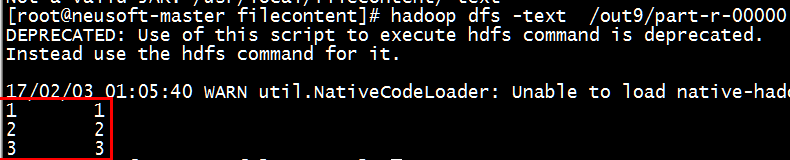
- [root@neusoft-master filecontent]# hadoop jar GroupTest.jar /neusoft/twoint /out9
- [root@neusoft-master filecontent]# hadoop jar -text /out9/part-r-00000
- [root@neusoft-master filecontent]# hadoop dfs -text /out9/part-r-00000
第二部分:方法一达到任务目的
前两列都作为k3,无v3,由此类推,k2也是前两列
但是如果采用默认分组的话,上述数据集分为6组,无法达到同样的数值取得最大值的目的。
由此,利用Mapreduce的自定义分组规则,使得第一列相同的数值可以在一个组里面,从而正确的分组。
MapReduce提供了job.setGroupingComparatorClass(cls);其中cls是自定义分组的类
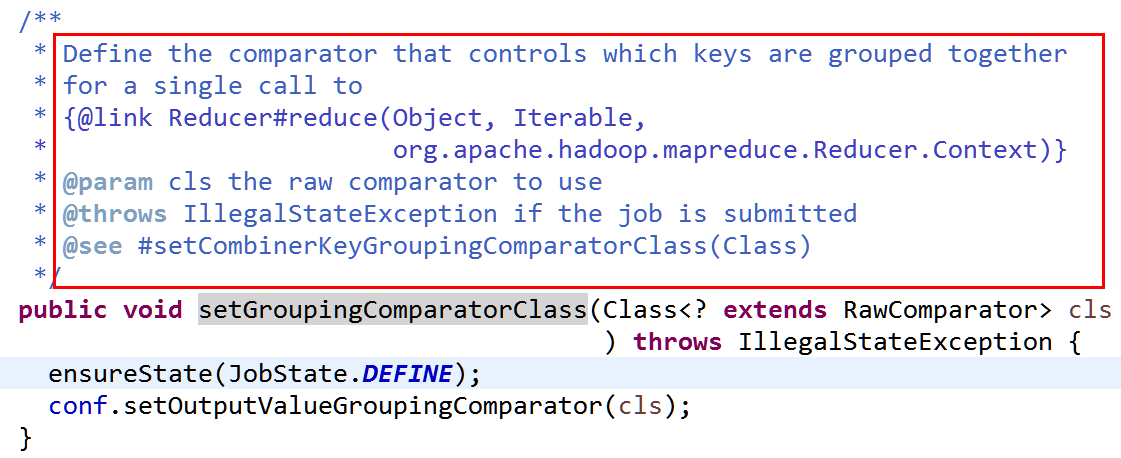
(1) 从源代码可知,该类需要继承RawComparator类,自定义分组代码如下:
 //分组比较--自定义分组

     private static class MyGroupingComparator implements RawComparator {

         public int compare(Object o1, Object o2) {

             return 0;//默认的比较方法

         }

         //byte[] b1 表示第一个参数的输入字节表示,byte[] b2表示第二个参数的输入字节表示

         //b1 The first byte array. 第一个字节数组,

         //b1表示前8个字节,b2表示后8个字节,字节是按次序依次比较的

         //s1 The position index in b1. The object under comparison's starting index.第一列开始位置

         //l1 The length of the object in b1.第一列长度 ,在这里表示长度8

         //提供的数据集中的k2一共48个字节,k2的每一行的TwoInt类型表示8字节(t1和t2分别为4字节)

         public int compare(byte[] b1, int s1, int l1, byte[] b2, int s2, int l2) {

             //compareBytes是按字节比较的方法,其中k2表示的是两列,第一列比较,第二例不比较

             //第一个字节数组的前四个字节和第二个字节数组的前四个字节比较

             //{3,3},{3,2},{3,1},{2,2},{2,1},{1,1}

             //比较上述六组的每组的第一个数字,也就是比较twoint中得t1数值

             //现在就根据t1可分成3个组了{3,(3,2,1)}{2,(2,1)}{1,1}

             //之后再从v2中取出最大值

             return WritableComparator.compareBytes(b1, s1, l1-4, b2, s2, l2-4);

         }

     }
(2)主函数中调用
//当没有下面的自定义分组的话,会调用k2的compareto方法执行k2的比较,如果自定义了分组类则使用自定义分组类

        job.setGroupingComparatorClass(MyGroupingComparator.class);
(3)根据比较函数个字段的含义,可以得到v2的类型为intwritable,而不是nullwritable,v2是由第二列的数组成的集合
Mapper函数如下:
 private static class MyMapper extends

             Mapper<LongWritable, Text, TwoInt, IntWritable> {

         //这里的v2需要改为IntWritable而不是nullwritable

         TwoInt K2 = new TwoInt();

         IntWritable v2= new IntWritable();

         @Override

         protected void map(LongWritable key, Text value,

                 Mapper<LongWritable, Text, TwoInt, IntWritable>.Context context)

                 throws IOException, InterruptedException {

             String[] splited = value.toString().split("\t");

             K2.set(Integer.parseInt(splited[0]), Integer.parseInt(splited[1]));

             v2.set(Integer.parseInt(splited[1])); //要比较第二列,需要将第二列的值赋值为v2

             context.write(K2, v2);

         }

     }
(4)k3和v3的类型为reduce输出的类型,均为intwritable类型,但是如何根据得到的v2去统计其中相同key的value中得最大值呢?
 private static class MyReducer extends

             Reducer<TwoInt, IntWritable, IntWritable, IntWritable> {//k2,v2s,k3,v3

         IntWritable k3 = new IntWritable();

         IntWritable v3 = new IntWritable();

         @Override

         protected void reduce(

                 TwoInt k2,

                 Iterable<IntWritable> v2s,

                 Reducer<TwoInt, IntWritable, IntWritable, IntWritable>.Context context)

                 throws IOException, InterruptedException {

             int max=Integer.MIN_VALUE;

             for (IntWritable v2 : v2s) {

                 if (v2.get()>max) {

                     max=v2.get();

                 }

             }

             //每个组求得一个最大值可得到结果的序列

             v3.set(max);

             k3.set(k2.t1);//k2的第一列作为k3,因为k2为Twoint类型

             context.write(k3,v3);

         }

     }
最终的代码如下:
 package Mapreduce;

 import java.io.DataInput;

 import java.io.DataOutput;

 import java.io.IOException;

 import org.apache.hadoop.conf.Configuration;

 import org.apache.hadoop.fs.Path;

 import org.apache.hadoop.io.IntWritable;

 import org.apache.hadoop.io.LongWritable;

 import org.apache.hadoop.io.NullWritable;

 import org.apache.hadoop.io.RawComparator;

 import org.apache.hadoop.io.Text;

 import org.apache.hadoop.io.WritableComparable;

 import org.apache.hadoop.io.WritableComparator;

 import org.apache.hadoop.mapreduce.Job;

 import org.apache.hadoop.mapreduce.Mapper;

 import org.apache.hadoop.mapreduce.Reducer;

 import org.apache.hadoop.mapreduce.lib.input.FileInputFormat;

 import org.apache.hadoop.mapreduce.lib.output.FileOutputFormat;

 public class Group2Test {

     public static void main(String[] args) throws Exception {

         Job job = Job.getInstance(new Configuration(),

                 Group2Test.class.getSimpleName());

         job.setJarByClass(Group2Test.class);

         // 1.自定义输入路径

         FileInputFormat.setInputPaths(job, new Path(args[0]));

         // 2.自定义mapper

         job.setMapperClass(MyMapper.class);

         //这里的k2,v2和k3,v3不同,需要显式定义k2和v2类型

         job.setMapOutputKeyClass(TwoInt.class);

         job.setMapOutputValueClass(IntWritable.class);

         //当没有下面的自定义分组的话,会调用k2的compareto方法执行k2的比较,如果自定义了分组类则使用自定义分组类

         job.setGroupingComparatorClass(MyGroupingComparator.class);

         // 3.自定义reduce

         job.setReducerClass(MyReducer.class);

         job.setOutputKeyClass(IntWritable.class);

         job.setOutputValueClass(IntWritable.class);

         // 4.自定义输出路径

         FileOutputFormat.setOutputPath(job, new Path(args[1]));

         job.waitForCompletion(true);

     }

     //分组比较--自定义分组

     private static class MyGroupingComparator implements RawComparator {

         public int compare(Object o1, Object o2) {

             return 0;//默认的比较方法

         }

         //byte[] b1 表示第一个参数的输入字节表示,byte[] b2表示第二个参数的输入字节表示

         //b1 The first byte array. 第一个字节数组,

         //b1表示前8个字节,b2表示后8个字节,字节是按次序依次比较的

         //s1 The position index in b1. The object under comparison's starting index.第一列开始位置

         //l1 The length of the object in b1.第一列长度 ,在这里表示长度8

         //提供的数据集中的k2一共48个字节,k2的每一行的TwoInt类型表示8字节(t1和t2分别为4字节)

         public int compare(byte[] b1, int s1, int l1, byte[] b2, int s2, int l2) {

             //compareBytes是按字节比较的方法,其中k2表示的是两列,第一列比较,第二例不比较

             //第一个字节数组的前四个字节和第二个字节数组的前四个字节比较

             //{3,3},{3,2},{3,1},{2,2},{2,1},{1,1}

             //比较上述六组的每组的第一个数字,也就是比较twoint中得t1数值

             //现在就根据t1可分成3个组了{3,(3,2,1)}{2,(2,1)}{1,1}

             //之后再从v2中取出最大值

             return WritableComparator.compareBytes(b1, s1, l1-4, b2, s2, l2-4);

         }

     }

     private static class MyMapper extends

             Mapper<LongWritable, Text, TwoInt, IntWritable> {

         //这里的v2需要改为IntWritable而不是nullwritable

         TwoInt K2 = new TwoInt();

         IntWritable v2= new IntWritable();

         @Override

         protected void map(LongWritable key, Text value,

                 Mapper<LongWritable, Text, TwoInt, IntWritable>.Context context)

                 throws IOException, InterruptedException {

             String[] splited = value.toString().split("\t");

             K2.set(Integer.parseInt(splited[0]), Integer.parseInt(splited[1]));

             v2.set(Integer.parseInt(splited[1]));

             context.write(K2, v2);

         }

     }

     private static class MyReducer extends

             Reducer<TwoInt, IntWritable, IntWritable, IntWritable> {//k2,v2s,k3,v3

         IntWritable k3 = new IntWritable();

         IntWritable v3 = new IntWritable();

         @Override

         protected void reduce(

                 TwoInt k2,

                 Iterable<IntWritable> v2s,

                 Reducer<TwoInt, IntWritable, IntWritable, IntWritable>.Context context)

                 throws IOException, InterruptedException {

             int max=Integer.MIN_VALUE;

             for (IntWritable v2 : v2s) {

                 if (v2.get()>max) {

                     max=v2.get();

                 }

             }

             //每个组求得一个最大值可得到结果的序列

             v3.set(max);

             k3.set(k2.t1);//k2的第一列作为k3,因为k2为Twoint类型

             context.write(k3,v3);

         }

     }

     private static class TwoInt implements WritableComparable<TwoInt> {

         public int t1;

         public int t2;

         public void write(DataOutput out) throws IOException {

             out.writeInt(t1);

             out.writeInt(t2);

         }

         public void set(int t1, int t2) {

             this.t1 = t1;

             this.t2 = t2;

         }

         public void readFields(DataInput in) throws IOException {

             this.t1 = in.readInt();

             this.t2 = in.readInt();

         }

         public int compareTo(TwoInt o) {

             if (this.t1 == o.t1) { // 當第一列相等的時候,第二列升序排列

                 return this.t2 - o.t2;

             }

             return this.t1 - o.t1;// 當第一列不相等的時候,按第一列升序排列

         }

         @Override

         public String toString() {

             return t1 + "\t" + t2;

         }

     }

 }
方法1求最值
测试并运行结果如下:
[root@neusoft-master filecontent]# hadoop dfs -text /out9/part-r-00000
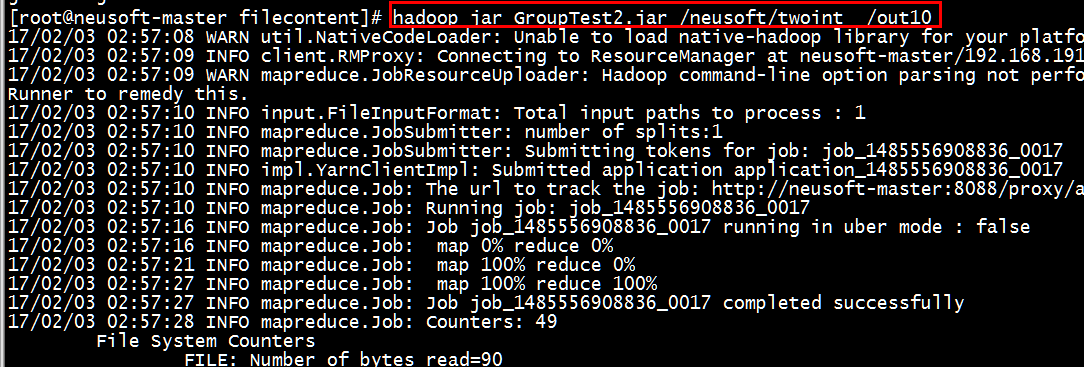
[root@neusoft-master filecontent]# hadoop dfs -text /out10/part-r-00000
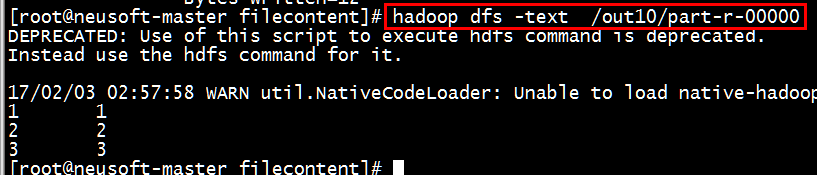
结果是正确无误的。
END~
MapReduce分组的更多相关文章
- MongoDB 的 MapReduce 大数据统计统计挖掘
MongoDB虽然不像我们常用的mysql,sqlserver,oracle等关系型数据库有group by函数那样方便分组,但是MongoDB要实现分组也有3个办法: * Mongodb三种分组方式 ...
- MongoDB的MapReduce用法及php示例代码
MongoDB虽然不像我们常用的mysql,sqlserver,oracle等关系型数据库有group by函数那样方便分组,但是MongoDB要实现分组也有3个办法: * Mongodb三种分组方式 ...
- mongo14-----group,aggregate,mapReduce
group,aggregate,mapReduce 分组统计: group() 简单聚合: aggregate() 强大统计: mapReduce() db.collection.group(docu ...
- 关于MapReduce中自定义分组类(三)
Job类 /** * Define the comparator that controls which keys are grouped together * for a single ...
- Hadoop学习笔记—11.MapReduce中的排序和分组
一.写在之前的 1.1 回顾Map阶段四大步骤 首先,我们回顾一下在MapReduce中,排序和分组在哪里被执行: 从上图中可以清楚地看出,在Step1.4也就是第四步中,需要对不同分区中的数据进行排 ...
- Hadoop Mapreduce分区、分组、二次排序过程详解[转]
原文地址:Hadoop Mapreduce分区.分组.二次排序过程详解[转]作者: 徐海蛟 教学用途 1.MapReduce中数据流动 (1)最简单的过程: map - reduce (2) ...
- Hadoop Mapreduce分区、分组、二次排序
1.MapReduce中数据流动 (1)最简单的过程: map - reduce (2)定制了partitioner以将map的结果送往指定reducer的过程: map - partiti ...
- 一脸懵逼学习Hadoop中的MapReduce程序中自定义分组的实现
1:首先搞好实体类对象: write 是把每个对象序列化到输出流,readFields是把输入流字节反序列化,实现WritableComparable,Java值对象的比较:一般需要重写toStrin ...
- C#使用MapReduce实现对分片数据的分组
事由:mongodb已经进行数据分片,这样就不能使用一些方法就不能使用,例如eval,$group如果尝试使用mongodb会提示 Error: { , "errmsg" : &q ...
随机推荐
- PopupWindow错误:PopupWindow$1.onScrollChanged 出现 NullPointerException和PopupViewContainer.dispatchKeyEvent 出现 NullPointerException【转载】
PopupWindow错误:PopupWindow$1.onScrollChanged 出现 NullPointerException和PopupViewContainer.dispatchKeyEv ...
- MySQL Study之--MySQL普通用户无法本地登陆
MySQL Study之--MySQL普通用户无法本地登陆 在安装完毕MySQL后,我们通常加入拥有对应权限的普通用户用来訪问数据库.在使用用户本地登录数据库的时候,常常会出现怎么登录也无 ...
- VSCode------搭建.net core 2.0,并配置到IIS服务器
前奏 安装VSCode最新版: https://code.visualstudio.com/ 安装window server hosting,发布和部署到IIS使用: https://www.micr ...
- [AX2012]代码更改默认财务维度
在前文(http://www.cnblogs.com/duanshuiliu/p/3243048.html)最后演示了如何使用代码更改默认财务维度,那段代码模拟了创建各数据表记录的过程,实际上AX提供 ...
- 产品半夜发现bug让程序员加班,程序员应如何回应?
群友半夜2点被产品叫起来改东西,然后他打车去公司加班,群友愤慨,特为此创作一个小段子 产品:XXX出bug了你赶紧看看 修复一下 开发:我宿舍没电脑 没网络啊 产品:你看看周围有没有网吧远程一下 或者 ...
- pgpool-II 的使用
1.pgpool-II的概念 pgpool-II 是一个位于 PostgreSQL 服务器和 PostgreSQL 数据库客户端之间的中间件,它提供以下功能: 连接池 pgpool-II 保持已经连接 ...
- sutdio中替换全局方法
Ctril Shift R Text to find :是要搜索的内容或者要被替换的内容 Replace with :是要替换的内容 Preview:是可以看到预览 在Scope的选项卡里 Whole ...
- React Native(十三)——ios键盘挡住textInput
渐入佳境 用React Native重构的项目也快接近尾声,剩下的就是适配ios的功能了.慢慢地也从中琢磨出了一点门道,于是就遇见了键盘遮挡textInput问题斑斑: 正常页面: android点击 ...
- php文件的处理和操作
好长时间没有看php手册了,有些关于文件操作方面的知识点发现从没有学过,现补习一下,顺便整理一下: 1.文件的打开:fopen() 此函数的第一个参数含有要打开的文件的名称,第二个参数规定了使用哪 ...
- .net webservices 代理类生成命令
wsdl.exe /l:cs /out:d:/WxPayment.cs http://localhost/WxPayment.asmx