
java8 stream编程
说明:这是基于同事的培训材料做的练习,记录下来,以作日后自己coding分析和改进
1.准备
pom.xml
<dependency>

            <groupId>org.apache.commons</groupId>

            <artifactId>commons-collections4</artifactId>

            <version>4.1</version>

        </dependency>

        <dependency>

            <groupId>com.google.guava</groupId>

            <artifactId>guava</artifactId>

            <version>14.0</version>

        </dependency>
Dish.java
package com.example.demo;

import lombok.AllArgsConstructor;

import lombok.Data;

/**

 * Created by Administrator on 2019/9/7.

 */

@Data

@AllArgsConstructor

public class Dish {

    private int calories;

    private String name;

}
List<Dish> list;
list = Lists.newArrayList(
        new Dish( 1,"aa"),
        new Dish(13,"bb"),
        new Dish(7,"cc"),
        new Dish( 6,"aa"),
        new Dish(9,"dd"),
        new Dish(1,"ee"),
        new Dish( 3,"aa"),
        new Dish(1,"ff"),
        new Dish(1,"gg")
        );
2.stream的创建
Integer[] ints={1,2};

        List<Integer> list2=Lists.newArrayList(ints);

        List<String> collect3 = list2.stream().map(o -> "1" + o).collect(Collectors.toList());

        List<String> collect4 = Stream.of(1,2).map(o -> "1" + o).collect(Collectors.toList());

        List<String> collect5 = Stream.of(ints).map(o -> "1" + o).collect(Collectors.toList());

        List<String> collect6 = Stream.of(list2).map(o -> "1" + o).collect(Collectors.toList());

 System.out.println(collect3);

        System.out.println(collect4);

        System.out.println(collect5);

        System.out.println(collect6);
输出:
[11, 12]
[11, 12]
[11, 12]
[1[1, 2]]
3.list转map并排序
list排序参照java8排序 java8 list转Map报错Collectors.toMap :: results in "Non-static method cannot be refernced from static context"
TreeMap<String, String> collect1 = list.stream()

                .collect(Collectors.toMap(Dish::getName, o -> "", (key1, key2) -> key2, TreeMap<String, String>::new)); //Map中的value自己o->o或者Function.identity()
System.out.println(collect1);
输出:{aa=, bb=, cc=, dd=, ee=, ff=, gg=}
4.list转linkedList
LinkedList<Dish> collect2 = list.stream().collect(Collectors.toCollection(LinkedList::new));
输出:[Dish(calories=1, name=aa), Dish(calories=13, name=bb), Dish(calories=7, name=cc), Dish(calories=6, name=aa), Dish(calories=9, name=dd), Dish(calories=1, name=ee), Dish(calories=3, name=aa), Dish(calories=1, name=ff), Dish(calories=1, name=gg)]
5.filter筛选,map映射,sorted排序,limit截断流,collect的使用
List<String> collect = list.stream()

                .filter(d ->d.getCalories() < 9)

                .sorted(Comparator.comparing(Dish::getCalories).reversed())

                .map(d->d.getName())

                .limit(3)
输出:[cc, aa, aa]
打印日志:
        List<String> collect = list.stream()

                .filter(d ->{

                                System.out.println("filter "+d.getName());

                        return d.getCalories() < 9;})

                .sorted(Comparator.comparing(Dish::getCalories).reversed())

                .map(d->{

                    System.out.println("map "+d.getName());

                    return d.getName();

                })

                .limit(3)

                .collect(Collectors.toList());
System.out.println(collect);
输出:
filter aa
filter bb
filter cc
filter aa
filter dd
filter ee
filter aa
filter ff
filter gg
map cc
map aa
map aa
[cc, aa, aa]
//不排序
Stream在迭代的时候称为内部迭代,会进行一系列的优化,并不会将前面的执行完再进行后面的操作,它会进行全面的评估,执行最优迭代,前面的操作都不会执行,直到最后的collect方法调用时,这称为惰性执行.(你在某些情况下甚至可以使用parallelStream(),它会根据你cpu核数并行计算.)
        List<Dish> list;

        list = Lists.newArrayList(

                new Dish( 1,"aa"),

                new Dish(13,"bbc"),

                new Dish(7,"cc"),

                new Dish( 6,"aa"),

                new Dish(9,"dd"),

                new Dish(1,"ee"),

                new Dish( 3,"aa"),

                new Dish(1,"ff"),

                new Dish(1,"gg")

        );

        List<String> collect = list.stream()

                .filter(d ->{

                    System.out.println("filter "+d.getName());

                    return d.getCalories() < 9;})

               // .sorted(Comparator.comparing(Dish::getCalories).reversed())

                .map(d->{

                    System.out.println("map "+d.getName());

                    return d.getName();

                })

                .limit(3)

                .collect(Collectors.toList());

        System.out.println(collect);
输出:
filter aa
map aa
filter bbc
filter cc
map cc
filter aa
map aa
[aa, cc, aa]
比如:这里filter只进行了4次就找够了,map也只进行了三次,他们是并行进行的
6.skip,distinct,flatMap的使用
//distinct
        List<String> collect7 = list.stream().map(Dish::getName).distinct().collect(Collectors.toList());

        System.out.println(collect7);
输出:[aa, bb, cc, dd, ee, ff, gg]
//skip
        List<String> collect7 = list.stream().map(Dish::getName).distinct().skip(3).collect(Collectors.toList());

        System.out.println(collect7);
输出:[dd, ee, ff, gg]
//Map
String[] words=new String[]{"hello","world"};
List<String[]> collect8 = Arrays.stream(words).map(w -> w.split(""))

                .distinct()

                .collect(Collectors.toList());

        System.out.println(JSONObject.toJSONString(collect8));
输出:[["h","e","l","l","o"],["w","o","r","l","d"]]
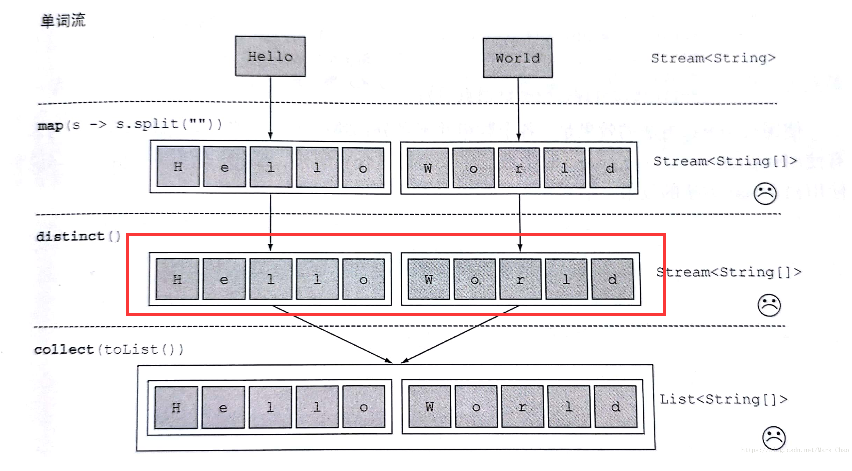
//flatmap对流扁平化处理
        List<String> collect8 = Arrays.stream(words).map(w -> w.split(""))

                .flatMap(Arrays::stream)

                .distinct()

                .collect(Collectors.toList());

        System.out.println(JSONObject.toJSONString(collect8));
输出:["h","e","l","o","w","r","d"]

7.终结操作:
7.1 匹配anyMatch,allMatch,oneMatch
anyMatch,只有找到第一个匹配的就退出并返回true
if(Stream.of(9,5,8,6,5,9,8,3,1,0,8,2).anyMatch(o->o==8)){

            System.out.println("find the item");

        };
输出:find the item
allMatch,匹配所有元素才返回true
if(Stream.of(9,5,8,6,5,9,8,3,1,0,8,2).allMatch(o->o==8)){

            System.out.println("success");

        }else {

            System.out.println("failure");

        };
输出:failure
noneMatch,所有元素都不匹配才返回true,否则false
if(Stream.of(9,5,8,6,5,9,8,3,1,0,8,2).noneMatch(o->o==11)){

            System.out.println("success");

        }else {

            System.out.println("failure");

        };
输出:false
7.2查找findAny,findFirst
findAny,返回任意一个,注意是否为null的判断,关于Optional参考理解、学习与使用 Java 中的 Optional
        Optional<Integer> any = Stream.of(9, 5, 8, 6, 5, 9, 8, 3, 1, 0, 8, 2).filter(o -> o < 2).findAny();

        if(any.isPresent())

            System.out.println(any.get());
输出:1
findFirst,找到第一个符合条件的,如找到第一个平方能被4整除的值
        Optional<Integer> any = Stream.of(9, 5, 8, 6, 5, 9, 8, 3, 1, 0, 8, 2).map(o->o*o).filter(o -> o%4==0).findAny();

        if(any.isPresent())

            System.out.println(any.get());
输出:64
相比于findAny,findFirst在并行上有更多的限制,如果不关心找到哪个元素,推荐用findAny。与limit(1)不同,它们是终结操作,不需要collect
8.归约操作
8.1求和(广义归约)
归约操作是指将流中的所有元素反复组合起来,得到一个值。比如,将流中的元素求和:int sum = numbers.stream().reduce(0, (a, b) -> a + b);为什么说是反复组合起来?
求和归约操作中是将指定的初始值0(reduce方法的第一个参数)与流中的第一个元素相加(表达为reduce的第二个参数BinaryOperator,我们传递是Lambda表达式(a, b) -> a + b)得到一个中间值后与流中的第二个元素相加,直至流中的所有元素都被累加完,得到最终的求和结果。
        Integer reduce = Stream.of(9, 5, 8, 6, 5, 9, 8, 3, 1, 0, 8, 2).reduce(, (a, b) -> a + b);

        System.out.println(reduce);//
只传一个参数
        Optional<Integer> reduce = Stream.of(9, 5, 8, 6, 5, 9, 8, 3, 1, 0, 8, 2).reduce((a, b) -> a + b);

        if(reduce.isPresent())

            System.out.println(reduce.get());//64
也可以这样
        Optional<Integer> reduce = Stream.of(9, 5, 8, 6, 5, 9, 8, 3, 1, 0, 8, 2).reduce(Integer::sum);

        if(reduce.isPresent())

            System.out.println(reduce.get());//64
也可以
        Integer collect9 = list.stream().collect(Collectors.reducing(0,//初始值

                Dish::getCalories, //转换函数

                Integer::sum));//累积函数

        System.out.println(collect9);//42
预定义归约:
        Integer collect9 = list.stream().collect(Collectors.summingInt(Dish::getCalories));

        System.out.println(collect9);
更简洁的用法:
       int sum = Stream.of(9, 5, 8, 6, 5, 9, 8, 3, 1, 0, 8, 2).mapToInt(Integer::intValue).sum();

        System.out.println("sum===="+sum);//sum====42
8.2求最大值
        Optional<Integer> reduce = Stream.of(9, 5, 8, 6, 5, 9, 8, 3, 1, 0, 8, 2).reduce(Integer::max);

        if(reduce.isPresent())

            System.out.println(reduce.get());//9
也可以
        Optional<Dish> collect9 = list.stream().collect(Collectors.maxBy(Comparator.comparing(Dish::getCalories)));

        Optional<Dish> collect10 = list.stream().max(Comparator.comparing(Dish::getCalories));

        if(collect9.isPresent())

        System.out.println(collect9.get());//Dish(calories=13, name=bb)
8.3求最小值
        Optional<Integer> reduce = Stream.of(9, 5, 8, 6, 5, 9, 8, 3, 1, 0, 8, 2).reduce(Integer::min);

        if(reduce.isPresent())

            System.out.println(reduce.get());//0
8.4其它归约函数count
     Long collect9 = list.stream().collect(Collectors.counting());

        long count = list.stream().count();

        System.out.println(collect9);
8.5 join连接
        String collect11 = list.stream().map(Dish::getName).collect(Collectors.joining());

        System.out.println(collect11);//aabbccaaddeeaaffgg

        String collect12 = list.stream().map(Dish::getName).collect(Collectors.joining("--", "start:", ":end"));

        System.out.println(collect12);//start:aa--bb--cc--aa--dd--ee--aa--ff--gg:end
8.6 groupingBy
        Map<String, List<Dish>> collect13 = list.stream().collect(Collectors.groupingBy(Dish::getName));

        System.out.println(JSONObject.toJSONString(collect13));

        System.out.println(JSONObject.toJSONString(list));
输出:
{"gg":[{"calories":1,"name":"gg"}],"ff":[{"calories":1,"name":"ff"}],"ee":[{"calories":1,"name":"ee"}],"dd":[{"calories":9,"name":"dd"}],"cc":[{"calories":7,"name":"cc"}],"bb":[{"calories":13,"name":"bb"}],"aa":[{"calories":1,"name":"aa"},{"calories":6,"name":"aa"},{"calories":3,"name":"aa"}]}
[{"calories":1,"name":"aa"},{"calories":13,"name":"bb"},{"calories":7,"name":"cc"},{"calories":6,"name":"aa"},{"calories":9,"name":"dd"},{"calories":1,"name":"ee"},{"calories":3,"name":"aa"},{"calories":1,"name":"ff"},{"calories":1,"name":"gg"}]
只要统计个数
        Map<String, Long> collect13 = list.stream().collect(Collectors.groupingBy(Dish::getName, Collectors.counting()));

        System.out.println(JSONObject.toJSONString(collect13));
输出:{"gg":1,"ff":1,"ee":1,"dd":1,"cc":1,"bb":1,"aa":3}
9并行执行
        int sum = Stream.of(9, 5, 8, 6, 5, 9, 8, 3, 1, 0, 8, 2).parallel().mapToInt(Integer::intValue).sum();

        System.out.println("sum===="+sum);//42
数据并行处理,只需要在原来的基础上加一个parallel()就可以开启~。顺便提一下这里parallel()开启的底层并行框架是fork/join,默认的并行数是Ncpu个。
java8 stream编程的更多相关文章
- 关于Java8函数式编程你需要了解的几点
函数式编程与面向对象的设计方法在思路和手段上都各有千秋,在这里,我将简要介绍一下函数式编程与面向对象相比的一些特点和差异. 函数作为一等公民 在理解函数作为一等公民这句话时,让我们先来看一下一种非常常 ...
- Java8 函数式编程详解
Java8 函数式编程详解 Author:Dorae Date:2017年11月1日23:03:26 转载请注明出处 说起Java8,可能很多人都已经知道其最大的改进,就是引入了Lambda表达式与S ...
- java8 Stream的实现原理 (从零开始实现一个stream流)
1.Stream 流的介绍 1.1 java8 stream介绍 java8新增了stream流的特性,能够让用户以函数式的方式.更为简单的操纵集合等数据结构,并实现了用户无感知的并行计算. 1.2 ...
- Java8函数式编程探秘
引子 将行为作为数据传递 怎样在一行代码里同时计算一个列表的和.最大值.最小值.平均值.元素个数.奇偶分组.指数.排序呢? 答案是思维反转!将行为作为数据传递. 文艺青年的代码如下所示: public ...
- 简洁又快速地处理集合——Java8 Stream(下)
上一篇文章我讲解 Stream 流的基本原理,以及它与集合的区别关系,讲了那么多抽象的,本篇文章我们开始实战,讲解流的各个方法以及各种操作 没有看过上篇文章的可以先点击进去学习一下 简洁又快速地处理集 ...
- [2017.02.23] Java8 函数式编程
以前学过Haskell,前几天又复习了其中的部分内容. 函数式编程与命令式编程有着不一样的地方,函数式编程中函数是第一等公民,通过使用少量的几个数据结构如list.map.set,以及在这些数据结构上 ...
- Java8 Stream新特性详解及实战
Java8 Stream新特性详解及实战 背景介绍 在阅读Spring Boot源代码时,发现Java 8的新特性已经被广泛使用,如果再不学习Java8的新特性并灵活应用,你可能真的要out了.为此, ...
- 【转】Java8 Stream 流详解
当我第一次阅读 Java8 中的 Stream API 时,说实话,我非常困惑,因为它的名字听起来与 Java I0 框架中的 InputStream 和 OutputStream 非常类似.但是 ...
- 《Java8 Stream编码实战》正式推出
当我第一次在项目代码中看到Stream流的时候,心里不由得骂了一句"傻X"炫什么技.当我开始尝试在代码中使用Stream时,不由得感叹真香. 记得以前有朋友聊天说,他在代码中用了 ...
随机推荐
- C++有静态成员变量的类继承
声明和定义 1.变量的定义 变量的定义用于为变量分配存储空间,还可以为变量指定初始值.在一个程序中,变量有且仅有一个定义. 2.变量的声明 用于向程序表明变量的类型和名字.程序中变量可以声明多次,但只 ...
- ld - GNU linker (连接器)
总览 (SYNOPSIS) ld [-o output] objfile... [-Aarchitecture] [-b input-format] [-Bstatic] [-Bdynamic] [- ...
- [工具] BurpSuite--Intruder功能
BurpSuite--Intruder功能 0x00 配置说明 intruder是进行爆破的,基本流程是标注请求的爆破参数,然后配置字段,选择爆破方式进行爆破,下面来记录下工具的使用 选中intrud ...
- 如何使用Beyond Compare比较两个文件夹的差异
很多时候,我们需要比较两个文件或者两个文件夹的差异性,看看是哪里不同.这时候就需要一款比较软件来处理,Beyond Compare就是其中一款非常好用的版本比较工具,下面简单介绍一下Beyond Co ...
- oracle pl/sql 程序设计 历史笔记整理
20131016 周三 oracle pl/sql 程序设计 第2章 创建并运行pl/sql代码 sqlplus yjkhecc/yjkhecc@10.85.23.92:1521/orcl 在java ...
- Collections 工具类和 Arrays 工具类常见方法
Collections Collections 工具类常用方法: 排序 查找,替换操作 同步控制(不推荐,需要线程安全的集合类型时请考虑使用 JUC 包下的并发集合) 排序操作 void revers ...
- yaf 生成项目
yaf 生成项目 yaf下载安装地址 https://github.com/laruence/yaf/releases 生成项目 一定需要在安装yaf的php版本环境中执行该语句 sudo /usr/ ...
- PHP基础教程探讨一些php编程性能优化总结
兄弟连PHP培训 小编最近在做php程序的性能优化,一些经过测试后发现的东西就先记录下来,以备后用. 首先对于一些反应慢的操作或页面要跟踪处理一下,可以使用webGrind的方式看一下主要问题出在 ...
- HTML 和 CSS 画三角形和画多边行基本原理及实践
基本 HTML 标签 <div class = 'test'></div> 基本 CSS 代码 .test { width: 100px; height: 100px; bac ...
- 【python 应用之四】提升 Python 运行性能的 7 个习惯
大家都知道艺赛旗的 RPA 依赖于 python 语言.因此我们可以掌握一些技巧,可尽量提高 Python 程序性能,也可以避免不必要的资源浪费.1.使用局部变量 尽量使用局部变量代替全局变量:便于维 ...