
PAT甲级——A1131 Subway Map【30】
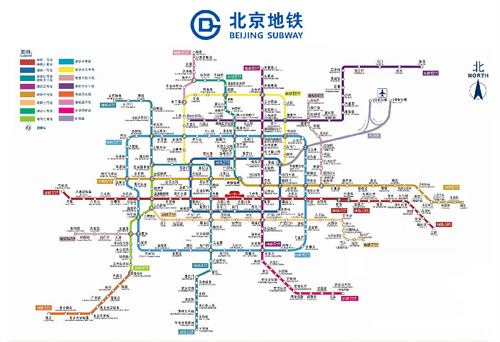
In the big cities, the subway systems always look so complex to the visitors. To give you some sense, the following figure shows the map of Beijing subway. Now you are supposed to help people with your computer skills! Given the starting position of your user, your task is to find the quickest way to his/her destination.
Input Specification:
Each input file contains one test case. For each case, the first line contains a positive integer N (≤ 100), the number of subway lines. Then N lines follow, with the i-th (,) line describes the i-th subway line in the format:
M S[1] S[2] ... S[M]
where M (≤ 100) is the number of stops, and S[i]'s (,) are the indices of the stations (the indices are 4-digit numbers from 0000 to 9999) along the line. It is guaranteed that the stations are given in the correct order -- that is, the train travels between S[i] and S[i+1] (,) without any stop.
Note: It is possible to have loops, but not self-loop (no train starts from S and stops at S without passing through another station). Each station interval belongs to a unique subway line. Although the lines may cross each other at some stations (so called "transfer stations"), no station can be the conjunction of more than 5 lines.
After the description of the subway, another positive integer K (≤ 10) is given. Then K lines follow, each gives a query from your user: the two indices as the starting station and the destination, respectively.
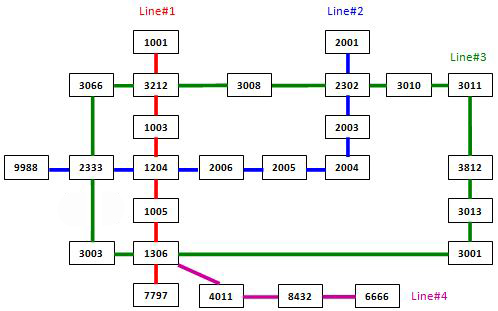
The following figure shows the sample map.
Note: It is guaranteed that all the stations are reachable, and all the queries consist of legal station numbers.
Output Specification:
For each query, first print in a line the minimum number of stops. Then you are supposed to show the optimal path in a friendly format as the following:
Take Line#X1 from S1 to S2.

Take Line#X2 from S2 to S3.

......
where Xi's are the line numbers and Si's are the station indices. Note: Besides the starting and ending stations, only the transfer stations shall be printed.
If the quickest path is not unique, output the one with the minimum number of transfers, which is guaranteed to be unique.
Sample Input:
4

7 1001 3212 1003 1204 1005 1306 7797

9 9988 2333 1204 2006 2005 2004 2003 2302 2001

13 3011 3812 3013 3001 1306 3003 2333 3066 3212 3008 2302 3010 3011

4 6666 8432 4011 1306

3

3011 3013

6666 2001

2004 3001
Sample Output:
2

Take Line#3 from 3011 to 3013.

10

Take Line#4 from 6666 to 1306.

Take Line#3 from 1306 to 2302.

Take Line#2 from 2302 to 2001.

6

Take Line#2 from 2004 to 1204.

Take Line#1 from 1204 to 1306.

Take Line#3 from 1306 to 3001.#include <iostream>
#include <vector>
#include <unordered_map>
using namespace std;
vector<int> route[];
int visit[], minCnt, minTra, n, m, k, start, end1;
unordered_map<int, int>line;
vector<int>path, tempPath;
int transferCnt(vector<int>a)
{
int cnt = -, preLine = ;
for (int i = ; i < a.size(); ++i)
{
if (line[a[i - ] * + a[i]] != preLine)
{
cnt++;//换乘了
preLine = line[a[i - ] * + a[i]];
}
}
return cnt;
}
void DFS(int node, int cnt)
{
if (node == end1 && (cnt < minCnt || (cnt == minCnt && transferCnt(tempPath) < minTra)))
{
minCnt = cnt;
minTra = transferCnt(tempPath);
path = tempPath;
}
if (node == end1)return;
for (int i = ; i < route[node].size(); ++i)
{
if (visit[route[node][i]] == )//未遍历过
{
visit[route[node][i]] = ;
tempPath.push_back(route[node][i]);//保存可行路径
DFS(route[node][i], cnt + );//经过一站
visit[route[node][i]] = ;
tempPath.pop_back();//使用回溯法
}
}
}
int main()
{
cin >> n;
for (int i = ; i <= n; ++i)
{
cin >> m >> start;
for (int j = ; j < m; ++j)
{
cin >> end1;
route[start].push_back(end1);
route[end1].push_back(start);
line[start * + end1] = line[end1 * + start] = i;//用pot1*10000+pot来表示这两个站是可行的
start = end1;
}
}
cin >> k;
while (k--)
{
cin >> start >> end1;
minCnt = minTra = INT32_MAX-;
tempPath.clear();
tempPath.push_back(start);
visit[start] = ;
DFS(start, );
visit[start] = ;
cout << minCnt << endl;
int preLine = , preTra = start;
for (int i = ; i < path.size(); ++i)
{
if (line[path[i - ] * + path[i]] != preLine)//换乘了
{
if (preLine != )
printf("Take Line#%d from %04d to %04d.\n", preLine, preTra, path[i - ]);
preLine = line[path[i - ] * + path[i]];
preTra = path[i - ];
}
}
printf("Take Line#%d from %04d to %04d.\n", preLine, preTra, end1);
}
return ;
}
PAT甲级——A1131 Subway Map【30】的更多相关文章
- PAT甲级1131. Subway Map
PAT甲级1131. Subway Map 题意: 在大城市,地铁系统对访客总是看起来很复杂.给你一些感觉,下图显示了北京地铁的地图.现在你应该帮助人们掌握你的电脑技能!鉴于您的用户的起始位置,您的任 ...
- PAT甲级——1131 Subway Map (30 分)
可以转到我的CSDN查看同样的文章https://blog.csdn.net/weixin_44385565/article/details/89003683 1131 Subway Map (30 ...
- A1131. Subway Map (30)
In the big cities, the subway systems always look so complex to the visitors. To give you some sense ...
- PAT甲级1131 Subway Map【dfs】【输出方案】
题目:https://pintia.cn/problem-sets/994805342720868352/problems/994805347523346432 题意: 告诉你一个地铁线路图,站点都是 ...
- PAT甲级1111. Online Map
PAT甲级1111. Online Map 题意: 输入我们当前的位置和目的地,一个在线地图可以推荐几条路径.现在你的工作是向你的用户推荐两条路径:一条是最短的,另一条是最快的.确保任何请求存在路径. ...
- PAT甲级——1111 Online Map (单源最短路经的Dijkstra算法、priority_queue的使用)
本文章同步发布在CSDN:https://blog.csdn.net/weixin_44385565/article/details/90041078 1111 Online Map (30 分) ...
- PAT 1131. Subway Map (30)
最短路. 记录一下到某个点,最后是哪辆车乘到的最短距离.换乘次数以及从哪个位置推过来的,可以开$map$记录一下. #include<map> #include<set> #i ...
- PAT甲级——A1111 Online Map【30】
Input our current position and a destination, an online map can recommend several paths. Now your jo ...
- PAT A1131 Subway Map
dfs,选择最优路径并输出~ 这道题难度非常炸裂,要求完完整整自己推一遍,DFS才算过关!思路:一遍dfs,过程中要维护两个变量,minCnt 中途停靠最少的站.minTransfer需要换成的最少次 ...
随机推荐
- 关于springboot错误:“找不到或无法加载主类”的解决办法
我从网上找的一个Demo,运行的时候报 错误:“找不到或无法加载主类”,百度了一番,都是说在项目目录打开cmd,使用 mvn install.mvn clean complie之类的命令,都成功了,但 ...
- Java中的接口是怎么实现的
接口 使用关键字interface来定义一个接口,和类的定义方法很相似分为接口声明和接口体. interface Printable { final int MAX = 100; void add( ...
- 【优化】碎片OPTIMIZE
来看看手册中关于 OPTIMIZE 的描述: OPTIMIZE [LOCAL | NO_WRITE_TO_BINLOG] TABLE tbl_name [, tbl_name] ... 如果您已经删除 ...
- php面向对象深入理解(一)
面向对象(Object Oriented Programming,OOP)的基础知识: 第一个例子: 类Test.class.php <?php class Test{ public $a= ...
- javascript中内置函数
一.基本函数库 split():用于把一个字符串分割成字符串数组 toUpperCase(): substr(): 长度 length() 拼接(两种) + concat():合并多个字符串,并返回合 ...
- 20180713NOIP模拟赛
20180713NOIP模拟赛 T1:动物园 zoo.cpp 2s [题目描述] 给定一张图,点有点权,求每个点到其他所有点中所有点的权值最小值之和. [思路] \(50pts\)做法:对于每个点跑一 ...
- 如何用DOS命令查看占用某端口的程序及PID号
果学过JSP编程的朋友可以会发现,若用Eclipse运行JSP文件时常常会弹出某某端口正在使用,从而导致代码无法运行.如何查找出特定端口的使用情况以及对应的程序呢,针对该问题,本文介绍利用DOS命令查 ...
- 学习笔记——CDQ分治
再次感谢这位大佬的博客:https://www.cnblogs.com/ljc20020730/p/10395866.html CDQ分治,是一种在分治合并中计算前面值对后面答案的贡献的一种算法.今天 ...
- String类的substring()方法
截取字符串,在java语言中的用法 1. public String substring(int beginIndex) 返回一个新字符串,它是此字符串的一个子字符串.该子字符串始于指定索引处的字符 ...
- spring boot 重复提交
package com.future.interceptor; import javax.servlet.http.HttpServletRequest; import org.aspectj.lan ...