
poj3876 darts
| Time Limit: 1000MS | Memory Limit: 65536K | |||
| Total Submissions: 58 | Accepted: 32 | Special Judge | ||
Description
They always play 501, one of the easiest games. Players start with a score of N points (typically, N = 501, hence the name) and take turns throwing darts. The score of each player decreases by the value of the section hit by the dart, unless the score becomes negative, in which case it remains unchanged. The first player to reach a score of 0 wins. The figure below shows the dartboard with which the game is played.
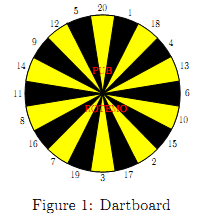
As the clock ticks closer to midnight and they start running out of beer, everyone wonders the same: is it worth trying to aim the dart at a specic section? Or is it better just to throw the dart at a random section on the dartboard? You are asked to deal with the question by finding out what would happen if two players (A and B) applying these two different strategies were to play against each other:
Player A throws the darts at random, and consequently they land with equal probability in each of the sections of the dartboard.
If Player B aims at a certain section, the dart has the same probability of landing in the correct one as in each of the two adjacent ones (the neighbouring regions to the left and right). Moreover, he is completely aware of his ability and sober enough to aim at the section that maximizes his probability of winning.
Given the initial score of both players, can you determine the probability that the first player wins? Of course, being the first to throw a dart might be advantageous, so the answer depends on who plays first.
Input
Output
Sample Input
5

100

0
Sample Output
0.136363636364 0.909090909091

0.072504908290 0.950215081962

题目大意:A,B两人比赛射飞镖,每个人都有一个一样的初始分数n,两人轮流扔。投中a时,如果n大于等于a,n=n-a,否则n不变。n先为0的一方胜。
         两人的策略不同,A随机射,每个数字射中的概率为20分之一。B瞄准某个数字射,但射中的概率只有三分之一,还有另外三分之一射中左右两个。
         给出N,求A先射A赢的概率以及B先射B赢的概率。
思路:很容易想出来是概率dp,特殊情况也比较比较好处理。但问题是这里的状态会出现从自身到自身的状态,即dp[i][j]的某一部分是由dp[i][j]推倒而来的,这就形成了一个环。这里有两种解决方法,一是将可能出现环的状态反复迭代做,做上几十次,这样将逐步逼近正确值。比较好写,但运行时间较长。二是把所有环列出,这样将会有许多个等式,然后用高斯消元直接求,速度比较快,但比较难写。
     本人采用的是第一种方法,但在poj上不是tle就是wa,实在找不出一个合适的迭代次数,无奈打表。下面给出打表程序。
 /*

  * Author:  Joshua

  * Created Time:  2014年08月23日 星期六 22时20分08秒

  * File Name: poj3876.cpp

  */

 #include<cstdio>

 #define maxn 505

 int a[]={,,,,,,,,,,,,,,,,,,,,,};

 double dp1[maxn][maxn],dp2[maxn][maxn];

 void solve()

 {

     for (int i=;i<maxn;++i)

     {

         dp1[][i]=;

         dp2[i][]=;

     }

     for (int i=;i<=;++i)

         for (int j=;j<=;++j)

         {

             for (int t=;t<=;++t)

             {

                 dp1[i][j]=;

                 for (int k=;k<;++k)

                     if (i-a[k]>=)

                         dp1[i][j]+=(-dp2[i-a[k]][j])/20.0;

                     else

                         dp1[i][j]+=(-dp2[i][j])/20.0;

                 dp2[i][j]=;

                 for (int k=;k<;++k)

                 {

                     double temp=;

                     for (int l=;l<=;++l)

                         if (j-a[k+l]>=)

                             temp+=(-dp1[i][j-a[k+l]])/3.0;

                         else

                             temp+=(-dp1[i][j])/3.0;

                     if (temp>dp2[i][j]) dp2[i][j]=temp;

                 }

                 if (i> && j>) break;

             }

         }

 }

 int main()

 {

     int n;

     solve();

     while (scanf("%d",&n) && n)

     {

         printf("%.12f %.12f\n",dp1[n][n],dp2[n][n]);

     }

     return ;

 }
poj3876 darts的更多相关文章
- 日本DARTS 支撑的一系列应用项目
DARTS是多学科空间科学数据平台,例如天体物理.太阳物理.太阳物理.月球与行星科学和微重力科学.在此数据支撑下,有许多应用. 1.http://wms.selene.darts.isas.jaxa. ...
- Project Euler 109 :Darts 飞镖
Darts In the game of darts a player throws three darts at a target board which is split into twenty ...
- 4063: [Cerc2012]Darts
4063: [Cerc2012]Darts Time Limit: 10 Sec Memory Limit: 128 MBSubmit: 85 Solved: 53[Submit][Status] ...
- 论文笔记:DARTS: Differentiable Architecture Search
DARTS: Differentiable Architecture Search 2019-03-19 10:04:26accepted by ICLR 2019 Paper:https://arx ...
- 论文笔记系列-DARTS: Differentiable Architecture Search
Summary 我的理解就是原本节点和节点之间操作是离散的,因为就是从若干个操作中选择某一个,而作者试图使用softmax和relaxation(松弛化)将操作连续化,所以模型结构搜索的任务就转变成了 ...
- POJ-1959 Darts
Darts Time Limit: 1000MS Memory Limit: 30000K Total Submissions: 1286 Accepted: 741 Description Back ...
- UVALive 6262 Darts
Description Consider a game in which darts are thrown at a board. The board is formed by 10 circles ...
- DARTS代码分析(Pytorch)
最近在看DARTS的代码,有一个operations.py的文件,里面是对各类点与点之间操作的方法. OPS = { 'none': lambda C, stride, affine: Zero(st ...
- ZOJ3720 Magnet Darts(点在多边形内)
第一道点在多边形内的判断题,一开始以为是凸的.其实题意很简单的啦,最后转化为判断一个点是否在一个多边形内. 如果只是简单的凸多边形的话,我们可以枚举每条边算下叉积就可以知道某个点是不是在范围内了.但对 ...
随机推荐
- RabbitMq学习一入门篇(hello world)
简介 RabbitMQ是一个开源的AMQP实现,服务器端用Erlang语言编写,支持多种客户端,如:Python.Ruby..NET.Java,也是众多消息队列中表现不俗的一员,作用就是提高系统的并发 ...
- 如是使用JS实现页面内容随机显示
之前有个客户咨询我,因为他们公司的业务员有多个人,但公司网站的联系方式板块里只够放一个人的信息,所以就想能不能实现这个联系方式信息随机显示,对于业务或客服人员来说也能做到分配均匀公平.本文我们将和大家 ...
- java数组排序(冒泡、直排)反转
package lianxi; public class maopao { public static void main(String[] args){ int[] i=new int[]{45,6 ...
- (转)log4j(三)——如何控制不同级别的日志信息的输出?
一:测试环境与log4j(一)——为什么要使用log4j?一样,这里不再重述 1 老规矩,先来个栗子,然后再聊聊感受 package test.log4j.test3; import org.apac ...
- (转)js jquery.qrcode生成二维码 带logo 支持中文
场景:公司最最近在开发二维码支付业务,所以需要做一个html5中的二维码生成和部署! 前天用js生成二维码,节省服务器资源及带宽 原版jquery.qrcode不能生成logo,本文采用的是修改版 1 ...
- (转)生产者/消费者问题的多种Java实现方式 (待整理)
实质上,很多后台服务程序并发控制的基本原理都可以归纳为生产者/消费者模式,而这是恰恰是在本科操作系统课堂上老师反复讲解,而我们却视而不见不以为然的.在博文<一种面向作业流(工作流)的轻量级可复用 ...
- ui-router ^1.x在ng1中使用state events
官网信息:https://ui-router.github.io/ng1/docs/latest/modules/ng1_state_events.html Legacy state events P ...
- Entity Framework Core 执行SQL语句和存储过程
无论ORM有多么强大,总会出现一些特殊的情况,它无法满足我们的要求.在这篇文章中,我们介绍几种执行SQL的方法. 表结构 在具体内容开始之前,我们先简单说明一下要使用的表结构. public clas ...
- Java基础之TCP与UDP
OSI 7层参考模型 物理层 --> 数据链路层 --> 网络层 --> 传输层 --> 会话层 --> 表示层 --> 应用层 按此顺序称为拆包,反之为封包. T ...
- little bird
LITTLE BIRD Bzoj 3831 相对而言是一道比较简单的DP,不过它需要用单调队列优化.首先是朴素O(n2), if(d[j]>f[i]) f[i]=min(f[i],f[j]); ...