
string类的用法总结
string中常见的成员函数
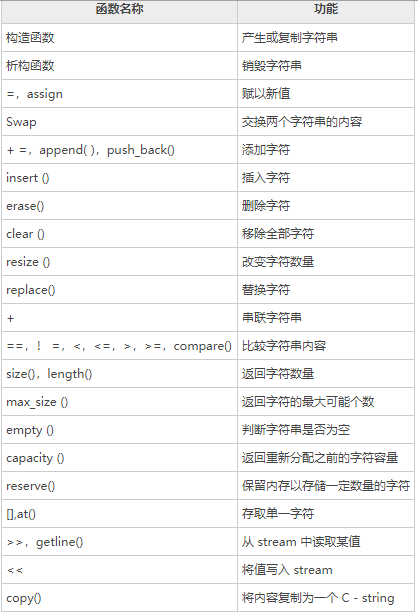
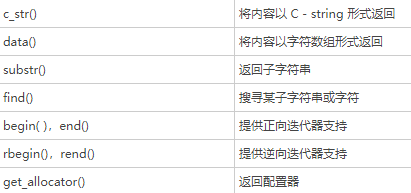
示例代码:
string s= string("abcdefg");

char ch[] = "abcdefgd";

//调用构造函数全部复制

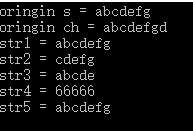
string str1 = string(s);

//构造函数,从字符串str的第2个元素开始,复制5个元素,赋值给str2

string str2 = string(s,2,5);

//复制ch前5个字符串

string str3 = string(ch,5);

//将5个'6'赋给字符串

string str4 = string(5,'6');

//

string str5 = string(s.begin(),s.end());

cout << "oringin s = " + s << endl;

cout << "oringin ch = " <<ch << endl;

cout << "str1 = " + str1<< endl;

cout << "str2 = " + str2<<endl;

cout << "str3 = " + str3<<endl;

cout << "str4 = " + str4<<endl;

cout << "str5 = " + str5<<endl;
输出结果:
string的常用方法
取string中元素
使用at()或[]去字符串的元素
string s = "hello";

char c = s.at(2);

char ch = s[2];
上面两行的效果是一样的,都是将l取出。
字符串比较
compare函数
函数原型如下所示:int compare (const basic_string& s) const;
int compare (const Ch* p) const;
int compare (size_type pos, size_type n, const basic_string& s) const;
int compare (size_type pos, size_type n, const basic_string& s,size_type pos2, size_type n2) const;
int compare (size_type pos, size_type n, const Ch* p, size_type = npos) const;
函数返回值介绍:若参与比较的两个串值相同,则函数返回 0;若字符串 S 按字典顺序要先于 S2,则返回负值;反之,则返回正值。下面举例说明如何使用 string 类的 compare() 函数。
具体示例如下:
string s1 = "Hello";

string s2 = "Ok";

string s3 = "abdcds";

string s4("abdcds");

cout << "s1 = " + s1 <<endl;

cout << "s2 = " + s2 <<endl;

cout << "s3 = " + s3 <<endl;

cout << "s4 = " + s4 <<endl;

cout<<"s1.comapre(s2) = " << s1.compare(s2) <<endl;

cout<<"s2.comapre(s3) = " << s2.compare(s3) <<endl;

cout<<"s3.comapre(s4) = " << s3.compare(s4) <<endl;
输出结果如下:
s1 = Hello

s2 = Ok

s3 = abdcds

s4 = abdcds

s1.comapre(s2) = -1

s2.comapre(s3) = -1

s3.comapre(s4) = 0
- 比较运算符
String 类的常见运算符包括 >、<、==、>=、<=、!=。其意义分别为"大于"、"小于"、"等于"、"大于等于"、"小于等于"、"不等于"
示例用法:
#include <iostream>

#include <string>

using namespace std;

void TrueOrFalse (int x)

{

cout << (x?"True":"False")<<endl;

}

int main ()

{

string S1 = "DEF";

string CP1 = "ABC";

string CP2 = "DEF";

string CP3 = "DEFG";

string CP4 ="def";

cout << "S1= " << S1 << endl;

cout << "CP1 = " << CP1 <<endl;

cout << "CP2 = " << CP2 <<endl;

cout << "CP3 = " << CP3 <<endl;

cout << "CP4 = " << CP4 <<endl;

cout << "S1 <= CP1 returned ";

TrueOrFalse (S1 <=CP1);

cout << "S1 <= CP2 returned ";

TrueOrFalse (S1 <= CP2);

cout << "S1 <= CP3 returned ";

TrueOrFalse (S1 <= CP3);

cout << "CP1 <= S1 returned ";

TrueOrFalse (CP1 <= S1);

cout << "CP2 <= S1 returned ";

TrueOrFalse (CP2 <= S1);

cout << "CP4 <= S1 returned ";

TrueOrFalse (CP4 <= S1);

cin.get();

return 0;

}
输出结果:
S1= DEF

CP1 = ABC

CP2 = DEF

CP3 = DEFG

CP4 = def

S1 <= CP1 returned False

S1 <= CP2 returned True

S1 <= CP3 returned True

CP1 <= S1 returned True

CP2 <= S1 returned True

CP4 <= S1 returned False
字符串内容的修改
使用append()函数
basic_string& append (const E * s); //在原始字符串后面追加字符串s
basic_string& append (const E * s, size_type n);//在原始字符串后面追加字符串 s 的前 n 个字符
basic_string& append (const basic_string& str, size_type pos,size_type n);//在原始字符串后面追加字符串 s 的子串 s [ pos,…,pos +n -1]
basic_string& append (const basic_string& str);
basic_string& append (size_type n, E c); //追加 n 个重复字符
basic_string& append (const_iterator first, const_iterator last); //使用迭代器追加
示例代码如下:
string s1 = "123456";

string s2 = "abcdefgh";

string str;

str.assign(s1);

cout <<"after use assign: str = " << str << endl;
使用insert函数
basic_string& insert (size_type p0 , const E * s); //插人 1 个字符至字符串 s 前面
basic_string& insert (size_type p0 , const E * s, size_type n); // 将 s 的前 3 个字符插入p0 位置
basic_string& insert (size_type p0, const basic_string& str);
basic_string& insert (size_type p0, const basic_string& str,size_type pos, size_type n); //选取 str 的子串
basic_string& insert (size_type p0, size_type n, E c); //在下标 p0 位置插入 n 个字符 c
iterator insert (iterator it, E c); //在 it 位置插入字符 c
void insert (iterator it, const_iterator first, const_iterator last); //在字符串前插入字符
void insert (iterator it, size_type n, E c) ; //在 it 位置重复插入 n 个字符 c
示例代码如下:
string A("ello");

string B ;

B.insert(1,A);

cout << B << endl;

A = "ello";

B = "H";

B.insert (1,"yanchy ",3);

cout<< B <<endl;

A = "ello";

B = "H";

B.insert (1,A,2,2);

cout << B << endl;

A="ello";

B.insert (1 , 5 , 'C');

cout << B << endl;
字符串替换函数
方法原型:
basic_string& replace (size_type p0, size_type n0, const E * s); //使用字符串 s 中的 n 个字符,从源串的位置 P0 处开始替换

basic_string& replace (size_type p0, size_type n0, const E *s, size_type n); //使用字符串 s 中的 n 个字符,从源串的位置 P0 处开始替换 1 个字符

basic_string& replace (size_type p0, size_type n0, const basic_string& str); //使用字符串 s 中的 n 个字符,从源串的位置 P0 处开始替换

basic_string& replace (size_type p0, size_type n0, const basic_string& str, size_type pos, size_type n); //使用串 str 的子串 str [pos, pos + n-1] 替换源串中的内容,从位置 p0 处开

始替换,替换字符 n0 个

basic_string& replace (size_type p0, size_type n0, size_type n, E c); //使用 n 个字符 'c' 替换源串中位置 p0 处开始的 n0 个字符

basic_string& replace (iterator first0, iterator last0, const E * s);//使用迭代器替换,和 1) 用法类似

basic_string& replace (iterator first0, iterator last0, const E * s, size_type n);//和 2) 类似

basic_string& replace (iterator first0, iterator last0, const basic_string& str); //和 3) 类似

basic_string& replace (iterator first0, iterator last0, size_type n, E c); //和 5) 类似

basic_string& replace (iterator first0, iterator last0, const_iterator first, const_iterator last); //使用迭代器替换
示例代码如下:
#include <iostream>

#include <string>

using namespace std;

int main ()

{

string var ("abcdefghijklmn");

const string dest ("1234");

string dest2 ("567891234");

var.replace (3,3, dest);

cout << "1: " << var << endl;

var = "abcdefghijklmn";

var.replace (3,1, dest.c_str(), 1, 3);

cout << "2: " << var << endl;

var ="abcdefghijklmn";

var.replace (3, 1, 5, 'x');

cout << "3: " << var << endl;

string::iterator itA, itB;

string::iterator itC, itD;

itA = var.begin();

itB = var.end();

var = "abcdefghijklmn";

var.replace (itA, itB, dest);

cout << "4: " << var << endl;

itA = var.begin ();

itB = var.end();

itC = dest2.begin () +1;

itD = dest2.end ();

var = "abodefghijklmn";

var.replace (itA, itB, itC, itD);

cout << "5: " << var << endl;

var = "abcdefghijklmn";

var.replace (3, 1, dest.c_str(), 4); //这种方式会限定字符串替换的最大长度

cout <<"6: " << var << endl;

return 0;

}
输出结果 :
1: abc1234ghijklmn

2: abc234efghijklmn

3: abcxxxxxefghijklmn

4: 1234

5: 67891234efghijklmn

6: abc1234efghijklmn
字符串查找find
string类的用法总结的更多相关文章
- 标准C++中的string类的用法总结
标准C++中的string类的用法总结 相信使用过MFC编程的朋友对CString这个类的印象应该非常深刻吧?的确,MFC中的CString类使用起来真的非常的方便好用.但是如果离开了MFC框架,还有 ...
- VC++ 标准C++中的string类的用法总结
相信使用过MFC编程的朋友对CString这个类的印象应该非常深刻吧?的确,MFC中的CString类使用起来真的非常的方便好用.但是如果离开了MFC框架,还有没有这样使用起来非常方便的类呢?答案是肯 ...
- [C++][语言语法]标准C++中的string类的用法总结
转自:http://www.cnblogs.com/xFreedom/archive/2011/05/16/2048037.html 要想使用标准C++中string类,必须要包含 #include ...
- 标准C++中string类的用法
转自博客园:http://www.cnblogs.com/xFreedom/archive/2011/05/16/2048037.html 相信使用过MFC编程的朋友对CString这个类的印象应该非 ...
- 标准C++中的string类的用法总结(转)
http://www.cnblogs.com/xFreedom/archive/2011/05/16/2048037.html 相信使用过MFC编程的朋友对CString这个类的印象应该非常深刻吧?的 ...
- 【C++】C++中的string类的用法总结
相信使用过MFC编程的朋友对CString这个类的印象应该非常深刻吧?的确,MFC中的CString类使用起来真的非常的方便好用.但是如果离开了MFC框架,还有没有这样使用起来非常方便的类呢?答案是肯 ...
- string类的用法笔记
要想使用标准C++中string类,必须要包含 #include <string>// 注意是<string>,不是<string.h>,带.h的是C语言中的头文件 ...
- [转]标准C++中的string类的用法总结
原文地址:http://www.cnblogs.com/xFreedom/archive/2011/05/16/2048037.html 相信使用过MFC编程的朋友对CString这个类的印象应该非常 ...
- String类的用法
练习如何创建一个类. package create; public class Newstring { String aa; public Newstring() { // TODO Auto-gen ...
- 标准C++中string类的用法总结
相信使用过MFC编程的朋友对CString这个类的印象应该非常深刻吧?的确,MFC中的CString类使用起来真的非常的方便好用.但是如果离开了MFC框架,还有没有这样使用起来非常方便的类呢?答案是肯 ...
随机推荐
- Implementing Azure AD Single Sign-Out in ASP.NET Core(转载)
Let's start with a scenario. Bob the user has logged in to your ASP.NET Core application through Azu ...
- SpringBoot与SpringDateJPA和Mybatis的整合
一.SpringBoot与SpringDateJPA的整合 1-1.需求 查询数据库---->得到数据------>展示到页面上 1-2.整合步骤 1-2-1.创建SpringBoot工程 ...
- (一)类型转换 is 和 as
c# 是强类型语言. CLR最重要的特性之一就是 类型安全,在运行时,CLR总是知道对象的类型是什么,C#所有的类的继承自system.Object ,所以都包含GetType方法,调用GetType ...
- Beego 学习比较8:SQL语句
SQL语句 1> 常用的SQL语句 1->新增 insert into 表名(字段A,字段B,…) Values(字段A值,字段B值,…) 2->更新 update 表名 ...
- Java 面向对象(九)内部类
一.概述 1.引入 类的成员包括: 1.属性:成员变量2.方法:成员方法3.构造器4.代码块5.内部类:成员内部类 其中 1.2是代表这类事物的特征 其中3.4是初始化类和对象用的 其中5协助 ...
- AttributeError: module 'matplotlib' has no attribute 'verbose'
AttributeError: module 'matplotlib' has no attribute 'verbose' 翻译:attributeError:模块“matplotlib”没有“ve ...
- Java 7 NIO.2学习(Ing)
Path类 1.Path的基本用法 Path代表文件系统中的位置,即文件的逻辑路径,并不代表物理路径,程序运行的时候JVM会把Path(逻辑路径)对应到运行时的物理位置上. package com.j ...
- Miniconda
什么是conda conda的基本使用方式 conda是一个开源包管理系统和环境管理系统,用于安装多个版本的软件包及其依赖关系,并在它们之间轻松切换. 它适用于Linux,OS X和Windows,是 ...
- CentOS7- 配置阿里镜像源
CentOS7- 配置阿里镜像源 1. 安装wgetyum install -y wget 2. 用wget下载repo文件 输入命令wget http://mirrors.aliyun.com/re ...
- python中pymsql常用方法(1)
python中pymysql模块常用方法以及其使用 首先我们知道pymysql 是python中操作数据库的模块 使用步骤分为如下几步: 1.与数据库服务器建立链接 conn=pymysql.Co ...