
spring容器启动的加载过程(三)
第十步:
public class XmlBeanDefinitionReader extends AbstractBeanDefinitionReader {

    /**

     * Load bean definitions from the specified XML file.

     * @param resource the resource descriptor for the XML file

     * @return the number of bean definitions found

     * @throws BeanDefinitionStoreException in case of loading or parsing errors

     */

     //这里是调用的入口

    public int loadBeanDefinitions(Resource resource) throws BeanDefinitionStoreException {

        return loadBeanDefinitions(new EncodedResource(resource));

    }

    /**

     * Load bean definitions from the specified XML file.

     * @param encodedResource the resource descriptor for the XML file,

     * allowing to specify an encoding to use for parsing the file

     * @return the number of bean definitions found

     * @throws BeanDefinitionStoreException in case of loading or parsing errors

     */

     //这里是载入XML形式的BeanDefinition的地方

    public int loadBeanDefinitions(EncodedResource encodedResource) throws BeanDefinitionStoreException {

        Assert.notNull(encodedResource, "EncodedResource must not be null");

        if (logger.isInfoEnabled()) {

            logger.info("Loading XML bean definitions from " + encodedResource.getResource());

        }

        Set<EncodedResource> currentResources = this.resourcesCurrentlyBeingLoaded.get();

        if (currentResources == null) {

            currentResources = new HashSet<EncodedResource>(4);

            this.resourcesCurrentlyBeingLoaded.set(currentResources);

        }

        if (!currentResources.add(encodedResource)) {

            throw new BeanDefinitionStoreException(

                    "Detected cyclic loading of " + encodedResource + " - check your import definitions!");

        }

        try {

            //这里得到XML文件,并得到IO的InputStream准备进行读取

            InputStream inputStream = encodedResource.getResource().getInputStream();

            try {

                InputSource inputSource = new InputSource(inputStream);

                if (encodedResource.getEncoding() != null) {

                    inputSource.setEncoding(encodedResource.getEncoding());

                }

                return doLoadBeanDefinitions(inputSource, encodedResource.getResource());

            }

            finally {

                inputStream.close();

            }

        }

        catch (IOException ex) {

            throw new BeanDefinitionStoreException(

                    "IOException parsing XML document from " + encodedResource.getResource(), ex);

        }

        finally {

            currentResources.remove(encodedResource);

            if (currentResources.isEmpty()) {

                this.resourcesCurrentlyBeingLoaded.remove();

            }

        }

    }

    ...

}
第十一步:
    /**

     * Actually load bean definitions from the specified XML file.

     * @param inputSource the SAX InputSource to read from

     * @param resource the resource descriptor for the XML file

     * @return the number of bean definitions found

     * @throws BeanDefinitionStoreException in case of loading or parsing errors

     */

     //具体的读取过程。这是从特定的XML文件中实际载入的BeanDefinition的地方

    protected int doLoadBeanDefinitions(InputSource inputSource, Resource resource)

            throws BeanDefinitionStoreException {

        try {

            int validationMode = getValidationModeForResource(resource);

            //取得XML文件的Document对象,这个解析过程由DocumentLoader完成,这个DocumentLoader是DefaultDocumentLoader,在定义DocumentLoader的地方创建

            Document doc = this.documentLoader.loadDocument(

                    inputSource, getEntityResolver(), this.errorHandler, validationMode, isNamespaceAware());

            //启动对BeanDefinition解析的详细过程,这个解析会使用到Spring的Bean配置规则。

            return registerBeanDefinitions(doc, resource);

        }

        catch (BeanDefinitionStoreException ex) {

            throw ex;

        }

        catch (SAXParseException ex) {

            throw new XmlBeanDefinitionStoreException(resource.getDescription(),

                    "Line " + ex.getLineNumber() + " in XML document from " + resource + " is invalid", ex);

        }

        catch (SAXException ex) {

            throw new XmlBeanDefinitionStoreException(resource.getDescription(),

                    "XML document from " + resource + " is invalid", ex);

        }

        catch (ParserConfigurationException ex) {

            throw new BeanDefinitionStoreException(resource.getDescription(),

                    "Parser configuration exception parsing XML from " + resource, ex);

        }

        catch (IOException ex) {

            throw new BeanDefinitionStoreException(resource.getDescription(),

                    "IOException parsing XML document from " + resource, ex);

        }

        catch (Throwable ex) {

            throw new BeanDefinitionStoreException(resource.getDescription(),

                    "Unexpected exception parsing XML document from " + resource, ex);

        }

    }
第十二步:
public class XmlBeanDefinitionReader extends AbstractBeanDefinitionReader {

    public int registerBeanDefinitions(Document doc, Resource resource) throws BeanDefinitionStoreException {

        //这里得到BeanDefinitionDocumentReader来对XML的BeanDefinition进行解析

        BeanDefinitionDocumentReader documentReader = createBeanDefinitionDocumentReader();

        documentReader.setEnvironment(this.getEnvironment());

        //根据通用的XML进行解析,并没有根据Spring的Bean规则

        int countBefore = getRegistry().getBeanDefinitionCount();

        //具体的解析过程在这个registerBeanDefinitions中完成,这里是按照Spring的Bean规则进行解析

        documentReader.registerBeanDefinitions(doc, createReaderContext(resource));

        //总的Bean减去通用的,剩下就是spring的bean规则的bean个数

        return getRegistry().getBeanDefinitionCount() - countBefore;

    }

        /**

     * Create the {@link BeanDefinitionDocumentReader} to use for actually

     * reading bean definitions from an XML document.

     * <p>The default implementation instantiates the specified "documentReaderClass".

     * @see #setDocumentReaderClass

     */

     //创建BeanDefinitionDocumentReader

    protected BeanDefinitionDocumentReader createBeanDefinitionDocumentReader() {

        return BeanDefinitionDocumentReader.class.cast(BeanUtils.instantiateClass(this.documentReaderClass));

    }

}
第十三步:
public class DefaultBeanDefinitionDocumentReader implements BeanDefinitionDocumentReader {

    /**

     * {@inheritDoc}

     * <p>This implementation parses bean definitions according to the "spring-beans" XSD

     * (or DTD, historically).

     * <p>Opens a DOM Document; then initializes the default settings

     * specified at the {@code <beans/>} level; then parses the contained bean definitions.

     */

     //根据spring的bean规则解析bean的定义

    public void registerBeanDefinitions(Document doc, XmlReaderContext readerContext) {

        this.readerContext = readerContext;

        logger.debug("Loading bean definitions");

        Element root = doc.getDocumentElement();

        doRegisterBeanDefinitions(root);

    }

        protected void doRegisterBeanDefinitions(Element root) {

        String profileSpec = root.getAttribute(PROFILE_ATTRIBUTE);

        if (StringUtils.hasText(profileSpec)) {

            Assert.state(this.environment != null, "environment property must not be null");

            String[] specifiedProfiles = StringUtils.tokenizeToStringArray(profileSpec, BeanDefinitionParserDelegate.MULTI_VALUE_ATTRIBUTE_DELIMITERS);

            if (!this.environment.acceptsProfiles(specifiedProfiles)) {

                return;

            }

        }

        BeanDefinitionParserDelegate parent = this.delegate;

        this.delegate = createHelper(readerContext, root, parent);

        preProcessXml(root);

        //委派给delegate解析

        parseBeanDefinitions(root, this.delegate);

        postProcessXml(root);

        this.delegate = parent;

    }

    protected void parseBeanDefinitions(Element root, BeanDefinitionParserDelegate delegate) {

        if (delegate.isDefaultNamespace(root)) {

            NodeList nl = root.getChildNodes();

            for (int i = 0; i < nl.getLength(); i++) {

                Node node = nl.item(i);

                if (node instanceof Element) {

                    Element ele = (Element) node;

                    if (delegate.isDefaultNamespace(ele)) {

                        parseDefaultElement(ele, delegate);

                    }

                    else {

                        delegate.parseCustomElement(ele);

                    }

                }

            }

        }

        else {

            delegate.parseCustomElement(root);

        }

    }

    ...

}
第十四步:
public class BeanDefinitionParserDelegate {

    //在这里面定义了大量的bean的属性

    public BeanDefinition parseCustomElement(Element ele) {

        return parseCustomElement(ele, null);

    }

    public BeanDefinition parseCustomElement(Element ele, BeanDefinition containingBd) {

        String namespaceUri = getNamespaceURI(ele);

        NamespaceHandler handler = this.readerContext.getNamespaceHandlerResolver().resolve(namespaceUri);

        if (handler == null) {

            error("Unable to locate Spring NamespaceHandler for XML schema namespace [" + namespaceUri + "]", ele);

            return null;

        }

        return handler.parse(ele, new ParserContext(this.readerContext, this, containingBd));

    }

        ...

}
第十五步:
public abstract class NamespaceHandlerSupport implements NamespaceHandler {

    public BeanDefinition parse(Element element, ParserContext parserContext) {

        //这里就是解析Bean得到BeanDefinition的地方了

        return findParserForElement(element, parserContext).parse(element, parserContext);

    }

    /**

     * Locates the {@link BeanDefinitionParser} from the register implementations using

     * the local name of the supplied {@link Element}.

     */

    private BeanDefinitionParser findParserForElement(Element element, ParserContext parserContext) {

        String localName = parserContext.getDelegate().getLocalName(element);

        BeanDefinitionParser parser = this.parsers.get(localName);

        if (parser == null) {

            parserContext.getReaderContext().fatal(

                    "Cannot locate BeanDefinitionParser for element [" + localName + "]", element);

        }

        return parser;

    }

    ...

}
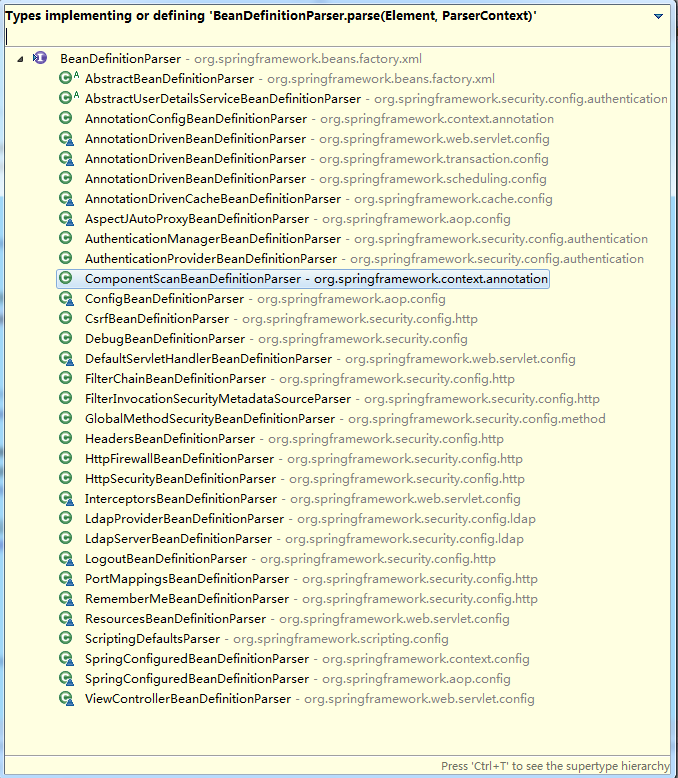
在上面的BeanDefinitionParser中的parse,有很多种BeanDefinitionParser对其进行解析,BeanDefinitionParser接口就定义了一个BeanDefinition parse(Element element, ParserContext parserContext);专业用来解析bean的,具体的实现交给他的具体。结构如下图:
我们来看下这个ComponentScanBeanDefinitionParser
public class ComponentScanBeanDefinitionParser implements BeanDefinitionParser {

    //这两个是我们常用的属性配置 当然还有别的

    private static final String ANNOTATION_CONFIG_ATTRIBUTE = "annotation-config";

    private static final String BASE_PACKAGE_ATTRIBUTE = "base-package";

    ...

    //这里就是他解析的地方了

    public BeanDefinition parse(Element element, ParserContext parserContext) {

        String[] basePackages = StringUtils.tokenizeToStringArray(element.getAttribute(BASE_PACKAGE_ATTRIBUTE),

                ConfigurableApplicationContext.CONFIG_LOCATION_DELIMITERS);

        // Actually scan for bean definitions and register them.

        ClassPathBeanDefinitionScanner scanner = configureScanner(parserContext, element);

        //得到ClassPathBeanDefinitionScanner,通过它去扫描包中的类文件,注意:这里是类文件而不是类,因为现在这些类还没有被加载,只是ClassLoader能找到这些class的路径而已。

        Set<BeanDefinitionHolder> beanDefinitions = scanner.doScan(basePackages);

        registerComponents(parserContext.getReaderContext(), beanDefinitions, element);

        return null;

    }

        ...

}
第十六步:再来看看ClassPathBeanDefinitionScanner的doScan方法
protected Set<BeanDefinitionHolder> doScan(String... basePackages) {

        Assert.notEmpty(basePackages, "At least one base package must be specified");

        //用来保存BeanDefinitionHolder,即Bean的属性

        Set<BeanDefinitionHolder> beanDefinitions = new LinkedHashSet<BeanDefinitionHolder>();

        for (String basePackage : basePackages) {

            //得到扫描出来的类

            Set<BeanDefinition> candidates = findCandidateComponents(basePackage);

            //得到扫描出来的类后,把他加进beanDefinitions中

            for (BeanDefinition candidate : candidates) {

                ScopeMetadata scopeMetadata = this.scopeMetadataResolver.resolveScopeMetadata(candidate);

                candidate.setScope(scopeMetadata.getScopeName());

                String beanName = this.beanNameGenerator.generateBeanName(candidate, this.registry);

                if (candidate instanceof AbstractBeanDefinition) {

                    postProcessBeanDefinition((AbstractBeanDefinition) candidate, beanName);

                }

                if (candidate instanceof AnnotatedBeanDefinition) {

                    AnnotationConfigUtils.processCommonDefinitionAnnotations((AnnotatedBeanDefinition) candidate);

                }

                if (checkCandidate(beanName, candidate)) {

                    BeanDefinitionHolder definitionHolder = new BeanDefinitionHolder(candidate, beanName);

                    definitionHolder = AnnotationConfigUtils.applyScopedProxyMode(scopeMetadata, definitionHolder, this.registry);

                    beanDefinitions.add(definitionHolder);

                    registerBeanDefinition(definitionHolder, this.registry);

                }

            }

        }

        return beanDefinitions;

}
第十七:ClassPathScanningCandidateComponentProvider的findCandidateComponents方法
public class ClassPathScanningCandidateComponentProvider implements EnvironmentCapable, ResourceLoaderAware {

static final String DEFAULT_RESOURCE_PATTERN = "**/*.class";

private ResourcePatternResolver resourcePatternResolver = new PathMatchingResourcePatternResolver();

public Set<BeanDefinition> findCandidateComponents(String basePackage) {

        //创建一个candidates,用来保存BeanDefinition

        Set<BeanDefinition> candidates = new LinkedHashSet<BeanDefinition>();

        try {

            String packageSearchPath = ResourcePatternResolver.CLASSPATH_ALL_URL_PREFIX +

                    resolveBasePackage(basePackage) + "/" + this.resourcePattern;

            Resource[] resources = this.resourcePatternResolver.getResources(packageSearchPath);

            boolean traceEnabled = logger.isTraceEnabled();

            boolean debugEnabled = logger.isDebugEnabled();

            for (Resource resource : resources) {

                if (traceEnabled) {

                    logger.trace("Scanning " + resource);

                }

                if (resource.isReadable()) {

                    try {

                        MetadataReader metadataReader = this.metadataReaderFactory.getMetadataReader(resource);

                        if (isCandidateComponent(metadataReader)) {

                            //封装一个ScannedGenericBeanDefinition,并设置属性,然后添加进candidates中。

                            ScannedGenericBeanDefinition sbd = new ScannedGenericBeanDefinition(metadataReader);

                            sbd.setResource(resource);

                            sbd.setSource(resource);

                            if (isCandidateComponent(sbd)) {

                                if (debugEnabled) {

                                    logger.debug("Identified candidate component class: " + resource);

                                }

                                candidates.add(sbd);

                            }

                            else {

                                if (debugEnabled) {

                                    logger.debug("Ignored because not a concrete top-level class: " + resource);

                                }

                            }

                        }

                        else {

                            if (traceEnabled) {

                                logger.trace("Ignored because not matching any filter: " + resource);

                            }

                        }

                    }

                    catch (Throwable ex) {

                        throw new BeanDefinitionStoreException(

                                "Failed to read candidate component class: " + resource, ex);

                    }

                }

                else {

                    if (traceEnabled) {

                        logger.trace("Ignored because not readable: " + resource);

                    }

                }

            }

        }

        catch (IOException ex) {

            throw new BeanDefinitionStoreException("I/O failure during classpath scanning", ex);

        }

        return candidates;

    }

}
来看这两句:
String packageSearchPath = ResourcePatternResolver.CLASSPATH_ALL_URL_PREFIX + resolveBasePackage(basePackage) + "/" + this.resourcePattern;
假设我们配置的需要扫描的包名为com.cengle.service,那么packageSearchPath的值就是classpath*:com.cengle.service/**/*.class,意思就是com.cengle.service包(包括子包)下所有class文件;如果配置的是*,那么packageSearchPath的值就是classpath*:*/**/*.class。这里的表达式是Spring自己定义的。Spring会根据这种表达式找出相关的class文件。
Resource[] resources = this.resourcePatternResolver.getResources(packageSearchPath);
这些资源是怎么得到的。看下面:
    public Resource[] getResources(String locationPattern) throws IOException {

        Assert.notNull(locationPattern, "Location pattern must not be null");

        //判断是否以classpath*:开头

        if (locationPattern.startsWith(CLASSPATH_ALL_URL_PREFIX)) {

            // a class path resource (multiple resources for same name possible)

            //判断多个资源是否有相同的名称

            if (getPathMatcher().isPattern(locationPattern.substring(CLASSPATH_ALL_URL_PREFIX.length()))) {

                // a class path resource pattern

                //得到类路径的资源模式

                return findPathMatchingResources(locationPattern);

            }

            else {

                // all class path resources with the given name

                //得到所有的类路径资源名字

                return findAllClassPathResources(locationPattern.substring(CLASSPATH_ALL_URL_PREFIX.length()));

            }

        }

        else {

            // Only look for a pattern after a prefix here

            // (to not get fooled by a pattern symbol in a strange prefix).

            int prefixEnd = locationPattern.indexOf(":") + 1;

            if (getPathMatcher().isPattern(locationPattern.substring(prefixEnd))) {

                // a file pattern

                //得到文件模式

                return findPathMatchingResources(locationPattern);

            }

            else {

                // a single resource with the given name

                //得到一个给定名称的资源

                return new Resource[] {getResourceLoader().getResource(locationPattern)};

            }

        }

    }

    /**

     * Find all class location resources with the given location via the ClassLoader.

     * @param location the absolute path within the classpath

     * @return the result as Resource array

     * @throws IOException in case of I/O errors

     * @see java.lang.ClassLoader#getResources

     * @see #convertClassLoaderURL

     */

    protected Resource[] findAllClassPathResources(String location) throws IOException {

        String path = location;

        if (path.startsWith("/")) {

            path = path.substring(1);

        }

        //根据路径,将资源存进一个迭代器中

        Enumeration<URL> resourceUrls = getClassLoader().getResources(path);

        Set<Resource> result = new LinkedHashSet<Resource>(16);

        while (resourceUrls.hasMoreElements()) {

            URL url = resourceUrls.nextElement();

            //将迭代器的元素存进set集合中

            result.add(convertClassLoaderURL(url));

        }

        //将集合转化为数组

        return result.toArray(new Resource[result.size()]);

    }

    protected Resource[] findPathMatchingResources(String locationPattern) throws IOException {

        String rootDirPath = determineRootDir(locationPattern);

        String subPattern = locationPattern.substring(rootDirPath.length());

        //根据路径,得到一个资源数组

        Resource[] rootDirResources = getResources(rootDirPath);

        Set<Resource> result = new LinkedHashSet<Resource>(16);

        //循环数组,将数组元素放进一个set集合中。

        for (Resource rootDirResource : rootDirResources) {

            rootDirResource = resolveRootDirResource(rootDirResource);

            if (isJarResource(rootDirResource)) {

                result.addAll(doFindPathMatchingJarResources(rootDirResource, subPattern));

            }

            else if (rootDirResource.getURL().getProtocol().startsWith(ResourceUtils.URL_PROTOCOL_VFS)) {

                result.addAll(VfsResourceMatchingDelegate.findMatchingResources(rootDirResource, subPattern, getPathMatcher()));

            }

            else {

                result.addAll(doFindPathMatchingFileResources(rootDirResource, subPattern));

            }

        }

        if (logger.isDebugEnabled()) {

            logger.debug("Resolved location pattern [" + locationPattern + "] to resources " + result);

        }

        //将集合转化为数组

        return result.toArray(new Resource[result.size()]);

    }
Spring也是用的ClassLoader加载的class文件。一路追踪,原始的ClassLoader是Thread.currentThread().getContextClassLoader();。到此为止,就拿到class文件了。
Spring会将class信息封装成BeanDefinition,然后再放进DefaultListableBeanFactory的beanDefinitionMap中。
spring容器启动的加载过程(三)的更多相关文章
- spring容器启动的加载过程(一)
使用spring,我们在web.xml都会配置ContextLoaderListener <listener> <listener-class> org.springframe ...
- spring容器启动的加载过程(二)
第六步: public abstract class AbstractApplicationContext extends DefaultResourceLoader implements Confi ...
- 微服务架构 | *2.3 Spring Cloud 启动及加载配置文件源码分析(以 Nacos 为例)
目录 前言 1. Spring Cloud 什么时候加载配置文件 2. 准备 Environment 配置环境 2.1 配置 Environment 环境 SpringApplication.prep ...
- 1. spring5源码 -- Spring整体脉络 IOC加载过程 Bean的生命周期
可以学习到什么? 0. spring整体脉络 1. 描述BeanFactory 2. BeanFactory和ApplicationContext的区别 3. 简述SpringIoC的加载过程 4. ...
- 启动就加载(三)initializingbean实现afterPropertiesSet方法
TransactionTemplate,就直接以TransactionTemplate为入口开始学习. TransactionTemplate的源码如下: public class Transacti ...
- Tomcat源码分析三:Tomcat启动加载过程(一)的源码解析
Tomcat启动加载过程(一)的源码解析 今天,我将分享用源码的方式讲解Tomcat启动的加载过程,关于Tomcat的架构请参阅<Tomcat源码分析二:先看看Tomcat的整体架构>一文 ...
- 深入理解 spring 容器,源码分析加载过程
Spring框架提供了构建Web应用程序的全功能MVC模块,叫Spring MVC,通过Spring Core+Spring MVC即可搭建一套稳定的Java Web项目.本文通过Spring MVC ...
- spring启动component-scan类扫描加载过程(转)
文章转自 http://www.it165.net/pro/html/201406/15205.html 有朋友最近问到了 spring 加载类的过程,尤其是基于 annotation 注解的加载过程 ...
- 【Spring源码分析系列】启动component-scan类扫描加载过程
原文地址:http://blog.csdn.net/xieyuooo/article/details/9089441/ 在spring 3.0以上大家都一般会配置一个Servelet,如下所示: &l ...
随机推荐
- 在tableview的headerView中添加webView,webView自适应高度
最近在项目中需要添加一个webView加载的页面,下面显示的是对这个webView所显示的内容的一个评论列表 ,列表要根据后台加载过来的HTML自适应的变化高度,tableview的cell在webV ...
- CodeForces 659F Polycarp and Hay
并查集,$dfs$. 从大的数字往里加,每加一个数字合并一下连通块,判断连通块内数字个数是否够,以及k能不能被当前加入的数字整除.然后$dfs$一下构造答案. #pragma comment(link ...
- USACO 3.2 Factorials
Factorials The factorial of an integer N, written N!, is the product of all the integers from 1 thro ...
- 一篇顺手的Ubuntu+caffe配置笔记
主要参考: https://github.com/lbzhang/dl-setup http://ouxinyu.github.io/Blogs/20151108001.html http://www ...
- jvm原理及调优
一.java内存管理及垃圾回收 jvm内存组成结构 jvm栈由堆.栈.本地方法栈.方法区等部分组成,结构图如下所示: (1)堆 所有通过new创建的对象的内存都在堆中分配,堆的大小可以通过-Xmx和- ...
- Tiny6410之控制icache驱动
什么是cache: 基于程序访问的局限性,在主存和CPU通用寄存器之间设置了一类高速的.容量较小的存储器,把正在执行的指令地址附件的一部分指令或数据从主存调入这类存储器,供CPU 在一段时间内使 ...
- oracle查询排序后的前几条记录
select * from (select * from table order by 字段名 desc) where rownum<你要查的记录条数,这样才能符合条件.
- $.ajax()方法详解 jquery中的ajax方法
jquery中的ajax方法参数总是记不住,这里记录一下. 1.url: 要求为String类型的参数,(默认为当前页地址)发送请求的地址. 2.type: 要求为String类型的参数,请求方式(p ...
- HDU 3294 Girls' research
题目地址 manacher #include<cstdio> #include<string.h> #include<algorithm> using namesp ...
- 利用flashBack恢复误删除(delete)的表数据
Flashback query(闪回查询)原理 Oracle根据undo信息,利用undo数据,类似一致性读取方法,可以把表置于一个删除前的时间点(或SCN),从而将数据找回. Flashback q ...