
ASCII 码对应表
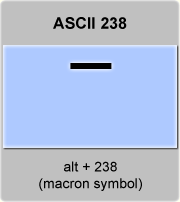
Macron symbol
ASCII CODE 238 :
HTML entity :
What is my IP address ?
your public IP address is:
118.163.184.243
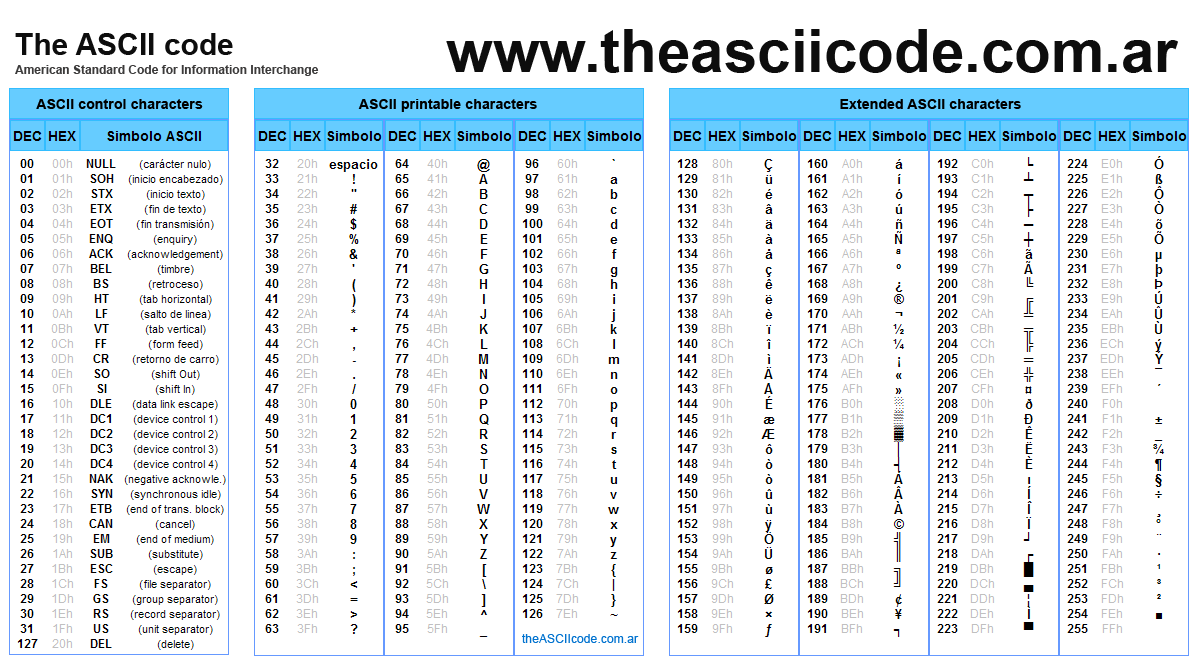
ASCII control characters
ASCII printable
characters
Extended ASCII
characters
most consulted
frequently-used
(spanish language)
vowels acute accent
(spanish language)
vowels with
diaresis
mathematical
symbols
commercial / trade
symbols
quotes and
parenthesis
Brief History of ASCII code:
The American Standard Code for Information Interchange, or ASCII code, was created in 1963 by the "American Standards Association" Committee or "ASA", the agency changed its name in 1969 by "American National Standards Institute" or "ANSI" as it is known since.
This code arises from reorder and expand the set of symbols and characters already used in telegraphy at that time by the Bell company.
At first only included capital letters and numbers , but in 1967 was added the lowercase letters and some control characters, forming what is known as US-ASCII, ie the characters 0 through 127.
So with this set of only 128 characters was published in 1967 as standard, containing all you need to write in English language.
In 1981, IBM developed an extension of 8-bit ASCII code, called "code page 437", in this version were replaced some obsolete control characters for graphic characters. Also 128 characters were added , with new symbols, signs, graphics and latin letters, all punctuation signs and characters needed to write texts in other languages, such as Spanish.
In this way was added the ASCII characters ranging from 128 to 255.
IBM includes support for this code page in the hardware of its model 5150, known as "IBM-PC", considered the first personal computer.
The operating system of this model, the "MS-DOS" also used this extended ASCII code.
Almost all computer systems today use the ASCII code to represent characters and texts. (329) .
How to use the ASCII code:
Without knowing it you use it all the time, every time you use a computer system, but if all you need is to get some of the characters not included in your keyboard should do the following, for example:
How typing: Macron symbol ?
WINDOWS: on computers with Windows operating system like Windows 8, Win 7, Vista, Windows XP, etc..
To get the letter, character, sign or symbol "¯" : ( Macron symbol ) on computers with Windows operating system:
1) Press the "Alt" key on your keyboard, and do not let go.
2) While keep press "Alt", on your keyboard type the number "238", which is the number of the letter or symbol "¯" in ASCII table.
3) Then stop pressing the "Alt" key, and ...you got it! (330)
Full list of ASCII characters, letters, symbols and signs with descriptions:
ASCII control characters non printable :
ASCII code 00 = NULL ( Null character )
ASCII code 01 = SOH ( Start of Header )
ASCII code 02 = STX ( Start of Text )
ASCII code 03 = ETX ( End of Text, hearts card suit )
ASCII code 04 = EOT ( End of Transmission, diamonds card suit )
ASCII code 05 = ENQ ( Enquiry, clubs card suit )
ASCII code 06 = ACK ( Acknowledgement, spade card suit )
ASCII code 07 = BEL ( Bell )
ASCII code 08 = BS ( Backspace )
ASCII code 09 = HT ( Horizontal Tab )
ASCII code 10 = LF ( Line feed )
ASCII code 11 = VT ( Vertical Tab, male symbol, symbol for Mars )
ASCII code 12 = FF ( Form feed, female symbol, symbol for Venus )
ASCII code 13 = CR ( Carriage return )
ASCII code 14 = SO ( Shift Out )
ASCII code 15 = SI ( Shift In )
ASCII code 16 = DLE ( Data link escape )
ASCII code 17 = DC1 ( Device control 1 )
ASCII code 18 = DC2 ( Device control 2 )
ASCII code 19 = DC3 ( Device control 3 )
ASCII code 20 = DC4 ( Device control 4 )
ASCII code 21 = NAK ( NAK Negative-acknowledge )
ASCII code 22 = SYN ( Synchronous idle )
ASCII code 23 = ETB ( End of trans. block )
ASCII code 24 = CAN ( Cancel )
ASCII code 25 = EM ( End of medium )
ASCII code 26 = SUB ( Substitute )
ASCII code 27 = ESC ( Escape )
ASCII code 28 = FS ( File separator )
ASCII code 29 = GS ( Group separator )
ASCII code 30 = RS ( Record separator )
ASCII code 31 = US ( Unit separator )
ASCII code 127 = DEL ( Delete )
Printable ASCII characters :
( alphanumeric, symbols and signs )
ASCII code 32 = space ( Space )
ASCII code 33 = ! ( Exclamation mark )
ASCII code 34 = " ( Double quotes ; Quotation mark ; speech marks )
ASCII code 35 = # ( Number sign )
ASCII code 36 = $ ( Dollar sign )
ASCII code 37 = % ( Percent sign )
ASCII code 38 = & ( Ampersand )
ASCII code 39 = ' ( Single quote or Apostrophe )
ASCII code 40 = ( ( round brackets or parentheses, opening round bracket )
ASCII code 41 = ) ( parentheses or round brackets, closing parentheses )
ASCII code 42 = * ( Asterisk )
ASCII code 43 = + ( Plus sign )
ASCII code 44 = , ( Comma )
ASCII code 45 = - ( Hyphen , minus sign )
ASCII code 46 = . ( Dot, full stop )
ASCII code 47 = / ( Slash , forward slash , fraction bar , division slash )
ASCII code 48 = 0 ( number zero )
ASCII code 49 = 1 ( number one )
ASCII code 50 = 2 ( number two )
ASCII code 51 = 3 ( number three )
ASCII code 52 = 4 ( number four )
ASCII code 53 = 5 ( number five )
ASCII code 54 = 6 ( number six )
ASCII code 55 = 7 ( number seven )
ASCII code 56 = 8 ( number eight )
ASCII code 57 = 9 ( number nine )
ASCII code 58 = : ( Colon )
ASCII code 59 = ; ( Semicolon )
ASCII code 60 = < ( Less-than sign )
ASCII code 61 = = ( Equals sign )
ASCII code 62 = > ( Greater-than sign ; Inequality )
ASCII code 63 = ? ( Question mark )
ASCII code 64 = @ ( At sign )
ASCII code 65 = A ( Capital letter A )
ASCII code 66 = B ( Capital letter B )
ASCII code 67 = C ( Capital letter C )
ASCII code 68 = D ( Capital letter D )
ASCII code 69 = E ( Capital letter E )
ASCII code 70 = F ( Capital letter F )
ASCII code 71 = G ( Capital letter G )
ASCII code 72 = H ( Capital letter H )
ASCII code 73 = I ( Capital letter I )
ASCII code 74 = J ( Capital letter J )
ASCII code 75 = K ( Capital letter K )
ASCII code 76 = L ( Capital letter L )
ASCII code 77 = M ( Capital letter M )
ASCII code 78 = N ( Capital letter N )
ASCII code 79 = O ( Capital letter O )
ASCII code 80 = P ( Capital letter P )
ASCII code 81 = Q ( Capital letter Q )
ASCII code 82 = R ( Capital letter R )
ASCII code 83 = S ( Capital letter S )
ASCII code 84 = T ( Capital letter T )
ASCII code 85 = U ( Capital letter U )
ASCII code 86 = V ( Capital letter V )
ASCII code 87 = W ( Capital letter W )
ASCII code 88 = X ( Capital letter X )
ASCII code 89 = Y ( Capital letter Y )
ASCII code 90 = Z ( Capital letter Z )
ASCII code 91 = [ ( square brackets or box brackets, opening bracket )
ASCII code 92 = \ ( Backslash , reverse slash )
ASCII code 93 = ] ( box brackets or square brackets, closing bracket )
ASCII code 94 = ^ ( Circumflex accent or Caret )
ASCII code 95 = _ ( underscore , understrike , underbar or low line )
ASCII code 96 = ` ( Grave accent )
ASCII code 97 = a ( Lowercase letter a , minuscule a )
ASCII code 98 = b ( Lowercase letter b , minuscule b )
ASCII code 99 = c ( Lowercase letter c , minuscule c )
ASCII code 100 = d ( Lowercase letter d , minuscule d )
ASCII code 101 = e ( Lowercase letter e , minuscule e )
ASCII code 102 = f ( Lowercase letter f , minuscule f )
ASCII code 103 = g ( Lowercase letter g , minuscule g )
ASCII code 104 = h ( Lowercase letter h , minuscule h )
ASCII code 105 = i ( Lowercase letter i , minuscule i )
ASCII code 106 = j ( Lowercase letter j , minuscule j )
ASCII code 107 = k ( Lowercase letter k , minuscule k )
ASCII code 108 = l ( Lowercase letter l , minuscule l )
ASCII code 109 = m ( Lowercase letter m , minuscule m )
ASCII code 110 = n ( Lowercase letter n , minuscule n )
ASCII code 111 = o ( Lowercase letter o , minuscule o )
ASCII code 112 = p ( Lowercase letter p , minuscule p )
ASCII code 113 = q ( Lowercase letter q , minuscule q )
ASCII code 114 = r ( Lowercase letter r , minuscule r )
ASCII code 115 = s ( Lowercase letter s , minuscule s )
ASCII code 116 = t ( Lowercase letter t , minuscule t )
ASCII code 117 = u ( Lowercase letter u , minuscule u )
ASCII code 118 = v ( Lowercase letter v , minuscule v )
ASCII code 119 = w ( Lowercase letter w , minuscule w )
ASCII code 120 = x ( Lowercase letter x , minuscule x )
ASCII code 121 = y ( Lowercase letter y , minuscule y )
ASCII code 122 = z ( Lowercase letter z , minuscule z )
ASCII code 123 = { ( braces or curly brackets, opening braces )
ASCII code 124 = | ( vertical-bar, vbar, vertical line or vertical slash )
ASCII code 125 = } ( curly brackets or braces, closing curly brackets )
ASCII code 126 = ~ ( Tilde ; swung dash )
ASCII Extended Characters :
ASCII code 128 = Ç ( Majuscule C-cedilla )
ASCII code 129 = ü ( letter u with umlaut or diaeresis , u-umlaut )
ASCII code 130 = é ( letter e with acute accent or e-acute )
ASCII code 131 = â ( letter a with circumflex accent or a-circumflex )
ASCII code 132 = ä ( letter a with umlaut or diaeresis , a-umlaut )
ASCII code 133 = à ( letter a with grave accent )
ASCII code 134 = å ( letter a with a ring )
ASCII code 135 = ç ( Minuscule c-cedilla )
ASCII code 136 = ê ( letter e with circumflex accent or e-circumflex )
ASCII code 137 = ë ( letter e with umlaut or diaeresis ; e-umlauts )
ASCII code 138 = è ( letter e with grave accent )
ASCII code 139 = ï ( letter i with umlaut or diaeresis ; i-umlaut )
ASCII code 140 = î ( letter i with circumflex accent or i-circumflex )
ASCII code 141 = ì ( letter i with grave accent )
ASCII code 142 = Ä ( letter A with umlaut or diaeresis ; A-umlaut )
ASCII code 143 = Å ( Capital letter A with a ring )
ASCII code 144 = É ( Capital letter E with acute accent or E-acute )
ASCII code 145 = æ ( Latin diphthong ae in lowercase )
ASCII code 146 = Æ ( Latin diphthong AE in uppercase )
ASCII code 147 = ô ( letter o with circumflex accent or o-circumflex )
ASCII code 148 = ö ( letter o with umlaut or diaeresis ; o-umlaut )
ASCII code 149 = ò ( letter o with grave accent )
ASCII code 150 = û ( letter u with circumflex accent or u-circumflex )
ASCII code 151 = ù ( letter u with grave accent )
ASCII code 152 = ÿ ( Lowercase letter y with diaeresis )
ASCII code 153 = Ö ( Letter O with umlaut or diaeresis ; O-umlaut )
ASCII code 154 = Ü ( Letter U with umlaut or diaeresis ; U-umlaut )
ASCII code 155 = ø ( Lowercase slashed zero or empty set )
ASCII code 156 = £ ( Pound sign ; symbol for the pound sterling )
ASCII code 157 = Ø ( Uppercase slashed zero or empty set )
ASCII code 158 = × ( Multiplication sign )
ASCII code 159 = ƒ ( Function sign ; f with hook sign ; florin sign )
ASCII code 160 = á ( Lowercase letter a with acute accent or a-acute )
ASCII code 161 = í ( Lowercase letter i with acute accent or i-acute )
ASCII code 162 = ó ( Lowercase letter o with acute accent or o-acute )
ASCII code 163 = ú ( Lowercase letter u with acute accent or u-acute )
ASCII code 164 = ñ ( eñe, enie, spanish letter enye, lowercase n with tilde )
ASCII code 165 = Ñ ( Spanish letter enye, uppercase N with tilde, EÑE, enie )
ASCII code 166 = ª ( feminine ordinal indicator )
ASCII code 167 = º ( masculine ordinal indicator )
ASCII code 168 = ¿ ( Inverted question marks )
ASCII code 169 = ® ( Registered trademark symbol )
ASCII code 170 = ¬ ( Logical negation symbol )
ASCII code 171 = ½ ( One half )
ASCII code 172 = ¼ ( Quarter, one fourth )
ASCII code 173 = ¡ ( Inverted exclamation marks )
ASCII code 174 = « ( Angle quotes, guillemets, right-pointing quotation mark )
ASCII code 175 = » ( Guillemets, angle quotes, left-pointing quotation marks )
ASCII code 176 = ░ ( Graphic character, low density dotted )
ASCII code 177 = ▒ ( Graphic character, medium density dotted )
ASCII code 178 = ▓ ( Graphic character, high density dotted )
ASCII code 179 = │ ( Box drawing character single vertical line )
ASCII code 180 = ┤ ( Box drawing character single vertical and left line )
ASCII code 181 = Á ( Capital letter A with acute accent or A-acute )
ASCII code 182 = Â ( Letter A with circumflex accent or A-circumflex )
ASCII code 183 = À ( Letter A with grave accent )
ASCII code 184 = © ( Copyright symbol )
ASCII code 185 = ╣ ( Box drawing character double line vertical and left )
ASCII code 186 = ║ ( Box drawing character double vertical line )
ASCII code 187 = ╗ ( Box drawing character double line upper right corner )
ASCII code 188 = ╝ ( Box drawing character double line lower right corner )
ASCII code 189 = ¢ ( Cent symbol )
ASCII code 190 = ¥ ( YEN and YUAN sign )
ASCII code 191 = ┐ ( Box drawing character single line upper right corner )
ASCII code 192 = └ ( Box drawing character single line lower left corner )
ASCII code 193 = ┴ ( Box drawing character single line horizontal and up )
ASCII code 194 = ┬ ( Box drawing character single line horizontal down )
ASCII code 195 = ├ ( Box drawing character single line vertical and right )
ASCII code 196 = ─ ( Box drawing character single horizontal line )
ASCII code 197 = ┼ ( Box drawing character single line horizontal vertical )
ASCII code 198 = ã ( Lowercase letter a with tilde or a-tilde )
ASCII code 199 = Ã ( Capital letter A with tilde or A-tilde )
ASCII code 200 = ╚ ( Box drawing character double line lower left corner )
ASCII code 201 = ╔ ( Box drawing character double line upper left corner )
ASCII code 202 = ╩ ( Box drawing character double line horizontal and up )
ASCII code 203 = ╦ ( Box drawing character double line horizontal down )
ASCII code 204 = ╠ ( Box drawing character double line vertical and right )
ASCII code 205 = ═ ( Box drawing character double horizontal line )
ASCII code 206 = ╬ ( Box drawing character double line horizontal vertical )
ASCII code 207 = ¤ ( Generic currency sign )
ASCII code 208 = ð ( Lowercase letter eth )
ASCII code 209 = Ð ( Capital letter Eth )
ASCII code 210 = Ê ( Letter E with circumflex accent or E-circumflex )
ASCII code 211 = Ë ( Letter E with umlaut or diaeresis, E-umlaut )
ASCII code 212 = È ( Capital letter E with grave accent )
ASCII code 213 = ı ( Lowercase dot less i )
ASCII code 214 = Í ( Capital letter I with acute accent or I-acute )
ASCII code 215 = Î ( Letter I with circumflex accent or I-circumflex )
ASCII code 216 = Ï ( Letter I with umlaut or diaeresis ; I-umlaut )
ASCII code 217 = ┘ ( Box drawing character single line lower right corner )
ASCII code 218 = ┌ ( Box drawing character single line upper left corner )
ASCII code 219 = █ ( Block, graphic character )
ASCII code 220 = ▄ ( Bottom half block )
ASCII code 221 = ¦ ( Vertical broken bar )
ASCII code 222 = Ì ( Capital letter I with grave accent )
ASCII code 223 = ▀ ( Top half block )
ASCII code 224 = Ó ( Capital letter O with acute accent or O-acute )
ASCII code 225 = ß ( Letter Eszett ; scharfes S or sharp S )
ASCII code 226 = Ô ( Letter O with circumflex accent or O-circumflex )
ASCII code 227 = Ò ( Capital letter O with grave accent )
ASCII code 228 = õ ( Lowercase letter o with tilde or o-tilde )
ASCII code 229 = Õ ( Capital letter O with tilde or O-tilde )
ASCII code 230 = µ ( Lowercase letter Mu ; micro sign or micron )
ASCII code 231 = þ ( Lowercase letter Thorn )
ASCII code 232 = Þ ( Capital letter Thorn )
ASCII code 233 = Ú ( Capital letter U with acute accent or U-acute )
ASCII code 234 = Û ( Letter U with circumflex accent or U-circumflex )
ASCII code 235 = Ù ( Capital letter U with grave accent )
ASCII code 236 = ý ( Lowercase letter y with acute accent )
ASCII code 237 = Ý ( Capital letter Y with acute accent )
ASCII code 238 = ¯ ( Macron symbol )
( HTML entity = ¯ )ASCII code 239 = ´ ( Acute accent )
ASCII code 240 = ≡ ( Congruence relation symbol )
ASCII code 241 = ± ( Plus-minus sign )
ASCII code 242 = ‗ ( underline or underscore )
ASCII code 243 = ¾ ( three quarters, three-fourths )
ASCII code 244 = ¶ ( Paragraph sign or pilcrow ; end paragraph mark )
ASCII code 245 = § ( Section sign )
ASCII code 246 = ÷ ( The division sign ; Obelus )
ASCII code 247 = ¸ ( cedilla )
ASCII code 248 = ° ( Degree symbol )
ASCII code 249 = ¨ ( Diaresis )
ASCII code 250 = · ( Interpunct or space dot )
ASCII code 251 = ¹ ( Superscript one, exponent 1, first power )
ASCII code 252 = ³ ( Superscript three, exponent 3, cube, third power )
ASCII code 253 = ² ( Superscript two, exponent 2, square, second power )
ASCII code 254 = ■ ( black square )
ASCII code 255 = nbsp ( Non-breaking space or no-break space )
Keywords for this page - ASCII code Macron symbol : ¯
How to type or write ASCII code Macron symbol, ¯ macron, symbol,ascii,238, ascii art, ascii table, code ascii, ascii character, ascii text, ascii chart, ascii characters, ascii codes, characters, codes, tables, symbols, list, alt, keys, keyboard, spelling, control, printable, extended, letters, epistles, handwriting, scripts, lettering, majuscules, capitals, minuscules, lower, case, small, acute, accent, sharp, engrave, diaresis, circumflex, tilde, cedilla, anillo, circlet, eñe, enie, arroba, pound, sterling, cent, type, write, spell, spanish, english, notebooks, laptops, ascii, asci, asccii, asqui, askii, aski, aschi, aschii, (331) .
ASCII 码对应表的更多相关文章
- (转) ASCII码对应表chr(9)、chr(10)、chr(13)、chr(32)、chr(34)、chr(39)、chr(
chr(9) tab空格 chr(10) 换行 chr(13) 回车 Chr(13)&chr(10) 回车换行 chr(32) 空格符 ...
- ASCII码对应表
chr(9) tab空格 chr(10) 换行 chr(13) 回车 Chr(13)&chr(10) 回车换行 chr(32) 空格符 ...
- ASCII码对应表chr(num)
chr(9) tab空格 chr(10) 换行 chr(13) 回车 Chr(13)&chr(10) 回车换行 chr(32) 空格符 ...
- ASCII码对应表chr(9)、chr(10)、chr(13)、chr(32)、chr(34)、chr(39)
chr(9) tab空格 chr(10) 换行 chr(13) 回车 Chr(13)&chr(10) 回车换行 chr(32) 空格符 ...
- ASCII码对应表chr(9)、chr(10)、chr(13)、chr(32)、chr(34)、chr(39)、chr(..
chr(9) tab空格 chr(10) 换行 chr(13) 回车 Chr(13)&chr(10) 回车换行 chr(32) 空格符 ...
- Oracle学习笔记:ASCII码转换(chr和ascii函数)
今天get到一个骚操作,通过ascii码转换之后来进行互换编码的. select chr(ascii('f') + ascii('m') - ascii('a')) from dual; 有必要对as ...
- 扩展ASCII码,不同的国家有不同的字符集。Unicode转换为utf8的规则,utf8没有大小端的问题。超过0xFFFF的Unicode字符WINAPI也无能为力(附各种字符编码表及转换表)good
一.概念 1,ASCII ASCII(American Standard Code for Information Interchange),中文名称为美国信息交换标准代码.是 ...
- php与ascii码
首先 简单说一下历史,ascii码最开始是美国人搞出来的,用来干什么呢?我们知道,计算机只知道0和1,如果我们要计算机识别除了01之外的字符,例如 'a',我们要先告诉计算机‘1100001’就是'a ...
- 实现textarea限制输入字数(包含中文只能输入10个,全ASCII码能够输入20个)
document.getElementById("<%=textBox1.ClientID %>").value 实现textarea限制输入字数(包含中文只能输入10 ...
随机推荐
- JQuery选择所有标题的元素
$(":header") 参考:http://www.w3school.com.cn/jquery/selector_header.asp
- Android Studio的使用(八)--// TODO代码
我们都知道Eclipse存在// TODO代码,该段代码在方法中用于标识该方法仍未完成,也可以用于作为该方法的一个快捷键.例如我们可以用于标识onClick()方法,当我们需要查找onClick()方 ...
- ubuntu下如何安装及使用 pysvn-workbench
网上对于 pysvn-workbench 的教程几乎没有,没办法,只好去官网自学了,现在能正常上传资料了,写点东西,以免今后忘了 安装方面:在新立得中查找svn-workbench,subversio ...
- javascript之定义函数时 this 和prototype区别
注:原文 http://www.2cto.com/kf/201406/307790.html 这里作为学习,写在这里 在面向对象的方式编写js脚本时,定义实例的方法主要有两种:this.XXX = f ...
- java代码如何发送QQ邮件
近来想写一个qq之间互相发送邮件的工具.奈何一直报错服务错误: org.apache.commons.mail.EmailException: Sending the email to the fol ...
- Fiddler 教程 转自小坦克
-- 此文章是转载小坦克的;直接复制文章的目的是因为原文章地址经常被重置,找不到原来的文章.小坦克博客园主页:https://home.cnblogs.com/u/TankXiao/ 目录 Fiddl ...
- sql server 2008 把远程的数据库的数据转移到本地数据数据库里
如题:把远程的数据库对应表里的数据转移到本地数据数据库的对应表里 比如把192.168.188.160的DB的A表的数据转移到本地的DB的A表里 第一步:连接远程服务器前准备 exec sp_addl ...
- Web工程师必备的43款可视化工具
国外站点DATAVISUALIZATION.CH为大家总结出了当前热用的43款可视化工具,包括Arbor.Chroma.js.D3.js.Google Chart Tools等,绝对让你一饱眼福. 1 ...
- Super Jumping! Jumping! Jumping! 基础DP
Super Jumping! Jumping! Jumping! Time Limit: 2000/1000 MS (Java/Others) Memory Limit: 65536/32768 ...
- oracle 主键自动增长
oracle 主键自动增长 2009-12-11 16:07:00| 分类: 数据库资料|字号 订阅 这几天搞Oracle,想让表的主键实现自动增长,查网络实现如下: create tabl ...