
IIS Modules Overview
Introduction
The IIS 7 and above Web server feature set is componentized into more than thirty independent modules.
A module is either a Win32 DLL (native module) or a .NET 2.0 type contained within an assembly (managed module).
Similar to a set of building blocks, modules are added to the server in order to provide the desired functionality for your applications.
Likewise, all IIS modules can be removed, or replaced with custom modules developed using the IIS C++ APIs, or the familiar ASP.NET 2.0 APIs.
This article describes common IIS module management tasks,
and details each module including its configuration settings and the potential effect a module removal has on the Web server.
The management examples are given using both the graphical IIS Manager and the AppCmd command line tool.
Prerequisites
首先要安装IIS
Getting Started with Modules
In order to add a module to the server, you must perform two steps:
- Install a module on the server (native modules only).
- Enable the module in an application.
The first step registers the module globally with the server, making it available within each server worker process.
It is necessary only for native modules due to the trusted nature of native code, and is available only to administrators.
Note:
A native module has unrestricted access to any resource available to the server worker process, just like an ISAPI filter or extension in previous versions.
Because of this unrestricted access, you should install only native modules that come from a trusted source.
The second step enables the module to execute within a particular application and effectively allows the application administrator to control the server features enabled for the application.
This step allows both installed native modules and managed modules to be enabled for each application.
To Install a Native Module
In order to install a native module, it must be registered with the server using one of the options below:
- Manually editing the IIS configuration store. In IIS 7.5 and later you can use the Configuration Editor in the IIS Manager.
- Using the IIS Manager
- Using the AppCmd.exe command line tool
All three of these options result in the module entry being added to the <globalModules> IIS configuration section, which can be set only at the server level.
To examine the contents of this section, open the root configuration file located in %windir%\system32\inetsrv\config\applicationhost.config, and search for the string "<globalModules>".
After a full IIS installation, this section contains an entry for each of the native modules shipped with IIS, specifying a name and the path to the module DLL:
<globalModules>

    <addname="DefaultDocumentModule"image="%windir%\system32\inetsrv\defdoc.dll"/>

    <addname="DirectoryListingModule"image="%windir%\system32\inetsrv\dirlist.dll"/>

    <add name="StaticFileModule"image="%windir%\system32\inetsrv\static.dll"/>

    ...

</globalModules>
All of these modules are described in detail later in this document.
在IIS Manager中,按照如下步骤可以找到对应的Modules
1.打开IIS,在Features View中,找到Management,然后打开Configuration Editor

2.在Configuration Editor中,点击Search

3.输入globalModules进行搜索

3.1搜索页面,有两种视图,默认为Hierarchy View,直接显示出所有的config文件

FlatView,直接列出config文件,看起来比较直观,一下子就看到有几个文件
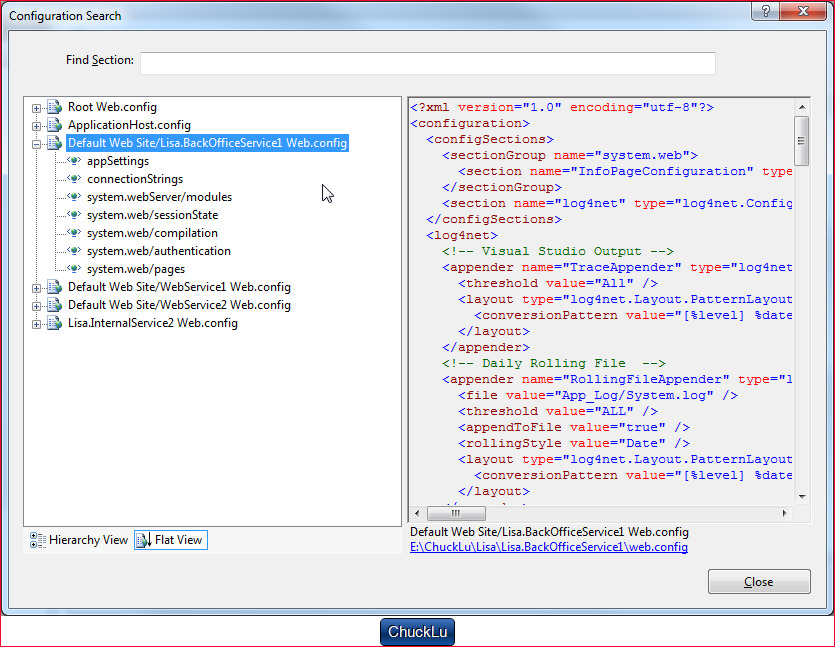
4.在第三步定位到globalModules的位置后,关闭搜索界面
5.在Configuration Editor下的Section中找到globalModules

6.在显示出来的Collection上的空白处点击一下,右侧出现浏览按钮。最右侧还有一个EditItems的按钮

7.找到对应的Module就可以进行remove

8.左侧的导航栏,可以选中Site处理Site的config;处理Application的config,需要单独选中Application,然后再选择Config Editor
Enabling a Module for an Application
A module must be enabled before it can provide service for a particular application. In order to enable a native module, it must first be installed on the server (see the previous section, To Install a Native Module).
A managed module does not require installation, and can be enabled directly for each application. This allows applications to include their managed modules directly within the application by registering them in the application's web.config file, and providing the implementation in /BIN or /App_Code directories.
To enable a module, do one of the following:
- Manually edit the IIS configuration store, either globally to enable the module for all applications on the server, or in a particular web.config file located within each application for which you would like to enable this module. In IIS 7.5 or above you can use the Configuration Editor.
- Use the IIS Manager
- Use the AppCmd.exe command line tool
All three of these options add the module entry to the <modules> IIS configuration section, which is can be set at both the server level and application level. Examine the contents of this section by opening the root configuration file located in %windir%\system32\inetsrv\config\applicationhost.config, and searching for the string "<modules>".
Unlike native modules, a managed module does not require adding an entry to the <globalModules> configuration section.
After a full IIS installation, the configuration section contains an entry for each of the modules (both managed and native) that shipped with IIS. The entry indicates that all these modules are enabled by default for all applications on the server. Each entry in this section specifies either the name of a native module that was previously installed on the server, or the name and .NET type of a managed module:
Preconditions
There is another attribute on a module entry called precondition. The IIS core engine uses preconditions to determine when to enable a particular module.
Performance reasons, for example, might determine that you only want to execute managed modules for requests that also go to a managed handler.
The precondition in the following example (precondition="managedHandler") only enables the forms authentication module for requests that are also handled by a managed handler, such as requests to .aspx or .asmx files:
<addname="FormsAuthentication"type="System.Web.Security.FormsAuthenticationModule" preCondition="managedHandler" />
If you remove the attribute precondition="managedHandler", Forms Authentication also applies to content that is not served by managed handlers, such as .html, .jpg, .doc, but also for classic ASP (.asp) or PHP (.php) extensions.
See "How to Take Advantage of IIS Integrated Pipeline" for an example of enabling ASP.NET modules to run for all content.
You can also use a shortcut to enable all managed (ASP.NET) modules to run for all requests in your application, regardless of the "managedHandler" precondition.
To enable all managed modules to run for all requests without configuring each module entry to remove the "managedHandler" precondition, use the runAllManagedModulesForAllRequests property in the <modules> section:
<modules runAllManagedModulesForAllRequests="true"/>
When you use this property, the "managedHandler" precondition has no effect and all managed modules run for all requests.
https://autofaccn.readthedocs.io/en/latest/integration/webforms.html
 <system.webServer>

    <!-- This section is used for IIS7 -->

    <modules>

      <add

        name="ContainerDisposal"

        type="Autofac.Integration.Web.ContainerDisposalModule, Autofac.Integration.Web"

        preCondition="managedHandler"/>

      <add

        name="PropertyInjection"

        type="Autofac.Integration.Web.Forms.PropertyInjectionModule, Autofac.Integration.Web"

        preCondition="managedHandler"/>

    </modules>

  </system.webServer>
IIS Modules Overview的更多相关文章
- <modules runAllManagedModulesForAllRequests="true" />(转1)
最近在使用 MVC 开发的时候,遇到一个对我来说“奇怪的问题”,就是使用 BundleTable 进行 CSS.JS 文件绑定,然后使用 Styles.Render.Scripts.Render 进行 ...
- 塞翁失马,焉知非福:由 Styles.Render 所引发 runAllManagedModulesForAllRequests="true" 的思考
最近在使用 MVC 开发的时候,遇到一个对我来说"奇怪的问题",就是使用 BundleTable 进行 CSS.JS 文件绑定,然后使用 Styles.Render.Scripts ...
- AspNet Mvc 路由解析中添加.html 等后缀 出现404错误的解决办法
使用Mvc 有时候我们希望,浏览地址以.html .htm 等后缀名进行结尾. 于是我们就在RouteConfig 中修改路由配置信息,修改后的代码如下 routes.IgnoreRoute(&quo ...
- IIS 7.0 的 ASP.NET 应用程序生命周期概述(转载)
IIS 7.0 的 ASP.NET 应用程序生命周期概述更新:2007 年 11 月本主题介绍在 IIS 7.0 集成模式下运行以及与 IIS 7.0 或更高版本一起运行的 ASP.NET 应用程序的 ...
- Install Typical IIS Workloads
原文 Install Typical IIS Workloads Introduction The IIS 7.0 and above modular architecture is designed ...
- Installing IIS 8.5 on Windows Server 2012 R2
原文 Installing IIS 8.5 on Windows Server 2012 R2 Introduction This document describes how to install ...
- Asp.net core 学习笔记 ( IIS, static file 性能优化 )
更新 : 2019-02-06 最后还是把 rewrite 给替换掉了. 所以 rewrite url 也不依赖 iis 了咯. refer : https://docs.microsoft.com/ ...
- NET项目发布到IIS上报错:HTTP 错误 403.14
NET项目发布到IIS上报错:HTTP 错误 404.0 - Not Found 原因:由于本机开发环境是Net4.5,所以虽然创建项目时选择的是net framework4.5的,但是webconf ...
- iis深入学习资源
iis站点:https://www.iis.net/overview/reliability/richdiagnostictools 感兴趣可以深入学习下iis
随机推荐
- 状压DP复习
深感自己姿势水平之蒻……一直都不是很会状压DP,NOIP又特别喜欢考,就来复习一发…… 题目来源 Orz sqzmz T1 [BZOJ4197][NOI2015]寿司晚宴 (做过)质因数分解最大的质因 ...
- GDOI2017 再次酱油记
Day 0 13:00 pm 啊...今天中午一点钟从ez出发,感觉吼有趣啊.出发前先大喊一声****,在书包里放一本党史,感觉玄学可以救命[滑稽] 15:00 pm 到达东莞,坐标:石龙名冠金凯悦大 ...
- angular7升级到angular8
1.首先我们对:angular的命令的安装 ng install -g @angular/cli的安装则会升级到最新的版本,并且再次创建项目的时候,我们就能够使用ng version查看到已经是最新的 ...
- react-native 编译 undefined is not an object (evaluating '_react2.PropTypes.func')
情况通报: 因为是我的二维码模块报错,提示报错代码如下 重要信息是下面的红色字体部分(Android 模拟器红屏) undefined is not an object (evaluating '_r ...
- C/C++中相对路径与绝对路径以及斜杠与反斜杠的区别
1 绝对路径与相对路径 绝对路径表示相对容易得多,依次将文件所在盘符文件夹逐级展开就是绝对路径: ofstream infile("E:\\MyDoc\\file.txt", io ...
- log_archive_min_succeed_dest
博客上.看了一大神的文章:http://blog.csdn.net/msdnchina/article/details/45141427 我表示有疑问:归档日志路径爆满,那么对于开启归档模式的数据库, ...
- 手动配置三大框架整合:Spring+Struts2+mybatis
如今主流的项目框架中,数据库持久层有可能不是hibernate,而是mybatis或者ibatis,事实上它们都是一样的,以下我来把环境搭建一下: [导入相关jar包]新建web项目projectms ...
- bzoj1005: [HNOI2008]明明的烦恼(prufer+高精度)
1005: [HNOI2008]明明的烦恼 题目:传送门 题解: 毒瘤题啊天~ 其实思考的过程还是比较简单的... 首先当然还是要了解好prufer序列的基本性质啦 那么和1211大体一致,主要还是利 ...
- PHP join() 函数
PHP join() 函数 实例 把数组元素组合为一个字符串: <?php $arr = array('Hello','World!','I','love','Shanghai!'); echo ...
- SparkCore基础(一)
* SparkCore基础(一) 学习Spark,首先要熟悉Scala,当然你说你会Python或者Java能不能玩Spark?能!但是不推荐,首推Scala,因为Scala非常便捷,而且Scala有 ...