
Mysql系列六:(Mycat分片路由原理、Mycat常用分片规则及对应源码介绍)
一、Mycat分片路由原理
我们先来看下面的一个SQL在Mycat里面是如何执行的:
select * from travelrecord where id in(5000001, 10000001);
有3个分片dn1,dn2,dn3, id=5000001这条数据在dn2上,id=10000001这条数据在dn3上。
查询时可能有出现的问题:
1)全部扫描一遍dn1 dn2 dn3,结果导致性能浪费。
2)只扫描某个片。漏掉数据的情况。
总结:
不能多扫——>性能不足
也不能少——>漏掉数据
那么Mycat是如何解决上面的问题的呢?
Mycat使用Druid的DruidParser作为分析器/解析器,解析的过程主要有Visitor和Statement两个阶段

说明:
1)Visitor过程,解析出如下属性:
哪一张表
字段列表
条件信息
什么样的SQL
解析出以上信息以后就可以根据schema.xml和rule.xml文件确认要去哪个分片上进行DML操作了
2)Statement过程转化:转化后知道执行的是什么样的SQL(增删改查)
3)改写SQL
通过查询条件可以知道要查询的数据都在哪些分片上
Dn2, id= 5000001
Dn3, id= 100000001
所以SQL被改写成以下的形式:
select * from travelrecord where id = 5000001;(dn2执行)

select * from travelrecord where id = 10000001;(dn3执行)
4)分别在分片dn2,dn3上执行第 3)步改写的SQL,然后把从dn2,dn3上得到的结果进行拼装就是最终的结果了
备注:
多表关联查询的时候,visitor会遍历出所有的表,然后去各个分片上去获取结果,同时把结果缓存起来,最后根据关联查询计算出结果。
确定分片的过程:首先看where条件里面是否含有分片字段,有就根据分片字段的值结合schema.xml、rule.xml的值确定是哪个分片。当不能确定在哪一个分片上的时候,mycat会到所有的分片上去找
二、Mycat常用分片规则
1. 时间类:按天分片、自然月分片、单月小时分片
2. 哈希类:Hash固定分片、日期范围Hash分片、截取数字Hash求模范围分片、截取数字Hash分片、一致性Hash分片
3. 取模类:取模分片、取模范围分片、范围求模分片
4. 其他类:枚举分片、范围约定分片、应用指定分片、冷热数据分片
下面基于源码来介绍Mycat的常用分片规则,源码地址
三、Mycat常用分片规则介绍
说明:分片规则都定义在rule.xml文件里面
    <!--

        tableRule标签:定义table分片策略

    -->

    <tableRule name="rule1">

        <!--

        rule标签:策略定义标签

        -->

        <rule>

            <!--

            columns标签:对应的分片字段

            -->

            <columns>id</columns>

            <!--

            algorithm标签:tableRule分片策略对应的function名称

            -->

            <algorithm>func1</algorithm>

        </rule>

    </tableRule>

    <!-- 定义分片函数 -->

    <function name="func1" class="io.mycat.route.function.PartitionByLong">

        <property name="partitionCount">1,1,2,3,1</property><!-- 分片数 -->

        <property name="partitionLength">128,128,128,128,128</property><!-- 分片长度 -->

    </function>
1. 自动范围分片
在rule.xml里面的配置:
<tableRule name="auto-sharding-long">

   <rule>

      <columns>id</columns>

     <algorithm>rang-long</algorithm>

   </rule>

</tableRule>

<function name="rang-long"

        class="io.mycat.route.function.AutoPartitionByLong">

        <property name="mapFile">autopartition-long.txt</property>

</function>
说明:
有3个分片,第1个分片存储的是1-500000的数据,第2个分片存储的是500001-1000000的数据,第3个分片存储的是1000001-1500000的数据
insert into employee(id, name) value(1,Tom);在第1个分片
insert into employee(id, name) value(500002,Jack);在第2个分片
insert into employee(id, name) value(1000002,Lucy);在第3个分片
对应代码:
package io.mycat.route.function;

import java.io.BufferedReader;

import java.io.InputStream;

import java.io.InputStreamReader;

import java.util.HashSet;

import java.util.LinkedList;

import java.util.Set;

import io.mycat.config.model.rule.RuleAlgorithm;

/**

 * auto partition by Long ,can be used in auto increment primary key partition

 *

 * @author wuzhi

 */

public class AutoPartitionByLong extends AbstractPartitionAlgorithm implements RuleAlgorithm{

    private String mapFile;

    private LongRange[] longRongs;

    private int defaultNode = -1;

    @Override

    public void init() {

        initialize();

    }

    public void setMapFile(String mapFile) {

        this.mapFile = mapFile;

    }

    @Override

    public Integer calculate(String columnValue)  {

//        columnValue = NumberParseUtil.eliminateQoute(columnValue);

        try {

            long value = Long.parseLong(columnValue);

            Integer rst = null;

            for (LongRange longRang : this.longRongs) {

                if (value <= longRang.valueEnd && value >= longRang.valueStart) {

                    return longRang.nodeIndx;

                }

            }

            //数据超过范围,暂时使用配置的默认节点

            if (rst == null && defaultNode >= 0) {

                return defaultNode;

            }

            return rst;

        } catch (NumberFormatException e){

            throw new IllegalArgumentException(new StringBuilder().append("columnValue:").append(columnValue).append(" Please eliminate any quote and non number within it.").toString(),e);

        }

    }

    @Override

    public Integer[] calculateRange(String beginValue, String endValue)  {

        return AbstractPartitionAlgorithm.calculateSequenceRange(this, beginValue, endValue);

    }

    @Override

    public int getPartitionNum() {

//        int nPartition = longRongs.length;

        /*

         * fix #1284 这里的统计应该统计Range的nodeIndex的distinct总数

         */

        Set<Integer> distNodeIdxSet = new HashSet<Integer>();

        for(LongRange range : longRongs) {

            distNodeIdxSet.add(range.nodeIndx);

        }

        int nPartition = distNodeIdxSet.size();

        return nPartition;

    }

    private void initialize() {

        BufferedReader in = null;

        try {

            // FileInputStream fin = new FileInputStream(new File(fileMapPath));

            InputStream fin = this.getClass().getClassLoader()

                    .getResourceAsStream(mapFile);

            if (fin == null) {

                throw new RuntimeException("can't find class resource file "

                        + mapFile);

            }

            in = new BufferedReader(new InputStreamReader(fin));

            LinkedList<LongRange> longRangeList = new LinkedList<LongRange>();

            for (String line = null; (line = in.readLine()) != null;) {

                line = line.trim();

                if (line.startsWith("#") || line.startsWith("//")) {

                    continue;

                }

                int ind = line.indexOf('=');

                if (ind < 0) {

                    System.out.println(" warn: bad line int " + mapFile + " :"

                            + line);

                    continue;

                }

                    String pairs[] = line.substring(0, ind).trim().split("-");

                    long longStart = NumberParseUtil.parseLong(pairs[0].trim());

                    long longEnd = NumberParseUtil.parseLong(pairs[1].trim());

                    int nodeId = Integer.parseInt(line.substring(ind + 1)

                            .trim());

                    longRangeList

                            .add(new LongRange(nodeId, longStart, longEnd));

            }

            longRongs = longRangeList.toArray(new LongRange[longRangeList

                    .size()]);

        } catch (Exception e) {

            if (e instanceof RuntimeException) {

                throw (RuntimeException) e;

            } else {

                throw new RuntimeException(e);

            }

        } finally {

            try {

                in.close();

            } catch (Exception e2) {

            }

        }

    }

    public int getDefaultNode() {

        return defaultNode;

    }

    public void setDefaultNode(int defaultNode) {

        this.defaultNode = defaultNode;

    }

    static class LongRange {

        public final int nodeIndx;

        public final long valueStart;

        public final long valueEnd;

        public LongRange(int nodeIndx, long valueStart, long valueEnd) {

            super();

            this.nodeIndx = nodeIndx;

            this.valueStart = valueStart;

            this.valueEnd = valueEnd;

        }

    }

}
2. 枚举分片
把数据分类存储
在rule.xml里面的配置:
<tableRule name="sharding-by-intfile">

  <rule>

     <columns>sharding_id</columns>

     <algorithm>hash-int</algorithm>

  </rule>

</tableRule>

<function name="hash-int"

        class="io.mycat.route.function.PartitionByFileMap">

        <property name="mapFile">partition-hash-int.txt</property>

        <property name="defaultNode">0</property> <!-- 找不到分片时设置容错规则,把数据插入到默认分片0里面 -->

 </function>
说明:找不到分片时设置容错规则,把数据插入到默认分片0里面
对应代码:
package io.mycat.route.function;

import java.io.BufferedReader;

import java.io.InputStream;

import java.io.InputStreamReader;

import java.util.HashMap;

import java.util.HashSet;

import java.util.Map;

import java.util.Set;

import io.mycat.config.model.rule.RuleAlgorithm;

/**

 *

 * @author mycat

 */

public class PartitionByFileMap extends AbstractPartitionAlgorithm implements RuleAlgorithm {

    private String mapFile;

    private Map<Object, Integer> app2Partition;

    /**

     * Map<Object, Integer> app2Partition中key值的类型:默认值为0,0表示Integer,非零表示String

     */

    private int type;

    /**

     * 默认节点在map中的key

     */

    private static final String DEFAULT_NODE = "DEFAULT_NODE";

    /**

     * 默认节点:小于0表示不设置默认节点,大于等于0表示设置默认节点

     *

     * 默认节点的作用:枚举分片时,如果碰到不识别的枚举值,就让它路由到默认节点

     *                如果不配置默认节点(defaultNode值小于0表示不配置默认节点),碰到

     *                不识别的枚举值就会报错,

     *                like this:can't find datanode for sharding column:column_name val:ffffffff

     */

    private int defaultNode = -1;

    @Override

    public void init() {

        initialize();

    }

    public void setMapFile(String mapFile) {

        this.mapFile = mapFile;

    }

    public void setType(int type) {

        this.type = type;

    }

    public void setDefaultNode(int defaultNode) {

        this.defaultNode = defaultNode;

    }

    @Override

    public Integer calculate(String columnValue)  {

        try {

            Object value = columnValue;

            if (type == 0) {

                value = Integer.valueOf(columnValue);

            }

            Integer rst = null;

            Integer pid = app2Partition.get(value);

            if (pid != null) {

                rst = pid;

            } else {

                rst = app2Partition.get(DEFAULT_NODE);

            }

            return rst;

        } catch (NumberFormatException e){

            throw new IllegalArgumentException(new StringBuilder().append("columnValue:").append(columnValue).append(" Please check if the format satisfied.").toString(),e);

        }

    }

    @Override

    public int getPartitionNum() {

        Set<Integer> set = new HashSet<Integer>(app2Partition.values());

        int count = set.size();

        return count;

    }

    private void initialize() {

        BufferedReader in = null;

        try {

            // FileInputStream fin = new FileInputStream(new File(fileMapPath));

            InputStream fin = this.getClass().getClassLoader()

                    .getResourceAsStream(mapFile);

            if (fin == null) {

                throw new RuntimeException("can't find class resource file "

                        + mapFile);

            }

            in = new BufferedReader(new InputStreamReader(fin));

            app2Partition = new HashMap<Object, Integer>();

            for (String line = null; (line = in.readLine()) != null;) {

                line = line.trim();

                if (line.startsWith("#") || line.startsWith("//")) {

                    continue;

                }

                int ind = line.indexOf('=');

                if (ind < 0) {

                    continue;

                }

                try {

                    String key = line.substring(0, ind).trim();

                    int pid = Integer.parseInt(line.substring(ind + 1).trim());

                    if(type == 0) {

                        app2Partition.put(Integer.parseInt(key), pid);

                    } else {

                        app2Partition.put(key, pid);

                    }

                } catch (Exception e) {

                }

            }

            //设置默认节点

            if(defaultNode >= 0) {

                app2Partition.put(DEFAULT_NODE, defaultNode);

            }

        } catch (Exception e) {

            if (e instanceof RuntimeException) {

                throw (RuntimeException) e;

            } else {

                throw new RuntimeException(e);

            }

        } finally {

            try {

                in.close();

            } catch (Exception e2) {

            }

        }

    }

}
3. Hash固定分片(固定分片Hash算法)
固定分片Hash算法,最多有1024个分片
在rule.xml里面的配置:
    <tableRule name="rule1">

        <!--

        rule标签:策略定义标签

        -->

        <rule>

            <!--

            columns标签:对应的分片字段

            -->

            <columns>id</columns>

            <!--

            algorithm标签:tableRule分片策略对应的function名称

            -->

            <algorithm>func1</algorithm>

        </rule>

    </tableRule>

    <function name="func1" class="io.mycat.route.function.PartitionByLong">

        <property name="partitionCount">1,1,2,3,1</property><!-- 分片数 -->

        <property name="partitionLength">128,128,128,128,128</property><!-- 分片长度 -->

    </function>
说明:
1) partitionCount.length必须等于partitionLength.length
2) sum((partitionCount[i]*partitionLength[j])) === 1024——>partitionCount[0]*partitionLength[0]+partitionCount[1]*partitionLength[1] === 1024
即:1*128+1*128+2*128+3*128+1*128 === 1024
eg:
8个分片表
第1个分片表的下标为0: 0-127
第2个分片表的下标为1: 127-255
...................
第8个分片表的下标为7: 896-1024
如何确定落在哪个分片上呢?分片id的值与1024取余可确定在哪个分片上:
如id%1024 = 128 则落在第2个分片上
对应代码:
package io.mycat.route.function;

import io.mycat.config.model.rule.RuleAlgorithm;

import io.mycat.route.util.PartitionUtil;

public final class PartitionByLong extends AbstractPartitionAlgorithm implements RuleAlgorithm {

    protected int[] count;

    protected int[] length;

    protected PartitionUtil partitionUtil;

    private static int[] toIntArray(String string) {

        String[] strs = io.mycat.util.SplitUtil.split(string, ',', true);

        int[] ints = new int[strs.length];

        for (int i = 0; i < strs.length; ++i) {

            ints[i] = Integer.parseInt(strs[i]);

        }

        return ints;

    }

    public void setPartitionCount(String partitionCount) {

        this.count = toIntArray(partitionCount);

    }

    public void setPartitionLength(String partitionLength) {

        this.length = toIntArray(partitionLength);

    }

    @Override

    public void init() {

        partitionUtil = new PartitionUtil(count, length);

    }

    @Override

    public Integer calculate(String columnValue)  {

//        columnValue = NumberParseUtil.eliminateQoute(columnValue);

        try {

            long key = Long.parseLong(columnValue);

            return partitionUtil.partition(key);

        } catch (NumberFormatException e){

            throw new IllegalArgumentException(new StringBuilder().append("columnValue:").append(columnValue).append(" Please eliminate any quote and non number within it.").toString(),e);

        }

    }

    @Override

    public Integer[] calculateRange(String beginValue, String endValue)  {

        return AbstractPartitionAlgorithm.calculateSequenceRange(this, beginValue, endValue);

    }

//    @Override

//    public int getPartitionCount() {

//        int nPartition = 0;

//        for(int i = 0; i < count.length; i++) {

//            nPartition += count[i];

//        }

//        return nPartition;

//    }

}
4. 求模分片
分片字段id%分片数=分片下标
在rule.xml里面的配置:
    <tableRule name="mod-long">

        <rule>

            <columns>id</columns><!--分片字段 -->

            <algorithm>mod-long</algorithm>

        </rule>

    </tableRule>

    <function name="mod-long" class="io.mycat.route.function.PartitionByMod">

        <!-- how many data nodes -->

        <property name="count">3</property><!--分片数 -->

    </function>
对应代码:
package io.mycat.route.function;

import java.math.BigInteger;

import java.util.ArrayList;

import java.util.HashMap;

import java.util.List;

import java.util.Map;

import io.mycat.config.model.rule.RuleAlgorithm;

/**

 * number column partion by Mod operator

 * if count is 10 then 0 to 0,21 to 1 (21 % 10 =1)

 * @author wuzhih

 *

 */

public class PartitionByMod extends AbstractPartitionAlgorithm implements RuleAlgorithm  {

    private int count;

    @Override

    public void init() {

    }

    public void setCount(int count) {

        this.count = count;

    }

    @Override

    public Integer calculate(String columnValue)  {

//        columnValue = NumberParseUtil.eliminateQoute(columnValue);

        try {

            BigInteger bigNum = new BigInteger(columnValue).abs();

            return (bigNum.mod(BigInteger.valueOf(count))).intValue();

        } catch (NumberFormatException e){

            throw new IllegalArgumentException(new StringBuilder().append("columnValue:").append(columnValue).append(" Please eliminate any quote and non number within it.").toString(),e);

        }

    }

    @Override

    public int getPartitionNum() {

        int nPartition = this.count;

        return nPartition;

    }

    private static void hashTest()  {

        PartitionByMod hash=new PartitionByMod();

        hash.setCount(11);

        hash.init();

        int[] bucket=new int[hash.count];

        Map<Integer,List<Integer>> hashed=new HashMap<>();

        int total=1000_0000;//数据量

        int c=0;

        for(int i=100_0000;i<total+100_0000;i++){//假设分片键从100万开始

            c++;

            int h=hash.calculate(Integer.toString(i));

            bucket[h]++;

            List<Integer> list=hashed.get(h);

            if(list==null){

                list=new ArrayList<>();

                hashed.put(h, list);

            }

            list.add(i);

        }

        System.out.println(c+"   "+total);

        double d=0;

        c=0;

        int idx=0;

        System.out.println("index    bucket   ratio");

        for(int i:bucket){

            d+=i/(double)total;

            c+=i;

            System.out.println(idx+++"  "+i+"   "+(i/(double)total));

        }

        System.out.println(d+"  "+c);

        System.out.println("****************************************************");

        rehashTest(hashed.get(0));

    }

    private static void rehashTest(List<Integer> partition)  {

        PartitionByMod hash=new PartitionByMod();

        hash.count=110;//分片数

        hash.init();

        int[] bucket=new int[hash.count];

        int total=partition.size();//数据量

        int c=0;

        for(int i:partition){//假设分片键从100万开始

            c++;

            int h=hash.calculate(Integer.toString(i));

            bucket[h]++;

        }

        System.out.println(c+"   "+total);

        c=0;

        int idx=0;

        System.out.println("index    bucket   ratio");

        for(int i:bucket){

            c+=i;

            System.out.println(idx+++"  "+i+"   "+(i/(double)total));

        }

    }

    public static void main(String[] args)  {

//        hashTest();

        PartitionByMod partitionByMod = new PartitionByMod();

        partitionByMod.count=8;

        partitionByMod.calculate("\"6\"");

        partitionByMod.calculate("\'6\'");

    }

}
5. 自然月分片
按照自然月的方式进行分片
在rule.xml里面的配置:
    <tableRule name="sharding-by-month">

        <rule>

            <columns>create_time</columns>

            <algorithm>partbymonth</algorithm>

        </rule>

    </tableRule>

    <function name="partbymonth"

        class="io.mycat.route.function.PartitionByMonth">

        <property name="dateFormat">yyyy-MM-dd</property>

        <property name="sBeginDate">2015-01-01</property>

    </function>
说明:
如果月份超过了分片数,则通过设置sEndDated的值来解决
如有3个分片,分别插入2015-01-12,2015-02-12、2015-03-12、2016-11-12,月份超过了分片数,此时设置sEndDated= 2015-04-12表示4个月放一个分片,如下可知2016-11-12在分片2上
|
分片0 |
分片1 |
分片2 |
|
1月 |
5月 |
9月 |
|
2月 |
6月 |
10月 |
|
3月 |
7月 |
11月 |
|
4月 |
8月 |
12月 |
对应代码:
package io.mycat.route.function;

import java.text.ParseException;

import java.text.SimpleDateFormat;

import java.util.ArrayList;

import java.util.Calendar;

import java.util.Collections;

import java.util.List;

import io.mycat.config.model.rule.RuleAlgorithm;

import org.apache.log4j.Logger;

/**

 * 例子 按月份列分区 ,每个自然月一个分片,格式 between操作解析的范例

 *

 * @author wzh

 *

 */

public class PartitionByMonth extends AbstractPartitionAlgorithm implements

        RuleAlgorithm {

    private static final Logger LOGGER = Logger.getLogger(PartitionByDate.class);

    private String sBeginDate;

    private String dateFormat;

    private String sEndDate;

    private Calendar beginDate;

    private Calendar endDate;

    private int nPartition;

    private ThreadLocal<SimpleDateFormat> formatter;

    @Override

    public void init() {

        try {

            beginDate = Calendar.getInstance();

            beginDate.setTime(new SimpleDateFormat(dateFormat)

                    .parse(sBeginDate));

            formatter = new ThreadLocal<SimpleDateFormat>() {

                @Override

                protected SimpleDateFormat initialValue() {

                    return new SimpleDateFormat(dateFormat);

                }

            };

            if(sEndDate!=null&&!sEndDate.equals("")) {

                endDate = Calendar.getInstance();

                endDate.setTime(new SimpleDateFormat(dateFormat).parse(sEndDate));

                nPartition = ((endDate.get(Calendar.YEAR) - beginDate.get(Calendar.YEAR)) * 12

                                + endDate.get(Calendar.MONTH) - beginDate.get(Calendar.MONTH)) + 1;

                if (nPartition <= 0) {

                    throw new java.lang.IllegalArgumentException("Incorrect time range for month partitioning!");

                }

            } else {

                nPartition = -1;

            }

        } catch (ParseException e) {

            throw new java.lang.IllegalArgumentException(e);

        }

    }

    /**

     * For circulatory partition, calculated value of target partition needs to be

     * rotated to fit the partition range

     */

    private int reCalculatePartition(int targetPartition) {

        /**

         * If target date is previous of start time of partition setting, shift

         * the delta range between target and start date to be positive value

         */

        if (targetPartition < 0) {

            targetPartition = nPartition - (-targetPartition) % nPartition;

        }

        if (targetPartition >= nPartition) {

            targetPartition =  targetPartition % nPartition;

        }

        return targetPartition;

    }

    @Override

    public Integer calculate(String columnValue)  {

        try {

            int targetPartition;

            Calendar curTime = Calendar.getInstance();

            curTime.setTime(formatter.get().parse(columnValue));

            targetPartition = ((curTime.get(Calendar.YEAR) - beginDate.get(Calendar.YEAR))

                    * 12 + curTime.get(Calendar.MONTH)

                    - beginDate.get(Calendar.MONTH));

            /**

             * For circulatory partition, calculated value of target partition needs to be

             * rotated to fit the partition range

              */

            if (nPartition > 0) {

                targetPartition = reCalculatePartition(targetPartition);

            }

            return targetPartition;

        } catch (ParseException e) {

            throw new IllegalArgumentException(new StringBuilder().append("columnValue:").append(columnValue).append(" Please check if the format satisfied.").toString(),e);

        }

    }

    @Override

    public Integer[] calculateRange(String beginValue, String endValue) {

        try {

            int startPartition, endPartition;

            Calendar partitionTime = Calendar.getInstance();

            SimpleDateFormat format = new SimpleDateFormat(dateFormat);

            partitionTime.setTime(format.parse(beginValue));

            startPartition = ((partitionTime.get(Calendar.YEAR) - beginDate.get(Calendar.YEAR))

                    * 12 + partitionTime.get(Calendar.MONTH)

                    - beginDate.get(Calendar.MONTH));

            partitionTime.setTime(format.parse(endValue));

            endPartition = ((partitionTime.get(Calendar.YEAR) - beginDate.get(Calendar.YEAR))

                    * 12 + partitionTime.get(Calendar.MONTH)

                    - beginDate.get(Calendar.MONTH));

            List<Integer> list = new ArrayList<>();

            while (startPartition <= endPartition) {

                Integer nodeValue = reCalculatePartition(startPartition);

                if (Collections.frequency(list, nodeValue) < 1)

                    list.add(nodeValue);

                startPartition++;

            }

            int size = list.size();

            return (list.toArray(new Integer[size]));

        } catch (ParseException e) {

            LOGGER.error("error",e);

            return new Integer[0];

        }

    }

    @Override

    public int getPartitionNum() {

        int nPartition = this.nPartition;

        return nPartition;

    }

    public void setsBeginDate(String sBeginDate) {

        this.sBeginDate = sBeginDate;

    }

    public void setDateFormat(String dateFormat) {

        this.dateFormat = dateFormat;

    }

    public void setsEndDate(String sEndDate) {

        this.sEndDate = sEndDate;

    }

}
6. 匹配求模分片
根据prefixLength截取n个字符并charAt(i)每个字符的值进行累加得到一个整数,然后和分区长度patternValue进行求模,得出的值就是分区编号。
在rule.xml里面的配置:
    <tableRule name="partitionbyprefixpattern">

        <rule>

            <columns>id</columns>

            <algorithm>partitionbyprefixpattern</algorithm>

        </rule>

    </tableRule>

    <function name="partitionbyprefixpattern" class="io.mycat.route.function.PartitionByPrefixPattern">

        <property name="patternValue">3</property>  <!-- 分区长度/分区数量 -->

        <property name="prefixLength">6</property>  <!-- 截取多少字符串 -->

    </function>
说明:
有下面这种类型的数据
年月+大区+流水编号
201801 01 10001
就可以采用匹配求模分片,把分片字段columns取前6个字符串201801并charAt(i)每个字符的值进行累加得到一个整数,然后和分区长度3进行求模,得出的值就是分区编号
对应代码:
package io.mycat.route.function;

import java.io.BufferedReader;

import java.io.InputStream;

import java.io.InputStreamReader;

import java.util.HashSet;

import java.util.LinkedList;

import java.util.Set;

import io.mycat.config.model.rule.RuleAlgorithm;

import io.mycat.route.function.AutoPartitionByLong.LongRange;

/**

 * partition by Prefix length ,can be used in String partition

 *

 * @author hexiaobin

 */

public class PartitionByPrefixPattern extends AbstractPartitionAlgorithm implements RuleAlgorithm {

    private static final int PARTITION_LENGTH = 1024;

    private int patternValue = PARTITION_LENGTH;// 分区长度,取模数值(默认为1024)

    private int prefixLength;// 字符前几位进行ASCII码取和

    private String mapFile;

    private LongRange[] longRongs;

    @Override

    public void init() {

        initialize();

    }

    public void setMapFile(String mapFile) {

        this.mapFile = mapFile;

    }

    public void setPatternValue(int patternValue) {

        this.patternValue = patternValue;

    }

    public void setPrefixLength(int prefixLength) {

        this.prefixLength = prefixLength;

    }

    @Override

    public Integer calculate(String columnValue)  {

        try {

            int Length = Integer.valueOf(prefixLength);

            Length = columnValue.length() < Length ? columnValue.length() : Length;

            int sum = 0;

            for (int i = 0; i < Length; i++) {

                sum = sum + columnValue.charAt(i);

            }

            Integer rst = null;

            for (LongRange longRang : this.longRongs) {

                long hash = sum % patternValue;

                if (hash <= longRang.valueEnd && hash >= longRang.valueStart) {

                    return longRang.nodeIndx;

                }

            }

            return rst;

        } catch (NumberFormatException e){

            throw new IllegalArgumentException(new StringBuilder().append("columnValue:").append(columnValue).append(" Please eliminate any quote and non number within it.").toString(),e);

        }

    }

    @Override

    public int getPartitionNum() {

//        int nPartition = this.longRongs.length;

        /*

         * fix #1284 这里的统计应该统计Range的nodeIndex的distinct总数

         */

        Set<Integer> distNodeIdxSet = new HashSet<Integer>();

        for(LongRange range : longRongs) {

            distNodeIdxSet.add(range.nodeIndx);

        }

        int nPartition = distNodeIdxSet.size();

        return nPartition;

    }

    private void initialize() {

        BufferedReader in = null;

        try {

            // FileInputStream fin = new FileInputStream(new File(fileMapPath));

            InputStream fin = this.getClass().getClassLoader()

                    .getResourceAsStream(mapFile);

            if (fin == null) {

                throw new RuntimeException("can't find class resource file "

                        + mapFile);

            }

            in = new BufferedReader(new InputStreamReader(fin));

            LinkedList<LongRange> longRangeList = new LinkedList<LongRange>();

            for (String line = null; (line = in.readLine()) != null;) {

                line = line.trim();

                if (line.startsWith("#") || line.startsWith("//")) {

                    continue;

                }

                int ind = line.indexOf('=');

                if (ind < 0) {

                    System.out.println(" warn: bad line int " + mapFile + " :"

                            + line);

                    continue;

                }

                    String pairs[] = line.substring(0, ind).trim().split("-");

                    long longStart = NumberParseUtil.parseLong(pairs[0].trim());

                    long longEnd = NumberParseUtil.parseLong(pairs[1].trim());

                    int nodeId = Integer.parseInt(line.substring(ind + 1)

                            .trim());

                    longRangeList

                            .add(new LongRange(nodeId, longStart, longEnd));

            }

            longRongs = longRangeList.toArray(new LongRange[longRangeList

                    .size()]);

        } catch (Exception e) {

            if (e instanceof RuntimeException) {

                throw (RuntimeException) e;

            } else {

                throw new RuntimeException(e);

            }

        } finally {

            try {

                in.close();

            } catch (Exception e2) {

            }

        }

    }

    static class LongRange {

        public final int nodeIndx;

        public final long valueStart;

        public final long valueEnd;

        public LongRange(int nodeIndx, long valueStart, long valueEnd) {

            super();

            this.nodeIndx = nodeIndx;

            this.valueStart = valueStart;

            this.valueEnd = valueEnd;

        }

    }

}
7. 冷热数据分片
根据日期查询日志数据冷热数据分布 ,最近 n 个月的到实时交易库查询,超过 n 个月的按照 m 天分片。
在rule.xml里面的配置:
    <tableRule name="sharding-by-date">

        <rule>

            <columns>create_time</columns>

            <algorithm>sharding-by-hotdate</algorithm>

        </rule>

    </tableRule>

    <function name="sharding-by-hotdate" class="org.opencloudb.route.function.PartitionByHotDate">

        <property name="dateFormat">yyyy-MM-dd</property> <!-- 定义日期格式 -->

        <property name="sLastDay">30</property> <!-- 热库存储多少天数据 -->

        <property name="sPartionDay">30</property> <!-- 超过热库期限的数据按照多少天来分片 -->

    </function>
对应代码:
package io.mycat.route.function;

import java.text.ParseException;

import java.text.SimpleDateFormat;

import java.util.Calendar;

import org.slf4j.Logger;

import org.slf4j.LoggerFactory;

import io.mycat.config.model.rule.RuleAlgorithm;

/**

 * 根据日期查询日志数据 冷热数据分布 ,最近n个月的到实时交易库查询,超过n个月的按照m天分片

 *

 * @author sw

 *

 * <tableRule name="sharding-by-date">

      <rule>

        <columns>create_time</columns>

        <algorithm>sharding-by-hotdate</algorithm>

      </rule>

   </tableRule>

<function name="sharding-by-hotdate" class="org.opencloudb.route.function.PartitionByHotDate">

    <property name="dateFormat">yyyy-MM-dd</property>

    <property name="sLastDay">10</property>

    <property name="sPartionDay">30</property>

  </function>

 */

public class PartitionByHotDate extends AbstractPartitionAlgorithm implements RuleAlgorithm {

    private static final Logger LOGGER = LoggerFactory.getLogger(PartitionByHotDate.class);

    private String dateFormat;

    private String sLastDay;

    private String sPartionDay;

    private long sLastTime;

    private long partionTime;

    private ThreadLocal<SimpleDateFormat> formatter;

    private long beginDate;

    private static final long oneDay = 86400000;

    @Override

    public void init() {

        try {

            formatter = new ThreadLocal<SimpleDateFormat>() {

                @Override

                protected SimpleDateFormat initialValue() {

                    return new SimpleDateFormat(dateFormat);

                }

            };

            sLastTime = Integer.valueOf(sLastDay);

            partionTime = Integer.parseInt(sPartionDay) * oneDay;

        } catch (Exception e) {

            throw new java.lang.IllegalArgumentException(e);

        }

    }

    @Override

    public Integer calculate(String columnValue)  {

        Integer targetPartition = -1;

        try {

            long targetTime = formatter.get().parse(columnValue).getTime();

            Calendar now = Calendar.getInstance();

            long nowTime = now.getTimeInMillis();

            beginDate = nowTime - sLastTime * oneDay;

            long diffDays = (nowTime - targetTime) / (1000 * 60 * 60 * 24) + 1;

            if(diffDays-sLastTime <= 0 || diffDays<0 ){

                targetPartition = 0;

            }else{

                targetPartition = (int) ((beginDate - targetTime) / partionTime) + 1;

            }

            LOGGER.debug("PartitionByHotDate calculate for " + columnValue + " return " + targetPartition);

            return targetPartition;

        } catch (ParseException e) {

            throw new IllegalArgumentException(new StringBuilder().append("columnValue:").append(columnValue).append(" Please check if the format satisfied.").toString(),e);

        }

    }

    @Override

    public Integer[] calculateRange(String beginValue, String endValue)  {

        Integer[] targetPartition = null;

        try {

            long startTime = formatter.get().parse(beginValue).getTime();

            long endTime = formatter.get().parse(endValue).getTime();

            Calendar now = Calendar.getInstance();

            long nowTime = now.getTimeInMillis();

            long limitDate = nowTime - sLastTime * oneDay;

            long diffDays = (nowTime - startTime) / (1000 * 60 * 60 * 24) + 1;

            if(diffDays-sLastTime <= 0 || diffDays<0 ){

                Integer [] re = new Integer[1];

                re[0] = 0;

                targetPartition = re ;

            }else{

                Integer [] re = null;

                Integer begin = 0, end = 0;

                end = this.calculate(beginValue);

                boolean hasLimit = false;

                if(endTime-limitDate > 0){

                    endTime = limitDate;

                    hasLimit = true;

                }

                begin = this.calculate(formatter.get().format(endTime));

                if(begin == null || end == null){

                    return re;

                }

                if (end >= begin) {

                    int len = end-begin+1;

                    if(hasLimit){

                        re = new Integer[len+1];

                        re[0] = 0;

                        for(int i =0;i<len;i++){

                            re[i+1]=begin+i;

                        }

                    }else{

                        re = new Integer[len];

                        for(int i=0;i<len;i++){

                            re[i]=begin+i;

                        }

                    }

                    return re;

                }else{

                    return re;

                }

            }

        } catch (ParseException e) {

            throw new IllegalArgumentException(new StringBuilder().append("endValue:").append(endValue).append(" Please check if the format satisfied.").toString(),e);

        }

        return targetPartition;

    }

    public void setsPartionDay(String sPartionDay) {

        this.sPartionDay = sPartionDay;

    }

    public void setDateFormat(String dateFormat) {

        this.dateFormat = dateFormat;

    }

    public String getsLastDay() {

        return sLastDay;

    }

    public void setsLastDay(String sLastDay) {

        this.sLastDay = sLastDay;

    }

}
8. 一致性哈希分片
1)首先求出mysql服务器(节点)的哈希值,并将其配置到0~2^32的圆(continuum)上。
2)为每台mysql服务器物理节点虚拟出多个虚拟节点,并计算hash值映射到相同的圆上。
3)然后从数据映射到的mysql服务器虚拟节点的位置开始顺时针查找,将数据保存到找到的第一个mysql服务器上。如果超过232仍然找不到服务器,就会保存到第一台mysql服务器上。
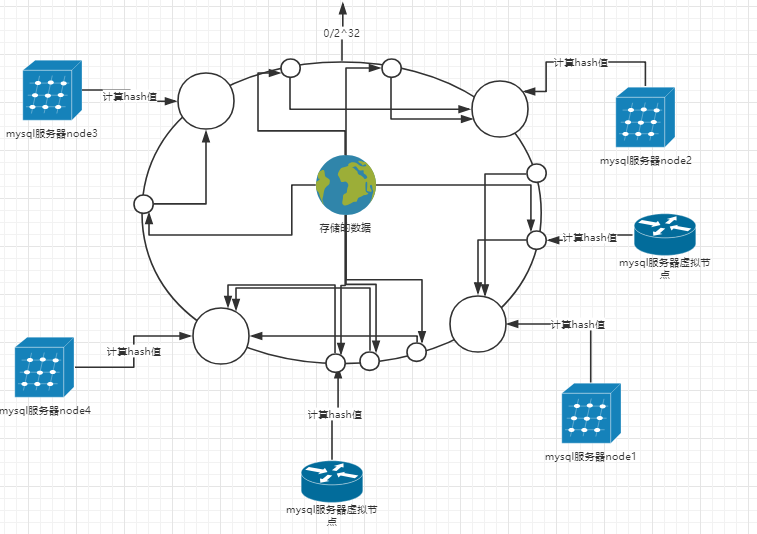
特点:解决数据均匀分布
在rule.xml里面的配置:
<tableRule name="sharding-by-murmur">

    <rule>

        <columns>id</columns>

        <algorithm>murmur</algorithm>

    </rule>

</tableRule>

<function name="murmur"

        class="io.mycat.route.function.PartitionByMurmurHash">

        <property name="seed">0</property><!-- 默认是0 -->

        <property name="count">2</property><!-- 要分片的数据库节点数量,必须指定,否则没法分片 -->

        <property name="virtualBucketTimes">160</property><!-- 一个实际的数据库节点被映射为这么多虚拟节点,默认是160倍,也就是虚拟节点数是物理节点数的160倍 -->

        <!-- <property name="weightMapFile">weightMapFile</property> 节点的权重,没有指定权重的节点默认是1。以properties文件的格式填写,以从0开始到count-1的整数值也就是节点索引为key,以节点权重值为值。所有权重值必须是正整数,否则以1代替 -->

        <!-- <property name="bucketMapPath">/etc/mycat/bucketMapPath</property>

            用于测试时观察各物理节点与虚拟节点的分布情况,如果指定了这个属性,会把虚拟节点的murmur hash值与物理节点的映射按行输出到这个文件,没有默认值,如果不指定,就不会输出任何东西 -->

    </function>
对应代码:
package io.mycat.route.function;

import java.io.BufferedReader;

import java.io.ByteArrayInputStream;

import java.io.ByteArrayOutputStream;

import java.io.File;

import java.io.FileInputStream;

import java.io.FileNotFoundException;

import java.io.FileOutputStream;

import java.io.IOException;

import java.io.InputStream;

import java.io.InputStreamReader;

import java.io.OutputStream;

import java.nio.charset.Charset;

import java.util.ArrayList;

import java.util.HashMap;

import java.util.List;

import java.util.Map;

import java.util.Properties;

import java.util.SortedMap;

import java.util.TreeMap;

import com.google.common.hash.HashFunction;

import com.google.common.hash.Hashing;

import io.mycat.config.model.rule.RuleAlgorithm;

import io.mycat.util.exception.MurmurHashException;

/**

 * consistancy hash, murmur hash

 * implemented by Guava

 * @author wuzhih

 *

 */

public class PartitionByMurmurHash extends AbstractPartitionAlgorithm implements RuleAlgorithm  {

    private static final int DEFAULT_VIRTUAL_BUCKET_TIMES=160;

    private static final int DEFAULT_WEIGHT=1;

    private static final Charset DEFAULT_CHARSET=Charset.forName("UTF-8");

    private int seed;

    private int count;

    private int virtualBucketTimes=DEFAULT_VIRTUAL_BUCKET_TIMES;

    private Map<Integer,Integer> weightMap=new HashMap<>();

//    private String bucketMapPath;

    private HashFunction hash;

    private SortedMap<Integer,Integer> bucketMap;

    @Override

    public void init()  {

        try{

            bucketMap=new TreeMap<>();

//            boolean serializableBucketMap=bucketMapPath!=null && bucketMapPath.length()>0;

//            if(serializableBucketMap){

//                File bucketMapFile=new File(bucketMapPath);

//                if(bucketMapFile.exists() && bucketMapFile.length()>0){

//                    loadBucketMapFile();

//                    return;

//                }

//            }

            generateBucketMap();

//            if(serializableBucketMap){

//                storeBucketMap();

//            }

        }catch(Exception e){

            throw new MurmurHashException(e);

        }

    }

    private void generateBucketMap(){

        hash=Hashing.murmur3_32(seed);//计算一致性哈希的对象

        for(int i=0;i<count;i++){//构造一致性哈希环,用TreeMap表示

            StringBuilder hashName=new StringBuilder("SHARD-").append(i);

            for(int n=0,shard=virtualBucketTimes*getWeight(i);n<shard;n++){

                bucketMap.put(hash.hashUnencodedChars(hashName.append("-NODE-").append(n)).asInt(),i);

            }

        }

        weightMap=null;

    }

//    private void storeBucketMap() throws IOException{

//        try(OutputStream store=new FileOutputStream(bucketMapPath)){

//            Properties props=new Properties();

//            for(Map.Entry entry:bucketMap.entrySet()){

//                props.setProperty(entry.getKey().toString(), entry.getValue().toString());

//            }

//            props.store(store,null);

//        }

//    }

//    private void loadBucketMapFile() throws FileNotFoundException, IOException{

//        try(InputStream in=new FileInputStream(bucketMapPath)){

//            Properties props=new Properties();

//            props.load(in);

//            for(Map.Entry entry:props.entrySet()){

//                bucketMap.put(Integer.parseInt(entry.getKey().toString()), Integer.parseInt(entry.getValue().toString()));

//            }

//        }

//    }

    /**

     * 得到桶的权重,桶就是实际存储数据的DB实例

     * 从0开始的桶编号为key,权重为值,权重默认为1。

     * 键值必须都是整数

     * @param bucket

     * @return

     */

    private int getWeight(int bucket){

        Integer w=weightMap.get(bucket);

        if(w==null){

            w=DEFAULT_WEIGHT;

        }

        return w;

    }

    /**

     * 创建murmur_hash对象的种子,默认0

     * @param seed

     */

    public void setSeed(int seed){

        this.seed=seed;

    }

    /**

     * 节点的数量

     * @param count

     */

    public void setCount(int count) {

        this.count = count;

    }

    /**

     * 虚拟节点倍数,virtualBucketTimes*count就是虚拟结点数量

     * @param virtualBucketTimes

     */

    public void setVirtualBucketTimes(int virtualBucketTimes){

        this.virtualBucketTimes=virtualBucketTimes;

    }

    /**

     * 节点的权重,没有指定权重的节点默认是1。以properties文件的格式填写,以从0开始到count-1的整数值也就是节点索引为key,以节点权重值为值。

     * 所有权重值必须是正整数,否则以1代替

     * @param weightMapPath

     * @throws IOException

     * @throws

     */

    public void setWeightMapFile(String weightMapPath) throws IOException{

        Properties props=new Properties();

        try(BufferedReader reader=new BufferedReader(new InputStreamReader(this.getClass().getClassLoader().getResourceAsStream(weightMapPath), DEFAULT_CHARSET))){

            props.load(reader);

            for(Map.Entry entry:props.entrySet()){

                int weight=Integer.parseInt(entry.getValue().toString());

                weightMap.put(Integer.parseInt(entry.getKey().toString()), weight>0?weight:1);

            }

        }

    }

//    /**

//     * 保存一致性hash的虚拟节点文件路径。

//     * 如果这个文件不存在或是空文件就按照指定的count, weightMapFile等构造新的MurmurHash数据结构并保存到这个路径的文件里。

//     * 如果这个文件已存在且不是空文件就加载这个文件里的内容作为MurmurHash数据结构,此时其它参数都忽略。

//     * 除第一次以外在之后增加节点时可以直接修改这个文件,不过不推荐这么做。如果节点数量变化了,推荐删除这个文件。

//     * 可以不指定这个路径,不指定路径时不会保存murmur hash

//     * @param bucketMapPath

//     */

//    public void setBucketMapPath(String bucketMapPath){

//        this.bucketMapPath=bucketMapPath;

//    }

    @Override

    public Integer calculate(String columnValue) {

        SortedMap<Integer, Integer> tail = bucketMap.tailMap(hash.hashUnencodedChars(columnValue).asInt());

        if (tail.isEmpty()) {

            return bucketMap.get(bucketMap.firstKey());

        }

        return tail.get(tail.firstKey());

    }

    @Override

    public int getPartitionNum() {

        int nPartition = this.count;

        return nPartition;

    }

    private static void hashTest() throws IOException{

        PartitionByMurmurHash hash=new PartitionByMurmurHash();

        hash.count=10;//分片数

        hash.init();

        int[] bucket=new int[hash.count];

        Map<Integer,List<Integer>> hashed=new HashMap<>();

        int total=1000_0000;//数据量

        int c=0;

        for(int i=100_0000;i<total+100_0000;i++){//假设分片键从100万开始

            c++;

            int h=hash.calculate(Integer.toString(i));

            bucket[h]++;

            List<Integer> list=hashed.get(h);

            if(list==null){

                list=new ArrayList<>();

                hashed.put(h, list);

            }

            list.add(i);

        }

        System.out.println(c+"   "+total);

        double d=0;

        c=0;

        int idx=0;

        System.out.println("index    bucket   ratio");

        for(int i:bucket){

            d+=i/(double)total;

            c+=i;

            System.out.println(idx+++"  "+i+"   "+(i/(double)total));

        }

        System.out.println(d+"  "+c);

        Properties props=new Properties();

        for(Map.Entry entry:hash.bucketMap.entrySet()){

            props.setProperty(entry.getKey().toString(), entry.getValue().toString());

        }

        ByteArrayOutputStream out=new ByteArrayOutputStream();

        props.store(out, null);

        props.clear();

        props.load(new ByteArrayInputStream(out.toByteArray()));

        System.out.println(props);

        System.out.println("****************************************************");

//        rehashTest(hashed.get(0));

    }

    private static void rehashTest(List<Integer> partition){

        PartitionByMurmurHash hash=new PartitionByMurmurHash();

        hash.count=12;//分片数

        hash.init();

        int[] bucket=new int[hash.count];

        int total=partition.size();//数据量

        int c=0;

        for(int i:partition){//假设分片键从100万开始

            c++;

            int h=hash.calculate(Integer.toString(i));

            bucket[h]++;

        }

        System.out.println(c+"   "+total);

        c=0;

        int idx=0;

        System.out.println("index    bucket   ratio");

        for(int i:bucket){

            c+=i;

            System.out.println(idx+++"  "+i+"   "+(i/(double)total));

        }

    }

    public static void main(String[] args) throws IOException {

        hashTest();

    }

}
Mysql系列六:(Mycat分片路由原理、Mycat常用分片规则及对应源码介绍)的更多相关文章
- GGTalk——C#开源即时通讯系统源码介绍系列(一)
坦白讲,我们公司其实没啥技术实力,之所以还能不断接到各种项目,全凭我们老板神通广大!要知道他每次的饭局上可都是些什么人物! 但是项目接下一大把,就凭咱哥儿几个的水平,想要独立自主.保质保量保期地一个个 ...
- Elasticsearch 分片路由原理指定分片存储查询
Elasticsearch 项目中使用到Es的父子结构.在数据填充之后,查看每个节点的数据分布情况,发现有的节点数据多,有的节点少的情况,在未使用Es父级结构之前,每个节点的数据分布还算平均,如下图: ...
- 五分钟,让你明白MySQL是怎么选择索引《死磕MySQL系列 六》
系列文章 二.一生挚友redo log.binlog<死磕MySQL系列 二> 三.MySQL强人"锁"难<死磕MySQL系列 三> 四.S 锁与 X 锁的 ...
- 深入浅出Mybatis系列(四)---配置详解之typeAliases别名(mybatis源码篇)
上篇文章<深入浅出Mybatis系列(三)---配置详解之properties与environments(mybatis源码篇)> 介绍了properties与environments, ...
- Android应用系列:手把手教你做一个小米通讯录(附图附源码)
前言 最近心血来潮,突然想搞点仿制品玩玩,很不幸小米成为我苦逼的第一个试验品.既然雷布斯的MIUI挺受欢迎的(本人就是其的屌丝用户),所以就拿其中的一些小功能做一些小demo来玩玩.小米的通讯录大家估 ...
- Android ListView工作原理完全解析,带你从源码的角度彻底理解
版权声明:本文出自郭霖的博客,转载必须注明出处. 目录(?)[+] Adapter的作用 RecycleBin机制 第一次Layout 第二次Layout 滑动加载更多数据 转载请注明出处:h ...
- linux下安装mysql的三种方法:rpm包安装、yum安装、源码包安装
1 安装MySQL数据库服务器安装方法一://查询系统自带的数据库rpm -qa | grep -i mysql //卸载查询到的所有mysqlrpm -e --nodeps mysql-libs-5 ...
- 数据结构与算法系列2 线性表 链表的分类+使用java实现链表+链表源码详解
数据结构与算法系列2.2 线性表 什么是链表? 链表是一种物理存储单元上非连续,非顺序的存储结构,数据元素的逻辑顺序是通过链表的链接次序实现的一系列节点组成,节点可以在运行时动态生成,每个节点包括两个 ...
- mysql系列六、mysql创建用户、授权、备份及恢复命令
一.创建用户和授权 下面的操作中,其中someusername为用户名,somepassword为密码,somedbname为数据库名 1.创建用户 create user 'someusername ...
随机推荐
- Codeforces Round #516 (Div. 2) (A~E)
目录 Codeforces 1064 A.Make a triangle! B.Equations of Mathematical Magic C.Oh Those Palindromes D.Lab ...
- 洛谷.2042.[NOI2005]维护数列(Splay)
题目链接 2017.12.24 第一次写: 时间: 2316ms (1268ms) 空间: 19.42MB (19.5MB)(O2) 注:洛谷测的时间浮动比较大 /* 插入一段数:将这些数先单独建一棵 ...
- Mysql 创建用户并授权
设置MySQL用户账号,指定哪个用户可以连接服务器,从哪里连接,连接后能做什么. MySQL管理员应该知道如何设置MySQL用户账号,指出哪个用户可以连接服务器,从哪里连接,连接后能做什么? GRAN ...
- Django关于设置自定义404和安装debug-toolbar的笔记
Django关于设置自定义404和安装debug-toolbar的笔记 关于设置404 先做好404页面,然后在views.py文件中做好映射,最后是在urls.py做好路由,而这个urls.py必须 ...
- pycharm如何设置python版本、设置国内pip镜像、添加第三方类库
直接上图(mac环境): 一.设置项目的python版本 File->Default Settings ... 在弹出的界面上(参考下图),左上角的下拉框里,选择python解释器的版本即可(建 ...
- CentOS禁止packagekit离线更新服务的办法
以CentOs7为例,以root身份登录系统,然后执行以下命令: [root@localhost ~]# systemctl disable packagekit-offline-update.ser ...
- 根据 train_test.prototxt文件生成 deploy.prototxt文件
本文参考博文 (1)介绍 *_train_test.prototxt文件与 *_deploy.prototxt文件的不同:http://blog.csdn.net/sunshine_in_moon/a ...
- Shiro基础知识03----shiro授权(编程式授权),Permission详解,授权流程(zz)
授权,也叫访问控制,即在应用中控制谁能访问哪些资源(如访问页面/编辑数据/页面操作等). 在权限认证中,最核心的是:主体/用户(Subject).权限(Permission).角色(Role).资源 ...
- 病毒木马查杀实战第020篇:Ring3层主动防御之基本原理
前言 假设说我们的计算机中安装有杀毒软件,那么当我们有意或无意地下载了一个恶意程序后.杀软一般都会弹出一个对话框提示我们,下载的程序非常可能是恶意程序,建议删除之类的.或者杀软就不提示.直接删除了:或 ...
- c/c++ 读入一行不确定个数的整数
假设有一个文件,文件的每一行包括n个整数,整数之间以一个空格隔开,文件总共有m行,但是事先不知道n,m.如何每次从文件中读取一行整数放到一个数组中. 可以分为两步:1.首先从文件中读入一行字符串,2. ...