
SALALchemy Session与scoped_session的源码分析
我们发现Session与scoped_session都有一些方法:
但是scoped_session的源码里面没有设置这些方法让我们从源码里去窥探下源码在哪里设置了这些方法:
Session里面的方法放在了public_methods里面:
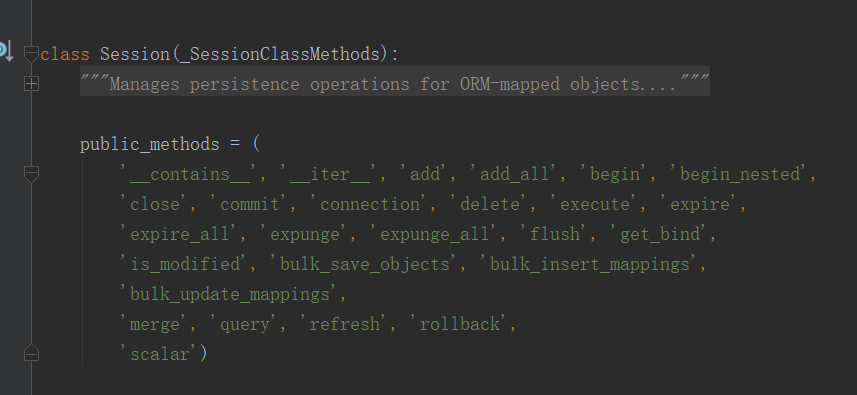
scoped_session的源码里面没有这些方法?:
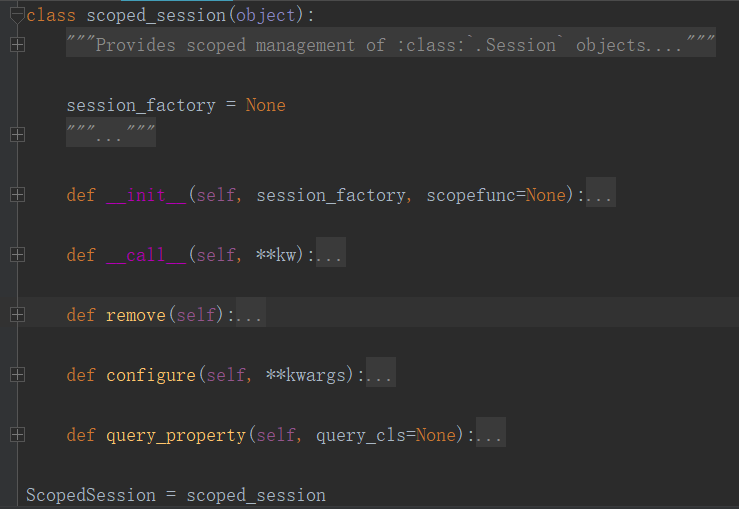
那它怎么实现这些方法的呢?
我们看到了它的构造方法:
 def __init__(self, session_factory, scopefunc=None):

        """Construct a new :class:`.scoped_session`.

        :param session_factory: a factory to create new :class:`.Session`

         instances. This is usually, but not necessarily, an instance

         of :class:`.sessionmaker`.

        :param scopefunc: optional function which defines

         the current scope.   If not passed, the :class:`.scoped_session`

         object assumes "thread-local" scope, and will use

         a Python ``threading.local()`` in order to maintain the current

         :class:`.Session`.  If passed, the function should return

         a hashable token; this token will be used as the key in a

         dictionary in order to store and retrieve the current

         :class:`.Session`.

        """

        self.session_factory = session_factory

        if scopefunc:

            self.registry = ScopedRegistry(session_factory, scopefunc)

        else:

            self.registry = ThreadLocalRegistry(session_factory)
第一次进来时,scopefunc是空的。
走else,
 self.registry = ThreadLocalRegistry(session_factory)
就会实例化:ThreadLocalRegistry。
class ThreadLocalRegistry(ScopedRegistry):

    """A :class:`.ScopedRegistry` that uses a ``threading.local()``

    variable for storage.

    """

    def __init__(self, createfunc):

        self.createfunc = createfunc

        self.registry = threading.local()
里面有两个对象 self.createfunc和registry:
registry是唯一标识,
session加上括号就会执行__call__方法:
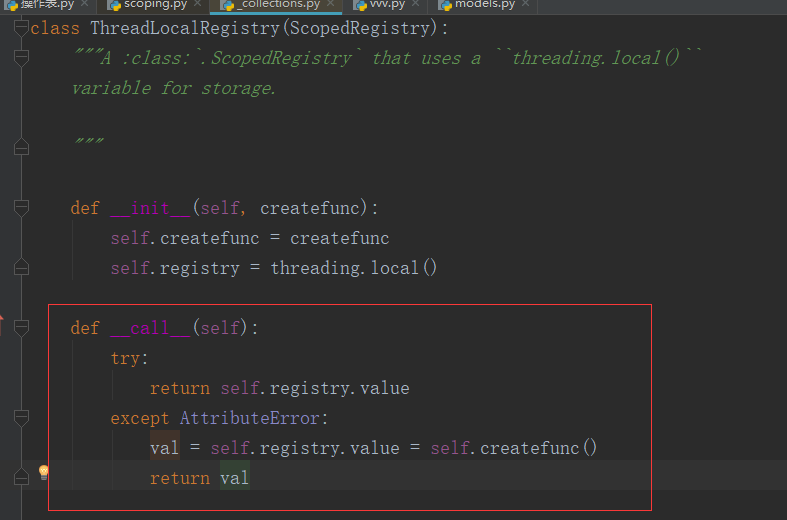
因为self.registry.value第一次进入没有值:
所以走except 就是执行self.createfunc()往前找传的值是session_factory那么session_factory是谁呢?就是我们传入的session,也就是实例化了我们的session。
就这就会走下面的方法:
def instrument(name):

    def do(self, *args, **kwargs):

        return getattr(self.registry(), name)(*args, **kwargs)

    return do

for meth in Session.public_methods:

    setattr(scoped_session, meth, instrument(meth))
方法二:
我们发现
class scoped_session(object):

    """Provides scoped management of :class:`.Session` objects.

    See :ref:`unitofwork_contextual` for a tutorial.

    """

    session_factory = None

    """The `session_factory` provided to `__init__` is stored in this

    attribute and may be accessed at a later time.  This can be useful when

    a new non-scoped :class:`.Session` or :class:`.Connection` to the

    database is needed."""

    def __init__(self, session_factory, scopefunc=None):

        """Construct a new :class:`.scoped_session`.

        :param session_factory: a factory to create new :class:`.Session`

         instances. This is usually, but not necessarily, an instance

         of :class:`.sessionmaker`.

        :param scopefunc: optional function which defines

         the current scope.   If not passed, the :class:`.scoped_session`

         object assumes "thread-local" scope, and will use

         a Python ``threading.local()`` in order to maintain the current

         :class:`.Session`.  If passed, the function should return

         a hashable token; this token will be used as the key in a

         dictionary in order to store and retrieve the current

         :class:`.Session`.

        """

        self.session_factory = session_factory

        if scopefunc:

            self.registry = ScopedRegistry(session_factory, scopefunc)

        else:

            self.registry = ThreadLocalRegistry(session_factory)
如果我们给
scopefunc传值就会走if语句,
class ScopedRegistry(object):

    """A Registry that can store one or multiple instances of a single

    class on the basis of a "scope" function.

    The object implements ``__call__`` as the "getter", so by

    calling ``myregistry()`` the contained object is returned

    for the current scope.

    :param createfunc:

      a callable that returns a new object to be placed in the registry

    :param scopefunc:

      a callable that will return a key to store/retrieve an object.

    """

    def __init__(self, createfunc, scopefunc):

        """Construct a new :class:`.ScopedRegistry`.

        :param createfunc:  A creation function that will generate

          a new value for the current scope, if none is present.

        :param scopefunc:  A function that returns a hashable

          token representing the current scope (such as, current

          thread identifier).

        """

        self.createfunc = createfunc

        self.scopefunc = scopefunc

        self.registry = {}

    def __call__(self):

        key = self.scopefunc()

        try:

            return self.registry[key]

        except KeyError:

            return self.registry.setdefault(key, self.createfunc())
我们看到如果对象加括号就会走__call__方法:
第一次没有值,就会走except,设置并且实例化session。
往下方法和方式一一样啦。
在执行到最后我们要加上一句:
session.remove()
我们来看下这句话做了什么?
    def remove(self):

        """Dispose of the current :class:`.Session`, if present.

        This will first call :meth:`.Session.close` method

        on the current :class:`.Session`, which releases any existing

        transactional/connection resources still being held; transactions

        specifically are rolled back.  The :class:`.Session` is then

        discarded.   Upon next usage within the same scope,

        the :class:`.scoped_session` will produce a new

        :class:`.Session` object.

        """

        if self.registry.has():

            self.registry().close()

        self.registry.clear()
我们进入has看下:
    def has(self):

        return hasattr(self.registry, "value")
如果有值就执行close方法。
然后在执行clear方法:
    def clear(self):

        try:

            del self.registry.value

        except AttributeError:

            pass
SALALchemy Session与scoped_session的源码分析的更多相关文章
- SqlAlchemy 中操作数据库时session和scoped_session的区别(源码分析)
原生session: from sqlalchemy.orm import sessionmaker from sqlalchemy import create_engine from sqlalch ...
- springMVC源码分析--国际化实现Session和Cookie(二)
上一篇博客springMVC源码分析--国际化LocaleResolver(一)中我们介绍了springMVC提供的国际化的解决方案,接下来我们根据springMVC提供的解决方案来简单的实现一个多语 ...
- [asp.net core 源码分析] 01 - Session
1.Session文档介绍 毋庸置疑学习.Net core最好的方法之一就是学习微软.Net core的官方文档:https://docs.microsoft.com/zh-cn/aspnet/cor ...
- TOMCAT8源码分析——SESSION管理分析(上)
前言 对于广大java开发者而已,对于J2EE规范中的Session应该并不陌生,我们可以使用Session管理用户的会话信息,最常见的就是拿Session用来存放用户登录.身份.权限及状态等信息.对 ...
- Tomcat源码分析——Session管理分析(下)
前言 在<TOMCAT源码分析——SESSION管理分析(上)>一文中我介绍了Session.Session管理器,还以StandardManager为例介绍了Session管理器的初始化 ...
- Tomcat源码分析——Session管理分析(上)
前言 对于广大java开发者而已,对于J2EE规范中的Session应该并不陌生,我们可以使用Session管理用户的会话信息,最常见的就是拿Session用来存放用户登录.身份.权限及状态等信息.对 ...
- 一个由正则表达式引发的血案 vs2017使用rdlc实现批量打印 vs2017使用rdlc [asp.net core 源码分析] 01 - Session SignalR sql for xml path用法 MemCahe C# 操作Excel图形——绘制、读取、隐藏、删除图形 IOC,DIP,DI,IoC容器
1. 血案由来 近期我在为Lazada卖家中心做一个自助注册的项目,其中的shop name校验规则较为复杂,要求:1. 英文字母大小写2. 数字3. 越南文4. 一些特殊字符,如“&”,“- ...
- Flask框架(三)—— 请求扩展、中间件、蓝图、session源码分析
Flask框架(三)—— 请求扩展.中间件.蓝图.session源码分析 目录 请求扩展.中间件.蓝图.session源码分析 一.请求扩展 1.before_request 2.after_requ ...
- Flask框架(五) —— session源码分析
Flask框架(五) —— session源码分析 目录 session源码分析 1.请求来了,执行__call__方法 2.__call__方法 3.调用__call__方法 3.1.ctx = s ...
随机推荐
- springboot aop 自定义注解方式实现完善日志记录(完整源码)
版权声明:本文为博主原创文章,欢迎转载,转载请注明作者.原文超链接 一:功能简介 本文主要记录如何使用aop切面的方式来实现日志记录功能. 主要记录的信息有: 操作人,方法名,参数,运行时间,操作类型 ...
- linux | 网卡驱动
linux 1. 查看网卡信息 lspci | grep -i 'eth' 1a:00.0 Ethernet controller: Intel Corporation Ethernet Connec ...
- [Luogu 3613] 睡觉困难综合征
Description 给定一棵 \(n\) 个点的树,每个点上有位运算 \(opt\) 和一个权值 \(x\),位运算有 &,|,^ 三种. 要求支持: 修改点 \(v\) 的 \(opt\ ...
- Session会话保持机制的原理与Tomcat Session共享的几种实现方式(Session Cluster、memcached+MSM)
一.Session的定义 在计算机科学中,特别是在网络中,session是两个或更多个通信设备之间或计算机和用户之间的临时和交互式信息交换.session在某个时间点建立,然后在之后的某一时间点拆除. ...
- [转]Building a REST-Backend for Angular with Node.js & Express
本文转自:https://malcoded.com/posts/angular-backend-express Angular is a single page application framewo ...
- spring cloud config客户端
上篇介绍了spring cloud config服务器,本篇介绍客户端.客户端主要是从config服务器获取配置信息. 代码示例 首先创建一个Maven项目,在pom.xml文件中添加依赖: < ...
- c# DataSet转换为Json
/// <summary> /// DataSet转换为Json /// </summary> /// <param name="dataSet"&g ...
- Net 如何计算一段代码的效率
在.Net 4.0以后的版本,提供了一个类,该类在 System.Diagnostics命名空间下,使用该类就可以计算出执行结果相同的两端代码的效率,在代码优化上是很实用的. 泛型效率是高是低呢??我 ...
- quartz部署出现找不到表的情况,错误提示: Table 'heart_beat.QRTZ_LOCKS' doesn't exist
描述一下,本地可以,部署到Linux就不行,Linux上的数据库是本地直接拷贝上去的,项目环境是Spring Boot2.1.Shiro.MyBatis.Redis.swagger.Bootstrap ...
- 【Java深入研究】7、ThreadLocal详解
ThreadLocal翻译成中文比较准确的叫法应该是:线程局部变量. 这个玩意有什么用处,或者说为什么要有这么一个东东?先解释一下,在并发编程的时候,成员变量如果不做任何处理其实是线程不安全的,各个线 ...