
mybatis的typeHandler
typeHandler作用:
1.传参时将javaType类型转换成jdbcType
2.结果集中ResultSet中取值时,jdbcType转换为javaType;
系统自定义的typeHandler:
mybatis系统内部定义了一系列的typeHandler;基本涵盖了我们正常使用的类型转换;如下
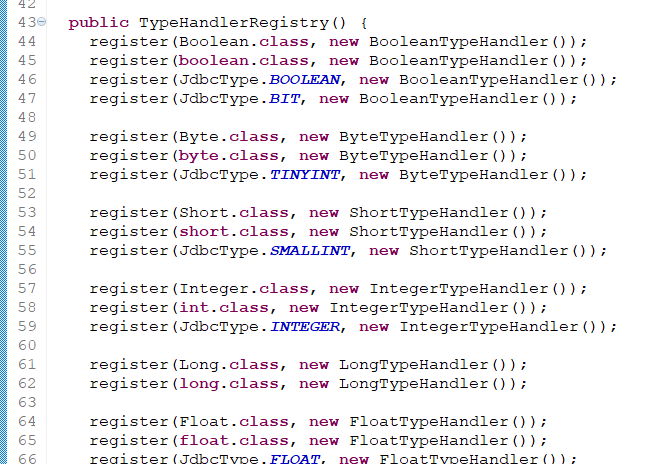
选取一个系统自定义的typeHandler看看;
在包org.apache.ibatis.type下有一个StringTypeHandler.java
源码如下:
public class StringTypeHandler extends BaseTypeHandler<String> {

  @Override

  public void setNonNullParameter(PreparedStatement ps, int i, String parameter, JdbcType jdbcType)

      throws SQLException {

    ps.setString(i, parameter);

  }

  @Override

  public String getNullableResult(ResultSet rs, String columnName)

      throws SQLException {

    return rs.getString(columnName);

  }

  @Override

  public String getNullableResult(ResultSet rs, int columnIndex)

      throws SQLException {

    return rs.getString(columnIndex);

  }

  @Override

  public String getNullableResult(CallableStatement cs, int columnIndex)

      throws SQLException {

    return cs.getString(columnIndex);

  }

}
StringTypeHandler继承了BaseTypeHandler;而BaseTypeHandler实现了接口TypeHandler,
BaseTypeHandler中代码
/**

 *    Copyright 2009-2015 the original author or authors.

 *

 *    Licensed under the Apache License, Version 2.0 (the "License");

 *    you may not use this file except in compliance with the License.

 *    You may obtain a copy of the License at

 *

 *       http://www.apache.org/licenses/LICENSE-2.0

 *

 *    Unless required by applicable law or agreed to in writing, software

 *    distributed under the License is distributed on an "AS IS" BASIS,

 *    WITHOUT WARRANTIES OR CONDITIONS OF ANY KIND, either express or implied.

 *    See the License for the specific language governing permissions and

 *    limitations under the License.

 */

package org.apache.ibatis.type;

import java.sql.CallableStatement;

import java.sql.PreparedStatement;

import java.sql.ResultSet;

import java.sql.SQLException;

import org.apache.ibatis.executor.result.ResultMapException;

import org.apache.ibatis.session.Configuration;

/**

 * @author Clinton Begin

 * @author Simone Tripodi

 */

public abstract class BaseTypeHandler<T> extends TypeReference<T> implements TypeHandler<T> {

  protected Configuration configuration;

  public void setConfiguration(Configuration c) {

    this.configuration = c;

  }

  @Override

  public void setParameter(PreparedStatement ps, int i, T parameter, JdbcType jdbcType) throws SQLException {

    if (parameter == null) {

      if (jdbcType == null) {

        throw new TypeException("JDBC requires that the JdbcType must be specified for all nullable parameters.");

      }

      try {

        ps.setNull(i, jdbcType.TYPE_CODE);

      } catch (SQLException e) {

        throw new TypeException("Error setting null for parameter #" + i + " with JdbcType " + jdbcType + " . " +

                "Try setting a different JdbcType for this parameter or a different jdbcTypeForNull configuration property. " +

                "Cause: " + e, e);

      }

    } else {

      try {

        setNonNullParameter(ps, i, parameter, jdbcType);

      } catch (Exception e) {

        throw new TypeException("Error setting non null for parameter #" + i + " with JdbcType " + jdbcType + " . " +

                "Try setting a different JdbcType for this parameter or a different configuration property. " +

                "Cause: " + e, e);

      }

    }

  }

  @Override

  public T getResult(ResultSet rs, String columnName) throws SQLException {

    T result;

    try {

      result = getNullableResult(rs, columnName);

    } catch (Exception e) {

      throw new ResultMapException("Error attempting to get column '" + columnName + "' from result set.  Cause: " + e, e);

    }

    if (rs.wasNull()) {

      return null;

    } else {

      return result;

    }

  }

  @Override

  public T getResult(ResultSet rs, int columnIndex) throws SQLException {

    T result;

    try {

      result = getNullableResult(rs, columnIndex);

    } catch (Exception e) {

      throw new ResultMapException("Error attempting to get column #" + columnIndex+ " from result set.  Cause: " + e, e);

    }

    if (rs.wasNull()) {

      return null;

    } else {

      return result;

    }

  }

  @Override

  public T getResult(CallableStatement cs, int columnIndex) throws SQLException {

    T result;

    try {

      result = getNullableResult(cs, columnIndex);

    } catch (Exception e) {

      throw new ResultMapException("Error attempting to get column #" + columnIndex+ " from callable statement.  Cause: " + e, e);

    }

    if (cs.wasNull()) {

      return null;

    } else {

      return result;

    }

  }

  public abstract void setNonNullParameter(PreparedStatement ps, int i, T parameter, JdbcType jdbcType) throws SQLException;

  public abstract T getNullableResult(ResultSet rs, String columnName) throws SQLException;

  public abstract T getNullableResult(ResultSet rs, int columnIndex) throws SQLException;

  public abstract T getNullableResult(CallableStatement cs, int columnIndex) throws SQLException;

}
getResult分别用columnName和columnIndex从ResultSet中获取数据,CallableStatement表示从存储过程中获取结果及数据的方法;
下面我们创建自定义typeHandler
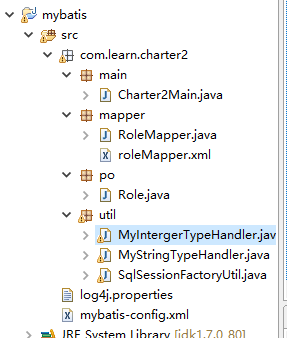
RoleMapper.java
package com.learn.charter2.mapper;

import java.util.List;

import com.learn.charter2.po.Role;

public interface RoleMapper {

    Role getRole(Long id) throws Exception;

    int deleteRole(Long id) throws Exception;

    int insertRole(Role role) throws Exception;

    List<Role> findRole(Role role) throws Exception;

}
Role.java
package com.learn.charter2.po;

public class Role {

    private Long id;

    private String roleName;

    private String note;

    private Integer pk;

    public Long getId() {

        return id;

    }

    public void setId(Long id) {

        this.id = id;

    }

    public String getRoleName() {

        return roleName;

    }

    public void setRoleName(String roleName) {

        this.roleName = roleName;

    }

    public String getNote() {

        return note;

    }

    public void setNote(String note) {

        this.note = note;

    }

    public Integer getPk() {

        return pk;

    }

    public void setPk(Integer pk) {

        this.pk = pk;

    }

}
SqlSessionFactoryUtil.java
package com.learn.charter2.util;

import java.io.InputStream;

import java.util.logging.Level;

import java.util.logging.Logger;

import org.apache.ibatis.io.Resources;

import org.apache.ibatis.session.SqlSession;

import org.apache.ibatis.session.SqlSessionFactory;

import org.apache.ibatis.session.SqlSessionFactoryBuilder;

public class SqlSessionFactoryUtil {

    private static SqlSessionFactory sqlSessionFactory=null;

    private static final Class class_lock=SqlSessionFactoryUtil.class;

    private SqlSessionFactoryUtil() {

    }

    public static SqlSessionFactory initSqlSessionFactory(){

        String resource="mybatis-config.xml";

        InputStream inputStream=null;

        try {

            inputStream=Resources.getResourceAsStream(resource);

        } catch (Exception e) {

            Logger.getLogger(SqlSessionFactoryUtil.class.getName()).log(Level.SEVERE,null,e);

        }

        synchronized (class_lock) {

            if(sqlSessionFactory==null){

                sqlSessionFactory=new SqlSessionFactoryBuilder().build(inputStream);

            }

        }

        return sqlSessionFactory;

    }

    public static SqlSession openSqlSession(){

        if(sqlSessionFactory==null){

            initSqlSessionFactory();

        }

        return sqlSessionFactory.openSession();

    }

}
log4j.properties
log4j.rootLogger=debug,stdout

log4j.logger.org.mybatis=debug

log4j.appender.stdout=org.apache.log4j.ConsoleAppender

log4j.appender.stdout.layout=org.apache.log4j.PatternLayout

log4j.appender.stdout.layout.ConversionPattern=%5p %d %C:%m%n
mybatis-config.xml
 <?xml version="1.0" encoding="UTF-8" ?> <!DOCTYPE configuration  PUBLIC "-//mybatis.org//DTD Config 3.0//EN"  "http://mybatis.org/dtd/mybatis-3-config.dtd">

 <configuration>

     <typeHandlers>

         <typeHandler handler="com.learn.charter2.util.MyStringTypeHandler" javaType="string" jdbcType="VARCHAR"/>

         <typeHandler handler="com.learn.charter2.util.MyIntergerTypeHandler" javaType="int" jdbcType="VARCHAR"/>

     </typeHandlers>

     <environments default="development">

         <environment id="development">

             <transactionManager type="JDBC">

                 <property name="autoCommit" value="false" />

             </transactionManager>

             <dataSource type="POOLED">

                 <property name="driver" value="com.mysql.jdbc.Driver" />

                 <property name="url" value="jdbc:mysql://localhost:3306/mybatis" />

                 <property name="username" value="root" />

                 <property name="password" value="gys" />

             </dataSource>

         </environment>

     </environments>

     <mappers>

         <mapper resource="com/learn/charter2/mapper/roleMapper.xml" />

     </mappers>

 </configuration>
roleMapper.xml
 <?xml version="1.0" encoding="UTF-8" ?> <!DOCTYPE mapper  PUBLIC "-//mybatis.org//DTD Mapper 3.0//EN"  "http://mybatis.org/dtd/mybatis-3-mapper.dtd">

 <mapper namespace="com.learn.charter2.mapper.RoleMapper">

     <resultMap type="com.learn.charter2.po.Role" id="roleMap">

         <id column="id" property="id" javaType="long" jdbcType="BIGINT"/>

         <result column="role_name" property="roleName" javaType="string" jdbcType="VARCHAR"/>

         <result column="note" property="note" typeHandler="com.learn.charter2.util.MyStringTypeHandler"/>

         <result column="pk" property="pk" typeHandler="com.learn.charter2.util.MyIntergerTypeHandler"/>

     </resultMap>

     <select id="getRole" parameterType="long" resultMap="roleMap">

     select id,role_name as roleName,note from t_role where id=#{id}

     </select>

     <select id="findRole" parameterType="com.learn.charter2.po.Role" resultMap="roleMap">

     select id,role_name as roleName,note,pk from t_role

     <where>

         <if test="roleName !=null">

              role_name like concat('%',#{roleName,javaType=string,jdbcType=VARCHAR,typeHandler=com.learn.charter2.util.MyStringTypeHandler},'%')

         </if>

         <if test="pk !=null">

         and pk =#{pk,javaType=int,jdbcType=VARCHAR,typeHandler=com.learn.charter2.util.MyIntergerTypeHandler}

          </if>

     </where>

     </select>

     <insert id="insertRole" parameterType="com.learn.charter2.po.Role">

         insert into t_role

         (role_name,note)

         values

         (#{roleName},#{note})

     </insert>

     <delete id="deleteRole" parameterType="long">

         delete from t_role where id=#{id}

     </delete>

 </mapper>
MyIntergerTypeHandler.java
 package com.learn.charter2.util;

 import java.sql.CallableStatement;

 import java.sql.PreparedStatement;

 import java.sql.ResultSet;

 import java.sql.SQLException;

 import org.apache.ibatis.type.JdbcType;

 import org.apache.ibatis.type.MappedJdbcTypes;

 import org.apache.ibatis.type.MappedTypes;

 import org.apache.ibatis.type.TypeHandler;

 import org.apache.log4j.Logger;

 import sun.security.action.GetIntegerAction;

 /**

  * @MappedTypes({Integer.class})

    @MappedJdbcTypes(JdbcType.VARCHAR)

  *

  */

 public class MyIntergerTypeHandler implements TypeHandler<Integer> {

     private Logger log=Logger.getLogger(MyIntergerTypeHandler.class);

     private int getInt(String v){

         if("a".equals(v)){

             return 10;

         }else if("b".equals(v)){

             return 20;

         }else if("c".equals(v)){

              return 30;

         }else{

             return 60;

         }

     }

     @Override

     public Integer getResult(CallableStatement cs, int index)

             throws SQLException {

         log.info("使用我的IntegerTypeHandler,CallbleStatment下表获取字符串");

         return getInt(cs.getString(index));

     }

     @Override

     public Integer getResult(ResultSet rs, int index) throws SQLException {

         log.info("使用我的IntegerTypeHandler,ResultSet下标获取字符串");

         return getInt(rs.getString(index));

     }

     @Override

     public Integer getResult(ResultSet rs, String colName) throws SQLException {

         log.info("使用我的IntegerTypeHandler,ResultSet 列名获取字符串");

         return getInt(rs.getString(colName));

     }

     @Override

     public void setParameter(PreparedStatement ps, int index, Integer value,JdbcType jt) throws SQLException {

         log.info("使用我的IntegerTypeHandler==index:"+index+";value:"+value);

         String v="";

         if(value==1){

             v="a";

         }else if(value==2){

             v="b";

         }else if(value==3){

             v="c";

         }else {

             v="guoyansi";

         }

         ps.setString(index, v);

     }

 }
MyStringTypeHandler.java
 package com.learn.charter2.util;

 import java.sql.CallableStatement;

 import java.sql.PreparedStatement;

 import java.sql.ResultSet;

 import java.sql.SQLException;

 import org.apache.ibatis.type.JdbcType;

 import org.apache.ibatis.type.MappedJdbcTypes;

 import org.apache.ibatis.type.MappedTypes;

 import org.apache.ibatis.type.TypeHandler;

 import org.apache.log4j.Logger;

 @MappedTypes({String.class})

 @MappedJdbcTypes(JdbcType.INTEGER)

 public class MyStringTypeHandler implements TypeHandler<String> {

     private Logger log=Logger.getLogger(MyStringTypeHandler.class);

     @Override

     public String getResult(CallableStatement cs, int index)

             throws SQLException {

         log.info("使用我的StringTypeHandler,CallbleStatment下表获取字符串");

         return cs.getString(index);

     }

     @Override

     public String getResult(ResultSet rs, int index) throws SQLException {

         log.info("使用我的StringTypeHandler,ResultSet下标获取字符串");

         return rs.getString(index);

     }

     @Override

     public String getResult(ResultSet rs, String colName) throws SQLException {

         log.info("使用我的StringTypeHandler,ResultSet 列名获取字符串");

         return rs.getString(colName);

     }

     @Override

     public void setParameter(PreparedStatement ps, int index, String value,

             JdbcType jt) throws SQLException {

         value=value+"m";

         log.info("使用我的StringTypeHandler==index:"+index+";value:"+value);

         ps.setString(index, value);

     }

 }
Charter2Main.java
 package com.learn.charter2.main;

 import java.util.List;

 import org.apache.ibatis.session.SqlSession;

 import com.learn.charter2.mapper.RoleMapper;

 import com.learn.charter2.po.Role;

 import com.learn.charter2.util.SqlSessionFactoryUtil;

 public class Charter2Main {

     public static void main(String[] args) {

         SqlSession sqlSession = null;

         try {

             sqlSession = SqlSessionFactoryUtil.openSqlSession();

             RoleMapper roleMapper = sqlSession.getMapper(RoleMapper.class);

             Role role = new Role();

             role.setPk(10);

             List<Role> list=roleMapper.findRole(role);

             for(Role r:list){

                 System.out.println("id:"+r.getId()+";roleName:"+r.getRoleName()+";note:"+r.getNote()+";pk:"+r.getPk());

             }

         } catch (Exception e) {

             System.err.println(e.getMessage());

             sqlSession.rollback();

         }finally{

             if(sqlSession!=null){

                 sqlSession.close();

             }

         }

     }

 }
自定义typeHandler的三个步骤:
1.定义typeHandler(MyIntergerTypeHandler.java MyStringTypeHandler.java)
2.配置typeHandler(mybatis-config.xml中3-6行)
3.指定入参中哪个字段使用typeHandler(mapper.xml中19-24行)
4.指定出参中哪个字段使用typeHandler(mapper.xml中7-8行)
以MyIntergerTypeHandler为例,运行一下Charter2Main.java
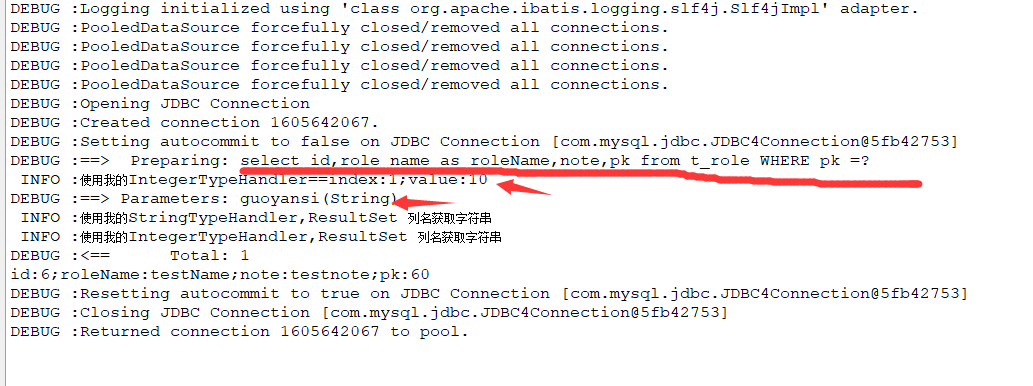
Charter2Main 中传入的pk参数是10,被typeHandler默默的转换成了guoyansi;
因为guoyansi在数据库中找到了值,在被返回到java中,guoyansi又被typeHandler转化成了60;
这个例子展示的就是Integer和String之间的转换。
mybatis的typeHandler的更多相关文章
- Mybatis使用TypeHandler实现数据的加解密转换
参考: MyBatis之TypeHandler: https://www.cnblogs.com/yulinfeng/p/5991170.html 前段时间收到这么个需求:为安全起见,要求在数据库 ...
- mybatis 枚举typeHandler
枚举typeHandler 在绝大多数情况下,typeHandler因为枚举而使用,MyBatis已经定义了两个类作为枚举类型的支持,这两个类分别是: •EnumOrdinalTypeHandler. ...
- [转]Mybatis之TypeHandler使用教程
Mybatis之TypeHandler使用教程 https://blog.csdn.net/jokemqc/article/details/81326109 深入浅出Mybatis系列(五)---Ty ...
- 使用Mybatis的TypeHandler加解密数据
使用Mybatis的TypeHandler加解密数据 一.背景 二.解决方案 三.需求 四.实现思路 1.编写一个实体类,凡是此实体类的数据都表示需要加解密的 2.编写一个加解密的`TypeHandl ...
- MyBatis之TypeHandler
在大学写web应用的时候经常会遇到这么个问题,当我要插入一条数据,某个数据是Date类型,数据库中却是VARCHAR类型,这个时候可能会傻乎乎的先把这个数据自己手动转换成String类型再插入到数据库 ...
- 关于mybatis中typeHandler的两个案例
在做开发时,我们经常会遇到这样一些问题,比如我有一个Java中的Date数据类型,我想将之存到数据库的时候存成一个1970年至今的毫秒数,怎么实现?再比如我有一个User类,User类中有一个属性叫做 ...
- mybatis的TypeHandler 的使用
今天看了别人的mybatis的教学视频,自己手写了一个简单的自定义的TypeHandler,有些细节记录一下. 1.定义自己的TypeHandler,代码如下: package com.example ...
- Mybatis自定义TypeHandler解决特殊类型转换问题
我们知道,Java和MySQL中的数据类型是不同的,Java中除了基本数据类型,还有对象. 有时候使用MySQL存储数据,或者从MySQL中读取数据时,会有一些特殊需求
- 深入浅出Mybatis系列(五)---TypeHandler简介及配置(mybatis源码篇)
上篇文章<深入浅出Mybatis系列(四)---配置详解之typeAliases别名(mybatis源码篇)>为大家介绍了mybatis中别名的使用,以及其源码.本篇将为大家介绍TypeH ...
随机推荐
- 除了Udacity,全球最聪明的那群人还上哪些网站?
01. ***,与世界相连 WikiWand——打开维基百科的新方式 http://www.wikiwand.com/ InsightfulQuestions(subreddit)——跨越界限的智力讨 ...
- unity中实现场景之间加载进度条
using UnityEngine; using System.Collections; using UnityEngine.SceneManagement; using UnityEngine.UI ...
- unity中获取七天的日期
private List<string> Date; private List<string> Day; private string now; private WMG_Axi ...
- C++ 抽象类与接口
1. 抽象类 在面向对象编程中,抽象类是一种只能定义类型,不能生成对象的类,它是对一系列看上去不同,但是本质相同的具体概念的抽象.最典型的的抽象类就是”图形”,三角形.矩形.梯形都是图形,它们都具有 ...
- nginx——Nginx 处理事件模型
Nginx 的连接处理机制在不同的操作系统会采用不同的 I/O 模型,要根据不同的系统选择不同的事件处理模型,可供选择的事件处理模型有:kqueue .rtsig .epoll ./dev/poll ...
- python自学第11天-单线程并发、迭代器,序列化,获取路径
单线程并发 import time def consumer(name): print("%s 准备吃包子了"%name) while True: baozi=yield#变成一个 ...
- pip3 install mysqlclient 报错 “/bin/sh: 1: mysql_config: not found”的解决方法
执行 sudo apt-get install libmysqlclient-dev, 然后执行 pip3 install mysqlclient 成功.
- single-cell RNA-seq 工具大全
[怪毛匠子-整理] awesome-single-cell List of software packages (and the people developing these methods) fo ...
- 3.1 unittest简介
3.1 unittest简介 前言 熟悉java的应该都清楚常见的单元测试框架Junit和TestNG.python里面也有单元测试框架-unittest,相当于是一个python版的junit.py ...
- oracle错误汇总1
这是遇见的第一个整个库正常,但某张表查询报错的情况 某张表数据可以查,但一排序查就报错 select * from acct_daily_bak; select * from acct_daily_b ...