
Both - Either - Neither English Grammar
http://www.grammar.cl/english/both-either-neither.htm
Both, Either, Neither Summary Chart
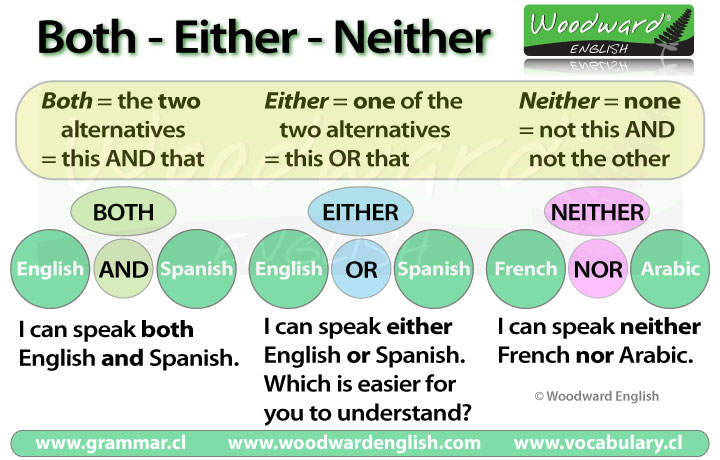
We use both, either and neither to refer to two people or things.
BOTH
Both = the two; that one AND the other one; this one AND that one
Both can be used as a pronoun to refer to two things that we have already mentioned.
- A: Do you want the blue shirt or the red one?
B: I’ll buy both (= the blue shirt AND the red shirt = both shirts)
Both X and Y
= not only X but also Y
Both + Adjective + and + Adjective
- He’s both tall and handsome.
- I’m both happy and confused at the same time!
- I have had a long, hard day and I’m both tired and hungry.
Both + Noun + and + Noun
Both can be used with a singular noun + and + singular noun
- She speaks both English and Arabic.
- They have both a cat and a dog.
- He is both an actor and a director.
We can also use Both + plural noun (see more below)
- She speaks both languages.
Both or Both of?
Both or Both of can be used without a difference in meaning though Both of is more common in the United States.
Both (of) + determiner + plural noun
You can use Both or Both of before a determiner (my, his, these, the etc.) and a plural noun.
- Both (of) my friends arrived late to class.
- Both of the wheels wobble too much.
- A prize was given to both of the players.
When we use Both (without of), we drop the article the.
- Both of the parents were nervous.
- Both parents were nervous.
Both of + Object Pronoun
When using Both with an object pronoun (me, you, him, her, it, us them), we need the preposition OF before that pronoun.
- He has invited both us. (incorrect)
- He has invited both of us. (correct)
- I’ll take both of them. (correct)
- I need to speak to both of you. (correct)
Verb + Object pronoun + both
We can use both after an object pronoun
- I hope they invite us both (= I hope they invite both of us)
- Do you need them both? (= Do you need both of them)
- The teacher sent them both to the principal’s office.
To be + both
Both comes after To Be (or an auxiliary such as have or modal verbs).
- He is both intelligent and agile.
- My sister and I are both ready for the trip.
- We were both happy with our exam results.
Modal verb + both + verb
- My parents can both speak French.
- They should both try harder.
- My brothers would both be shocked if they knew the truth.
Both + other verbs
Both goes before the other verbs. If there is an accompanying auxiliary verb, then it goes in the middle of the two verbs (i.e. auxiliary + both + verb)
- We both wanted to stay in bed and not go to work.
- They both liked the surprise.
- My parents both work in the same building.
- They have both studied a lot.
Both - Negative
We don’t use both in negative structures. Instead, we normally use Neither.
- We don’t say: Both of them are not ready (incorrect)
- We say: Neither of them are ready (correct)
See more about Neither below:
NEITHER
Neither = not one and not the other
Neither is a negative word and is accompanied by an affirmative singular verb.
Neither X nor Y
Neither … nor … is used as a conjunction. It is the opposite of “Both … and …” If a verb comes after this phrase, that verb is in the singular form (Sometimes you will hear it used in the plural form though it is not grammatically correct)
- Neither John nor Fred likes doing the dishes. (= “Both John and Fred don’t like doing the dishes”)
- I want neither the red shirt nor the blue shirt.
- I neither smoke nor drink.
Neither + singular noun
Neither is used as a determiner before a single noun.
- Neither team wanted to lose.
- That tennis game was very close. Neither player had a clear advantage.
- Neither parent knew about the accident.
Neither of + determiner + plural noun
You can use Neither of before a determiner (my, his, these, the etc.) and a plural noun.
- Neither of my friends came to class today.
- Neither of the parents understood what the baby was trying to say.
- Neither of our cars has enough petrol so we have to take the bus.
Neither of + Pronoun
When using Neither + of + pronoun (you, us, them), we need the preposition OF before that pronoun. (If a verb comes after this phrase then it is in singular form)
- The present is for neither of us.
- Neither of them is married.
- Neither of us expected to be fired.
Neither in short responses
Neither is frequently used as part of a short response when someone says something negative and you agree with them.
- A: I have never been to Switzerland
- B: Neither have I.
- A: I don’t want to go.
- B: Neither do I.
See more about So, Neither and Either as short answers
Neither can also be used alone.
- A: Would you like a blue tie or a green tie?
- B: Neither. (= Neither tie)
Neither vs. Either
You can use Either with a negative verb to replace Neither with a positive verb
- I have neither time nor money
- I don’t have either time or money.
See more about Either below.
EITHER
Either = any one of the two = this one or the other one
Either is accompanied by an affirmative singular verb and if mostly used in questions or negative sentences
Either X or Y
Either … or … is used as a conjunction. It is used to express alternatives and or a choice between two (and sometimes more) things. It is used a verb in singular form (Sometimes you will hear it used in the plural form though it is not grammatically correct).
- Either you or John has to finish the report before 5pm.
- You can have either the red shirt or the blue shirt. (= but not both)
- Either you leave the building now or I call the security guards.
Either + singular noun
Either is used as a determiner before a single noun.
- There are only two options and I’m not interested in either film.
- A: Do you want it ready for Thursday or Friday? B: Either day is fine for me.
Either of + determiner + plural noun
You can use Either of before a determiner (my, his, these, the etc.) and a plural noun.
- We’ve been dating for 6 months and I haven’t met either of her parents.
- I haven’t read either of these books.
- I don’t want either of those apples. Do you have one that is not rotten?
Either + of + Pronoun
When using Either + of + object pronoun (you, us, them), we need the preposition OF before that pronoun.
- I don’t think he is going to invite either of us.
- A: Which photo do you prefer? B: I don’t like either of them
- I think I left my keys and wallet at the office. I don’t want to lose either of them.
Either can also be used alone. It means it doesn’t matter which alternative. Sometimes it is accompanied by the pronoun “one”.
- A: Would you like a coffee or a tea?
- B: Either (one). (= I don’t mind if it’s coffee or tea, both alternatives are fine)
Either in short responses
Either can be used at the end of a negative sentence when you agree with something negative someone else has said. It is similar to meaning TOO and ALSO (which are used in affirmative sentences).
- A: I wasn’t thirsty. B: I wasn’t either. (You cannot say “I wasn’t too”)
- A: I’ve never been to Portugal. B: I haven’t either.
- A: I didn’t go to class yesterday. B: I didn’t either
See more about So, Neither and Either as short answers
Pronunciation of Either and Neither
You will hear the word Either pronounced two different ways:
- /ˈaɪðər/ (eye-ther – with a long I sound at the beginning) – British English
- /ˈiːðər/ (ee- ther – with a long E sound at the beginning) – American English
Both forms of pronunciation are correct and supposedly one is British English and the other American English. However within each country you may hear both forms used.
The same happens with the pronunciation of the word Neither:
- /ˈnaɪðər/ – British English
- /ˈniːðər/ – American English
Both - Either - Neither English Grammar的更多相关文章
- English Grammar
What is Grammar?
- English Grammar in Use - Part1 Present and past
Unit 1 Present continuous (I am doing) A) Am/is/are + -ing is the Present continuous. B) I am doing ...
- English Grammar - Subject Clause
that引导主语从句 一般置于句末,偶尔也置于句首 that引导的主语从句置于句首 That the seas are being overfished has been known for year ...
- Come and join us at English corner
2012.12.26 Hi all, How are you doing? Merry post-Christmas and happy upcoming New year!! I wish you ...
- Grammar Rules
Grammar Rules Here are 20 simple rules and tips to help you avoid mistakes in English grammar. For m ...
- [No00003E]26个字母暗藏的单词秘密
个字母暗藏的单词秘密 人们普通认为:英语是拼音文字,因而与象形无关.但是,实际上,即使作为拼音文字,其字母的来源也与象形有关.根据笔者十多年的研究结果,英语中的二十六个字母每个字母都有其象形意义,而且 ...
- [No00002A]26个英语字母的原始象形意义、含义、产生及发展历史
我们都知道汉字是象形文字,但如果说英语也是象形文字,你一定会以为纯是无稽之谈.其实,追根溯源,英语的26个字母确实来自于象形文字.这26个字母最初起源于埃及象形文字,后由腓尼基人改进发明了腓尼基字母, ...
- LaTeX Software & Manuals
LaTeX Software & Manuals How to Typeset Equations in LaTeX LaTeX is a very powerful tool for typ ...
- How I explained OOD to my wife(转)
How I explained OOD to my wife Learning Object Oriented Design principles through interesting conver ...
随机推荐
- expect 交互 之双引号较长变量
交互双引号较长变量 #!/bin/bash RemoteUser=xuesong12 Ip=192.168.1.2 RemotePasswd=xuesong Cmd="/bin/echo ...
- [BZOJ 1260][CQOI2007]涂色paint 题解(区间DP)
[BZOJ 1260][CQOI2007]涂色paint Description 假设你有一条长度为5的木版,初始时没有涂过任何颜色.你希望把它的5个单位长度分别涂上红.绿.蓝.绿.红色,用一个长度为 ...
- Git常见错误处理
如果输入$ Git remote add origin git@github.com:djqiang(github帐号名)/gitdemo(项目名).git 提示出错信息:fatal: remo ...
- 2017/05/17 java 基础 随笔
- malloc 函数详解
很多学过C的人对malloc都不是很了解,知道使用malloc要加头文件,知道malloc是分配一块连续的内存,知道和free函数是一起用的.但是但是: 一部分人还是将:malloc当作系统所提供的或 ...
- Linux内核中的printf实现【转】
转自:http://www.cnblogs.com/chenglei/archive/2009/08/06/1540702.html 从main.c中的printf开始读这个函数. 首先看printf ...
- linux远程windows执行命令
Linux下远程连接windows,执行命令 - Feng______的专栏 - 博客频道 - CSDN.NEThttp://blog.csdn.net/feng______/article/deta ...
- WCF使用Net.tcp绑定时候出现错误:元数据包含无法解析的引用
在WCF服务编程中,客户端添加引用服务时,出现如下错误: 元数据包含无法解析的引用:“net.tcp://192.168.1.105:1314/LoginService”. 套接字连接已中止.这可能是 ...
- Canvas 3D球形文字云动画特效
Canvas 3D球形文字云动画特效 效果图: 代码如下,复制即可使用: (适用浏览器:360.FireFox.Chrome.Opera.傲游.搜狗.世界之窗. 不支持Safari.IE8及以下浏览器 ...
- Zookeeper集群搭建以及python操作zk
一.Zookeeper原理简介 ZooKeeper是一个开放源码的分布式应用程序协调服务,它包含一个简单的原语集,分布式应用程序可以基于它实现同步服务,配置维护和命名服务等. Zookeeper设计目 ...