
Differential Evolution: A Survey of the State-of-the-Art
@
@article{das2011differential,
title={Differential Evolution: A Survey of the State-of-the-Art},
author={Das, Swagatam and Suganthan, P N},
journal={IEEE Transactions on Evolutionary Computation},
volume={15},
number={1},
pages={4--31},
year={2011}}
概
这是一篇关于Differential Evolution (DE) 的综述, 由于对这类方法并不熟悉, 只能简单地做个记录.
主要内容
考虑如下问题,
\]
其中\(X=(x_1,\ldots,x_D)\).
我所知的, 如梯度下降方法, 贝叶斯优化可以用来处理这类问题, 但是还有诸如 evolutionary algorithm (EA), evolutionary programming (EP), evolution strategies(ESs), genetic algorithm (GA), 以及本文介绍的 DE (后面的基本都不了解).
DE/rand/1/bin
先给出最初的形式, 称之为DE/rand/1/bin:
Input: scale factor \(F\), crossover rate \(Cr\), population size \(NP\).
1: 令\(G=0\), 并随机初始化\(P_G=\{ X_{1,G},\ldots, X_{NP,G}\}\).
2: While the stopping criterion is not satisfied Do:
- For \(i=1,\ldots, NP\) do:
- Mutation step:
\]
- Crossover step: 按照如下方式生成\(U_{i,G}=(u_{1,i,G},\ldots, u_{D,i,G})\)
\left \{ \begin{array}{ll}
v_{j,i,G} & if \: \mathrm{rand}[0,1] \le Cr \: or \: j=j_{rand} \\
x_{j,i,G} & otherwise.
\end{array} \right.
\]
- Selection step:
\left \{ \begin{array}{ll}
U_{i,G} & if \: f(U_{i,G}) \le f(X_{i,G}) \\
X_{i,G} & otherwise.
\end{array} \right.
\]
- End For.
- \(G=G+1\).
End While.
其中\(X_{i,G}=(x_{j,i,G}, \ldots, x_{D,i,G})\), \(j_{rand}\)是预先随机生成的一个属于\([1,D]\)的整数, 以保证\(U\)相对于\(X\)至少有些许变化产生, \(X_{r_1^i,G}, X_{r_2^i,G},X_{r_3^i,G}\)是从\(P_G\)中随机抽取且互异的.
在接下来我们可以发现很多变种, 而这些变种往往是Mutation step 和 Crossover step的变体.
DE/?/?/?
DE/rand/1/exp
这是crossover step步的的一个变种:
随机从\([1, D]\)中抽取整数\(n\)和\(L\), 然后
\left \{ \begin{array}{ll}
v_{j,i,G} & if \: n \le j \le n+L-1\\
x_{j,i,G} & otherwise.
\end{array} \right.
\]
\(L\)可以通过下面的步骤生成
- \(L=0\)
- while \(\mathrm{rand}[0,1] \le Cr\) and \(L\le D\):
\]
DE/best/1
\]
其中\(X_{best,G}\)是\(P_{G}\)中的最优的点.
DE/best/2
\]
DE/rand/2
\]
超参数的选择
真的没有细看, 文中粗略地介绍了几处, 还有很多需要查原文.
\(F\)的选择
有的推荐\([0.4, 1]\)(最佳0.5), 有的推荐\(0.6\), 有的推荐\([0.4, 0.95]\)(最佳0.9).
还有一些自适应的选择, 如
\left \{ \begin{array}{ll}
\max \{l_{\min}, 1- |\frac{f_{\max}}{f_{\min}}|\} & if : |\frac{f_{\max}}{f_{\min}}|<1 \\
\max \{l_{\min}, 1- |\frac{f_{\max}}{f_{\min}}|\} & otherwise,
\end{array} \right.
\]
我比较疑惑的是难道\(|\frac{f_{\max}}{f_{\min}}|\)不是大于等于1吗?
\left \{ \begin{array}{ll}
\mathrm{rand}[F_l, F_{u}] & with \: probability \:\tau \\
F_{i,G} & else,
\end{array} \right.
\]
其中\(F_l\), \(F_u\)分别为\(F\)取值的下界和上界.
\(NP\)的选择
有的推荐\([5D,10D]\), 有的推荐\([3D, 8D]\).
\(Cr\)的选择
有的推荐\([0.3, 0.9]\).
还有
\left \{ \begin{array}{ll}
\mathrm{rand}[0, 1] & with \: probability \:\tau \\
Cr_{i,G} & else,
\end{array} \right.
\]
一些连续变体
A
p_1 = f(X_{r_1})/p \\
p_2 = f(X_{r_2}) / p \\
p_3 = f(X_{r_1}) / p.
\]
如果\(\mathrm{rand}[0,1] < \Gamma\)(\(\Gamma\)是给定的):
V_{i,G+1} = & (X_{r_1}+X_{r_2}+X_{r_3})/3 +(p_2-p_1)(X_{r_1}-X_{r_2}) \\
&+ (p_3-p_2)(X_{r_2} - X_{r_3}) + (p_1-p_3) (X_{r_3}- X_{r_1}),
\end{array}
\]
否则
\]
B
\]
其中\(k_i\)给定, \(F'=k_i \cdot F\).
C

D
即在考虑\(x\)的时候, 还需要考虑其反\(a+b-x\), 假定\(x \in [a, b]\), \([a,b]\)为我们给定范围, \(X\)的反类似的构造.
E

其中\(X_{n_{best},G}\)表示在\(X_{i,G}\)的\(n\)的近邻中的最优点, \(p, q\in [i-k,i+k]\).

其中\(X_{g_{best},G}\)为\(P_G\)中的最优点.
\]
G

剩下的在复杂环境下的应用就不记录了(只是单纯讲了该怎么做).
一些缺点
- 高维问题不易处理;
- 容易被一些问题欺骗, 而现如局部最优解;
- 对不能分解的函数效果不是很好;
- 路径往往不会太大(即探索不充分);
- 缺少收敛性的理论的保证.
代码
\(f(x,y)=x^2+50y^2\).
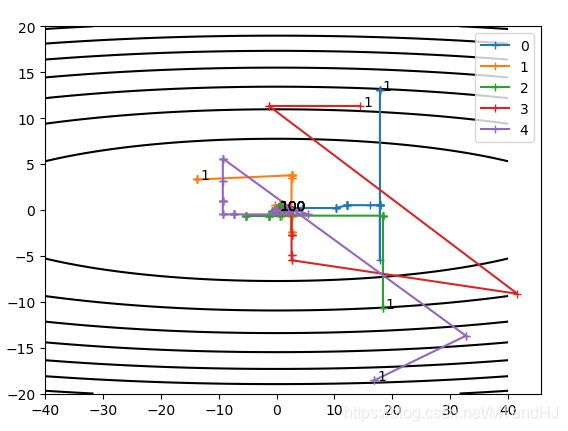
{

  "dim": 2,

  "F": 0.5,

  "NP": 5,

  "Cr": 0.35

}
"""

de.py

"""

import numpy as np

from scipy import stats

import random

class Parameter:

    def __init__(self, dim, xmin, xmax):

        self.dim = dim

        self.xmin = xmin

        self.xmax = xmax

        self.initial()

    def initial(self):

        self.para = stats.uniform.rvs(

            self.xmin, self.xmax - self.xmin

        )

    @property

    def data(self):

        return self.para

    def __getitem__(self, item):

        return self.para[item]

    def __setitem__(self, key, value):

        self.para[key] = value

    def __len__(self):

        return len(self.para)

    def __add__(self, other):

        return self.para + other

    def __mul__(self, other):

        return self.para * other

    def __pow__(self, power):

        return self.para ** power

    def __neg__(self):

        return -self.para

    def __sub__(self, other):

        return self.para - other

    def __truediv__(self, other):

        return self.para / other

class DE:

    def __init__(self, func, dim ,F=0.5, NP=50,

                 Cr=0.35, xmin=-10, xmax=10,

                 require_history=True):

        self.func = func

        self.dim = dim

        self.F = F

        self.NP = NP

        self.Cr = Cr

        self.xmin = np.array(xmin)

        self.xmax = np.array(xmax)

        assert all(self.xmin <= self.xmax), "Invalid xmin or xmax"

        self.require_history = require_history

        self.init_x()

        if self.require_history:

            self.build_history()

    def init_x(self):

        self.paras = [Parameter(self.dim, self.xmin, self.xmax)

                      for i in range(self.NP)]

    @property

    def data(self):

        return [para.data for para in self.paras]

    def build_history(self):

        self.paras_history = [self.data]

    def add_history(self):

        self.paras_history.append(self.data)

    def choose(self, size=3):

        return random.sample(self.paras, k=size)

    def mutation(self):

        x1, x2, x3 = self.choose(3)

        return x1 + self.F * (x2 - x3)

    def crossover(self, v, x):

        u = np.zeros_like(v)

        for i, _ in enumerate(v):

            jrand = random.randint(0, self.dim)

            if np.random.rand() < self.Cr or i is jrand:

                u[i] = v[i]

            else:

                u[i] = x[i]

            u[i] = v[i] if np.random.rand() < self.Cr else x[i]

        return u

    def selection(self, u, x):

        if self.func(u) < self.func(x):

            x.para = u

        else:

            pass

    def step(self):

        donors = [self.mutation()

                  for i in range(self.NP)]

        for i, donor in enumerate(donors):

            x = self.paras[i]

            u = self.crossover(donor, x)

            self.selection(u, x)

        if self.require_history:

            self.add_history()

    def multi_steps(self, times):

        for i in range(times):

            self.step()

class DEbest1(DE):

    def bestone(self):

        y = np.array([self.func(para)

             for para in self.paras])

        return self.paras[np.argmax(y)]

    def mutation(self, bestone):

        x1, x2 = self.choose(2)

        return bestone + self.F * (x1 - x2)

    def step(self):

        bestone = self.bestone()

        donors = [self.mutation(bestone)

                  for i in range(self.NP)]

        for i, donor in enumerate(donors):

            x = self.paras[i]

            u = self.crossover(donor, x)

            self.selection(u, x)

        if self.require_history:

            self.add_history()

class DEbest2(DEbest1):

    def mutation(self, bestone):

        x1, x2, x3, x4 = self.choose(4)

        return bestone + self.F * (x1 - x2) \

                + self.F * (x3 - x4)

class DErand2(DE):

    def mutation(self):

        x1, x2, x3, x4, x5 = self.choose(5)

        return x1 + self.F * (x2 - x3) \

                + self.F * (x4 - x5)

class DErandTM(DE):

    def mutation(self):

        x = self.choose(3)

        y = np.array(list(map(self.func, x)))

        p = y / y.sum()

        part1 = (x[0] + x[1] + x[2]) / 3

        part2 = (p[1] - p[0]) * (x[0] - x[1])

        part3 = (p[2] - p[1]) * (x[2] - x[1])

        part4 = (p[0] - p[2]) * (x[2] - x[0])

        return part1 + part2 + part3 + part4
Differential Evolution: A Survey of the State-of-the-Art的更多相关文章
- SBX(Simulated binary crossover)模拟二进制交叉算子和DE(differential evolution)差分进化算子
一起来学演化计算-SBX(Simulated binary crossover)模拟二进制交叉算子和DE(differential evolution)差分进化算子 觉得有用的话,欢迎一起讨论相互学习 ...
- Image Processing and Analysis_8_Edge Detection:Edge and line oriented contour detection State of the art ——2011
此主要讨论图像处理与分析.虽然计算机视觉部分的有些内容比如特 征提取等也可以归结到图像分析中来,但鉴于它们与计算机视觉的紧密联系,以 及它们的出处,没有把它们纳入到图像处理与分析中来.同样,这里面也有 ...
- differential evolution代码实例(DE算法)
DE算法是遗传算法中一种比较流行的算法,这种算法比较简单,速度也比较快,下面给出一份示例代码 clear all; close all; clc 2 %Function to be minimized ...
- 翻新并行程序设计的认知整理版(state of the art parallel)
近几年,业内对并行和并发积累了丰富的经验.有了较深刻的理解.但之前积累的大量教材,在当今的软硬件体系下.反而都成了负面教材.所以,有必要加强宣传,翻新大家的认知. 首先.天地倒悬,结论先行:当你须要并 ...
- HyperLogLog in Practice: Algorithmic Engineering of a State of The Art Cardinality Estimation Algorithm
HyperLogLog参考下面这篇blog, http://blog.codinglabs.org/articles/algorithms-for-cardinality-estimation-par ...
- awesome-RecSys
https://github.com/jihoo-kim/awesome-RecSys?fbclid=IwAR1m6OebmqO9mfLV1ta4OTihQc9Phw8WNS4zdr5IeT1X1OL ...
- 差分进化算法 DE-Differential Evolution
差分进化算法 (Differential Evolution) Differential Evolution(DE)是由Storn等人于1995年提出的,和其它演化算法一样,DE是一种模拟生物进化 ...
- 论文学习-深度学习目标检测2014至201901综述-Deep Learning for Generic Object Detection A Survey
目录 写在前面 目标检测任务与挑战 目标检测方法汇总 基础子问题 基于DCNN的特征表示 主干网络(network backbone) Methods For Improving Object Rep ...
- 机器学习经典论文/survey合集
Active Learning Two Faces of Active Learning, Dasgupta, 2011 Active Learning Literature Survey, Sett ...
随机推荐
- aboard, abolish
aboard board做动词有上车/船/飞机的意思,boarding就是正在上.board做名词有板的意思,车厢地板的板. a是个词根,有三种意思:1. 以某种状态或方式,如: ablaze, af ...
- 在服务端应用中如何获得客户端 IP
如果有 x-forwarded-for 的请求头,则取其中的第一个 IP,否则取建立连接 socket 的 remoteAddr. 而 x-forwarded-for 基本已成为了基于 proxy 的 ...
- Vue相关,vue.nextTick
vue中有一个较为特殊的API,nextTick.根据官方文档的解释,它可以在DOM更新完毕之后执行一个回调,用法如下: // 修改数据 vm.msg = 'Hello' // DOM 还没有更新 V ...
- 【Linux】【Services】【SaaS】Docker+kubernetes(9. 安装consul实现服务注册发现)
1. 简介 1.1. 官方网站: https://www.consul.io 1.2. Consul的功能: 服务发现:通过DNS或HTTP接口使得消费者发现服务,应用程序可以轻松找到所依赖的服务. ...
- ssh 无法使用
ssh 无法运行造成无法远程连接 linux 原因: 我将 /var 目录权限修改成了 777,但 linux 系统出于安全起见,该目录的 7 权限只对 root 用户开放,所以linux 系统认为 ...
- matplotlib subplot 多图合一
1:第一种方法 # method1: subplot2grid ################# ''' 第一个参数(3, 3) 是把图分成3行3列 第二个参数是位置 (0, 0)表示从0行0列开始 ...
- 【C/C++】BanGDream活动点数计算器
作为一个白嫖咸鱼,我每个活动都只打出三星卡就不玩了,于是写了一个模拟器,算算还要打几把hhh #include <iostream> #include <algorithm> ...
- Mysql资料 慢查询
目录 一.简介 二.查询 三.开启 永久配置 临时配置 四.测试 一.简介 MySQL的慢查询,全名是慢查询日志,是MySQL提供的一种日志记录,用来记录在MySQL中响应时间超过阀值的语句. 具体环 ...
- Linux内核配置-ARP系列
all为所有,defalut为默认,其他为接口自己的 如果接口没填写,将会把defalut的值放接口上,实际生效的为all和接口中参数值较大的那个 #arp_ignore arp_ignore的参数含 ...
- react的diff算法与antd中switch组件不更新问题
问题描述: 现在有个需求,现有一个列表table,里面的数据有启用的也有关闭的,switch组件会根据数据状态展示,同时进行排序,启用数据在前面,未启用的在后面.如图 然后现在需要操作,假如我将第四条 ...