
Notes for uc/OS-III User Guide
1. Architecture
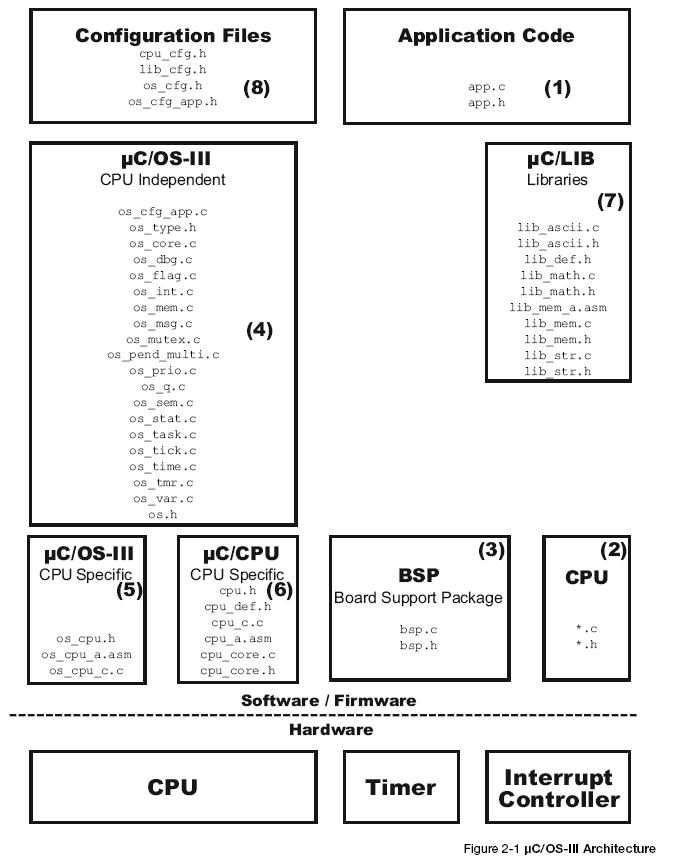
F2-1(1) The application code consists of project or product files. For convenience, these are simply called app.c and app.h, however an application can contain any number of files that do not have to be called app.*. The application code is typically where one would find the main().
F2-1(2) Semiconductor manufacturers often provide library functions in source form for accessing the peripherals on their CPU or MCU. These libraries are quite useful and often save valuable time. Since there is no naming convention for these files, *.c and *.h are assumed.
F2-1(3) The Board Support Package (BSP) is code that is typically written to interface to peripherals on a target board. For example such code can turn on and off LEDs, turn on and off relays, or read switches, temperature sensors, and more.
F2-1(4) This is the μC/OS-III processor-independent code. This code is written in highly portable ANSI C.
F2-1(5) This is the μC/OS-III code that is adapted to a specific CPU architecture and is called a port. μC/OS-III has its roots in μC/OS-II and benefits from being able to use most of the 45 or so ports available for μC/OS-II. μC/OS-II ports, however, will require small changes to work with μC/OS-III. These changes are described in Appendix C, “Migrating from μC/OS-II to μC/OS-III” on page 697.
F2-1(6) At Micriμm, we encapsulate CPU functionality. These files define functions to disable and enable interrupts, CPU_??? data types to be independent of the CPU and compiler used, and many more functions.
F2-1(7) μC/LIB is of a series of source files that provide common functions such as memory copy, string, and ASCII-related functions. Some are occasionally used to replace stdlib functions provided by the compiler. The files are provided to ensure that they are fully portable from application to application and especially, from compiler to compiler. μC/OS-III does not use these files, but μC/CPU does.
F2-1(8) Configuration files are used to define μC/OS-III features (os_cfg.h) to include in the application, specify the size of certain variables and data structures expected by μC/OS-III (os_cfg_app.h), such as idle task stack size, tick rate, size of the message pool, configure the μC/CPU features available to the application programmer (cpu_cfg.h) and also configure μC/LIB options (lib_cfg.h).
Notes for uc/OS-III User Guide的更多相关文章
- uc/os iii移植到STM32F4---IAR开发环境
也许是先入为主的原因,时钟用不惯Keil环境,大多数的教程都是拿keil写的,尝试将官方的uc/os iii 移植到IAR环境. 1.首先尝试从官网上下载的官方移植的代码,编译通过,但是执行会报堆栈溢 ...
- uC/OS - III 移植 IAR平台
关于移植uC/OS-III 网上已经有很多教程了此处只是做个记录 首先下载源码然后解压得到下面的文件: 然后在模版工程里新建各种文件夹: 最后全部都添加进工程: OK了,编译一下,惊呆了,竟然 0错误 ...
- uC/OS II原理分析及源码阅读(一)
uC/OS II(Micro Control Operation System Two)是一个可以基于ROM运行的.可裁减的.抢占式.实时多任务内核,具有高度可移植性,特别适合于微处理器和控制器,是和 ...
- uc/os 任务删除
问题描述: uc/os 任务删除 问题解决: uc/os任务删除流程图 具体代码 注: 如上是关中断,以及取消优先级对应的就绪标志 关中断代码为: 取消就绪标志,实际上是将就绪表中指定 ...
- uc/os任务创建
问题描述: uc/os中任务创建 问题解决: 创建一个任务,任务从无到有.任务创建函数分两种, 一种是基本的创建函数OSTaskCreate, 另一种是扩展的任务创建函数OSTaskCrea ...
- uC/OS 的任务调度解析 (转)
uC/OS 的任务调度解析 1.任务调度器启动之后(初始化,主要是TCB的初始化),就可以创建任务,开始任务调度了,实际上第一个任务准确的说不是进行任务切换,而是进行启动当前最高优先级任务.uC/OS ...
- 关于uC/OS的简单学习(转)
1.微内核 与Linux的首要区别是,它是一个微内核,内核所实现的功能非常简单,主要包括: 一些通用函数,如TaskCreate(),OSMutexPend(),OSQPost()等. 中断处理函数, ...
- STM32F40G-EVAL_UC/OS III
micrum官网下载uc/os程序包: 包含文件cotex_M4.h:
- 【原创】uC/OS 中LES BX,DWORD PTR DS:_OSTCBCur的作用及原理
LES BX, DWORD PTR DS:_OSTCBCur ;OSTCBCur->OSTCBStkPtr = SS:SP!!! ], SS ;将当前SS(栈的基地址)寄存器值存放至当前任务控制 ...
- 【原创】uC/OS II 任务切换原理
今天学习了uC/OS II的任务切换,知道要实现任务的切换,要将原先任务的寄存器压入任务堆栈,再将新任务中任务堆栈的寄存器内容弹出到CPU的寄存器,其中的CS.IP寄存器没有出栈和入栈指令,所以只能引 ...
随机推荐
- windows10下安装mysql8.0.25
只是安装一个练习用的库,所以基本配置没有什么好说的. # this is a config file for mysql [mysqld] # 设置3306端口 port=7799 # 设置mysql ...
- 【vue】利用输入框搜索过滤来选择列表
方法1 <div id="app"> <input type="text" @input="handleInput()" ...
- 基于 Linux 2.6的 硬中断 / 软中断的原理以及实现
Author:zhangskd @ csdn blog 概述 从本质上来讲,中断是一种电信号,当设备有某种事件发生时,它就会产生中断,通过总线把电信号发送给中断控制器. 如果中断的线是激活的,中断控制 ...
- 如何在不能求逆的时候做子集卷积 exp(即便能求逆也比常见方法优雅)
为什么要求逆?正常做子集卷积 exp 的时候递推求 \(G=\exp(F)\) 的系数时要用. 什么情况下不能求逆?模 \(2^{64}\),或者压根不取模. 我们可能会想,算出来肯定除得尽啊,因为组 ...
- 详解Web应用安全系列(8)不足的日志记录和监控
在Web安全领域,不足的日志记录和监控是一个重要的安全隐患,它可能导致攻击者能够更隐蔽地进行攻击,同时增加了攻击被检测和响应的难度.以下是对Web攻击中不足的日志记录和监控漏洞的详细介绍. 一.日志记 ...
- 洛谷P1057
#include<iostream> #include<utility> using namespace std; typedef long long ll; #define ...
- 文件系统(九):一文看懂yaffs2文件系统原理
liwen01 2024.07.07 前言 yaffs 是专为nand flash 设计的一款文件系统,与jffs 类似,都是属于日志结构文件系统.与jffs 不同的是,yaffs 文件系统利用了na ...
- 2. CMake 的简单使用
2. CMake 的简单使用 我们创建一个工程目录,在里面定义一些简单的加减乘除运算,然后定义一个 main.cpp 的文件: 结构如下: tree /f .\ D:\SOURCE\CMAKE_PRO ...
- [oeasy]python0007-调试程序_debug
调试程序 回忆上次内容 py 的程序是按照顺序执行的 是一行行挨排解释执行的 程序并不是数量越多越好 kpi也在不断演化 编辑 写的代码越多 出现的bug就越多 什么是bug 如何找bu ...
- Python爬虫(5-10)-编解码、ajax的get请求、ajax的post请求、URLError/HTTPError、微博的cookie登录、Handler处理器
五.编解码(Unicode编码) (1)GET请求 所提方法都在urllib.parse.路径下 get请求的quote()方法(适用于只提交一两个参数值) url='http://www.baidu ...