
Django rest framework 限制访问频率(源码分析)
基于 http://www.cnblogs.com/ctztake/p/8419059.html
当用发出请求时 首先执行dispatch函数,当执行当第二部时:
   #2.处理版本信息 处理认证信息 处理权限信息 对用户的访问频率进行限制

            self.initial(request, *args, **kwargs)
进入到initial方法:
  def initial(self, request, *args, **kwargs):

        """

        Runs anything that needs to occur prior to calling the method handler.

        """

        self.format_kwarg = self.get_format_suffix(**kwargs)

        # Perform content negotiation and store the accepted info on the request

        neg = self.perform_content_negotiation(request)

        request.accepted_renderer, request.accepted_media_type = neg

        # Determine the API version, if versioning is in use.

        #2.1处理版本信息

        version, scheme = self.determine_version(request, *args, **kwargs)

        request.version, request.versioning_scheme = version, scheme

        # Ensure that the incoming request is permitted

        #2.2处理认证信息

        self.perform_authentication(request)

        #2.3处理权限信息

        self.check_permissions(request)

        #2.4对用户的访问频率进行限制

        self.check_throttles(request)
 #2.4对用户的访问频率进行限制

        self.check_throttles(request)
下面 开始 限流的具体分析:
一、执行check_throttles方法
    def check_throttles(self, request):

        """

        Check if request should be throttled.

        Raises an appropriate exception if the request is throttled.

        """

        #遍历throttle对象列表

        for throttle in self.get_throttles():

            #根据allow_request()的返回值进行下一步操作,返回True的话不执行下面代码,标识不限流,返回False的话执行下面代码,还可以抛出异常

            if not throttle.allow_request(request, self):

                #返回False的话执行

                self.throttled(request, throttle.wait())
二、执行allow_request方法
首先找到BaseThrottle类,有好多类继承了该类,并且都有allow_request方法,至于执行那个类中的allow_request方法,取决于我们自定义的Throttle这个类继承谁
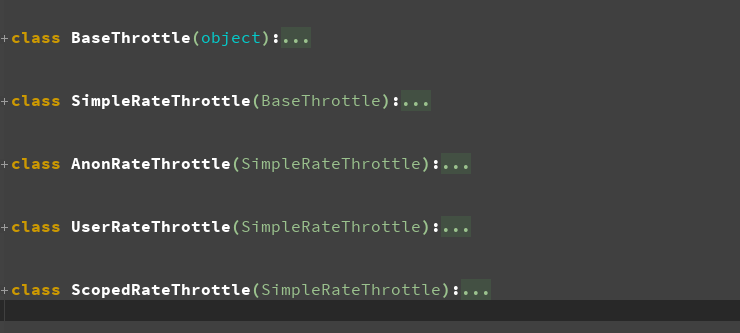
class BaseThrottle(object):

    """

    Rate throttling of requests.

    """

    def allow_request(self, request, view):

        """

        Return `True` if the request should be allowed, `False` otherwise.

        """

        raise NotImplementedError('.allow_request() must be overridden')

    #获取唯一标识,匿名用户用ip地址,认证用户用自己的user信息

    def get_ident(self, request):

        """

        Identify the machine making the request by parsing HTTP_X_FORWARDED_FOR

        if present and number of proxies is > 0. If not use all of

        HTTP_X_FORWARDED_FOR if it is available, if not use REMOTE_ADDR.

        """

        xff = request.META.get('HTTP_X_FORWARDED_FOR')

        remote_addr = request.META.get('REMOTE_ADDR')

        num_proxies = api_settings.NUM_PROXIES

        if num_proxies is not None:

            if num_proxies == 0 or xff is None:

                return remote_addr

            addrs = xff.split(',')

            client_addr = addrs[-min(num_proxies, len(addrs))]

            return client_addr.strip()

        return ''.join(xff.split()) if xff else remote_addr

    def wait(self):

        """

        Optionally, return a recommended number of seconds to wait before

        the next request.

        """

        return None
三、具体分析以具有代表性的SimpleRateThrottle类分析
class SimpleRateThrottle(BaseThrottle):

    """

    A simple cache implementation, that only requires `.get_cache_key()`

    to be overridden.

    The rate (requests / seconds) is set by a `throttle` attribute on the View

    class.  The attribute is a string of the form 'number_of_requests/period'.

    Period should be one of: ('s', 'sec', 'm', 'min', 'h', 'hour', 'd', 'day')

    Previous request information used for throttling is stored in the cache.

    """

    cache = default_cache

    timer = time.time

    cache_format = 'throttle_%(scope)s_%(ident)s'

    scope = None

    THROTTLE_RATES = api_settings.DEFAULT_THROTTLE_RATES

    def __init__(self):

        #判断是否有rate,实际上rate就是我们定义的scope的值

        if not getattr(self, 'rate', None):

            #没有调用get_rate()获取

            self.rate = self.get_rate()

        #num_requests代表具体的次数 duration代表具体的时间单位

        self.num_requests, self.duration = self.parse_rate(self.rate)

    def get_cache_key(self, request, view):

        """

        Should return a unique cache-key which can be used for throttling.

        Must be overridden.

        May return `None` if the request should not be throttled.

        """

        raise NotImplementedError('.get_cache_key() must be overridden')

    def get_rate(self):

        """

        Determine the string representation of the allowed request rate.

        """

        #判断当前类中我们定义的scope是否有值,没有则抛出异常,告诉我们必须设置scope

        if not getattr(self, 'scope', None):

            msg = ("You must set either `.scope` or `.rate` for '%s' throttle" %

                   self.__class__.__name__)

            raise ImproperlyConfigured(msg)

        try:

            #有的话直接返回scope对应的值

            return self.THROTTLE_RATES[self.scope]

        except KeyError:

            msg = "No default throttle rate set for '%s' scope" % self.scope

            raise ImproperlyConfigured(msg)

    def parse_rate(self, rate):

        """

        Given the request rate string, return a two tuple of:

        <allowed number of requests>, <period of time in seconds>

        """

        if rate is None:

            return (None, None)

        #rate实际就是我们自定义的scope的值 如10/m(代表10次每分钟)

        #按'/'切分num代表次数,period代表时间

        num, period = rate.split('/')

        #多少次

        num_requests = int(num)

        #获取具体的时间单位

        duration = {'s': 1, 'm': 60, 'h': 3600, 'd': 86400}[period[0]]

        return (num_requests, duration)

    def allow_request(self, request, view):

        """

        Implement the check to see if the request should be throttled.

        On success calls `throttle_success`.

        On failure calls `throttle_failure`.

        """

        #如果没有rate也就是scope没有值

        #如果没有则表示不限流,

        if self.rate is None:

            return True

        #get_cache_key必须自己重写,如果没有则表示不限流

        #key一般是唯一标示如用户名密码 或者登陆者的ip地址

        self.key = self.get_cache_key(request, view)

        if self.key is None:

            return True

        #获取当前key所对应的时间列表,也就是用户每一次访问的时间都放到该列表中

        self.history = self.cache.get(self.key, [])

        #当前时间

        self.now = self.timer()

        # Drop any requests from the history which have now passed the

        # throttle duration

        #当时间列表存在,并且当前时间已经超出了规定的时间

        while self.history and self.history[-1] <= self.now - self.duration:

            #把最开始加进去的时间删除

            self.history.pop()

        #如果列表中的时间数大于规定执行的次数

        if len(self.history) >= self.num_requests:

            #则return False

            return self.throttle_failure()

        #return True

        return self.throttle_success()

    def throttle_success(self):

        """

        Inserts the current request's timestamp along with the key

        into the cache.

        """

        self.history.insert(0, self.now)

        self.cache.set(self.key, self.history, self.duration)

        return True

    def throttle_failure(self):

        """

        Called when a request to the API has failed due to throttling.

        """

        return False

    def wait(self):

        """

        Returns the recommended next request time in seconds.

        """

        if self.history:

            #计算等待时间(也就是等待多久可以才可以访问下一次)

            remaining_duration = self.duration - (self.now - self.history[-1])

        else:

            remaining_duration = self.duration

        #在规定的时间内还可以访问多少次

        available_requests = self.num_requests - len(self.history) + 1

        if available_requests <= 0:

            return None

        return remaining_duration / float(available_requests)
四、回到第一步,执行allow_request方法
 def allow_request(self, request, view):

        """

        Implement the check to see if the request should be throttled.

        On success calls `throttle_success`.

        On failure calls `throttle_failure`.

        """

        #如果没有rate也就是scope没有值

        #如果没有则表示不限流,

        if self.rate is None:

            return True

        #get_cache_key必须自己重写,如果没有则表示不限流

        #key一般是唯一标示如用户名密码 或者登陆者的ip地址

        self.key = self.get_cache_key(request, view)

        if self.key is None:

            return True

        #获取当前key所对应的时间列表,也就是用户每一次访问的时间都放到该列表中

        self.history = self.cache.get(self.key, [])

        #当前时间

        self.now = self.timer()

        # Drop any requests from the history which have now passed the

        # throttle duration

        #当时间列表存在,并且当前时间已经超出了规定的时间

        while self.history and self.history[-1] <= self.now - self.duration:

            #把最开始加进去的时间删除

            self.history.pop()

        #如果列表中的时间数大于规定执行的次数

        if len(self.history) >= self.num_requests:

            #则return False

            return self.throttle_failure()

        #return True

        return self.throttle_success()
根据allow_request方法的返回值确定具体执行,返回False的话执行
#根据allow_request()的返回值进行下一步操作,返回True的话不执行下面代码,标识不限流,返回False的话执行下面代码,还可以抛出异常

            if not throttle.allow_request(request, self):

                #返回False的话执行

                self.throttled(request, throttle.wait())
 def throttled(self, request, wait):

        """

        If request is throttled, determine what kind of exception to raise.

        """

        raise exceptions.Throttled(wait)
class Throttled(APIException):

    status_code = status.HTTP_429_TOO_MANY_REQUESTS

    default_detail = _('Request was throttled.')

    extra_detail_singular = 'Expected available in {wait} second.'

    extra_detail_plural = 'Expected available in {wait} seconds.'

    default_code = 'throttled'

    def __init__(self, wait=None, detail=None, code=None):

        if detail is None:

            detail = force_text(self.default_detail)

        if wait is not None:

            wait = math.ceil(wait)

            detail = ' '.join((

                detail,

                force_text(ungettext(self.extra_detail_singular.format(wait=wait),

                                     self.extra_detail_plural.format(wait=wait),

                                     wait))))

        self.wait = wait

        super(Throttled, self).__init__(detail, code)
例子:继承BaseThrottle
url(r'^limit/', app03_views.Limitview.as_view()),
import time

from django.shortcuts import render

from rest_framework.views import APIView

from rest_framework.response import Response

from rest_framework.throttling import BaseThrottle

from rest_framework import exceptions

# Create your views here.

AllOW={}

class MyThrottle(BaseThrottle):

    '''

    要求每分钟只能访问十次

    '''

    ip = '1.1.1.1'

    def allow_request(self, request, view):

        ctime=time.time()

        ip=self.ip

        if ip not in AllOW:

            AllOW[ip]=[ctime,]

        else:

            time_list=AllOW[ip]

            while True:

                if ctime-60>time_list[-1]:

                    time_list.pop()

                else :

                    break

            if len(AllOW[ip])>10:

                return False

            AllOW[ip].insert(0,ctime)

        return True

    def wait(self):

        ip=self.ip

        ctime=time.time()

        first_in_time=AllOW[ip][-1]

        wt=60-(ctime-first_in_time)

        return wt

class Limitview(APIView):

    throttle_classes=[MyThrottle,]

    def get(self,reques):

        self.dispatch()

        return Response('欢迎访问')

    def throttled(self,request,wait):

        class InnerThrottled(exceptions.Throttled):

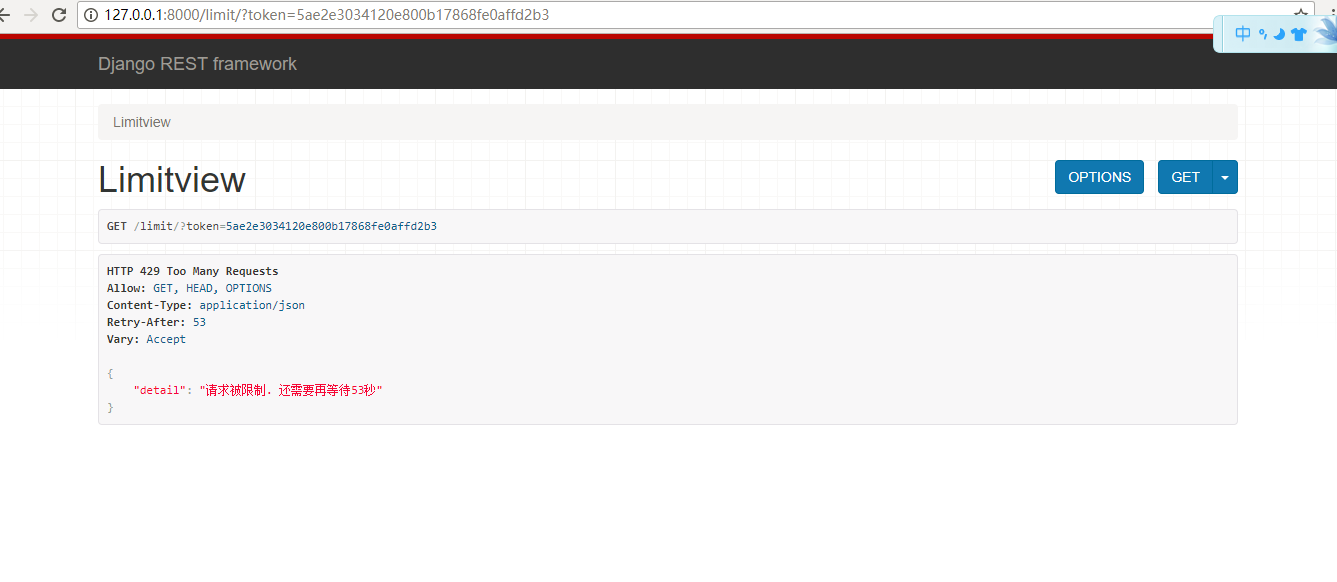
            default_detail = '请求被限制.'

            extra_detail_singular = 'Expected available in {wait} second.'

            extra_detail_plural = '还需要再等待{wait}秒'

        raise InnerThrottled(wait)
Views
REST_FRAMEWORK = {

    'UNAUTHENTICATED_USER': None,

    'UNAUTHENTICATED_TOKEN': None,

    "DEFAULT_AUTHENTICATION_CLASSES": [

      # "app01.utils.MyAuthentication",

        "app02.utils.MyAuthentication",

    ],

    "DEFAULT_PERMISSION_CLASSES":[

       "app02.utils.MyPermission",

       "app02.utils.AdminPermission",

    ],

}
settings
seetings中没有配置跟Throttle有的的信息
继承SimpleRateThrottle
url(r'^limit/', app03_views.Limitview.as_view()),
urls
import time

from django.shortcuts import render

from rest_framework.views import APIView

from rest_framework.response import Response

from rest_framework.throttling import BaseThrottle

from rest_framework.throttling import SimpleRateThrottle

from rest_framework import exceptions

# Create your views here.

AllOW={}

class MyThrottle(BaseThrottle):

    '''

    要求每分钟只能访问十次

    '''

    ip = '1.1.1.1'

    def allow_request(self, request, view):

        ctime=time.time()

        ip=self.ip

        if ip not in AllOW:

            AllOW[ip]=[ctime,]

        else:

            time_list=AllOW[ip]

            while True:

                if ctime-60>time_list[-1]:

                    time_list.pop()

                else :

                    break

            if len(AllOW[ip])>10:

                return False

            AllOW[ip].insert(0,ctime)

        return True

    def wait(self):

        ip=self.ip

        ctime=time.time()

        first_in_time=AllOW[ip][-1]

        wt=60-(ctime-first_in_time)

        return wt

class MySimpleRateThrottle(SimpleRateThrottle):

    #必须要写因为SimpleRateThrottle中要求了必须写

    '''

     def get_rate(self):

        """

        Determine the string representation of the allowed request rate.

        """

        #判断当前类中我们定义的scope是否有值,没有则抛出异常,告诉我们必须设置scope

        if not getattr(self, 'scope', None):

            msg = ("You must set either `.scope` or `.rate` for '%s' throttle" %

                   self.__class__.__name__)

            raise ImproperlyConfigured(msg)

    '''

    scope = 'tiga'

    #也必须必须要写

    '''

        def get_cache_key(self, request, view):

        """

        Should return a unique cache-key which can be used for throttling.

        Must be overridden.

        May return `None` if the request should not be throttled.

        """

        raise NotImplementedError('.get_cache_key() must be overridden')

    '''

    def get_cache_key(self, request, view):

        return self.get_ident(request)

class Limitview(APIView):

    throttle_classes=[MySimpleRateThrottle,]

    def get(self,reques):

        return Response('欢迎访问')

    def throttled(self,request,wait):

        class InnerThrottled(exceptions.Throttled):

            default_detail = '请求被限制.'

            extra_detail_singular = 'Expected available in {wait} second.'

            extra_detail_plural = '还需要再等待{wait}秒'

        raise InnerThrottled(wait)
Views
from django.db import models

# Create your models here.

class Userinfo(models.Model):

    name=models.CharField(max_length=32,verbose_name='用户名')

    pwd=models.CharField(max_length=32,verbose_name='密码')

    token=models.CharField(max_length=64,null=True)

    def __str__(self):

        return self.name
REST_FRAMEWORK = {

    'UNAUTHENTICATED_USER': None,

    'UNAUTHENTICATED_TOKEN': None,

    "DEFAULT_AUTHENTICATION_CLASSES": [

      # "app01.utils.MyAuthentication",

        "app02.utils.MyAuthentication",

    ],

    "DEFAULT_PERMISSION_CLASSES":[

       "app02.utils.MyPermission",

       "app02.utils.AdminPermission",

    ],

    "DEFAULT_THROTTLE_RATES":{

       'tiga':'10/m',

    }

}
settings
认证,权限,限流综合联系
    url(r'^index/', app04_views.IndexView.as_view()),

    url(r'^user/', app04_views.UserView.as_view()),

    url(r'^manage/', app04_views.ManageView.as_view()),
urls
from django.shortcuts import render

from rest_framework.views import APIView

from rest_framework.response import Response

from rest_framework.authentication import BaseAuthentication

from rest_framework.permissions import BasePermission

from rest_framework.throttling import SimpleRateThrottle

from rest_framework import exceptions

from app01 import models

# Create your views here.

class MyAuthentication(BaseAuthentication):

    def authenticate(self, request):

        token=request.query_params.get('token')

        user=models.Userinfo.objects.filter(token=token).first()

        if user:

            return (user.name,user)

        return None

class UserPermission(BasePermission):

    message='登录用户才可以访问'

    def has_permission(self, request, view):

        if request.user:

            return True

        return False

class AdminPermission(BasePermission):

    message='管理员才能访问'

    def has_permission(self, request, view):

        if request.user =='ctz':

            return True

        return False

class AnnoThrottle(SimpleRateThrottle):

    scope = 'anno'

    def get_cache_key(self, request, view):

        #如果是匿名用户则执行

        if not request.user:

            return self.get_ident(request)

        #如果不是匿名用户则让他执行

        return None

class UserThrottle(SimpleRateThrottle):

    scope = 'user'

    def get_cache_key(self, request, view):

        #当前用户登陆了,并且当前用户不是管理员

        if request.user and request.user!='ctz':

            return self.get_ident(request)

        #如果是匿名用户和管理员 则让他继续执行

        return None

class AdminThrottle(SimpleRateThrottle):

    scope = 'admin'

    def get_cache_key(self, request, view):

        #如果是管理员

        if request.user=='ctz':

            return self.get_ident(request)

        #不是管理员

        return  None

class IndexView(APIView):

    '''

    要求,所有用户都能访问,匿名用户5/m,普通用户10/m,管理员不限

    '''

    authentication_classes = [MyAuthentication,]

    permission_classes = []

    throttle_classes = [AnnoThrottle,UserThrottle,AdminThrottle]

    def get(self,request):

        return Response('首页')

    def throttled(self, request, wait):

        class UserInnerThrottled(exceptions.Throttled):

            default_detail = '请求被限制.'

            extra_detail_singular = 'Expected available in {wait} second.'

            extra_detail_plural = '还需要再等待{wait}秒'

        raise UserInnerThrottled(wait)

class UserView(APIView):

    '''

    要求:登录用户能访问,普通用户10/m,管理员20/m

    '''

    authentication_classes = [MyAuthentication,]

    permission_classes = [UserPermission,]

    throttle_classes = [UserThrottle,AdminThrottle]

    def get(self,request):

        return Response('用户界面')

    def permission_denied(self, request, message=None):

        """

        If request is not permitted, determine what kind of exception to raise.

        """

        if request.authenticators and not request.successful_authenticator:

            raise exceptions.NotAuthenticated('无权访问')

        raise exceptions.PermissionDenied(detail=message)

    def throttled(self, request, wait):

        class UserInnerThrottled(exceptions.Throttled):

            default_detail = '请求被限制.'

            extra_detail_singular = 'Expected available in {wait} second.'

            extra_detail_plural = '还需要再等待{wait}秒'

        raise UserInnerThrottled(wait)

class ManageView(APIView):

    '''

    要求:只有管理园能访问,5/m

    '''

    authentication_classes = [MyAuthentication,]

    permission_classes = [AdminPermission,]

    throttle_classes = [AdminThrottle]

    def get(self,request):

        return Response('管理员界面')

    def permission_denied(self, request, message=None):

        """

        If request is not permitted, determine what kind of exception to raise.

        """

        if request.authenticators and not request.successful_authenticator:

            raise exceptions.NotAuthenticated('无权访问')

        raise exceptions.PermissionDenied(detail=message)

    def throttled(self, request, wait):

        class UserInnerThrottled(exceptions.Throttled):

            default_detail = '请求被限制.'

            extra_detail_singular = 'Expected available in {wait} second.'

            extra_detail_plural = '还需要再等待{wait}秒'

        raise UserInnerThrottled(wait)
Views
from django.db import models

# Create your models here.

class Userinfo(models.Model):

    name=models.CharField(max_length=32,verbose_name='用户名')

    pwd=models.CharField(max_length=32,verbose_name='密码')

    token=models.CharField(max_length=64,null=True)

    def __str__(self):

        return self.name
models
REST_FRAMEWORK = {

    'UNAUTHENTICATED_USER': None,

    'UNAUTHENTICATED_TOKEN': None,

    "DEFAULT_AUTHENTICATION_CLASSES": [

      # "app01.utils.MyAuthentication",

        "app02.utils.MyAuthentication",

    ],

    "DEFAULT_PERMISSION_CLASSES":[

       "app02.utils.MyPermission",

       "app02.utils.AdminPermission",

    ],

    "DEFAULT_THROTTLE_RATES":{

       'tiga':'10/m',

       'anno':'5/m',

       'user':'10/m',

       'admin':'20/m',

    }

}
settings
Django rest framework 限制访问频率(源码分析)的更多相关文章
- Django rest framework 的认证流程(源码分析)
一.基本流程举例: urlpatterns = [ url(r'^admin/', admin.site.urls), url(r'^users/', views.HostView.as_view() ...
- Django(63)drf权限源码分析与自定义权限
前言 上一篇我们分析了认证的源码,一个请求认证通过以后,第二步就是查看权限了,drf默认是允许所有用户访问 权限源码分析 源码入口:APIView.py文件下的initial方法下的check_per ...
- django Rest Framework----APIView 执行流程 APIView 源码分析
在django—CBV源码分析中,我们是分析的from django.views import View下的执行流程,这篇博客我们介绍django Rest Framework下的APIView的源码 ...
- Django框架(十七)-- CBV源码分析、restful规范、restframework框架
一.CBV源码分析 1.url层的使用CBV from app01 import views url(r'book/',views.Book.as_view) 2.as_view方法 as_view是 ...
- Django(44)drf序列化源码分析(1)
序列化与反序列化 一般后端数据返回给前端的数据格式都是json格式,简单易懂,但是我们使用的语言本身并不是json格式,像我们使用的Python如果直接返回给前端,前端用的javascript语言 ...
- Django之admin的使用及源码分析
一.admin组件使用 Django本身提供了基于 web 的管理工具.其管理工具是django.contrib的一部分,可在settings.py中的 INSTALLED_APPS 看到: INST ...
- Django day24 cbv和APIView的源码分析 和 resful的规范
一:cbv的源码分析 1.CBV和FBV的区别: - Class Base View CBV(基于类的视图) - Function Base View FBV(基于函数的视图) 2.as_vi ...
- Django REST framework 总结(附源码剖析)
Django 的 CBV&FBV Django FBV, function base view 视图里使用函数处理请求 url url(r‘^users/‘, views.users), v ...
- Django Rest Framework用户访问频率限制
一. REST framework的请求生命周期 基于rest-framework的请求处理,与常规的url配置不同,通常一个django的url请求对应一个视图函数,在使用rest-framewor ...
随机推荐
- vs code 自动补全效果不理想的问题
之前一直用webstorm,最近换换口味,改用了VS Code,发现VS Code 智能提示得到的都不是我想要的 就比如 ! + tab ,HTML结构都出不来.经过一番搜索,发现是 VS Code ...
- java session特性
1.当前浏览器不关闭 则一直有效 servlet就能取到值(未设置过期时间情况下 或者在过期的时间范围内) 算成一次会话 再次会话内多个请求都能获得session 2.session保存在服务端,通 ...
- 【bzoj1038】瞭望塔 半平面交
题目描述 致力于建设全国示范和谐小村庄的H村村长dadzhi,决定在村中建立一个瞭望塔,以此加强村中的治安.我们将H村抽象为一维的轮廓.如下图所示 我们可以用一条山的上方轮廓折线(x1, y1), ( ...
- 【bzoj4715】囚人的旋律 dp
题目描述 给你一个 $1\sim n$ 的排列 $a_i$ ,若 $i\le j$ 且 $a_i\ge a_j$ ,则 $i$ 到 $j$ 有一条边.现在给你这张图,求既是独立集(任意两个选定点都没有 ...
- POJ3281:Dining——题解
http://poj.org/problem?id=3281 题目大意: N牛,F种吃的D种喝的,牛可以在它喜欢的吃的喝的选一组,之后就不能选这个吃的喝的. 问最多满足多少人. ——————————— ...
- POJ3498:March of the Penguins——题解
最近的题解的故事背景割. 题目: 描述 在靠近南极的某处,一些企鹅站在许多漂浮的冰块上.由于企鹅是群居动物,所以它们想要聚集到一起,在同一个冰块上.企鹅们不想把自己的身体弄湿,所以它们在冰块之间跳跃, ...
- BZOJ3714 [PA2014]Kuglarz 【最小生成树】
题目链接 BZOJ3714 题解 我们如果知道了所有的数,同样就知道了所有的前缀和 相反,我们如果求出了所有前缀和,就知道了所有的数,二者是等价的 对于一个区间\([l,r]\)如果我们知道了前缀和\ ...
- lnmp架构 实现lbs资料参考
查找附近的xxx 球面距离以及Geohash方案探讨 http://www.wubiao.info/372 http://digdeeply.org/archives/06152067.html
- ES6装饰器Decorator基本用法
1. 基本形式 @decorator class A {} // 等同于 class A {} A = decorator(A); 装饰器在javascript中仅仅可以修饰类和属性,不能修饰函数.装 ...
- sass的颜色函数
sass中有些非常实用的颜色处理函数,总结如下 1.颜色加深或变浅 lighten($color,$amount) //颜色变浅 darken($color,$amount) //颜色加深 例如: l ...