
Solr相似度算法二:Okapi BM25
In information retrieval, Okapi BM25 (BM stands for Best Matching) is a ranking function used by search engines to rank matching documents according to their relevance to a given search query. It is based on the probabilistic retrieval framework developed in the 1970s and 1980s byStephen E. Robertson, Karen Spärck Jones, and others.
The name of the actual ranking function is BM25. To set the right context, however, it usually referred to as "Okapi BM25", since the Okapi information retrieval system, implemented at London's City University in the 1980s and 1990s, was the first system to implement this function.
BM25, and its newer variants, e.g. BM25F (a version of BM25 that can take document structure and anchor text into account), represent state-of-the-art TF-IDF-like retrieval functions used in document retrieval, such as web search.
The ranking function[edit]
BM25 is a bag-of-words retrieval function that ranks a set of documents based on the query terms appearing in each document, regardless of the inter-relationship between the query terms within a document (e.g., their relative proximity). It is not a single function, but actually a whole family of scoring functions, with slightly different components and parameters. One of the most prominent instantiations of the function is as follows.
Given a query  , containing keywords
  , the BM25 score of a document
  is:
is:

where  is
is  's term frequency in the document ,
  is the length of the document in words, and
  is the average document length in the text collection from which documents are drawn.
  and
and  are free parameters, usually chosen, in absence of an advanced optimization, as
  and
and  .[1]
.[1]  is the IDF (inverse document frequency) weight of the query term . It is usually computed as:

where  is the total number of documents in the collection, and
  is the number of documents containing .
There are several interpretations for IDF and slight variations on its formula. In the original BM25 derivation, the IDF component is derived from the Binary Independence Model.
Please note that the above formula for IDF shows potentially major drawbacks when using it for terms appearing in more than half of the corpus documents. These terms' IDF is negative, so for any two almost-identical documents, one which contains the term and one which does not contain it, the latter will possibly get a larger score. This means that terms appearing in more than half of the corpus will provide negative contributions to the final document score. This is often an undesirable behavior, so many real-world applications would deal with this IDF formula in a different way:
- Each summand can be given a floor of 0, to trim out common terms;
- The IDF function can be given a floor of a constant
 , to avoid common terms being ignored at all;
 - The IDF function can be replaced with a similarly shaped one which is non-negative, or strictly positive to avoid terms being ignored at all.
IDF information theoretic interpretation[edit]
Here is an interpretation from information theory. Suppose a query term  appears in
  documents. Then a randomly picked document will contain the term with probability
  (where is again the cardinality of the set of documents in the collection). Therefore, the informationcontent of the message " contains " is:

Now suppose we have two query terms  and
and  . If the two terms occur in documents entirely independently of each other, then the probability of seeing both and in a randomly picked document is:

and the information content of such an event is:
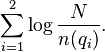
With a small variation, this is exactly what is expressed by the IDF component of BM25.
Modifications[edit]
- At the extreme values of the coefficient BM25 turns into ranking functions known as BM11 (for
 ) and BM15 (for
  ).[2]
).[2] - BM25F[3] is a modification of BM25 in which the document is considered to be composed from several fields (such as headlines, main text, anchor text) with possibly different degrees of importance.
- BM25+[4] is an extension of BM25. BM25+ was developed to address one deficiency of the standard BM25 in which the component of term frequency normalization by document length is not properly lower-bounded; as a result of this deficiency, long documents which do match the query term can often be scored unfairly by BM25 as having a similar relevancy to shorter documents that do not contain the query term at all. The scoring formula of BM25+ only has one additional free parameter
 (a default value is
  in absence of a training data) as compared with BM25:

Solr相似度算法二:Okapi BM25的更多相关文章
- Solr相似度算法二:BM25Similarity
BM25算法的全称是 Okapi BM25,是一种二元独立模型的扩展,也可以用来做搜索的相关度排序. Sphinx的默认相关性算法就是用的BM25.Lucene4.0之后也可以选择使用BM25算法(默 ...
- Solr相似度算法三:DRFSimilarity框架介绍
地址:http://terrier.org/docs/v3.5/dfr_description.html The Divergence from Randomness (DFR) paradigm i ...
- elasticsearch算法之词项相似度算法(二)
六.莱文斯坦编辑距离 前边的几种距离计算方法都是针对相同长度的词项,莱文斯坦编辑距离可以计算两个长度不同的单词之间的距离:莱文斯坦编辑距离是通过添加.删除.或者将一个字符替换为另外一个字符所需的最小编 ...
- Solr相似度算法四:IBSimilarity
Information based:它与Diveragence from randomness模型非常相似.与DFR相似度模型类似,据说该模型也适用于自然语言类的文本.
- Solr相似度算法三:DRFSimilarity
该Similarity 实现了 divergence from randomness (偏离随机性)框架,这是一种基于同名概率模型的相似度模型. 该 similarity有以下配置选项: basic ...
- Okapi BM25算法
引言 Okapi BM25,一般简称 BM25 算法,在 20 世纪 70 年代到 80 年代,由英国一批信息检索领域的计算机科学家发明.这里的 BM 是"最佳匹配"(Best M ...
- ES BM25 TF-IDF相似度算法设置——
Pluggable Similarity Algorithms Before we move on from relevance and scoring, we will finish this ch ...
- TensorFlow 入门之手写识别(MNIST) softmax算法 二
TensorFlow 入门之手写识别(MNIST) softmax算法 二 MNIST Fly softmax回归 softmax回归算法 TensorFlow实现softmax softmax回归算 ...
- elasticsearch算法之词项相似度算法(一)
一.词项相似度 elasticsearch支持拼写纠错,其建议词的获取就需要进行词项相似度的计算:今天我们来通过不同的距离算法来学习一下词项相似度算法: 二.数据准备 计算词项相似度,就需要首先将词项 ...
随机推荐
- Codeforces Round #474-E(树形dp)
一.题目链接 http://codeforces.com/contest/960/problem/B 二.题意 给定一棵$N$个节点的树,每个节点的权值$V$.定义树中两点$u_1$和$u_m$的权值 ...
- Oracle的操作系统身份认证(转)
oraclelogin数据库远程登录authenticationossqlnet.authentication_services=(NTS),在$ORACLE_HOME/network/admin/s ...
- canvas绘制曲线
canvas绘制曲线 方法 quadraticCurveTo(cp1x, cp1y, x, y) 只有一个控制点的贝塞尔曲线(其实就是控制点分别与起始点和结束点连线的公切线) bezierCurveT ...
- ubuntu sudo apt-get update与sudo apt-get upgrade的作用及区别,以及python pip的安装
在UBUNTU下,我们维护一个源列表,源列表里面都是一些网址信息,这每一条网址就是一个源,这个地址指向的数据标识着这台源服务器上有哪些软件可以安装使用.编辑源命令: sudo gedit /etc/a ...
- 39. Combination Sum + 40. Combination Sum II + 216. Combination Sum III + 377. Combination Sum IV
▶ 给定一个数组 和一个目标值.从该数组中选出若干项(项数不定),使他们的和等于目标值. ▶ 36. 数组元素无重复 ● 代码,初版,19 ms .从底向上的动态规划,但是转移方程比较智障(将待求数分 ...
- python 2.7中安装mysql
在python中进行安装mysql模块,但是怎么都不能导入mysql模块,出错如下所示: [root@python ~]# python Python 2.7.11 (default, Apr 5 2 ...
- Common Lisp
[Common Lisp] 1.操作符是什么? 2.quote. 3.单引号是quote的缩写. 4.car与cdr方法. 5.古怪的if语句. 6.and语句. 7.判断是真假. null 与 no ...
- ORA-10873
[问题现象] SQL> ALTER DATABASE OPEN; alter database open * ERROR at line 1: ORA-10873: file 36 needs ...
- 119. Pascal's Triangle II (Graph; WFS)
Given an index k, return the kth row of the Pascal's triangle. For example, given k = 3, Return [1,3 ...
- 基于注解的方式管理Bean
--------------------siwuxie095 基于注解的方式管理 Bean (一)准备 ...