
[FORWARD]ODBC 各种数据库连接串
Overview
Generally, one of the first steps when you are trying to work with databases is open it. You can find several types of those, and each have a different mode of connection. When you try to connect with your database sometimes, you don't know the correct connection string that you must use. It is for that I wrote this article. I wanted to compile the connection strings to the majority of known databases...
ODBC DSN Less Connection
ODBC Driver for dBASE
strConnection = _T("Driver={Microsoft dBASE Driver (*.dbf)};DriverID=277;"

                   "Dbq=c:\\DatabasePath;");
Note: You must specify the filename in the SQL statement... For example:
CString strQuery = _T("Select Name, Address From Clients.dbf");
ODBC Driver for Excel
strConnection = _T("Driver={Microsoft Excel Driver (*.xls)};DriverId=790;"

    bq=C:\\DatabasePath\\DBSpreadSheet.xls;DefaultDir=c:\\databasepath;");
ODBC Driver for Text
strConnection = _T("Driver={Microsoft Text Driver (*.txt; *.csv)};"

        "Dbq=C:\\DatabasePath\\;Extensions=asc,csv,tab,txt;");
If you are using tab delimited files, you must create the schema.ini file, and you must inform theFormat=TabDelimited option in your connection string.
Note: You must specify the filename in the SQL statement... For example:
CString strQuery = _T("Select Name, Address From Clients.csv");
Visual FoxPro
If you are using a database Container, the connection string is the following:
strConnection = _T("Driver={Microsoft Visual Foxpro Driver};UID=;"

    ourceType=DBC;SourceDB=C:\\DatabasePath\\MyDatabase.dbc;Exclusive=No");
If you are working without a database container, you must change the SourceType parameter by DBF as in the following connection string:
strConnection = _T("Driver={Microsoft Visual Foxpro Driver};UID=;"

    "SourceType=DBF;SourceDB=C:\\DatabasePath\\MyDatabase.dbc;Exclusive=No");
ODBC Driver for Access
strConnection = _T("Driver={Microsoft Access Driver (*.mdb)};"

        "Dbq=c:\\DatabasePath\\dbaccess.mdb;Uid=;Pwd=;");
If you are using a Workgroup (System database): you need to inform the SystemDB Path, the User Name and itspassword. For that, you have two solutions: inform the user and password in the connection string or in the moment of the open operation. For example:
strConnection = _T("Driver={Microsoft Access Driver (*.mdb)};"

        "Dbq=C:\\VC Projects\\ADO\\Samples\\AdoTest\\dbTestSecurity.mdb;"

        "SystemDB=C:\\Program Files\\Microsoft Office\\Office\\SYSTEM.mdw;"

        "Uid=Carlos Antollini;Pwd=carlos");
or may be:
strConnection = _T("Driver={Microsoft Access Driver (*.mdb)};"

        "Dbq=C:\\VC Projects\\ADO\\Samples\\AdoTest\\dbTestSecurity.mdb;"

        "SystemDB=C:\\Program Files\\Microsoft Office\\Office\\SYSTEM.mdw;");

if(pDB.Open(strConnection, "DatabaseUser", "DatabasePass"))

{

    DoSomething();

    pDB.Close();

}
If you want to open in Exclusive mode:
strConnection = _T("Driver={Microsoft Access Driver (*.mdb)};"

        "Dbq=c:\\DatabasePath\dbaccess.mdb;Exclusive=1;");
ODBC Driver for SQL Server
For Standard security:
strConnection = _T("Driver={SQL Server};Server=MyServerName;"

        "Trusted_Connection=no;"

        "Database=MyDatabaseName;Uid=MyUserName;Pwd=MyPassword;");
For Trusted Connection security (Microsoft Windows NT integrated security):
strConnection = _T("Driver={SQL Server};Server=MyServerName;"

     "Database=myDatabaseName;Uid=;Pwd=;");
Also, you can use the parameter Trusted_Connection that indicates that you are using the Microsoft Windows NT Authentication Mode to authorize user access to the SQL Server database. For example:
strConnection = _T("Driver={SQL Server};Server=MyServerName;"

    "Database=MyDatabaseName;Trusted_Connection=yes;");
If the SQL Server is running in the same computer, you can replace the name of the server by the word (local) like in the following sample:
strConnection = _T("Driver={SQL Server};Server=(local);"

        "Database=MyDatabaseName;Uid=MyUserName;Pwd=MyPassword;");
If you want to connect with a remote SQL Server, you must inform the address, the port, and the Network Library to use:
The Address parameter must be an IP address and must include the port. The Network parameter can be one of the following:
dbnmpntwWin32 Named PipesdbmssocnWin32 Winsock TCP/IPdbmsspxnWin32 SPX/IPXdbmsvinnWin32 Banyan VinesdbmsrpcnWin32 Multi-Protocol (Windows RPC)
For more information, see Q238949.
strConnection = _T("Driver={SQL Server};Server=130.120.110.001;"

     "Address=130.120.110.001,1052;Network=dbmssocn;Database=MyDatabaseName;"

     "Uid=myUsername;Pwd=myPassword;");
ODBC Driver for Oracle
For the current Oracle ODBC driver from Microsoft:
strConnect = _T("Driver={Microsoft ODBC for Oracle};Server=OracleServer.world;"

        "Uid=MyUsername;Pwd=MyPassword;");
For the older oracle ODBC driver from Microsoft:
strConnect = _T("Driver={Microsoft ODBC Driver for Oracle};"

     "ConnectString=OracleServer.world;Uid=myUsername;Pwd=myPassword;");
ODBC Driver for MySQL
If you want to connect to a local database, you can use a connection string like the following:
strConnect = _T("Driver={MySQL ODBC 3.51 Driver};Server=localhost;"

     "Database=MyDatabase;User=MyUserName;Password=MyPassword;Option=4;");
If you want to connect with a remote database, you need to specify the name of the server or its IP in the Serverparameter. If the Port is distinct to 3306 (default port), you must specify it.
strConnect = _T("Driver={mySQL ODBC 3.51 Driver};Server=MyRemoteHost;"

     "Port=3306;Option=4;Database=MyDatabase;Uid=MyUsername;Pwd=MyPassword;");
The parameter Option can be one or more of the following values:
1- The client can't handle that MyODBC returns the real width of a column.2- The client can't handle that MySQL returns the true value of affected rows. If this flag is set then MySQL returns 'found rows' instead. One must have MySQL 3.21.14 or newer to get this to work.4- Make a debug log in c:\myodbc.log. This is the same as puttingMYSQL_DEBUG=d:t:O,c::\myodbc.login AUTOEXEC.BAT.8- Don't set any packet limit for results and parameters.16- Don't prompt for questions even if driver would like to prompt.32- Enable or disable the dynamic cursor support. This is not allowed in MyODBC 2.50.64- Ignore use of database name in 'database.table.column'.128- Force use of ODBC manager cursors (experimental).256- Disable the use of extended fetch (experimental).512- PadCHARfields to full column length.1024-SQLDescribeCol()will return fully qualified column names.2048- Use the compressed server/client protocol.4096- Tell server to ignore space after function name and before '(' (needed by PowerBuilder). This will make all function names keywords!8192- Connect with named pipes to a MySQLd server running on NT.16384- ChangeLONGLONGcolumns toINTcolumns (some applications can't handleLONGLONG).32768- Return 'user' asTable_qualifierandTable_ownerfrom SQLTables (experimental).65536- Read parameters from the client and ODBC groups from my.cnf.131072- Add some extra safety checks (should not be needed but...).
If you want to have multiple options, you should add the above flags! For example: 16 + 1024 = 1030 and useOption= 1030;.
For more information, Go to MyODBC Reference Manual.
ODBC Driver for AS400
strConnect = _T("Driver={Client Access ODBC Driver (32-bit)};System=myAS400;"

      "Uid=myUsername;Pwd=myPassword;");
ODBC Driver for SyBase
strConnect = _T("Driver={Sybase System 10};Srvr=MyServerName;Uid=MyUsername;"

       "Pwd=myPassword;");
ODBC Driver for Sybase SQL AnyWhere
strConnect = _T("ODBC;Driver=Sybase SQL Anywhere 5.0;"

    "DefaultDir=C:\\DatabasePath\;Dbf=C:\\SqlAnyWhere50\\MyDatabase.db;"

    "Uid=MyUsername;Pwd=MyPassword;Dsn=\"\";");
DSN Connection
ODBC DSN
strConnect = _T("DSN=MyDSN;Uid=MyUsername;Pwd=MyPassword;");
OLE DB Provider
OLE DB Provider for SQL Server
For Standard security:
strConnect = _T("Provider=sqloledb;Data Source=MyServerName;"

        "Initial Catalog=MyDatabaseName;"

        "User Id=MyUsername;Password=MyPassword;");
For Trusted Connection security (Microsoft Windows NT integrated security):
strConnect = _T("Provider=sqloledb;Data Source=MyServerName;"

        "Initial Catalog=MyDatabaseName;"

        "Integrated Security=SSPI;");
If you want to connect to a "Named Instance" (SQL Server 2000), you must to specify Data Source=Servere Name\Instance Name like in the following example:
strConnect = _T("Provider=sqloledb;Data Source=MyServerName\MyInstanceName;"

    "Initial Catalog=MyDatabaseName;User Id=MyUsername;Password=MyPassword;");
If you want to connect with a SQL Server running on the same computer, you must specify the keyword (local) in the Data Source like in the following example:
strConnect = _T("Provider=sqloledb;Data Source=(local);"

        "Initial Catalog=myDatabaseName;"

        "User ID=myUsername;Password=myPassword;");
To connect to SQL Server running on a remote computer (via an IP address):
strConnect = _T("Provider=sqloledb;Network Library=DBMSSOCN;"

        "Data Source=130.120.110.001,1433;"

        "Initial Catalog=MyDatabaseName;User ID=MyUsername;"

        "Password=MyPassword;");
OLE DB Provider for MySQL (By Todd Smith)
strConnection = _T("Provider=MySQLProv;Data Source=test");
Where test is the name of MySQL database. Also, you can replace the name of the database by the followingconnection string: server=localhost;DB=test.
OLE DB Provider for AS400
strConnect = _T("Provider=IBMDA400;Data source=myAS400;User Id=myUsername;"

     "Password=myPassword;");
For more information, see: Using the OLE DB Provider for AS/400 and VSAM.
OLE DB Provider for Active Directory
strConnect = _T("Provider=ADSDSOObject;User Id=myUsername;Password=myPassword;");
For more information, see: Microsoft OLE DB Provider for Microsoft Active Directory Service.
OLE DB Provider for DB2
If you are using a TCP/IP connection:
strConnect = _T("Provider=DB2OLEDB;Network Transport Library=TCPIP;"

        "Network Address=130.120.110.001;"

        "Initial Catalog=MyCatalog;Package Collection=MyPackageCollection;"

        "Default Schema=MySchema;User ID=MyUsername;Password=MyPassword;");
If you are using APPC connection:
strConnect = _T("Provider=DB2OLEDB;APPC Local LU Alias=MyLocalLUAlias;"

        "APPC Remote LU Alias=MyRemoteLUAlias;Initial Catalog=MyCatalog;"

        "Package Collection=MyPackageCollection;Default Schema=MySchema;"

        "User ID=MyUsername;Password=MyPassword;");
For more information, see: Using the OLE DB Provider for DB2.
OLE DB Provider for Microsoft Jet
- Connecting to an Access file using the JET OLE DB Provider:
Using Standard security:
strConnect = _T("Provider=Microsoft.Jet.OLEDB.4.0;"

        "Data Source=C:\\DatabasePath\\MmDatabase.mdb;"

        "User Id=admin;Password=;");
If you are using a Workgroup (System database):
strConnect = _T("Provider=Microsoft.Jet.OLEDB.4.0;"

        "Data Source=C:\\DataBasePath\\mydb.mdb;"

        "Jet OLEDB:System Database=MySystem.mdw;");

pRs.Open(strConnect, "MyUsername", "MyPassword"); - Connecting to an Excel Spreadsheet using the JET OLE DB Provider:
strConnect = _T("Provider=Microsoft.Jet.OLEDB.4.0;"

        "Data Source=C:\\DatabasePath\\DBSpreadSheet.xls;"

        "Extended Properties=\"\"Excel 8.0;HDR=Yes;\"\";");
Note: If
"HDR=Yes", the provider will not include the first row of the selection into the recordset. If"HDR=No", the provider will include the first row of the cell range (or named ranged) into the recordset.For more information, see: Q278973.
- Connecting to a Text file using the JET OLE DB Provider:
strConnect =

        _T("Provider=Microsoft.Jet.OLEDB.4.0;Data Source=C:\\DatabasePath\\;"

        "Extended Properties=\"\"text;"

        "HDR=Yes;FMT=Delimited;\"\";");
Note: You must specify the filename in the SQL statement... For example:
CString strQuery = _T("Select Name, Address From Clients.txt");For more information, see: Q262537.
- Connecting to an Outlook 2000 personal mail box using the JET OLE DB Provider: (By J. Cardinal)
strConnect = _T("Provider=Microsoft.Jet.OLEDB.4.0;Outlook 9.0;"

      "MAPILEVEL=;DATABASE=C:\\Temp\\;")
Replace c:\temp with any temporary folder. It will create a schema file in that folder when you open it which shows all the fields available. Blank
MAPILEVELindicates top level of folders). - Connecting to an Exchange mail box through JET: (By J. Cardinal)
strConnect = _T("Provider=Microsoft.Jet.OLEDB.4.0;Exchange 4.0;"

      "MAPILEVEL=Mailbox - Pat Smith|;DATABASE=C:\\Temp\\;")
You must replace c:\temp with any temporary folder.
Replace Pat Smith with the name of the mail box and you must keep vertical pipe character | to indicate top level of folders. Place sub folder after vertical pipe if accessing specific folder.
Note: you can enter queries against the mail store just like a database... For example:
CString strQuery = _T("SQL "SELECT Contacts.* FROM Contacts;");For more information, see: The Jet 4.0 Exchange/Outlook IISAM.
OLE DB Provider for ODBC Databases
If you want to connect with a Microsoft Access database:
strConnect = _T("Provider=MSDASQL;Driver={Microsoft Access Driver (*.mdb)};"

        "Dbq=c:\\DatabasePath\\MyDatabase.mdb;Uid=MyUsername;Pwd=MyPassword;");
If you want to connect with a SQL Server database:
strConnect = _T("Provider=MSDASQL;Driver={SQL Server};Server=MyServerName;"

        "Database=MyDatabaseName;Uid=MyUsername;Pwd=MyPassword;");
If you want to use DSN:
strConnect = _T("Provider=MSDASQL;PersistSecurityInfo=False;"

        "Trusted_Connection=Yes;"

        "Data Source=MyDSN;catalog=MyDatabase;");
For more information, see: Microsoft OLE DB Provider for ODBC.
OLE DB Provider for OLAP
Microsoft� OLE DB for Online Analytical Processing (OLAP) is a set of objects and interfaces that extends the ability of OLE DB to provide access to multidimensional data stores.
strConnect = _T("Provider=MSOLAP;Data Source=MyOLAPServerName;"

     "Initial Catalog=MyOLAPDatabaseName;");
Connection using HTTP:
This feature enables a client application to connect to an Analysis server through Microsoft� Internet Information Services (IIS) by specifying a URL in the Data Source property in the client application's connection string. Thisconnection method allows PivotTable� Service to tunnel through firewalls or proxy servers to the Analysis server. A special Active Server Pages (ASP) page, Msolap.asp, enables the connection through IIS. The directory in which this file resides must be included as part of the URL when connecting to the server (for example,http://www.myserver.com/myolap/).
Using a URL
strConnect = _T("Provider=MSOLAP;Data Source=http://MyOLAPServerName/;"

     "Initial Catalog=MyOLAPDatabaseName;");
Using SSL
strConnect = _T("Provider=MSOLAP;Data Source=https://MyOLAPServerName/;"

     "Initial Catalog=MyOLAPDatabaseName;");
For more information, see: OLE DB for OLAP, Connecting Using HTTP.
OLE DB Provider for Oracle
OLE DB Provider for Oracle (from Microsoft)
The Microsoft OLE DB Provider for Oracle allows ADO to access Oracle databases.
strConnect = _T("Provider=MSDAORA;Data Source=MyOracleDB;User Id=myUsername;"

     "Password=myPassword;");
For more information, see: Microsoft OLE DB Provider for Oracle.
OLE DB Provider for Oracle (from Oracle).
For Standard security:
strConnect = _T("Provider=OraOLEDB.Oracle;Data Source=MyOracleDB;"

        "User Id=myUsername;Password=myPassword;");
For a Trusted connection:
- OS Authenticated connect setting user ID to "/":
strConnect = _T("Provider=OraOLEDB.Oracle;Data Source=MyOracleDB;"

"User Id=/;Password=;"); - OS Authenticated connect using OSAuthent:
strConnect = _T("Provider=OraOLEDB.Oracle;Data Source=MyOracleDB;OSAuthent=1;")Note: "
Data Source=" must be set to the appropriate Net8 name which is known to the naming method in use. For example, for Local Naming, it is the alias in the tnsnames.ora file; for Oracle Names, it is the Net8 Service Name.
For more information, see: Oracle Provider for OLE DB Developer's Guide.
OLE DB Provider for Visual FoxPro
strConnect = _T("Provider=vfpoledb;"

     "Data Source=C:\\DatabasePath\\MyDatabase.dbc;");
For more information, see: Microsoft OLE DB Provider for Visual FoxPro.
OLE DB Provider for Index Server (By Chris Maunder)
strConnect = _T("provider=msidxs;Data Source=MyCatalog;");
For more information, see: Microsoft OLE DB Provider for Microsoft Indexing Service.
OLE DB Data Link Connections
Data Link File - UDL
strConnection = _T("File Name=c:\\DataBasePath\\DatabaseName.udl;");
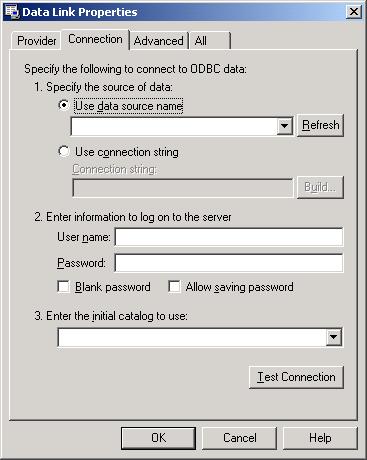
If you want to create a Data Link File, you can make a new empty text file, change its extension by .udl, then double click over the file, and the operating system calls for you the Data Link app.
[FORWARD]ODBC 各种数据库连接串的更多相关文章
- 【EF 2】浅谈ADO数据模型生成串(二):数据库连接串分析
导读:上篇博客中介绍了ADO生成串的前一部分,本篇博客结合报错,接着介绍剩下的部分. 一.代码展示 <span style="font-family:KaiTi_GB2312;font ...
- [奇思异想]使用Zookeeper管理数据库连接串
背景 有一套特定规格的应用(程序+数据库),当有业务需求时,就需要多部署应用,并且所有的应用都使用一个共同的后台来管理.应用新增后,如何通知后台更新连接串成了一个关键的问题.于是就产生了使用ZooKe ...
- 使用电脑ODBC测试数据库连接方法
使用电脑ODBC测试数据库连接方法 一.打开电脑的控制面板——管理工具——数据源(ODBC),在用户dsn页面中点击添加按钮,选择IBM DB2 ODBC DRIVER,点击完成. 二.在弹出的配置页 ...
- C#_数据库连接串的配置
数据库的连接串 数据库连接字符串的拼写规则的决定条件: 连接的数据库的类型:SQL Server,Oracle,MySQL,Acess,MogoDB,Visual FoxPro(dBASE),Exce ...
- 使用Aes对称加密解密Web.Config数据库连接串
现在很多公司开始为了保证数据库的安全性,通常会对Web.Config的数据库连接字符串进行加密.本文将介绍学习使用Aes加密解密数据库连接字符串.本文采用MySql数据库. AES概念简述 AES 是 ...
- 生成64位代码的mdb数据库连接串Provider的设置
生成32位程序的mdb连接串的 Provider为:Provider=Microsoft.Jet.OLEDB.4.0 而生成64位代码时,则需要使用如下的 Provider Provider=Micr ...
- oracle数据库连接串格式
oracle常用链接串格式:jdbc:oracle:thin:@//<host>:<port>/<service_name> jdbc:oracle:thin:@& ...
- VS2017增加数据库连接串
新装VS2017后,按照三石提供的MVC入门教程,创建MVC应用后,能生成数据库文件(在APP_DATA目录),但无法创建连接,服务器路径一直不正确. 解决方法: 1.重新打开VS2017安装界面,选 ...
- 常见ODBC及OLEDB连接串的写法
书 名:性能测试进阶指南——LoadRunner11实战 作 者:陈霁 关于数据库连接串的写法
随机推荐
- django系列5.2--ORM数据库的单表操作
单表操作 在views.py中添加对数据库的操作语句 #在逻辑代码中导入你要操作的表 from app import models def add_book(request): ''' 添加表记录 : ...
- jQuery中的each, data, 插件
一. each() $(' ').each(function (){...}) jQuery.each(collection, callback(indexInArray, valueOfEleme ...
- 初识Mybatis框架
mybatis框架 主要是对数据库进行操作的 编写sql语句 使我们对数据库的crud操作更加简洁方便!! 1.使用mybatis框架 进行第一个项目 查询数据库 并返回数据 :(简单) (1)搭建 ...
- LOJ#6049. 「雅礼集训 2017 Day10」拍苍蝇(计算几何+bitset)
题面 传送门 题解 首先可以用一个矩形去套这个多边形,那么我们只要枚举这个矩形的左下角就可以枚举完所有多边形的位置了 我们先对每一个\(x\)坐标开一个\(bitset\),表示这个\(x\)坐标里哪 ...
- [CSS3] 3D桃心
<!DOCTYPE html> <html> <head> <meta charset="UTF-8"> <title> ...
- solr安装教程
Solr Solr is the popular, blazing-fast, open source enterprise search platform built on Apache Lucen ...
- php实现图片base64编码解码
1.图片的base64编码 /*首先要确定图片的类型,需要安装一个php拓展php_fileinfo 如已安装可以在extension_dir目录下找到php_fileinfo.dll(windows ...
- HDU-1160-FatMouse's Speed(线性DP,LIS)
FatMouse's Speed Time Limit: 2000/1000 MS (Java/Others) Memory Limit: 65536/32768 K (Java/Others) ...
- Linux安装 jdk、tomcat、eclipse、mysql
概述如果需要在Linux下进行JavaEE的开发,我们需要安装如下软件: 安装JDK 安装步骤 0) 先将软件通过xftp5 上传到/opt 下 1) 解压缩到/opt tar -zxvf jdk. ...
- Java线程池的选择
在java的concurrent.Executors主要提供两种线程池:无固定线程数但有限制任务队列的cachedThreadPool与有固定线程数但无任务队列限制的fixedThreadPool,这 ...